
With the global dealer management market reaching a valuation of $5.5 billion in 2026, technology is clearly the engine of the automotive industry. Yet, many owners still find themselves asking, what is dms, while they struggle with fragmented software that fails to communicate. You’re likely tired of manual errors in borrower communication and the high risk of uninsured collateral. It’s frustrating when your tools don’t provide the security you need to navigate strict FTC geolocation rules or the latest CPPA enforcement actions.
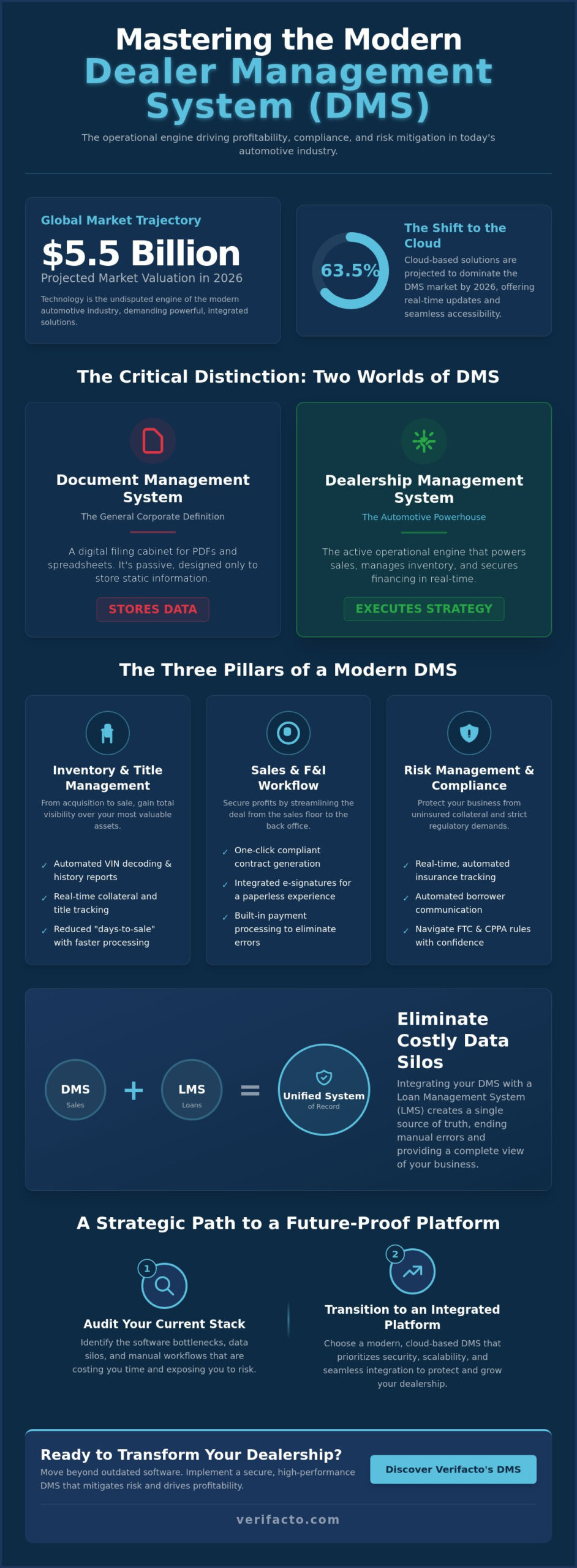
You deserve a system that acts as a reliable guardian for your business. This guide will help you master the definition of a DMS, its critical role in modern automotive operations, and how integrated platforms drive both profitability and risk mitigation. We’ll examine how cloud based dealer management systems, which now account for 63.5% of the market, can streamline your workflows and protect your bottom line. From automated insurance tracking to built-in payment processing, you’ll learn how to transform your dealership into a secure, high-performance operation that stays ahead of the competition.
Key Takeaways
- Master the modern definition of what is dms and identify the core pillars-inventory, sales, and F&I-that form the operational heartbeat of a successful dealership.
- Eliminate costly data silos by integrating your sales-focused DMS with a dedicated Loan Management System (LMS) to create a single, unified system of record.
- Mitigate your highest operational risks by implementing real-time insurance tracking and automated borrower communication to protect against uninsured collateral.
- Enhance your dealership’s profitability using built-in payment processing and CPI solutions that reduce manual errors and streamline financial workflows.
- Follow a strategic two-step audit to identify current software bottlenecks and transition to a future-proof platform that prioritizes both security and scalability.
Defining DMS: From Document Management to Automotive Powerhouses
If you search for the term online, you’ll quickly realize that the question “what is dms” has two very different answers depending on who you ask. In the general corporate world, it refers to Document Management Systems, which are essentially digital filing cabinets for PDFs and spreadsheets. However, for an auto dealer or lender, a DMS is something much more powerful. It’s the operational engine that powers every department from the front office to the back lot.
An automotive Dealership Management System is a centralized software hub designed to manage the entire lifecycle of a vehicle sale. It’s no longer just about storing data; it’s about executing the daily tasks that keep a dealership profitable. In the past, these systems lived on expensive, on-premise servers that required constant maintenance. Today, the industry has shifted toward cloud-based solutions. In fact, cloud deployment is projected to hold a 63.5% share of the market in 2026. This modernization allows for real-time updates and seamless communication across your entire organization.
DMS in the Automotive Context
For a modern dealership, the core functions of a DMS include inventory management, sales tracking, and Finance & Insurance (F&I) processing. Independent dealers specifically rely on these tools to compete with large franchises by automating workflows that would otherwise require a massive staff. As we move through 2026, the best platforms have become mobile-accessible, allowing your team to scan VINs, update inventory, and close deals directly from a tablet or smartphone. This agility is what separates thriving dealerships from those stuck in the past.
Why “Dealer Management” Outperforms “Document Management” for Lenders
Lenders need more than a place to save files; they need active operational control. While a document management system might store a copy of a title, an automotive DMS tracks the VIN, monitors borrower credit status, and manages the title’s location in real-time. This level of specificity is vital for risk mitigation. When you understand what is dms in a lending context, you see it’s about data integrity and speed. While a general DMS stores data, an Automotive DMS executes strategy and mitigates loan risk. By utilizing a platform like Verifacto DMS, you ensure that every data point is actionable and every collateral asset is accounted for.
The Core Pillars of a Modern Dealer Management System
A high-performing dealership is a complex machine with many moving parts. To understand what is dms in a practical sense, you have to look at the pillars that support your daily operations. Given the significant automotive industry economic impact, dealerships can’t afford the friction of outdated tools. A modern DMS serves as the central command, integrating every department to ensure no detail is missed and no revenue is lost.
Inventory and Title Management
Efficiency begins the moment a vehicle enters your system. A robust DMS automates VIN decoding and pulls vehicle history reports instantly, eliminating manual entry errors. You gain total visibility over your stock, which directly reduces “days-to-sale” by ensuring vehicles are processed and listed faster. Managing digital titles and lienholder information becomes a streamlined task rather than a logistical nightmare. When you can track collateral from acquisition to the lot in real-time, you protect your investment from the start.
The Sales and Finance Workflow
The sales floor is where the deal happens, but the back office is where the profit is secured. Modern systems allow you to generate compliant contracts and buyer orders with a single click. This is especially critical when handling subprime finance complexities, where precision is mandatory for lender approval. By integrating e-signatures, you create a paperless experience that satisfies the 2026 consumer’s demand for speed. If you’re looking to modernize your floor, exploring Verifacto DMS can help you unify these disparate steps into one seamless journey.
Beyond the paperwork, integrated payment solutions for dealers are a game-changer. Moving away from external terminals to built-in systems means payments are automatically recorded against the correct account. This eliminates reconciliation headaches and reduces the risk of human error. Finally, reporting and analytics turn your raw data into actionable insights. When you truly grasp what is dms, you see it’s not just a database; it’s a tool that identifies where your margins are highest and where your risks are concentrated. This data-driven approach transforms a standard business into a high-growth powerhouse.
Beyond the Basics: The Critical Integration of DMS and LMS
Selling the car is only half the battle. While a DMS manages the inventory and the initial contract, a Loan Management System (LMS) handles the years of servicing that follow. Understanding what is dms requires looking beyond the showroom floor to the long-term health of your portfolio. When these two systems remain separate, you create dangerous data silos. Information gets trapped, payments are missed, and your team wastes hours on manual data entry that could be spent on higher-value tasks.
This disconnect is more than an inconvenience; it’s a financial leak. If your sales data doesn’t flow instantly into your servicing platform, you lose the ability to act on delinquency immediately. True integration allows for a seamless handoff. As soon as the deal is inked, the borrower’s profile should populate in your LMS, triggering automated welcome messages and payment reminders. This ensures the relationship starts on a professional, secure footing.
The 2026 trend for Buy-Here-Pay-Here (BHPH) dealers is the “All-in-One” platform. This unified approach combines the sales power of a DMS with the recovery focus of an LMS. By using a solution like Verifacto LMS alongside your dealer management tools, you ensure that every borrower interaction is documented in a single system of record. This eliminates confusion during collection calls and provides a clear audit trail for compliance. You aren’t just managing a dealership; you’re protecting a financial asset.
Why Every Lender Needs an Integrated LMS
Real-time tracking is the only way to stay ahead of delinquency. An integrated LMS allows you to monitor payment schedules as they happen, not days later. You can set up automated borrower communication via text and email, which significantly boosts recovery rates without increasing your headcount. By removing the need to re-key data between the sale and the loan, you eliminate the manual errors that often lead to compliance headaches and frustrated customers. For dealers looking to take this further, a dedicated strategy for improving collection efficiency for auto loans can help you systematically lower delinquency rates through automation and proactive risk management.
Cloud-Based vs. On-Premise Integration
The shift toward cloud-based platforms is no longer optional for growth-minded dealers. In 2026, cloud deployment holds a 63.5% share of the market because it offers superior security and scalability. Unlike old on-premise servers that require physical maintenance and are vulnerable to local hardware failures, cloud based dealer management systems grow automatically as your portfolio expands. You get real-time updates across all locations instead of waiting for daily batch processing. This ensures your team always works with the most current data, whether they’re in the office or managing a remote team. When you truly understand what is dms in the modern era, you realize that cloud integration is the foundation of a resilient business.
Solving the Compliance Crisis: Risk Management Within Your DMS
Risk management is often the most overlooked aspect when dealers first explore what is dms for their daily operations. While inventory and sales are the visible components of the business, the invisible threat of uninsured collateral can dismantle your profitability overnight. In the high-stakes environment of 2026, where regulatory scrutiny from the FTC and state agencies like the CPPA is at an all-time high, your software must act as an automated guardian. It should work silently in the background to secure your assets while you focus on scaling your dealership.
Traditional systems wait for you to find a problem. A modern, integrated DMS identifies the problem for you. By centralizing your insurance data and linking it directly to your loan servicing, you transform your software from a digital ledger into a proactive defense system. This ensures that you’re never caught off guard by a sudden lapse in coverage or a compliance audit.
Real-Time Insurance Monitoring
One of the most dangerous moments in any deal is the “spot delivery.” A borrower drives off the lot with a valid insurance binder, only to cancel the policy days later to save on premiums. Without real-time monitoring, you might not discover this lapse until a total loss occurs and the claim is denied. Modern DMS platforms eliminate the need for manual phone calls to insurance agents. They verify coverage automatically through direct data feeds and alert your team the moment a policy status changes. This proactive approach significantly reduces charge-offs and ensures your portfolio remains protected throughout the life of the loan.
Automated CPI Solutions
When a borrower fails to maintain their own insurance despite your automated alerts, you need a reliable fallback. This is where Collateral Protection Insurance (CPI) becomes an essential part of your workflow. Within a sophisticated DMS, force-placed insurance can be triggered automatically to maintain coverage on the asset, with the premiums added to the borrower’s balance. Automated insurance tracking transforms a DMS from a record-keeper into a risk-manager. This seamless integration ensures that you aren’t left holding the bag when a borrower fails to meet their obligations. It creates a safety net that protects your capital without requiring constant manual oversight from your staff.
Protect your portfolio today by implementing Verifacto’s real-time insurance tracking to eliminate collateral risk and automate your compliance.
Implementing a Future-Proof DMS for Your Dealership
Modernizing your dealership doesn’t have to be a chaotic process. It begins with a strategic audit of your current data to find where bottlenecks are slowing you down. Before you look at new vendors, you must understand how your current tools handle what is dms and where they fail your loan servicing team. A successful transition requires a methodical approach that prioritizes security and operational continuity.
- Step 1: Audit and Identify. Map out your current workflows to spot manual data entry points and “data silos” that lead to errors.
- Step 2: Prioritize Integration. Ensure your DMS and LMS share a single database. This eliminates the need to re-key information and keeps your sales and servicing teams on the same page.
- Step 3: Evaluate Security. In 2026, compliance isn’t optional. Verify that your provider offers SOC2 compliance and robust data encryption to meet the strict standards set by the FTC and state privacy laws like the UCPA.
- Step 4: Phased Migration. Avoid total downtime by migrating data in stages. This allows you to maintain daily operations while your team gets comfortable with the new environment.
- Step 5: Team Training. Focus your training on the tools that drive immediate ROI, such as automated borrower communication and integrated payment solutions for dealers that eliminate manual reconciliation errors.
Evaluating the Total Cost of Ownership (TCO)
When you’re choosing a platform, look beyond the monthly subscription fee. The true cost of a system includes the hours your staff spends on administrative tasks that could be automated. A unified system reduces the need for additional headcount by handling insurance tracking and payment reminders in the background. By reducing loan defaults through better collateral tracking, the ROI of a high-quality DMS far outweighs the initial investment. You’re buying speed, accuracy, and peace of mind.
The Verifacto Advantage: A Unified Platform
Verifacto provides a seamless merge of DMS, LMS, and real-time insurance tracking. This unified approach eliminates the friction between selling a vehicle and servicing a loan. We offer more than just software; we provide the partner-like reassurance and professional support you need during the setup phase to ensure your data migrates safely. You don’t have to navigate these complex operational shifts alone. See how Verifacto streamlines your dealership operations and secures your portfolio for the future.
Modernize Your Dealership for Long-Term Success
The landscape of automotive retail and finance is moving faster than ever. By now, you understand that what is dms goes far beyond simple document storage; it’s the operational engine that drives your sales, manages your inventory, and secures your loan portfolio. Successful dealers in 2026 prioritize the seamless integration of their DMS and LMS to eliminate data silos and protect their assets from the high risk of uninsured collateral.
Verifacto has been at the forefront of this transformation since 2014. With over a decade of auto-finance expertise, we’ve built a cloud-based platform designed for national scalability and total reliability. Our system features real-time insurance tracking and CPI solutions built directly into the workflow; this gives you the security of an automated guardian. You don’t have to settle for fragmented tools that hinder your growth.
Optimize Your Dealership with Verifacto’s Integrated DMS and take control of your operational efficiency. You have the tools and the knowledge to mitigate risk and drive higher profitability. It’s time to build a more secure, scalable, and successful business today.
Frequently Asked Questions
What is the difference between a DMS and an LMS?
A DMS focuses on the “front-end” of your business, managing inventory, sales, and the initial deal structure. In contrast, an LMS handles the “back-end” loan servicing, including payment schedules, delinquency tracking, and collections. While they serve different purposes, integrating them ensures that your sales data flows seamlessly into your servicing platform without manual re-entry or data silos.
Does my dealership really need a cloud-based DMS in 2026?
Yes, cloud-based systems are essential for modern security and scalability. With cloud deployment holding over 60% of the market in 2026, these platforms allow your team to access data from any location while providing superior protection against local hardware failure. They also receive real-time updates that keep your operation compliant with shifting state and federal regulations without requiring manual software patches.
How does a DMS help with automotive compliance?
A modern DMS automates the documentation and security protocols required by agencies like the FTC and state-level privacy boards. When you ask what is dms in a legal context, it’s a system of record that provides audit trails, role-based access, and secure data encryption. These features help you navigate sensitive geolocation data rules and consumer privacy amendments by ensuring data is only shared with authorized parties.
Can a DMS track borrower insurance automatically?
Advanced platforms like Verifacto include built-in insurance tracking to verify coverage automatically. The system monitors policy status in real-time and triggers automated borrower communication if a lapse is detected. This proactive approach eliminates the need for manual phone calls to agents and ensures your collateral remains protected throughout the life of the loan, reducing the risk of uninsured losses.
What are the most important features for a used car dealer DMS?
Used car dealers should prioritize inventory management, F&I tools, and seamless LMS integration. Because used car portfolios often involve higher risk, having real-time insurance tracking and CPI solutions is critical for protecting your investment. A system that unifies these pillars allows you to spend less time on paperwork and more time on high-value sales, effectively lowering your “days-to-sale” metrics. For a detailed breakdown of how to evaluate your options, our guide to DMS software for used car dealers walks through the key selection criteria for 2026.
How much does a typical Dealer Management System cost?
The cost of a system depends on your inventory size, the number of users, and the specific modules your dealership requires. Most providers use tiered subscription models based on the level of functionality you need. You should evaluate the total cost of ownership by looking at how much the system saves you in administrative labor and the potential ROI from reduced loan defaults.
Is an integrated payment processor worth it for small dealers?
Absolutely, because integrated payment processing eliminates the manual errors associated with external terminals. When payments post directly to the borrower’s account within your DMS, you save hours on daily reconciliation and prevent accounting discrepancies. This level of automation is especially valuable for small teams that need to maximize their operational efficiency and provide a professional borrower experience.
How long does it take to implement a new DMS?
The timeline for implementation depends on the complexity of your existing data and the training needs of your staff. A phased migration is usually the best strategy to minimize dealership downtime and ensure data integrity. While the initial setup moves quickly, taking the time for thorough team onboarding ensures that you fully utilize automated features like borrower communication from day one.