
With auto loan delinquencies reaching 5.2% and 30-day delinquency rates climbing to 2.00% in early 2026, the traditional “dialing for dollars” approach is officially broken. You’ve likely noticed that as monthly payments soar, with one in five new vehicle loans now exceeding $1,000, borrowers are increasingly ignoring phone calls from unknown numbers. Relying on manual outreach isn’t just expensive; it’s often ineffective and creates massive compliance headaches under Regulation F’s “7-in-7” rule. Scaling your collections shouldn’t mean hiring more staff to leave voicemails that never get heard. By shifting to sophisticated, multi-channel automated payment reminders for car loans, you can meet borrowers where they actually spend their time.
This guide will show you how to reduce delinquencies and protect your collateral through strategic, automated communication that respects modern consumer habits. You’ll learn the exact steps to lower your Days Past Due (DPD) across the portfolio, improve staff productivity, and build a digital-first collections strategy that keeps you compliant and profitable. We’ll explore how to leverage preferred channels like text and email to drive engagement and secure your assets without the friction of traditional manual follow-up.
Key Takeaways
- Eliminate the high overhead of manual phone calls by replacing low-connection dialing with high-impact, trigger-based communication.
- Implement automated payment reminders for car loans using a DPD bucket strategy that scales communication intensity based on actual portfolio risk.
- Master the “Trigger-Message-Response” loop to ensure consistent follow-up for both routine pre-due notifications and urgent failed payment alerts.
- Maintain strict compliance with 2026 TCPA and FDCPA regulations by automating contact frequency and timing within legal boundaries.
- Discover the operational synergy of integrating automated borrower messaging with real-time insurance tracking to provide a total security solution for your collateral.
The High Cost of Manual Payment Follow-Ups in Auto Finance
Lenders often mistake manual dialing for personal service, but the reality is far more expensive. In the current market, automated payment reminders for car loans have evolved into essential infrastructure. These are trigger-based notifications delivered via SMS, email, or voice that fire automatically when a specific condition is met. By replacing reactive phone calls with proactive, systematic alerts, you eliminate the “Hidden Cost of the Phone Call.” This cost includes not just the hourly wage of your collection staff, but the overhead of telephony systems and the staggering waste of labor on low connection rates. When an agent spends forty minutes of every hour leaving voicemails, your operational efficiency suffers.
The modern borrower has fundamentally changed how they interact with financial institutions. By 2026, consumer behavior shifted toward “Borrower Avoidance,” where individuals almost universally ignore calls from unknown numbers to avoid spam. While your collectors are getting sent to voicemail, data shows that consumers read 98% of text messages, often within minutes of receipt. If your outreach strategy relies on a voice connection, you’re essentially invisible to your portfolio. This communication gap is dangerous because vehicle collateral depreciates rapidly. Every day a manual system fails to reach a borrower is a day the asset’s value drops while the risk of a total loss or skip increases.
Why Traditional Collection Calls are Failing Lenders
Dealership and lender phone numbers are frequently flagged with “Spam Likely” tags by major carriers, ensuring your calls are dead on arrival. Beyond technology hurdles, manual systems suffer from human bias. Agents often engage in “cherry-picking,” where they prioritize calling easy-to-reach borrowers while avoiding difficult conversations with high-risk accounts. This creates an inconsistent follow-up loop. Unlike automated logs, manual notes are often subjective or incomplete, making it difficult to prove compliance if challenged. The Fair Debt Collection Practices Act (FDCPA) requires strict adherence to contact standards that manual processes simply can’t guarantee at scale.
The ROI of Switching to Automated Borrower Communication
The financial argument for automation is undeniable when you contrast the cost per contact. A human agent call costs several dollars in labor and benefits, whereas an automated SMS costs only a few cents. This shift allows your team to focus on complex problem-solving rather than repetitive reminders. Automated systems can scale from 50 manual contacts per day to over 5,000 without increasing headcount. Transitioning to these digital-first workflows is the most direct path toward improving collection efficiency for auto loans. You gain the ability to touch every account in your portfolio simultaneously, ensuring no borrower falls through the cracks due to a busy staff or a long call list.
How Automated Payment Reminder Systems Work
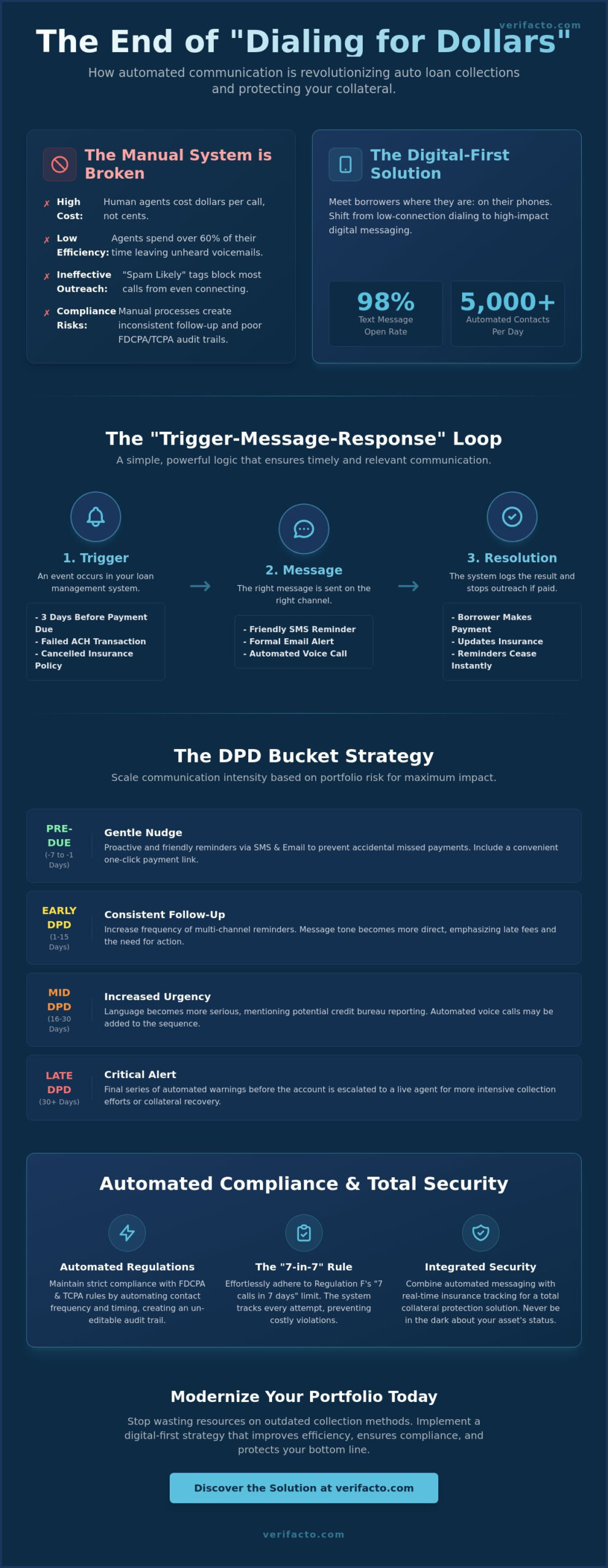
Modern loan management relies on a seamless “Trigger-Message-Response” loop. This cycle starts when your system identifies a specific data point. For instance, time-based triggers might fire a notification three days before a payment is due to prevent accidental late fees. Conversely, event-based triggers react to specific actions, such as a failed ACH transaction or a cancelled insurance policy. When these events occur, automated payment reminders for car loans instantly deploy the appropriate message. This logic ensures that your outreach is always relevant, timely, and data-driven.
Persistence across multiple channels is what separates high-performing portfolios from those struggling with delinquency. An omnichannel approach accounts for different borrower preferences and lifestyles. Younger demographics might engage exclusively with SMS, while older borrowers may prefer a formal email or an automated voice call. Lenders who implement automated payment reminders for car loans see a dramatic reduction in missed connections because the system reaches the borrower where they are most likely to respond. By synchronizing this data with your core Loan Management System (LMS), you ensure that once a payment is made, all outreach stops immediately. This level of coordination prevents the “double-reminding” error that frustrates borrowers and leads to ignored messages.
Primary Channels for 2026 Auto Loan Reminders
Text messaging remains the most effective tool in your arsenal. SMS boasts immediate open rates, making it perfect for urgent payment alerts or expiration warnings. Email serves as a secondary, formal layer. It’s ideal for sending detailed account statements or providing direct links to a secure payment portal. For more complex situations, Voice AI and Interactive Voice Response (IVR) systems can handle initial objections. These tools are sophisticated enough to capture “Promise to Pay” dates and update your records without human intervention, effectively improving collection efficiency for auto loans.
The Power of Integrated Payment Portals
A reminder is only effective if it removes the barriers to payment. Every message should contain a direct “Pay Now” link that leads to a mobile-responsive portal. Integrating ACH processing for auto finance directly into this workflow reduces friction significantly. It allows borrowers to settle their debt in seconds rather than calling your office or mailing a check.
Compliance is also a major factor here. Lenders must ensure they have proper consumer authorization for recurring debits to avoid regulatory scrutiny. When your reminder system and payment portal are linked, account balances update in real-time. This automation provides the stability you need to manage a growing portfolio safely while maintaining a positive borrower experience. For a deeper look at how modern portals eliminate data entry errors and accelerate cash flow, see our guide to integrated payment processing for auto lenders.
The DPD Bucket Strategy: Timing Your Reminders for Maximum Impact
Successful portfolio management requires more than just knowing who owes you money. You need a structured Days Past Due (DPD) framework to categorize risk and dictate the intensity of your outreach. Treating a borrower who is three days late the same as one who is thirty days late is a recipe for operational friction and poor borrower relations. By applying automated payment reminders for car loans to specific DPD buckets, you ensure your communication strategy remains both respectful and effective. Academic studies from the National Bureau of Economic Research confirm the effectiveness of payment reminders in influencing consumer behavior, but the impact depends entirely on the timing of the “nudge.”
Phase 1: The Pre-Due and Grace Period (DPD 0-5)
In this initial stage, your goal is to prevent accidental delinquency. A “Gentle Nudge” via SMS three days before the due date serves as a helpful service rather than a collection attempt. This is also an ideal window to verify that the borrower still has active insurance coverage. Maintaining a supportive, customer-service-oriented tone here builds trust. Most borrowers appreciate the heads-up, especially since many manage multiple monthly bills. If they pay during this window, you’ve successfully avoided the cost of moving them into a delinquency bucket.
Phase 2: Early Delinquency (DPD 6-30)
Once a borrower crosses the five-day mark, the strategy shifts toward “Urgent Action.” You should increase the frequency of communication and utilize a multi-channel approach that combines SMS and email. Every message at this stage must include a direct link to your payment portal to eliminate any technical excuses for non-payment. This is the time to introduce “Promise to Pay” (PTP) tracking. When a borrower commits to a specific date via your automated system, the software holds them accountable, firing off a reminder if that date passes without a transaction.
Phase 3: Late Stage and Default Prevention (DPD 31+)
When an account hits the 31-day mark, it enters the “Critical Risk” phase. The focus now shifts from simple reminders to collateral protection and recovery. At this point, automated Voice AI or human escalation becomes necessary to handle complex objections. You must also deploy “Final Notice” automation to satisfy legal requirements before initiating repossession. To stay on the right side of the law during this high-stakes phase, refer to our 2026 auto finance compliance management checklist. This ensures your default procedures are airtight and your portfolio remains protected from both credit loss and regulatory fines.
Compliance and Best Practices for US Auto Lenders
Lenders operating in 2026 face a complex regulatory environment that demands precision. When you deploy automated payment reminders for car loans, compliance isn’t just a feature; it’s your primary shield against litigation. The Telephone Consumer Protection Act (TCPA) and the Fair Debt Collection Practices Act (FDCPA) dictate exactly how and when you can contact a borrower. For example, Regulation F’s “7-in-7” rule strictly prohibits attempting to contact a debtor more than seven times within seven consecutive days regarding a specific debt. Managing this manually across a large portfolio is nearly impossible without making a mistake that could lead to heavy CFPB fines.
Automation removes the risk of human error by hard-coding these restrictions into your outreach schedule. Your software must maintain a permanent, time-stamped audit trail of every message sent. This record is vital if a borrower claims harassment or a violation of contact times. By centralizing these logs, you provide your legal team with the documentation needed to prove every interaction occurred within federal and state guidelines. This transparency builds a culture of accountability and protects your business from the financial fallout of accidental non-compliance.
Mastering SMS Compliance
Capturing express written consent during the loan origination process is the first step in a compliant strategy. You can’t simply start texting a borrower because you have their number; they must specifically opt-in to receive financial notifications. Once the loan is active, your system must handle unsubscribes instantly. If a borrower texts “STOP,” the software must immediately blacklist that number from future automated blasts. Manual tracking of these requests is a massive liability that often leads to accidental messages and subsequent lawsuits. To stay safely within the boundaries of “reasonable communication,” never exceed more than three automated touchpoints in a 7-day period to avoid harassment claims. This conservative approach prevents friction while still maintaining the persistence needed to secure payment.
Data Security and Borrower Privacy
Protecting sensitive financial data is a non-negotiable requirement for modern lenders. Cloud-based systems must employ bank-level encryption to ensure that borrower information remains secure during transit and at rest. One of the greatest risks to your business is “Shadow IT,” where staff members use personal phones to send collection texts. This practice bypasses your audit trail and leaves borrower data on unsecured, private devices. Integrating your communication tools with a robust platform ensures all data remains centralized and protected. Understanding what is DMS and how it secures your operational data is critical for maintaining privacy standards in an increasingly digital industry.
Protect your portfolio and your reputation by choosing a partner that prioritizes regulatory safety. Schedule a demo with Verifacto to see how our built-in compliance features safeguard your lending operations.
Modernizing Your Portfolio with Verifacto’s Automated Communication
Transitioning from manual outreach to a structured, digital-first strategy requires a platform that understands the specific pressures of auto finance. Verifacto provides this by integrating automated payment reminders for car loans directly into your existing Verifacto LMS and Verifacto DMS workflows. This integration eliminates the need for data silos, ensuring that every message sent is based on real-time account status. When a borrower makes a payment through our built-in payment processing, the system updates instantly, halting any further collection reminders and maintaining a positive borrower relationship.
The true power of the platform lies in the synergy between communication and collateral protection. Unlike generic messaging tools, Verifacto links payment reminders with real-time insurance tracking. If a borrower’s policy lapses, the system triggers an alert alongside their payment schedule. This dual-layered approach acts as a reliable guardian for your assets, often reducing the need for expensive GPS hardware in many cases. By maintaining high-frequency, compliant engagement through Automated Borrower Communication, you keep the borrower focused on their obligations and the status of their vehicle’s protection.
The Verifacto Advantage: Beyond Simple Texting
Independent and Buy Here Pay Here (BHPH) lenders often face the challenge of scaling operations without ballooning their payroll. Verifacto solves this by automating the most repetitive tasks in the collection cycle. Our platform doesn’t just send texts; it monitors for insurance lapses and payment failures simultaneously. Because we include built-in payment processing, your account updates happen in seconds, not days. This speed allows you to manage a larger portfolio with a smaller, more focused team. You gain the operational capacity of a national lender while keeping your overhead low. For BHPH dealers specifically, pairing this automation with a disciplined approach to BHPH cash flow management is essential to keeping liquidity healthy as your portfolio grows.
Getting Started: Transitioning to Automated Reminders
Implementing a new system shouldn’t be a months-long project. Verifacto uses a no-nonsense setup process designed to get your team up and running quickly. You can import your existing portfolio and establish custom trigger rules that match your specific DPD bucket strategy. Whether you want to send a soft reminder three days before a due date or a formal notice the moment an ACH transaction fails, the control remains in your hands. This level of automation provides the stability and security needed to navigate the 2026 lending market with confidence.
Ready to transform your collection efficiency and secure your collateral? Schedule a demo of Verifacto’s automated borrower communication system today.
Secure Your Portfolio with Smarter Communication
The shift toward digital-first collections isn’t just a trend; it’s a necessity for lenders navigating the high-delinquency environment of 2026. By implementing automated payment reminders for car loans, you replace the friction of manual dialing with a scalable, compliant, and results-driven system. You’ve seen how a structured DPD bucket strategy ensures that every borrower receives the right message at the right time, while integrated insurance tracking provides a level of collateral security that manual systems simply can’t match.
Verifacto brings over a decade of auto-finance expertise to your operations, offering a cloud-based platform designed for national scalability. Our integrated LMS and DMS solutions empower you to manage risk proactively without adding to your headcount. Don’t let your portfolio’s performance be limited by outdated outreach methods. Take control of your collection efficiency and protect your assets with a partner that understands the practical realities of modern lending.
Streamline your collections with Verifacto’s automated borrower communication tools.
Frequently Asked Questions
Is it legal to send automated text reminders for car loan payments?
Yes, it’s legal provided you adhere to the Telephone Consumer Protection Act (TCPA) and the Fair Debt Collection Practices Act (FDCPA). You must obtain express written consent during the loan origination phase to send these messages. Once consent is secured, you can legally utilize automated payment reminders for car loans to maintain portfolio health and ensure borrowers stay informed about their upcoming obligations.
What is the best time of day to send a payment reminder to a borrower?
The most effective window to send reminders is typically between 10 AM and 2 PM on weekdays. Legally, the FDCPA restricts contact to between 8 AM and 9 PM in the borrower’s local time zone. Sending messages during mid-day hours ensures borrowers can take immediate action, such as visiting your mobile-responsive payment portal or calling for support during their lunch break.
How many reminders should I send before a payment is actually due?
A single reminder sent three to five days before the due date is generally the most effective strategy for your portfolio. This “soft touch” serves as a helpful service that prevents accidental late fees without overwhelming the borrower with excessive notifications. If the payment isn’t received by the due date, you can then escalate to a second message within the grace period to trigger immediate action.
Can automated reminders help reduce the need for vehicle repossession?
Yes, automation significantly lowers repossession rates by resolving early-stage delinquencies before they spiral out of control. By maintaining consistent, low-friction contact through automated payment reminders for car loans, you identify and solve payment issues before they reach the 60-day or 90-day critical risk phase. This proactive engagement keeps the borrower in the vehicle and secures your revenue stream.
Do borrowers prefer text messages or phone calls for loan updates?
Modern borrowers overwhelmingly prefer text messages over phone calls for routine loan updates and payment alerts. Texting allows them to review account information on their own schedule without the perceived pressure of a live collection call. This preference is reflected in the high open rates seen across digital-first portfolios compared to the low connection rates of traditional manual dialing efforts.
How does automated communication integrate with my existing DMS?
Integration occurs through a real-time data link between your communication tool and your core Dealer Management System (DMS). This connection ensures that as soon as a payment is posted in your DMS, the automated messaging stops immediately. This prevents the operational error of sending reminders to borrowers who have already settled their accounts, protecting the borrower relationship and your professional reputation.
What happens if a borrower opts out of receiving automated messages?
If a borrower opts out by texting “STOP” or a similar keyword, your system must immediately cease all automated messaging to that number. Professional platforms handle this process automatically to ensure you remain compliant with TCPA regulations. Failing to honor an opt-out request creates a significant legal liability for your lending institution, making automated unsubscribe management a critical feature for any lender.
Can I customize the wording of my automated reminders for different loan types?
You can and should customize your messaging templates based on specific loan types or borrower risk profiles. Professional systems allow you to tailor the tone and call-to-action for different segments, such as subprime accounts versus prime loans. This level of personalization ensures your communication remains relevant and effective across your entire portfolio, driving higher engagement and faster payment resolutions.