
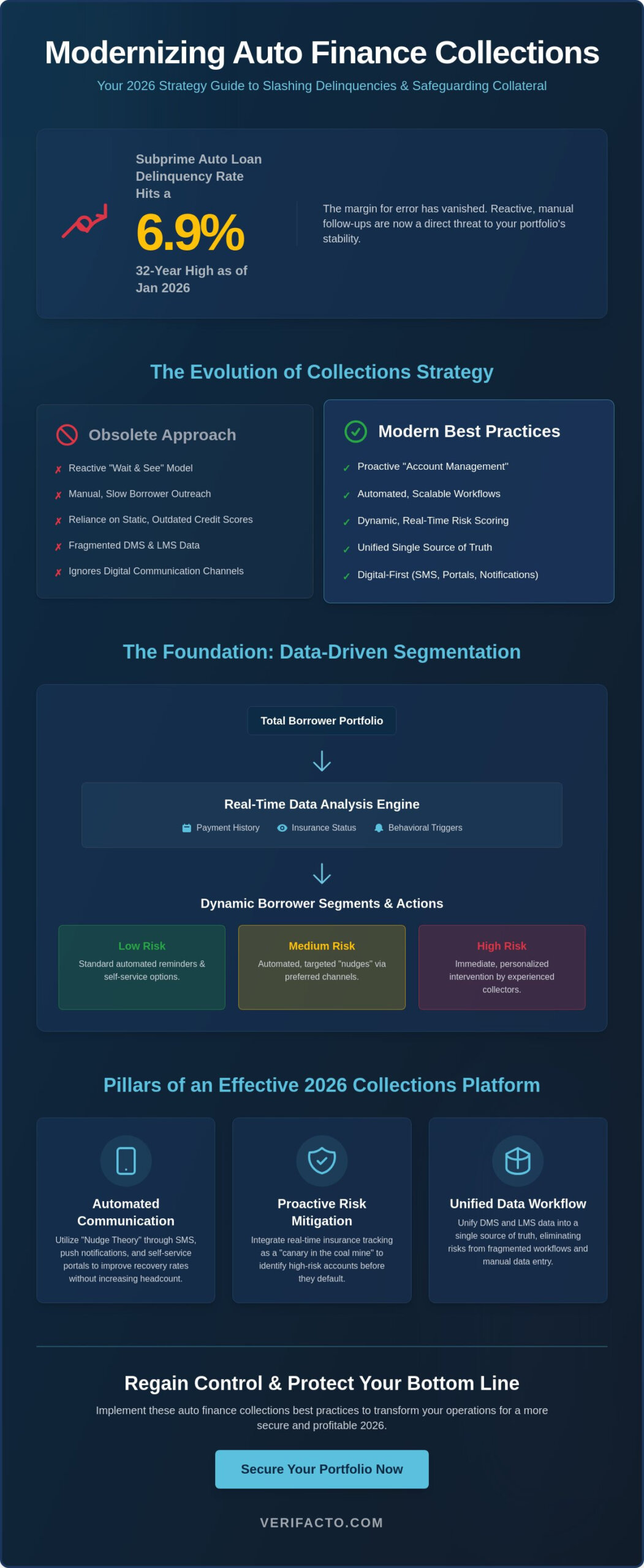
With subprime auto loan delinquency rates hitting a 32-year high of 6.9% in January 2026, the margin for error in your recovery strategy has effectively vanished. You likely recognize that manual follow-ups and fragmented data are no longer just minor inefficiencies; they’re direct threats to your portfolio’s stability. Implementing modern auto finance collections best practices is now the only way to stay ahead of an affordability crisis that is pushing overall delinquency rates to levels not seen in fifteen years.
We’re here to help you regain control and protect your bottom line. This guide will show you how to master the high-tech strategies and automated workflows required to slash delinquencies and safeguard your collateral in this volatile market. We’ll explore how to replace error-prone communication with compliant, automated touchpoints and how to maintain real-time visibility into insurance status. You’ll walk away with a clear plan to reduce charge-offs and modernize your operations for a more secure 2026.
Key Takeaways
- Understand why reactive collection models are failing in 2026 and how to transition to a proactive approach that addresses rising vehicle costs.
- Master auto finance collections best practices by moving beyond static credit scores to real-time, data-driven borrower segmentation.
- Leverage “Nudge Theory” through automated borrower communication to maintain a consistent presence and improve recovery rates without increasing headcount.
- Identify high-risk accounts before they default by integrating real-time insurance tracking as a “canary in the coal mine” for your portfolio.
- Streamline your operations by unifying your DMS and LMS data into a single source of truth, eliminating the risks associated with fragmented workflows.
The Evolution of Auto Finance Collections in 2026
The auto lending market in 2026 is defined by a paradox. Vehicle prices remain elevated while borrower liquidity is increasingly strained. With subprime delinquencies hitting a 32-year peak of 6.9% in early 2026, the process of pursuing payments has transformed from a back-office necessity into a frontline survival strategy. You can’t rely on reactive methods anymore. Modern auto finance collections best practices require a fundamental shift toward “account management.” This approach prioritizes borrower lifetime value and proactive resolution over aggressive, late-stage recovery.
A digital-first recovery strategy is now the industry standard. In an era where 7-year loan terms are common, your goal is to keep the borrower in the vehicle while maintaining a healthy cash flow. Move away from the cold, corporate tone of the past. Instead, adopt the persona of a supportive partner who provides the tools for financial stability. It’s about transformation, not just transaction. By modernizing your workflow, you protect your collateral and your reputation simultaneously.
Why the “Wait and See” Approach is Obsolete
Waiting for a borrower to reach 30 days past due is a recipe for disaster. For a subprime borrower, a single missed payment often snowballs into an insurmountable financial hurdle. The “velocity of default” has accelerated in 2026. Once a payment is missed, the likelihood of a total loss increases daily. Manual outreach is simply too slow to catch these early warning signs. You need automated intervention systems that trigger the moment a grace period ends. This ensures you’re the first priority in the borrower’s budget before other obligations take over. Immediate action isn’t aggressive; it’s protective.
The Rise of the Tech-Savvy Delinquent
Today’s borrowers are experts at filtering out traditional collection attempts. They don’t answer unknown calls. Physical letters often go straight to the shredder. This “communication gap” creates a wall of silence that manual teams struggle to climb. However, these same individuals are highly responsive to digital pings. SMS, push notifications, and self-service portals succeed where phone calls fail. Implementing auto finance collections best practices means meeting borrowers on their terms. By re-establishing contact through preferred digital channels, you break through the noise and provide a frictionless path to payment.
Data-Driven Segmentation: The Foundation of Modern Best Practices
Effective auto finance collections best practices begin with the realization that a borrower’s risk profile is not a static number. Traditional methods often rely on credit scores pulled at the time of origination, but these snapshots quickly become obsolete. Data-driven segmentation allows you to group borrowers based on real-time risk profiles instead of historical data. This approach ensures your team doesn’t waste hours on low-risk reminders while high-risk accounts slide toward a total loss. By categorizing your portfolio dynamically, you can apply the right level of pressure at the right time.
Risk-Based Prioritization is the engine of this strategy. By weighting variables like recent payment history and insurance status more heavily than the original FICO score, you focus your recovery resources where they have the highest impact. It’s about precision. When you identify which accounts are most likely to result in a charge-off, you can deploy your most experienced collectors to those specific files immediately. This proactive stance transforms your department from a reactive call center into a strategic asset that protects the company’s capital.
Moving Beyond Basic Credit Scores
A borrower with a 620 score at signing may behave like a 500 score just six months into the term due to shifting economic pressures. Scores decay. Fast. This is why you need dynamic scoring. Dynamic scoring is the real-time recalibration of a borrower’s risk profile based on current behavioral data, such as recent payment patterns and insurance status, rather than relying on historical snapshots from the time of origination. Adopting this method is critical for improving collection efficiency auto loans, as it provides a clear view of your portfolio’s current health.
Identifying Behavioral Triggers for Early Intervention
Waiting for a full 30-day delinquency is usually a mistake. Instead, your system should flag specific behavioral triggers that indicate imminent trouble. These signals often appear long before a payment is officially missed. Efficiency isn’t a luxury; it’s a requirement for survival in 2026. Look for these specific triggers in your data:
- Missed partial payments or erratic payment amounts that suggest cash flow issues.
- Broken promises to pay (PTPs) within a 48-hour window.
- Notifications of insurance cancellations or lapses from your tracking system.
You can use your Verifacto LMS data to flag these triggers automatically. This creates an Early Warning System that allows for intervention at day five or ten. By catching these slips early, you prevent minor setbacks from turning into permanent defaults. This level of visibility is what separates modern leaders from those still stuck in the “wait and see” era of collections.
Automated Borrower Communication: Scaling Recovery Efficiently
Scaling your portfolio doesn’t require a massive hiring surge if you leverage the right technology. Automated borrower communication allows your team to maintain a “constant presence” without the burnout of manual dialing. This is one of the most effective auto finance collections best practices for 2026. By applying “Nudge Theory,” you send small, frequent reminders that keep your payment top-of-mind. These nudges are supportive rather than confrontational. They guide the borrower back to good standing before they hit the critical 60-day mark. Your staff can then focus their energy on complex negotiations while the system handles the routine follow-ups with guardian-like precision.
Centralization is the key to this efficiency. Every text, email, and portal interaction must be logged in a single communication trail. This creates a bulletproof audit trail for compliance and ensures that any team member can pick up a conversation exactly where it left off. You aren’t just collecting money; you’re managing a relationship at scale. Modern automation ensures that no borrower falls through the cracks, regardless of how fast your portfolio grows.
Leveraging Multichannel Messaging
Traditional mail is too slow for the 2026 market. Phone calls are frequently ignored by a tech-savvy public. SMS remains the undisputed leader in engagement with a staggering 98% open rate. If you aren’t texting, you aren’t being seen. To maximize recovery, you must combine these messages with self-service payment portals. These portals reduce friction by allowing borrowers to resolve their debt in seconds without the perceived “shame” of a phone conversation. Utilizing integrated payment solutions for dealers allows for immediate fund verification and account updates, closing the loop on delinquency instantly.
Compliance and the TCPA in a Digital-First World
Automation requires a strict adherence to evolving regulations. While the new TCPA consent-revocation mechanics have been delayed until January 31, 2027, you still must operate within the current frameworks. Regulation F already limits call frequency to seven attempts per debt within a seven-day period. Your system must automatically enforce these caps and respect time-of-day restrictions to avoid litigation. Proactive compliance is your best defense. To build a fully compliant SMS outreach program, review our comprehensive guide on text messaging for loan collections for the operational steps needed to integrate SMS into your existing workflow while staying 100% compliant. For a detailed breakdown of how to audit your internal processes, refer to our auto finance compliance management guide. Staying compliant doesn’t just protect your license; it builds trust with your borrowers. Ensuring your digital outreach infrastructure is also protected against breaches is equally critical, and understanding data security for auto finance companies will help you avoid FTC penalties while maintaining the speed your borrower engagement demands.
Proactive Risk Mitigation: Integrating Insurance Tracking into Collections
An uninsured vehicle isn’t just a physical liability; it’s a financial red flag that often signals imminent loan default. In the 2026 lending environment, integrating real-time insurance tracking into your recovery workflow is one of the most critical auto finance collections best practices you can adopt. Think of an insurance lapse as the “canary in the coal mine.” When a borrower stops paying their premium, it’s usually because they’ve reached a financial breaking point. The car payment is almost always the next obligation to be abandoned. By the time the payment is officially missed, the risk of a total loss has already spiked.
By making insurance compliance a non-negotiable part of the borrower’s contract, you establish clear expectations from day one. When a policy is cancelled, your system shouldn’t wait for a manual audit to catch it. Instead, the workflow must be instantaneous: Insurance Cancelled, followed by an Automated Alert, leading to Immediate Borrower Outreach. This proactive approach allows you to address the root cause of the risk before the account ever hits the 30-day delinquency mark. You’re not just chasing money; you’re maintaining the integrity of your collateral.
How Real-Time Insurance Monitoring Prevents Total Loss
Manual insurance audits create dangerous blind spots. If you’re only checking coverage once a quarter, your collateral could be unprotected for months without your knowledge. Verifacto’s insurance tracking technology eliminates the need for time-consuming manual verification calls by providing a direct, digital link to provider data. This automation ensures that your records are always current. Real-time data reduces the window of risk for the lender by triggering alerts the moment a policy status changes, allowing you to protect your collateral with real-time tracking before an accident occurs.
Collateral Protection Insurance (CPI) as a Financial Safety Net
Collateral Protection Insurance (CPI) serves as your ultimate financial safety net when a borrower fails to maintain their own private coverage. This force-placed mechanism allows you to protect the asset’s value even during periods of extreme delinquency. It ensures that your interest in the vehicle remains covered, regardless of the borrower’s actions. When CPI is fully integrated within your LMS, the premium billing and collection process becomes a seamless part of the monthly statement. You don’t have to manage separate spreadsheets or manual invoices. This integration ensures that your collateral is always protected, and the cost is handled automatically within your existing payment processing framework.
Implementing a Unified LMS and DMS Workflow for Maximum Efficiency
A fragmented workflow is a vulnerable workflow. If your sales data lives in one silo and your recovery data in another, you’re inviting avoidable errors. A “Single Source of Truth” model eliminates the lag between the sales floor and the collections desk. When your DMS and LMS communicate in real-time, you gain a level of operational mastery that manual processes can’t match. This integration is the final pillar of auto finance collections best practices. It ensures that every borrower interaction is informed by the full history of the account, from the first credit pull to the most recent insurance update.
Cloud-based platforms provide the accessibility and security required for high-stakes environments. You need a system that updates in real-time, allowing your team to work from a foundation of absolute certainty. This technological backbone handles the routine, repetitive tasks that usually bog down your staff. By automating the “no-nonsense” requirements of daily operations, you empower your team to focus on the complex exceptions that require a human touch. This shift creates a culture of mastery and proactive assistance rather than one of constant catch-up. As your platform scales, ensuring that the underlying infrastructure meets the standards outlined for data security for auto finance companies is essential to protecting borrower information and avoiding costly regulatory penalties.
Breaking Down Silos Between Sales and Collections
The gap between “selling the car” and “collecting the money” is often where profits disappear. Friction occurs when collectors lack context from the point of sale. Shared notes and unified borrower profiles ensure that a promise made at the dealership is visible to the recovery team. Understanding how to reduce charge-offs in auto finance starts with ensuring that the data captured at the point of sale is accurate and immediately accessible to the LMS. This transparency prevents the communication errors that lead to broken trust and, ultimately, defaults. When your sales and collections teams speak the same language, your entire portfolio becomes more stable.
Selecting a Cloud-Based Platform for 2026 Scalability
Legacy on-premise software is a liability in 2026. It’s slow, expensive to maintain, and difficult to update. In contrast, modern cloud-based LMS solutions offer the scalability needed for a volatile market. These platforms provide automatic compliance patches, which are essential for navigating shifting state and federal regulations without manual intervention. Future-proofing your business means choosing a partner that evolves as fast as the industry does. You can’t afford to be held back by outdated tech. Modernize your collections with Verifacto’s integrated platform today and transition to a more secure, results-oriented operation. Use these auto finance collections best practices to protect your collateral and scale your business with confidence.
Secure Your Portfolio with Modern Recovery Strategies
The 2026 lending landscape doesn’t forgive slow reactions or fragmented data. By moving from a “wait and see” approach to real-time account management, you transform your collections department into a proactive engine of stability. Mastering auto finance collections best practices means leveraging data to segment risk, automating borrower nudges to maintain presence, and integrating insurance tracking to eliminate collateral blind spots. These steps ensure that you stay ahead of delinquency trends while protecting your bottom line.
You don’t have to navigate these operational hurdles alone. Verifacto provides the tools you need to achieve 100% portfolio visibility through real-time insurance tracking and a seamless “Single Source of Truth” with our integrated LMS and DMS. Our automated multichannel communication tools ensure you stay connected with tech-savvy borrowers while maintaining strict compliance. It’s time to replace manual inefficiency with scalable, high-tech workflows that drive results. Streamline your recovery and protect your collateral with Verifacto today. Your portfolio’s security is our priority, and we’re ready to help you thrive in this new era of auto finance.
Frequently Asked Questions
What are the most effective auto finance collection strategies in 2026?
Effective strategies in 2026 focus on proactive account management rather than reactive debt recovery. Success depends on early intervention through automated workflows and real-time data analysis. By prioritizing accounts based on behavioral triggers rather than just the age of delinquency, lenders can allocate resources more efficiently. These auto finance collections best practices ensure that you maintain a consistent presence in the borrower’s digital life, keeping your payment at the top of their financial priorities.
How can I reduce delinquency rates in a subprime auto portfolio?
Reducing subprime delinquency requires moving beyond static credit scores to dynamic risk profiling. You must monitor for early warning signs like partial payments or broken promises to pay within the first ten days. By identifying these slips early, your team can intervene before a borrower falls into a 60-day delinquency hole. Utilizing automated nudges and real-time collateral tracking helps stabilize high-risk portfolios by maintaining constant contact and visibility throughout the loan term.
Is text messaging for loan collections compliant in 2026?
Text messaging remains a compliant and highly effective tool in 2026, provided you adhere to TCPA and Regulation F guidelines. You must maintain clear opt-in records and respect time-of-day restrictions built into your LMS. Current rules limit the frequency of outreach, so your system should automatically enforce these caps to prevent litigation. When used correctly, SMS offers a 98% open rate, making it the most reliable way to reach tech-savvy borrowers who ignore traditional phone calls. For a complete operational walkthrough, our guide on text messaging for loan collections covers how to build a compliant, automated SMS system that accelerates cash flow recovery.
What is the benefit of integrating insurance tracking with my LMS?
Integrating insurance tracking with your LMS provides a “canary in the coal mine” for potential defaults. There’s a direct correlation between an insurance lapse and an imminent missed loan payment. When your system flags a cancelled policy in real-time, it triggers an immediate outreach workflow. This visibility allows you to address the root cause of the risk before the account becomes delinquent, protecting both your monthly cash flow and your physical collateral from total loss.
How does automated borrower communication improve recovery rates?
Automation improves recovery rates by ensuring no borrower falls through the cracks due to human error or staff burnout. It allows a small team to manage a large portfolio with precision through consistent, multichannel touchpoints. By applying “Nudge Theory,” the system sends frequent, helpful reminders that reduce the friction of making a payment. This constant presence keeps the loan top-of-mind and encourages self-service resolution through integrated payment portals, leading to faster recovery without increasing headcount.
What is the difference between a DMS and an LMS in auto finance?
A DMS (Dealer Management System) primarily handles the “front-end” of the business, including inventory, sales, and initial financing. An LMS (Loan Management System) manages the “back-end,” focusing on loan servicing, payment processing, and collections. For maximum efficiency, these systems should share a “Single Source of Truth.” This ensures that data from the sales floor informs the collections desk, preventing communication silos and improving the overall health of your portfolio through better data transparency.
Can I use Collateral Protection Insurance (CPI) to mitigate collection risks?
Yes, Collateral Protection Insurance (CPI) is a powerful tool for mitigating risk when borrowers fail to maintain private coverage. It acts as a financial safety net that preserves the asset’s value during periods of delinquency or default. By integrating CPI solutions directly into your LMS, you can automate the premium billing and collection process. This ensures your interest in the vehicle remains protected even if the borrower’s financial situation deteriorates, preventing a total loss after a repossession or accident.
How do I choose the best dealership software for collections?
The best dealership software for collections must be cloud-based, integrated, and compliance-focused. Look for a platform that unifies DMS and LMS functions to eliminate data silos. It should offer automated borrower communication and real-time insurance tracking to support modern auto finance collections best practices. Prioritize software that updates automatically for regulatory changes, ensuring your operations remain secure and scalable as your portfolio grows. Reliable support and a focus on “no-nonsense” daily operations are also critical factors.