
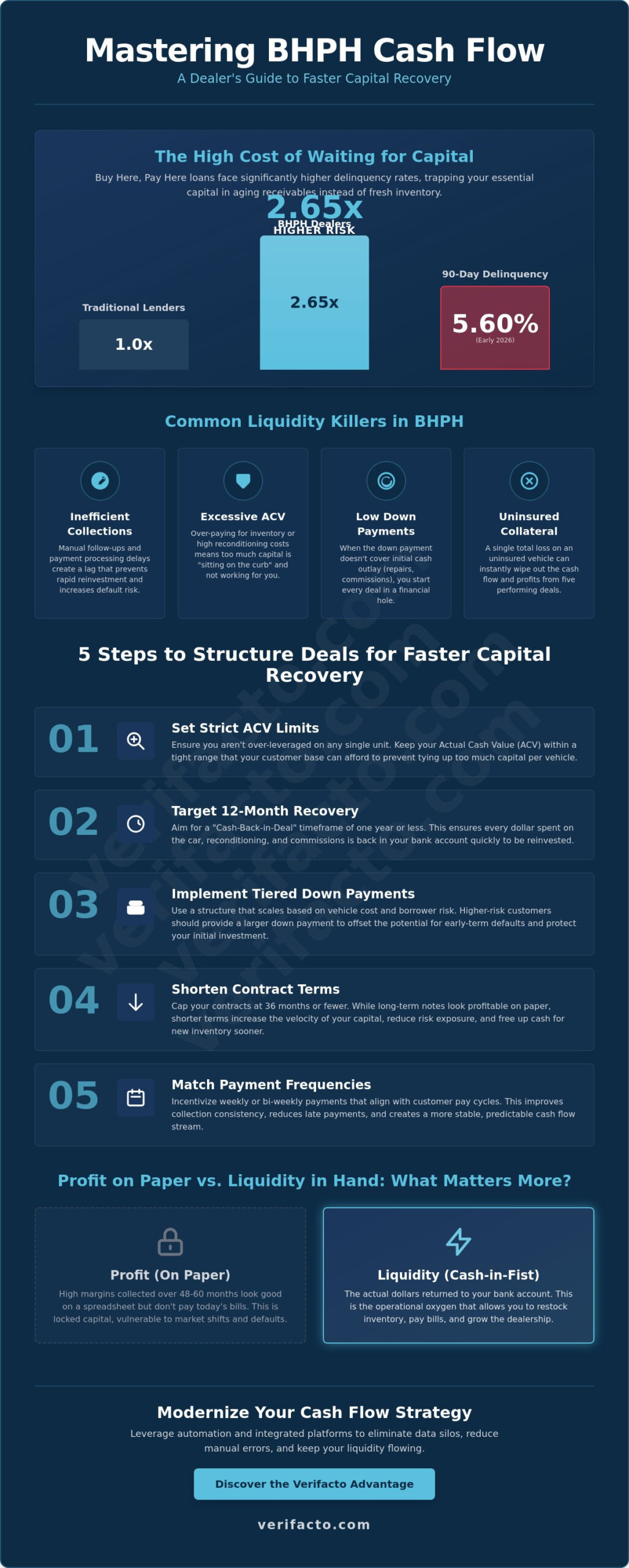
Did you know that Buy Here, Pay Here loans currently face delinquency rates approximately 2.65 times higher than traditional auto lenders? With the 90-day delinquency rate reaching 5.60 percent in early 2026, many dealers find their vital capital trapped in aging receivables rather than available for fresh inventory. You know the frustration of watching your liquid cash vanish into a portfolio of slow-paying accounts while manual collection costs eat away at your remaining margins. It’s a high-stakes environment where traditional methods simply can’t keep pace with rising subprime volatility.
Mastering BHPH cash flow management in this climate requires a shift toward micro-recoveries and aggressive automation. This guide provides the specific deal-structuring and technology strategies you need to recover capital faster and maintain a healthy, resilient cash position. We will show you how to leverage automated borrower communication and precise insurance tracking to slash delinquency rates. By the end of this article, you’ll have a clear roadmap to streamline your operational overhead and achieve the faster cash-in-fist metrics your dealership needs to thrive.
Key Takeaways
- Understand why the “Cash-in-Fist” (CIF) metric is a more accurate indicator of dealership health than total sales volume in a volatile market.
- Learn how to structure deals with strict ACV limits and a 12-month capital recovery target to prevent your capital from being spread too thin.
- Optimize your BHPH cash flow management by transitioning from manual collection efforts to integrated payment and communication automation.
- Identify the hidden operational costs of manual insurance tracking and how one collateral loss can erase the profits of multiple successful deals.
- Discover how a unified DMS and LMS platform eliminates data silos and manual errors to keep your liquidity flowing and your overhead low.
What is BHPH Cash Flow Management and Why Does It Fail?
BHPH cash flow management is the strategic orchestration of capital outlays against the timing of payment collections. In a business where you act as both the retailer and the bank, managing this flow determines whether you can buy your next ten cars or if you’re stuck waiting for the mail. Understanding What is Buy Here, Pay Here (BHPH) is foundational, but mastering the liquidity within that model is what separates thriving lots from those that struggle. Success isn’t measured by how many deals you sign; it’s measured by your Cash-in-Fist (CIF) metric. This represents the actual dollars returned to your bank account compared to the capital you deployed to put the car on the road.
The 2026 market presents unique pressures that demand faster recovery cycles. With subprime auto loan delinquencies reaching 5.60 percent in the first quarter of the year, the margin for error has vanished. If your capital recovery cycle is too slow, you won’t have the liquidity to restock inventory as prices fluctuate. You can’t afford to let your money sit idle in aging receivables while your competitors snap up the best units at auction.
Three primary drains typically cripple a dealership’s cash position:
- Excessive ACV: Over-paying for inventory or over-reconditioning units leaves too much capital “sitting on the curb.”
- Low Down Payments: When the down payment doesn’t cover the initial cash outlay, including repairs and commissions, you start every deal in a deep hole.
- Inefficient Collections: Relying on manual follow-ups creates a lag that prevents rapid reinvestment and increases the risk of default.
The Difference Between Profit and Liquidity
A dealer can look incredibly profitable on a spreadsheet while facing a total cash crisis. If you sell a car for a high margin but collect that money over 48 to 60 months, that “profit” doesn’t help you pay your bills or buy new inventory today. Long-term notes tie up your operational oxygen and leave you vulnerable to market shifts. Liquidity is the fuel that allows a dealership to restock inventory. Without it, your growth grinds to a halt regardless of your paper gains.
Common Liquidity Killers for Independent Dealers
Independent dealers often fall victim to “death by a thousand cuts.” High reconditioning costs that aren’t recouped in the down payment are a major culprit. If you spend $2,000 to get a car ready but only collect a $1,000 down payment, you’re essentially financing your own expenses. Additionally, manual payment processing delays and the classic “check is in the mail” excuse create unnecessary friction. Finally, untracked insurance lapses are silent killers; a single total loss on an uninsured vehicle can instantly wipe out the cash flow benefits of five performing deals. Modern BHPH cash flow management requires closing these gaps before they drain your reserves.
5 Steps to Structuring Deals for Faster Capital Recovery
Efficient BHPH cash flow management starts with the math behind every deal. If you structure a contract poorly, you’re essentially planning for a liquidity crisis six months down the road. In 2026, the goal isn’t just to move a unit; it’s to get your capital back into the business as quickly as possible so you can reinvest in fresh inventory. Speed of recovery is now more important than the total interest a long-term note might eventually earn.
To maximize your liquidity, follow these five strategic steps for deal structuring:
- Set strict ACV limits: Don’t let your passion for a specific vehicle blind you to the numbers. Ensure you aren’t over-leveraged on any single unit by keeping your Actual Cash Value within a tight range that your customer base can afford.
- Target a 12-month recovery: Aim for a “Cash-Back-in-Deal” timeframe of one year or less. This ensures that every dollar you spent on the car, reconditioning, and commissions is back in your bank account within 12 months.
- Implement tiered down payments: Use a structure that scales based on risk and vehicle cost. Higher-risk borrowers should provide more upfront to offset the potential for early-term defaults.
- Shorten contract terms: Cap your contracts at 36 months or fewer. This increases the velocity of capital and reduces the time your money is at risk in the field.
- Match payment frequencies: Incentivize weekly or bi-weekly payments to align with customer pay cycles. Research on Structuring Deals for Faster Capital Recovery shows that frequent, smaller payments significantly improve repayment consistency in subprime lending.
Optimizing the Down Payment Strategy
The “Skin in the Game” philosophy is your best defense against portfolio volatility. In the current economic climate, a 20% equity position is the minimum threshold for stability. Your down payment should ideally cover your entire initial ACV and reconditioning costs. While this approach might feel like it limits your sales volume, it ensures that every deal is a net positive for your liquidity from day one. Using a modern payment and tracking system can help you monitor these equity positions across your entire portfolio in real-time.
The Math of Shorter Loan Terms
Many dealers fall into the trap of stretching terms to 48 or 60 months to keep monthly payments low, but this is a dangerous mistake for BHPH cash flow management. In deep subprime lending, the length of the term is a much bigger risk factor than the interest rate. When you compare a 36-month note to a longer obligation, the principal recovery on the shorter term is significantly faster. Shorter terms reduce the window for high-mileage depreciation. By keeping terms brief, you ensure the borrower’s equity stays closer to the vehicle’s actual value, which gives them a stronger incentive to keep paying.
Leveraging Technology as a Cash Flow Multiplier
Technology isn’t just an operational expense; it’s the primary engine for accelerating your CIF metrics. In 2026, the dealers winning the liquidity game have moved beyond manual “cash at the counter” workflows that tether staff to the office and delay deposits. By adopting integrated payment solutions for dealers, you eliminate the friction of physical transactions and the errors of manual data entry. Every hour your team spends counting bills or driving to the bank is an hour your capital isn’t being reinvested in new inventory. Integrated systems ensure that the moment a payment is processed, your ledger reflects the update and your cash position is immediately visible.
Automation allows your team to focus their energy on high-risk accounts rather than chasing the “low-hanging fruit” of routine collections. If a borrower is only 24 hours late, an automated system should handle the initial outreach. This proactive approach to BHPH cash flow management prevents minor delays from snowballing into 60-day delinquencies. Real-time dashboards provide a high-level view of your portfolio, allowing you to spot negative trends across specific vehicle types or credit tiers before they result in a charge-off. Cloud-based DMS and LMS integration further protects your liquidity by ensuring data flows seamlessly between sales and collections, removing the silos where cash leaks often hide.
The Power of ACH and Recurring Payments
Shifting your portfolio toward ACH processing for auto finance is one of the most effective ways to stabilize monthly revenue. Recurring payments remove the “forgetfulness” factor that often plagues subprime lending. While credit card fees can erode your margins, ACH offers a cost-effective alternative with lower processing overhead. You can also strategically time these transfers to align precisely with a borrower’s payday, which significantly reduces the occurrence of Non-Sufficient Funds (NSF) returns. This level of precision keeps your cash flow predictable and your bank balance resilient.
Automated Communication: SMS and Email Reminders
Consistent communication is the backbone of a high-performing collection department. Implementing automated payment reminders for car loans ensures every customer receives a professional nudge three days before their due date. This digital presence establishes payment priority in the borrower’s mind without requiring a single minute of staff time. By eliminating manual phone calls for accounts that are only 1-5 days late, you drastically reduce your operational “cost-to-collect.” This efficiency allows your staff to dedicate their expertise to resolving complex, high-risk situations, further protecting your collateral and your capital. Modernizing your servicing stack with integrated payment processing for auto lenders gives borrowers mobile-friendly self-service options that further reduce friction and keep payments flowing on time.
Protecting Liquidity from Collateral Loss and Insurance Gaps
“I track insurance manually, it’s fine” is a common refrain among independent dealers, but it is often the most expensive mistake in BHPH cash flow management. Manual tracking is inherently reactive. By the time your staff discovers a lapse through a stack of mail or a phone call, the vehicle might already be totaled or missing. Real-time insurance tracking acts as a proactive shield for your capital, ensuring that you aren’t the last to know when your collateral is no longer protected. Relying on outdated paper trails in 2026 is a gamble that your bank balance cannot afford to lose.
Consider the devastating math of a total loss on an uninsured vehicle. If a unit with an $8,000 balance is destroyed without coverage, you lose the car, the remaining principal, and the projected interest. In the subprime world, one uninsured total loss can wipe out the net profit of five performing deals. This creates a massive hole in your liquidity that requires significant sales volume just to break even. Protecting your portfolio from these “silent killers” is just as vital as collecting the weekly note.
The Link Between Insurance Lapses and Default
There is a direct, undeniable correlation between insurance status and payment consistency. When a borrower stops paying their insurance premium, it is almost always the first domino to fall before they stop paying the car note. By monitoring these lapses in real time, you gain a powerful early warning system for your LMS. This allows your team to intervene before the customer disappears or the car is damaged. Insurance tracking serves as a predictive analytics tool for portfolio health, giving you the foresight to manage risk before it turns into a charge-off.
Mitigating Risk with Automated CPI
Collateral Protection Insurance (CPI) provides the ultimate safety net for your cash position. Automated CPI enrollment ensures that if a borrower’s policy lapses, the lender’s interest is immediately covered without manual intervention from your staff. This not only protects your capital but also provides significant compliance benefits through a structured, verifiable process. Positioning CPI as a standard safeguard is essential for high-risk subprime portfolios, as it guarantees that a single accident won’t derail your entire operational budget. To secure your portfolio and maintain a healthy cash position, explore how automated insurance tracking can protect your assets today.
The Verifacto Advantage: Modernizing Your Cash Flow Strategy
The 2026 economic climate demands more than just grit; it requires a technological foundation that works as hard as you do. Verifacto transforms your BHPH cash flow management from a manual struggle into a streamlined, automated engine. By unifying your operations with a modern what is dms and LMS platform, you gain the control necessary to navigate a volatile market. Our cloud-based architecture eliminates the delays associated with legacy software, ensuring that your data is always current and your cash is always moving toward reinvestment.
Manual data entry is a significant drain on both time and accuracy. Verifacto’s fully integrated payment and communication systems remove these human errors, protecting your margins from the cost of preventable mistakes. You get 24/7 visibility into your portfolio’s performance and insurance compliance status. This transparency allows you to scale your dealership’s volume without the traditional need to increase your collections headcount. You can manage more loans with higher precision and lower overhead, turning your operational efficiency into a competitive advantage.
Why Integration Beats Siloed Software
Using separate systems for sales, loan management, and insurance tracking creates dangerous blind spots. When your software doesn’t talk to itself, cash leaks go unnoticed until they become significant losses. Verifacto provides a single source of truth, linking every payment and insurance update to the borrower’s file in real time. Unlike legacy on-premise software that takes months to configure, our cloud solutions offer rapid implementation. You can modernize your workflow in days and start recovering capital faster while maintaining total security over your data.
Next Steps: Auditing Your Current Liquidity
Before you can optimize your cash flow, you must understand your current bottlenecks. Use this brief checklist to evaluate your operational health and identify where your capital is getting stuck:
- Calculate your current “cost-to-collect” per active loan.
- Measure the average “time-to-recover” capital on a typical deal.
- Identify how many hours per week your staff spends on manual insurance verification.
- Review your current 90-day delinquency rate against the 2026 industry average of 5.60 percent.
If these numbers aren’t where they need to be, it’s time for a change. Request a demo to see our real-time insurance tracking and automated communication tools in action. Optimize your BHPH cash flow with Verifacto today and secure the liquidity your business deserves to grow.
Take Control of Your Portfolio Today
Optimizing your capital recovery isn’t just about survival; it’s about building a foundation for scalable growth. We’ve explored how disciplined deal structuring and the 12-month recovery rule keep your money moving through the business. By shifting your focus from paper profits to actual cash-in-fist metrics, you protect your dealership from the volatility of the 2026 subprime market. Effective BHPH cash flow management requires a proactive stance that replaces manual guesswork with data-driven precision.
Don’t let aging receivables or uninsured total losses drain your reserves. You can automate the heavy lifting of collections and safeguard your collateral without increasing your staff’s workload. Streamline your BHPH cash flow with Verifacto’s integrated platform to leverage real-time insurance tracking, built-in payment processing, and automated borrower communication tools. It’s time to stop chasing payments and start growing your inventory with confidence. Your path to a more resilient, liquid dealership starts with the right technology partner.
Frequently Asked Questions
How can I improve my BHPH cash flow immediately?
Audit your current “Cash-in-Fist” metrics and shift to shorter contract terms to see an immediate impact. Reducing your average term from 42 to 36 months or less increases the velocity of capital returned to your lot. You should also tighten your ACV limits on all incoming inventory to ensure you aren’t over-leveraged on a single unit. These changes provide a rapid boost to your liquidity without requiring a total operational overhaul.
What is the ideal down payment for a BHPH deal in 2026?
Target a minimum down payment of 20 percent of the vehicle’s selling price to ensure the borrower has sufficient equity. Ideally, your down payment should cover the entire Actual Cash Value (ACV) and reconditioning costs of the unit. This strategy ensures you are cash-positive from day one. High-risk borrowers may require even higher thresholds to offset the increased potential for early-term default in the current economic climate.
Does automated payment processing really reduce delinquency?
Automation significantly reduces delinquency by removing the barriers to payment and the friction of manual transactions. By implementing automated payment processing, you eliminate the “forgetfulness” factor and the delays associated with physical cash handling. This technology ensures that funds are captured precisely when they are available, which is critical for maintaining healthy BHPH cash flow management. It allows your team to focus exclusively on high-risk accounts rather than routine payment collection.
How much does manual insurance tracking actually cost my dealership?
Manual tracking costs your dealership in both labor hours and unrecovered collateral losses. Staff members often spend dozens of hours per month chasing paper binders and calling agents, which is a significant drain on your operational budget. The true cost becomes apparent when a lapse goes unnoticed; a single total loss on an uninsured vehicle can erase the profits of five successful deals. Automated tracking replaces this reactive, expensive process with real-time protection.
What happens to my cash flow if a borrower totals an uninsured vehicle?
Your cash flow takes a direct hit as you lose the physical asset, the remaining principal balance, and all future interest revenue. This scenario creates a liquidity gap that forces you to sell more units just to recoup the initial loss. Without a safety net like Collateral Protection Insurance (CPI), a total loss is a complete capital drain. Automated insurance tracking prevents these financial leaks from eroding your dealership’s stability.
Can I use SMS reminders for loan collections legally?
You can use SMS reminders legally provided you comply with the Telephone Consumer Protection Act (TCPA) and obtain proper written consent from the borrower. It’s essential to include clear opt-out instructions in every message and respect the time-of-day restrictions for collection efforts. When used correctly, automated borrower communication is a highly effective, compliant way to nudge customers before their due dates and reduce the need for manual phone calls.
Is ACH better than credit card payments for BHPH dealers?
ACH is generally superior for BHPH dealers because it carries significantly lower processing fees and reduces the risk of chargebacks compared to credit cards. It allows you to set up recurring transfers that align with the borrower’s pay cycle, ensuring consistent BHPH cash flow management. While credit cards offer convenience, the high merchant fees can eat into your margins over the life of a 36-month loan.
How do I transition from a manual spreadsheet to a modern LMS?
Transitioning requires a clean data export and a partner that offers rapid cloud-based implementation. Start by auditing your current active loans and ensuring all borrower information is accurate before importing it into the new system. A modern LMS integrates directly with your payment processing and insurance tracking, eliminating the need for manual updates. This move replaces siloed data with a single “source of truth” for your entire portfolio. Dealers looking to eliminate manual friction should also explore how an online payment portal built for integrated payment processing for auto lenders can give borrowers a seamless self-service experience while keeping your cash flow moving.