
Compliance isn’t just a checkbox for auto lenders. It’s one of the most significant operational risks your business carries every single day. If you’re still relying on manual processes, spreadsheets, or disconnected systems to manage regulatory requirements, you’re not just creating inefficiencies; you’re leaving your portfolio exposed. The right auto loan compliance software doesn’t just reduce that risk. It actively transforms how your lending operation runs.
You already know the pressure. Regulators aren’t slowing down, loan volumes aren’t getting simpler, and tracking performance across a fragmented tech stack is exhausting. The question most lenders are asking isn’t whether they need a compliance solution. It’s what features actually matter and whether the platform can do more than just keep auditors satisfied.
This guide answers that directly. You’ll learn what to look for in a compliance platform, how integrated software connects compliance to operational efficiency, and how tools like Verifacto’s AI-powered platform are designed to support lenders from the first loan application through the final payment. Let’s get into it.
Key Takeaways
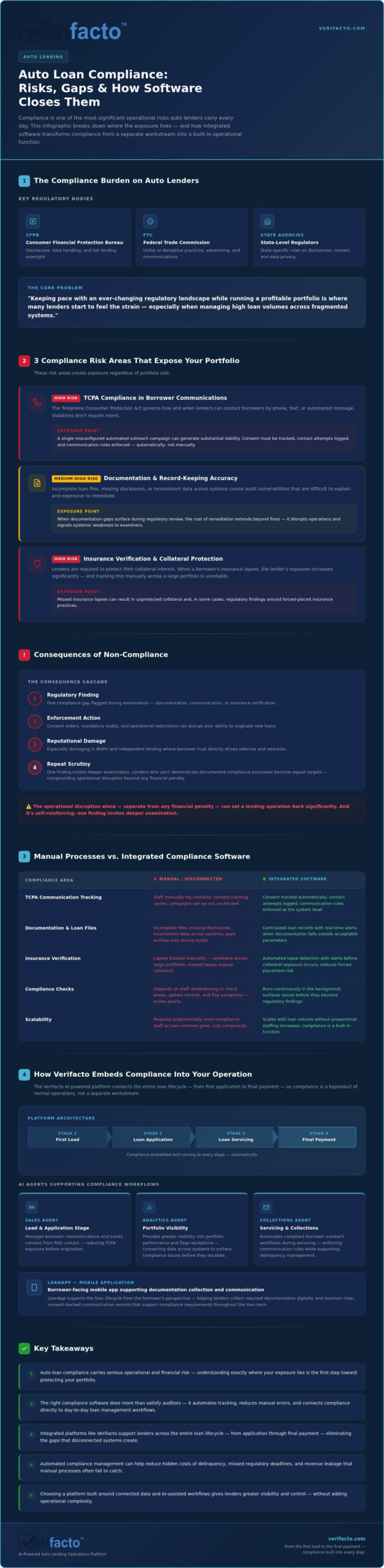
- Auto loan compliance carries serious operational and financial risk-understanding exactly where your exposure lies is the first step toward protecting your portfolio.
- The right auto loan compliance software does more than satisfy auditors; it automates tracking, reduces manual errors, and connects compliance directly to day-to-day loan management workflows.
- Integrated platforms like Verifacto are designed to support lenders across the entire loan lifecycle, from application through final payment, eliminating the gaps that disconnected systems create.
- Automated compliance management can help reduce the hidden costs of delinquency, missed regulatory deadlines, and revenue leakage that manual processes often fail to catch.
- Choosing a platform built around connected data and AI-assisted workflows gives lenders greater visibility and control-without adding operational complexity.
Understanding Auto Loan Compliance: Key Risks and Challenges
Auto loan compliance is the framework of federal, state, and industry regulations that govern how lenders originate, service, and collect on vehicle loans. It’s not a single rule or a one-time audit. It’s an ongoing operational responsibility that touches every stage of the loan lifecycle. And for lenders managing high volumes across fragmented systems, the margin for error is razor-thin.
The regulatory environment covering auto lending includes oversight from the Consumer Financial Protection Bureau (CFPB), the Federal Trade Commission (FTC), and various state-level agencies, each with their own requirements around disclosures, communications, and data handling. Keeping pace with that landscape while running a profitable portfolio is where many lenders start to feel the strain.
Common Compliance Risks in Auto Lending
Three risk areas consistently create exposure for lenders, regardless of portfolio size.
- TCPA compliance in borrower communications: The Telephone Consumer Protection Act governs how and when lenders can contact borrowers by phone, text, or automated message. Violations don’t require intent. A single misconfigured automated outreach campaign can generate substantial liability. Lenders need systems that track consent, log contact attempts, and enforce communication rules automatically, not manually.
- Documentation and record-keeping accuracy: Incomplete loan files, missing disclosures, or inconsistent data across systems create audit vulnerabilities. When documentation gaps surface during regulatory review, they’re difficult to explain and expensive to remediate.
- Insurance verification and collateral protection: Lenders are required to protect their collateral interest. When a borrower’s insurance lapses, the lender’s exposure increases. Tracking that manually across a large portfolio is unreliable. Missed lapses can result in unprotected collateral and, in some cases, regulatory findings around forced-placed insurance practices.
This is exactly where auto loan compliance software is designed to close the gap. Automated tracking, real-time alerts, and integrated documentation tools replace the manual workflows that create risk in the first place.
Consequences of Non-Compliance
The consequences extend well beyond a regulatory fine. Enforcement actions can trigger consent orders, mandatory audits, and operational restrictions that disrupt your ability to originate new loans. Reputational damage compounds quickly, particularly in the buy-here-pay-here and independent lender space where borrower trust is a direct driver of referrals and retention.
Increased regulatory scrutiny is also self-reinforcing. One finding invites deeper examination. Lenders who can’t demonstrate consistent, documented compliance processes become repeat targets. The operational disruption alone, separate from any financial penalty, can set a lending operation back significantly.
The practical answer isn’t hiring more compliance staff. It’s building systems that make compliance a byproduct of normal operations rather than a separate workstream entirely.
How Auto Loan Compliance Software Addresses Industry Challenges
Manual compliance processes don’t scale. As loan volumes grow and regulatory requirements multiply, the workflows that once felt manageable start creating real operational drag. The right auto loan compliance software doesn’t just digitize those manual steps; it restructures them entirely, embedding compliance into the normal flow of loan management so it happens automatically rather than as a separate task.
That distinction matters. When compliance is a parallel workstream, it depends on staff remembering to check boxes, update records, and flag exceptions. When it’s built into the platform, it runs continuously in the background, surfacing issues before they become findings.
Key Features of Effective Compliance Software
Not all platforms deliver the same depth of functionality. The features that separate genuinely useful tools from basic compliance trackers include:
- Automated compliance checks and alerts: The platform monitors loan files, borrower communications, and insurance status in real time, generating alerts when something falls outside acceptable parameters. Staff respond to flagged exceptions rather than manually reviewing every account.
- Integration with existing loan management systems: Compliance data needs to live where loan data lives. Disconnected systems create the exact documentation gaps that auditors find. A platform designed to connect across the loan lifecycle eliminates that fragmentation at the source.
- Centralized dashboards for compliance tracking: Portfolio-wide visibility in a single view lets managers identify exposure patterns, monitor open exceptions, and document remediation without chasing information across multiple systems.
AI plays a direct role in making these features more effective. Verifacto’s AI agents are designed to work with connected business data, identifying patterns across accounts that manual review would miss and supporting faster, better-informed decisions. That’s not automation for its own sake; it’s AI applied to the specific problem of managing compliance at scale.
Integrating Compliance Software into Existing Operations
Implementation doesn’t have to be disruptive. A practical approach starts with mapping your current compliance workflows, identifying where manual steps create the most risk, and prioritizing those areas for automation first. That gives your team early wins and builds confidence in the platform before broader rollout.
Staff training should focus on outcomes, not just features. Show your team what the system catches automatically and how to respond to alerts efficiently. The goal is to reduce the cognitive load of compliance, not add a new set of tasks on top of existing ones.
Post-implementation, track the metrics that matter: exception resolution time, documentation completeness rates, and audit findings. Those numbers tell you whether the platform is actually reducing risk or just reorganizing it.
Verifacto is designed to support lenders through this entire process, connecting compliance management directly to loan servicing, borrower communications, and payment processing within a single platform. Explore how Verifacto’s AI-powered platform connects your compliance and loan management workflows in one place.
Real-World Examples: Compliance Workflows Using Verifacto
Understanding compliance requirements in theory is one thing. Seeing how they translate into daily operations is where most platforms fall short. The gap between knowing what’s required and consistently executing it across hundreds or thousands of active loans is exactly where manual processes break down. Here’s how a compliance workflow actually runs inside Verifacto’s platform.
A Step-by-Step Compliance Workflow
Consider a mid-volume independent lender processing new loan applications daily. Without an integrated platform, compliance checks happen in fragments: one team member verifies disclosures, another follows up on insurance documentation, and a third monitors communication consent. Each handoff is a potential failure point.
Inside Verifacto, that workflow runs differently from the start:
- At application: Built-in compliance checks run as part of the loan origination process through LoanApp, the platform’s mobile application. Required disclosures are tracked, consent is documented, and the loan file is structured correctly before it moves forward.
- During servicing: Insurance tracking runs automatically against active loans. When a borrower’s coverage lapses or approaches expiration, the platform flags the account and triggers the appropriate response workflow, whether that’s a borrower notification or a CPI solution review, without a staff member needing to manually audit the portfolio.
- Throughout the loan lifecycle: Automated borrower communication tools enforce contact rules, log every outreach attempt, and maintain a documented record of interactions. That documentation doesn’t live in a separate system; it’s connected directly to the loan file.
That connected structure is what separates genuinely useful auto loan compliance software from a basic tracking tool. Compliance isn’t a separate checklist. It’s embedded in the workflow itself.
Leveraging AI for Compliance Efficiency
Verifacto’s AI agents are designed to work with the connected data across your portfolio, not just individual accounts in isolation. The Analytics Agent can surface patterns across your loan book that manual review would miss: accounts approaching insurance lapse clusters, communication response gaps, or documentation inconsistencies that appear minor individually but represent systemic exposure at scale.
That kind of visibility supports faster, better-informed decisions. Instead of reacting to compliance findings after the fact, your team is working from real-time data that flags emerging issues before they become audit items. The Collections Agent supports this further by ensuring borrower outreach stays within documented parameters, reducing the risk of communication-related regulatory exposure during the collections process.
The practical outcome is a team that spends less time manually verifying compliance status and more time resolving the exceptions the platform has already identified and prioritized. That’s the difference between auto loan compliance software that supports your operation and one that simply records what already happened.
To see how these workflows connect across your specific loan portfolio, explore Verifacto’s AI-powered platform and how its agents are built to support compliance management at scale.
The Financial Benefits of Implementing Compliance Software
Compliance failures are expensive. But the financial case for investing in auto loan compliance software goes well beyond avoiding penalties. The real return comes from what happens to your operation once manual processes are replaced with automated, connected workflows. Efficiency gains compound. Revenue leakage gets plugged. And the hidden costs that erode portfolio performance become visible and manageable.
Most lenders underestimate how much non-compliance costs them outside of formal enforcement actions. Staff hours spent on manual audits, documentation remediation, and reactive borrower outreach all carry a price tag that never appears on a compliance budget line. They show up instead as inflated operational overhead and compressed margins.
ROI from Compliance Software
The financial return from an integrated compliance platform comes from three distinct areas:
- Reduced exposure to regulatory penalties: Automated compliance checks are designed to catch documentation gaps, communication violations, and insurance lapses before they become findings. Avoiding even a single enforcement action can justify the platform investment many times over, given the legal, operational, and reputational costs that follow.
- Improved collections performance: When borrower communications are automated, documented, and executed within regulatory parameters, contact rates improve and accounts resolve faster. Fewer accounts age into serious delinquency when outreach is consistent and timely rather than dependent on staff bandwidth.
- Operational efficiency that compounds over time: Every hour your team stops spending on manual compliance tasks is an hour redirected toward revenue-generating activity. Across a mid-size portfolio, that reallocation of capacity is meaningful. It’s not a one-time gain; it scales as loan volume grows.
Success Stories of Compliance Implementation
Consider an independent BHPH lender managing several hundred active loans across a fragmented system setup. Insurance tracking was manual, borrower communications were inconsistent, and documentation lived across multiple platforms. Audit preparation took weeks and still produced findings.
After implementing an integrated platform that connected insurance tracking, automated borrower communications, and centralized loan documentation, the operational picture changed. Audit preparation time dropped significantly because documentation was already organized and current. Insurance lapse response time shortened because the platform flagged accounts automatically rather than waiting for staff to catch them during periodic reviews. Collections outreach became more consistent, which helped reduce the volume of accounts aging past early-stage delinquency.
The lesson isn’t that compliance software eliminates risk entirely. It’s that connected, automated systems are designed to surface problems earlier, respond faster, and maintain the documentation that protects your portfolio and your business.
Operational efficiency and compliance aren’t competing priorities. Built correctly, they reinforce each other. Connect with Verifacto to see how an integrated platform can help reduce operational overhead and strengthen your portfolio’s financial performance.
Conclusion: Transform Your Compliance Management with Verifacto
Managing compliance across a growing loan portfolio isn’t getting easier. Regulatory expectations are rising, loan volumes are increasing, and the cost of getting it wrong, whether through missed insurance lapses, documentation gaps, or communication violations, compounds quickly. The case for investing in purpose-built auto loan compliance software isn’t just about satisfying auditors. It’s about running a more efficient, more protected, and more profitable lending operation.
What this guide has walked through reflects a consistent theme: disconnected systems create the gaps that compliance failures live in. When insurance tracking, borrower communications, loan documentation, and payment processing all operate in separate tools, risk accumulates in the spaces between them. Connecting those workflows inside a single platform is what closes those gaps.
Verifacto is designed to do exactly that. Its AI-powered platform supports lenders across the entire loan lifecycle, from the first application through the final payment, with compliance embedded in the workflow rather than bolted on as an afterthought. The Analytics Agent surfaces portfolio-wide patterns. The Collections Agent keeps borrower outreach within documented parameters. Insurance tracking runs automatically, flagging lapses before they become unprotected collateral. Every piece connects back to the same loan file.
The operational benefits are real and measurable over time: less manual effort, faster exception resolution, cleaner documentation, and a team that’s responding to flagged issues rather than hunting for them. That’s the practical difference between a compliance tool and a compliance platform.
Next Steps for Interested Lenders
If you’re ready to see how an integrated approach fits your specific operation, the next step is straightforward. No pressure, no lengthy sales process. Just a direct look at how the platform works against your actual compliance and servicing workflows.
- Book a demonstration: See Verifacto in action against the specific challenges your portfolio faces. A live walkthrough is the fastest way to evaluate fit.
- Explore the AI solutions page: Visit Verifacto’s AI solutions page to understand how the platform’s AI agents are built to support compliance management, collections, and operational efficiency at scale.
- Start a conversation: Contact Verifacto directly to discuss your compliance challenges and how the platform can be configured to support your lending operation.
Compliance doesn’t have to be a separate workstream that drains resources and creates anxiety before every audit. Built into the right platform, it becomes a natural output of how your operation runs every day. That’s the shift Verifacto is designed to support.
Build a Lending Operation That Stays Ahead of Risk
Compliance pressure isn’t easing up in 2026. But the lenders who treat auto loan compliance software as a strategic investment rather than a cost center are the ones building operations that can scale without accumulating hidden risk along the way.
Three things stand out from everything covered here. First, manual workflows don’t just create inefficiency; they create exposure that compounds quietly until it surfaces as a regulatory finding or a revenue problem. Second, AI-driven automation is most powerful when it’s embedded in your existing workflows, not layered on top of them. Third, real-time compliance monitoring only delivers value when it connects to the same data your servicing and collections teams are already working from.
That’s exactly what Verifacto is designed to support: a connected operation where compliance, loan management, borrower communications, and payment processing work from a single source of truth.
The next step doesn’t have to be complicated. Explore how Verifacto connects your operation from the first lead to the final payment and see what a fully integrated platform can do for your portfolio.
Frequently Asked Questions About Auto Loan Compliance Software
What is auto loan compliance software and how does it work?
Auto loan compliance software is a platform designed to automate, monitor, and document the regulatory requirements that govern how lenders originate, service, and collect on vehicle loans. It works by embedding compliance checks directly into loan management workflows, so requirements around disclosures, borrower communications, and insurance tracking are handled continuously rather than through manual review cycles.
The most effective platforms connect compliance functions to the same data your servicing and collections teams use daily. That connection is what prevents the documentation gaps and missed alerts that create regulatory exposure in the first place.
How can compliance software help reduce risks in auto lending?
Compliance software is designed to surface problems before they become findings. Automated alerts flag insurance lapses, communication consent issues, and documentation gaps in real time, giving your team the opportunity to respond proactively rather than reactively. That shift from reactive to proactive risk management is where the meaningful exposure reduction happens.
It also creates a consistent, auditable record of every action taken across your portfolio. When a regulator asks for documentation, a connected platform can produce it quickly and accurately, rather than requiring weeks of manual file reconstruction.
What features should I look for in auto loan compliance software?
Prioritize platforms that offer automated compliance monitoring, centralized documentation, and real-time alerts built into your existing loan management workflow. Insurance tracking, TCPA-aligned communication logging, and audit-ready record-keeping are non-negotiable for lenders managing any meaningful loan volume. A platform that requires separate logins or manual data transfers between systems introduces the same gaps you’re trying to close.
AI-assisted analytics add a meaningful layer on top of those core functions. The ability to identify patterns across your entire portfolio, not just flag individual account exceptions, gives compliance managers a level of visibility that manual review can’t replicate at scale.
How does Verifacto ensure compliance within its platform?
Verifacto is designed to embed compliance directly into the loan lifecycle rather than treating it as a separate module. Insurance tracking runs automatically against active loans, flagging lapses without requiring manual portfolio audits. Automated borrower communication tools are built to log contact attempts and enforce outreach parameters, supporting TCPA-aligned documentation across every account.
The Analytics Agent works across connected portfolio data to surface patterns that individual account reviews would miss. Combined with the Collections Agent’s structured outreach workflows, the platform is built to support consistent, documented compliance as a natural output of daily operations rather than a separate administrative task.
What are the benefits of integrating compliance management into my operations?
The core benefit is that compliance stops being a parallel workstream and becomes part of how your operation runs every day. Staff spend less time manually verifying account status and more time resolving the exceptions the platform has already identified and prioritized. That reallocation of effort compounds over time, particularly as loan volume grows.
Integration also eliminates the data fragmentation that creates audit vulnerabilities. When insurance tracking, borrower communications, loan documentation, and payment processing all connect to the same loan file, there are no gaps between systems for compliance failures to develop in quietly.
How can I measure the ROI of compliance software?
Start with the metrics that reflect operational friction: exception resolution time, documentation completeness rates, audit preparation time, and the volume of accounts aging past early-stage delinquency. Improvements in those numbers indicate that the platform is doing what it’s designed to do, reducing the manual effort and response delays that erode portfolio performance.
Beyond operational efficiency, consider the avoided cost side of the equation. Regulatory findings carry legal, operational, and reputational costs that are difficult to quantify in advance but significant in practice. A platform that helps prevent a single enforcement action can justify its investment many times over, though results will vary based on your portfolio size, existing processes, and how thoroughly the platform is implemented.