
A CPI program can lose control when insurance status, borrower communication, and loan records sit in disconnected systems. Managing a CPI program effectively starts with making these moving parts visible and responding consistently when coverage changes.
For dealership owners and auto finance executives, CPI matters because insurance gaps can expose financed collateral to risk. But manual tracking across separate tools can make it difficult to see which accounts need attention and what actions have already been taken.
This article explains how to interpret CPI program activity, improve oversight, respond to changing coverage, and track follow-up over time. Dealerships operate one business but are often forced to manage it through disconnected systems. Verifacto is an AI-powered operating platform that connects dealership and lending operations, including insurance tracking and CPI, to help teams manage the process with greater visibility.
Key Takeaways
- Separate changes in coverage and program scope from changes in performance so results lead to the right response.
- Set a clear baseline and review actual activity against expectations to spot emerging cost and operational issues.
- Use connected tracking to improve visibility into insurance status, follow-up, and program activity across dealership operations.
- Build a consistent workflow for planning, responding to changes, and monitoring whether corrective actions are working.
- Explore how Verifacto DMS, Verifacto LMS, Insurance Tracking, and CPI Solutions can support a more connected approach.
Why CPI Program Results Can Be Difficult to Interpret
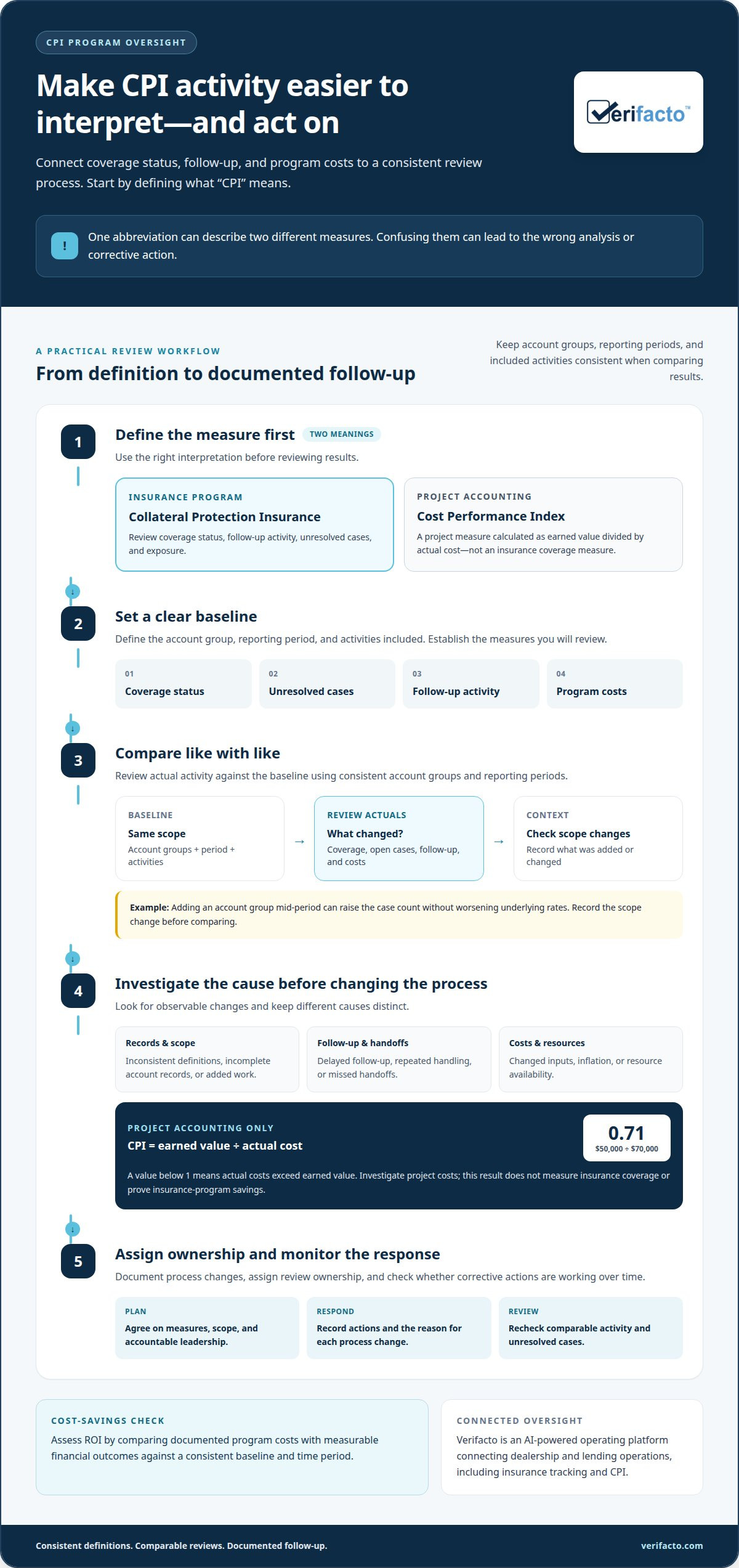
In auto finance, CPI usually means collateral protection insurance. Program results describe coverage status, follow-up, and exposure, not a dealership’s overall operating performance. CPI can also mean Cost Performance Index in project management. Mixing these definitions can lead executives to use the wrong measure or choose an unsuitable corrective action. Establish the meaning first, then interpret each result in its business context.
For an insurance program, review account coverage status alongside follow-up activity and unresolved cases. A report showing accounts with missing or changed coverage is more useful when managers can also see which cases need action. The answer to how to manage a CPI program effectively lies in connecting reported results with the work behind them. Compare consistent account groups over consistent reporting periods.
Cost Performance Index values use a separate calculation: earned value divided by actual cost. A value above 1 means delivered work exceeds its cost; 1 indicates parity; below 1 means actual costs exceed earned value. For example, $50,000 in earned value divided by $70,000 in actual costs produces a CPI of approximately 0.71. That project-management result does not measure insurance coverage or program ROI.
To measure insurance-program results, track defined operational measures such as coverage status, unresolved cases, follow-up activity, and program costs. Assess ROI by comparing documented program costs with measurable financial outcomes against a consistent baseline and time period. Cost savings should reflect that same comparison. Do not treat a project performance index as proof that an insurance program is saving money.
Scope control matters because results can change when account definitions, reporting periods, or included activities change. For example, adding an account group mid-period can raise the case count without worsening underlying rates. Record scope changes and compare like with like before adjusting processes or targets. This helps executives distinguish a genuine trend from a reporting change.
Common risks include inconsistent definitions, incomplete account records, delayed follow-up, and interpreting a result without context. Prevent these mistakes by setting clear measures, assigning review ownership, and investigating unusual changes before taking corrective action. A CPI below 1 in project accounting, for instance, calls for cost investigation, not an automatic change to insurance-program procedures.
Governance helps sustain a program: assign accountable leadership, establish controls, and plan funding for ongoing work. According to Universidade Federal Fluminense (UFF), effective cooperation requires good planning, leadership to organize and mediate the structure, controls, and a funding structure. For dealership leaders deciding how to manage a CPI program effectively, regular reviews and documented process changes help keep results comparable over time.
How Disconnected Systems Create Operational and Financial Risk
Separate records can hide how insurance follow-up, staffing, and process changes affect dealership operations. Project cost metrics offer another perspective, but they cannot replace account-level CPI oversight.
Managing Resources and Scope
Resource and scope management means matching assigned work and capacity to agreed objectives, then tracking changes against the plan. For dealership teams, this helps distinguish a workload increase from weaker execution. In project accounting, a cost performance index below 1 signals actual cost above earned value. Treat it as a prompt to investigate, not as a direct measure of insurance coverage or program effectiveness.
Scope changes can disrupt that investigation. If a contracted fence is 30 linear meters but gets built 10 meters longer, the extra work affects actual cost and changes the comparison with the original plan. In a dealership CPI operation, a similar mismatch can arise when teams add accounts or follow-up tasks without updating the reporting scope. Record the change, its owner, and its effect before comparing values.
Unforeseen events, inflation, or changes in resource availability can also make an earlier estimate less accurate. A supplier price change may increase actual costs, while staff reassignment may delay account follow-up. Keep these causes distinct in reports: a cost increase caused by changed inputs calls for a different response than repeated rework or missed handoffs. Update estimates when assumptions change, and document why.
Selecting and Prioritizing Processes
Process prioritization means directing improvement efforts toward work with clear operational or financial consequences. Start with steps where delays, repeated handling, or incomplete records affect account resolution. Compare processes using consistent measures, then identify the bottleneck before assigning resources. This keeps stakeholders focused on observable causes rather than a single CPI value that may reflect changed scope, inflation, or resource allocation.
Lean, Six Sigma, and Kaizen offer different improvement approaches: Lean targets wasted steps, Six Sigma focuses on reducing variation, and Kaizen emphasizes ongoing incremental changes. Choose based on the problem and available evidence; no method automatically fits every dealership process. Project managers, process owners, and frontline staff need clear responsibilities, shared measures, and practical training for the revised workflow.
Choosing Methods and Launching Improvements
Launching an improvement means setting an agreed baseline, defining ownership, and reviewing results after the change. Before altering a process, align stakeholders on its scope, expected work, resource needs, and measures. This matters because a revised workflow can appear to worsen performance simply by including tasks that were previously omitted. Keep the estimate and reporting definitions aligned with the work being assessed.
Employee engagement improves when affected teams understand the reason for a change and can identify practical obstacles. For example, invite staff who handle insurance follow-up to map handoffs and flag duplicate entry before revising the workflow. A project manager can coordinate training and review adoption, while process owners monitor results. If cost performance remains below plan, investigate the cause and adjust scope or resources deliberately.
Technology for Tracking CPI Program Performance
Disconnected records make it difficult to see whether a CPI operation follows its intended process. Software can bring account status, follow-up activity, and reporting into a more visible workflow. For example, a manager reviewing an account can distinguish an outstanding insurance issue from completed follow-up instead of relying on separate notes or spreadsheets.
Start by defining what “expected performance” means for the insurance program. Choose operational measures such as account status, open cases, and follow-up completion, then compare them with actual results using consistent periods and definitions. A change in case volume, for example, may reflect a different account group rather than weaker execution. Clear tracking helps identify which explanation fits.
Keep insurance-program measures distinct from the project-management Cost Performance Index. That index is calculated as earned value divided by actual cost: a result below 1 indicates cost exceeds earned value, while 1 indicates parity. It measures project cost performance, not insurance coverage. A dashboard that labels both measures “CPI” without context can mislead a dealership review.
Useful tracking connects each reported value to its underlying activity. If a report shows unresolved cases, managers should be able to identify the accounts behind that figure and see what follow-up has occurred. This detail helps teams find bottlenecks, assign ownership, and decide whether a process adjustment is warranted. A summary number alone rarely explains the cause.
Technology can also make changes easier to interpret over time. Record when reporting scope changes, such as when a new account group is added, and compare results against the revised baseline. If a measure shifts afterward, the timeline helps show whether the difference signals a real operational trend or a change in calculation. Keep definitions and reporting periods visible alongside results.
Insurance tracking software can support this work by making insurance status more visible. Dealership teams can use that visibility alongside follow-up and reporting to understand where attention is needed. The value comes from connecting a status to its operational context, not from assuming that software alone resolves an account or guarantees a financial outcome.
For executives, the practical takeaway is to track a small, clearly defined set of measures and investigate exceptions. Review activity against expected process outcomes, preserve the context behind each change, and use the findings to guide decisions. This makes software a management tool: it surfaces patterns and supports informed action on CPI program performance.
A Practical Workflow for Managing a CPI Program
For dealership leaders deciding how to manage a CPI program effectively, make the workflow follow each account from initial review through resolution. This sequence helps staff understand what to do when insurance information is incomplete, changes, or needs further attention.
Begin by tracing a representative account through the dealership’s current process. Note where insurance information arrives, how staff associate it with the account, and what happens when the record needs attention. This walkthrough reveals practical decision points, such as whether a case can proceed or needs review by a designated owner.
- Define the entry point. Decide what event starts a CPI review in the dealership’s process. For example, an account entering servicing may prompt a review of its insurance information. State what information the team uses to recognize the case and where staff record that it has entered the workflow.
- Make the next action explicit. For each status the team may encounter, describe the action that follows. If information is incomplete, staff should know whether to seek an update, hold the case for review, or route it to an accountable person. Clear transitions reduce uncertainty between handoffs.
- Separate routine cases from exceptions. A straightforward record and a conflicting record shouldn’t move through identical decision paths. Define which conditions require closer review and who has authority to resolve them. This gives staff a practical route for unusual cases without delaying routine handling.
- Test the workflow with realistic cases. Before applying a revised process broadly, walk through examples such as an account with updated insurance information, an unresolved record, and a case requiring escalation. Ask the people who handle each handoff to identify unclear instructions or duplicate steps. Adjust the process map based on those observations.
- Prepare staff for the change. Explain the new workflow using the same case examples used during testing. Show how responsibilities pass between roles and what information should accompany a handoff. Give employees a way to raise process questions so managers can address confusion early, before it becomes a repeated exception.
- Use reviews to refine the process. During operational reviews, examine examples of cases that stalled, changed direction, or required escalation. Identify where the workflow itself contributed to the delay, then revise the relevant instruction or handoff. Record what changed so teams apply the same process after the adjustment.
This sequence turns how to manage a CPI program effectively into a repeatable operating practice, not just a written policy. Starting with real account paths and refining handoffs helps dealership leaders clarify the workflow as day-to-day cases reveal where it needs adjustment.
How Verifacto Supports CPI Program Management
Disconnected dealership and loan systems can make it difficult to manage insurance tracking and CPI alongside the rest of the operation. Verifacto is an AI-powered operating platform that connects customer and loan lifecycle activity, including DMS, LMS, and insurance tracking. This gives dealerships and finance companies a connected environment for reviewing related work.
When records are disconnected, teams may have to piece together an account’s loan activity, insurance status, and follow-up. Verifacto’s connected operational data provides context for that review. Embedded AI, including the Analytics and Personal Assistant agents, can support teams in accessing and reviewing available operational information. CPI-related work remains subject to the dealership’s established process; the platform does not independently determine what action to take or promise real-time visibility or automated CPI management.
Connected operations do not promise a specific financial result. They provide a more organized basis for reviewing activity, identifying where information or follow-up needs attention, and deciding what action makes sense. When a coverage issue arises, teams can use their established workflow to assess the status, determine the next step, and keep the issue within the dealership’s management process. Human judgment remains central to decisions.
Verifacto’s DMS and LMS support distinct parts of dealership and loan operations within a broader AI-powered platform. For dealerships that handle both retail and finance activity, this context can help leaders consider CPI alongside the processes it affects, rather than treating it as an isolated task. Insurance tracking and CPI capabilities add relevant information to that operating picture, helping dealerships manage related responsibilities in one connected platform.
For executives, the practical question is whether the current setup provides enough visibility to manage insurance-related work and its associated operational risk. Verifacto brings relevant operational data into a connected context, while dealership leaders retain oversight of processes and decisions. The platform supports connected operations, not a replacement for staff judgment or a guarantee of reduced risk, savings, or a particular outcome.
Consider exploring Verifacto when separate systems make it difficult to maintain a clear view of dealership, loan, and insurance activity. A discussion can focus on how Verifacto’s DMS, LMS, insurance tracking, and CPI capabilities relate to the dealership’s operating needs. Contact Verifacto to discuss how the platform may fit your operation.
Frequently Asked Questions
Why is CPI important?
Collateral protection insurance matters because a lapse in a borrower’s insurance can leave financed collateral exposed to risk. For a dealership or lender, clear coverage records help staff identify accounts that need attention and keep follow-up visible. For example, if an insurance policy ends before an account is resolved, a timely status review can help the team determine the appropriate next step and document its handling.
How do you set measurable goals and KPIs for a CPI program?
Set goals around observable actions and outcomes, then define each measure consistently. A dealership might track the share of insurance records reviewed, unresolved coverage cases, or completed follow-ups. Assign an owner to each measure and choose a review cadence that suits the operation. For example, if the goal is to close information gaps, define what counts as a resolved case before comparing results across teams or periods.
What software and tools help manage a CPI program, and how much do they cost?
Insurance status tracking, account management, and follow-up tools can help coordinate CPI work; the right setup depends on the dealership’s workflow and required functions. Verifacto LMS is offered at no cost. Other product pricing depends on the selected setup. Verifacto’s CPI solution provides immediate coverage with no waiting period. Verifacto’s website and services are offered only to users 18 years or older residing in the United States or its territories or possessions.