
Did you know that a single oversight in your data security could now cost you up to $50,120 per violation, every single day? With the FTC Safeguards Rule in full effect and the CARS Act taking hold on October 1, 2026, the margin for error has effectively disappeared. For most owners, implementing robust compliance software for independent car dealers is the only way to stop the constant fear of a surprise audit or a massive fine. You likely already feel the pressure of manual paperwork errors and the rising 6.65% subprime delinquency rate, making it harder than ever to maintain a profitable portfolio.
We understand that managing your dealership is difficult enough without the added stress of shifting federal thresholds and complex disclosure requirements. This guide provides a strategic framework to help you master these regulations and protect your collateral from the ground up. You will learn how to transition from reactive troubleshooting to a proactive system that ensures total audit readiness. We will also break down how automated insurance verification and integrated CPI can turn your biggest financial risks into a streamlined, secure operation that protects your bottom line.
Key Takeaways
- Understand how the 2026 federal oversight trends and the FTC Safeguards Rule transform compliance from a static checklist into a real-time data requirement.
- Identify the essential features of high-impact compliance software for independent car dealers, specifically cloud-based security protocols and role-based access controls.
- Learn why real-time insurance tracking and integrated CPI solutions are critical for protecting your collateral portfolio from financial exposure.
- Discover a five-step framework for consolidating your DMS and LMS into a single, secure source of truth to eliminate manual paperwork errors.
- Explore how automated borrower communication and built-in payment processing simplify daily operations while maintaining a professional, audit-ready environment.
The Shifting Regulatory Landscape for Independent Dealers in 2026
Compliance is no longer a static manual sitting on a shelf. It has evolved into a dynamic risk-mitigation ecosystem that must live within your daily workflow. The regulatory landscape for car dealerships in 2026 demands a shift from reactive troubleshooting to proactive mastery. High-quality compliance software for independent car dealers acts as a digital shield, protecting your assets from evolving federal threats while ensuring your operations remain lean and efficient.
Federal oversight has reached a new peak. The FTC isn’t just issuing warnings; they’re enforcing rules with significant financial teeth. A single violation of the Safeguards Rule can now result in a fine of up to $50,120 per day. However, the cost of non-compliance stretches far beyond government penalties. It includes the risk of lawsuits, the loss of banking relationships, and a damaged reputation that can take years to rebuild. Achieving mastery over this complexity requires a move away from fragmented tools toward integrated automation.
The Evolving FTC Safeguards Rule
Current mandates for data encryption and multi-factor authentication are non-negotiable. If you’re still using manual spreadsheets to track customer data, you’ve created a major liability. These legacy methods lack the access controls required to prevent internal data breaches. Modern compliance software for independent car dealers solves this by logging every borrower interaction automatically. This creates a permanent, tamper-proof audit trail that proves your dealership follows every required protocol, from the initial credit application to the final account closure.
State-Level Variations and Federal Overlap
Independent dealers often struggle with the friction between state-specific rules and federal mandates. For instance, the California Consumer Auto Retail Sales (CARS) Act takes effect on October 1, 2026, introducing strict price disclosure requirements and limitations on add-on products. If you operate in multiple states, you need a platform that adapts to these localized nuances without manual intervention. Common F&I pitfalls, such as failing to file Form 8300 for cash transactions over $10,000 or missing “Buyer’s Guide” disclosures, are easily avoided when your software builds these requirements into the sales process. This level of automation ensures you stay protected, regardless of how the regulatory environment shifts.
Key Features of High-Impact Compliance Software
High-impact compliance software for independent car dealers is more than an HR tool; it’s the operational engine that secures your dealership’s future. While some platforms focus only on safety manuals, a truly modernized system handles the high-stakes data management required by the FTC’s Safeguards Rule. This includes automated data backups and cloud-based security protocols that ensure you meet the 30-day breach notification requirement if a security incident involving 500 or more customers occurs. These features transform compliance from a burden into a competitive advantage.
Security starts from within. Role-based access controls prevent unauthorized staff from viewing nonpublic personal information (NPI), effectively closing the door on internal data breaches. When every borrower interaction is logged in real-time, you create a bulletproof audit trail. This level of reporting gives you a birds-eye view of your portfolio’s compliance health, allowing you to spot risks before they become legal liabilities. Proactive monitoring ensures that your dealership remains stable and protected, even as regulations shift.
The Power of LMS and DMS Integration
Siloed tools are a recipe for data gaps. When your compliance data lives in a separate system from your loan data, you risk “compliance drift.” This happens when deal structures change but the associated disclosures don’t update accordingly. Integrating these functions into a single source of truth is vital. You can explore how these systems work together in our Ultimate Guide to Dealer Management Systems (DMS). By unifying your LMS and DMS, you ensure that every contract and disclosure remains accurate from the moment of sale through the final payment.
Automated Borrower Communication and TCPA
Manual text messages and phone calls are a legal minefield. The Telephone Consumer Protection Act (TCPA) and the Fair Debt Collection Practices Act (FDCPA) carry heavy penalties for non-compliant contact. Automated borrower communication systems eliminate this risk by managing consent and timing according to federal law. Instead of aggressive or unorganized outreach, these systems provide a partner-like reassurance to your customers. Professional, automated notifications keep borrowers informed and on track, reducing the friction that often leads to delinquency. To see how this looks in practice, you might consider how integrated communication tools can streamline your daily collections.
Insurance Tracking: The Often Overlooked Compliance Pillar
While many dealers focus heavily on data security to satisfy federal mandates, insurance tracking remains the most common “leaky bucket” in automotive finance. Uninsured collateral represents a dual threat: it’s a massive financial risk to your portfolio and a compliance vulnerability. When a borrower allows their policy to lapse, your asset is unprotected. If you lack a system to identify and remediate this immediately, you’re essentially flying blind. Integrating insurance tracking into your compliance software for independent car dealers transforms this process from a manual headache into a reliable guardian of your investments.
The stakes are higher than ever in 2026. With the national average cost for full coverage insurance reaching $2,932, many subprime borrowers are forced to make difficult choices between loan payments and insurance premiums. Research shows that approximately 1 in 7 motorists are driving without insurance. This makes real-time monitoring a necessity rather than a luxury. By automating this oversight, you ensure that every vehicle in your portfolio meets the insurance requirements established at the time of sale. This proactive stance protects your capital and keeps your operations aligned with the Used Car Rule and other consumer protection standards.
Moving Beyond Manual Verification
Manual insurance verification is a relic of the past that introduces unnecessary error rates. Relying on staff to make outbound calls to agents is inefficient and often produces outdated information by the time the call ends. Real-time tracking provides an immediate alert the moment a policy lapses or changes. This allows your team to act instantly rather than discovering a problem only after a total loss occurs. For a deeper look at how to manage these risks effectively, see our 2026 Lender’s Guide to CPI. Moving to an automated system ensures you never miss a lapse in coverage.
The Compliance of Lender-Placed Insurance
Placing Collateral Protection Insurance (CPI) requires a strict adherence to legal notification sequences. You can’t simply add insurance to a borrower’s account without proper warning. Modern compliance software for independent car dealers automates this entire communication chain. It sends the required notices at the correct intervals, documenting every step for your audit trail. This “no-nonsense” approach ensures that if you must protect the asset through CPI, you’ve done so with total transparency and legal accuracy. It’s about maintaining control over your portfolio while providing a professional, supportive experience for the borrower.
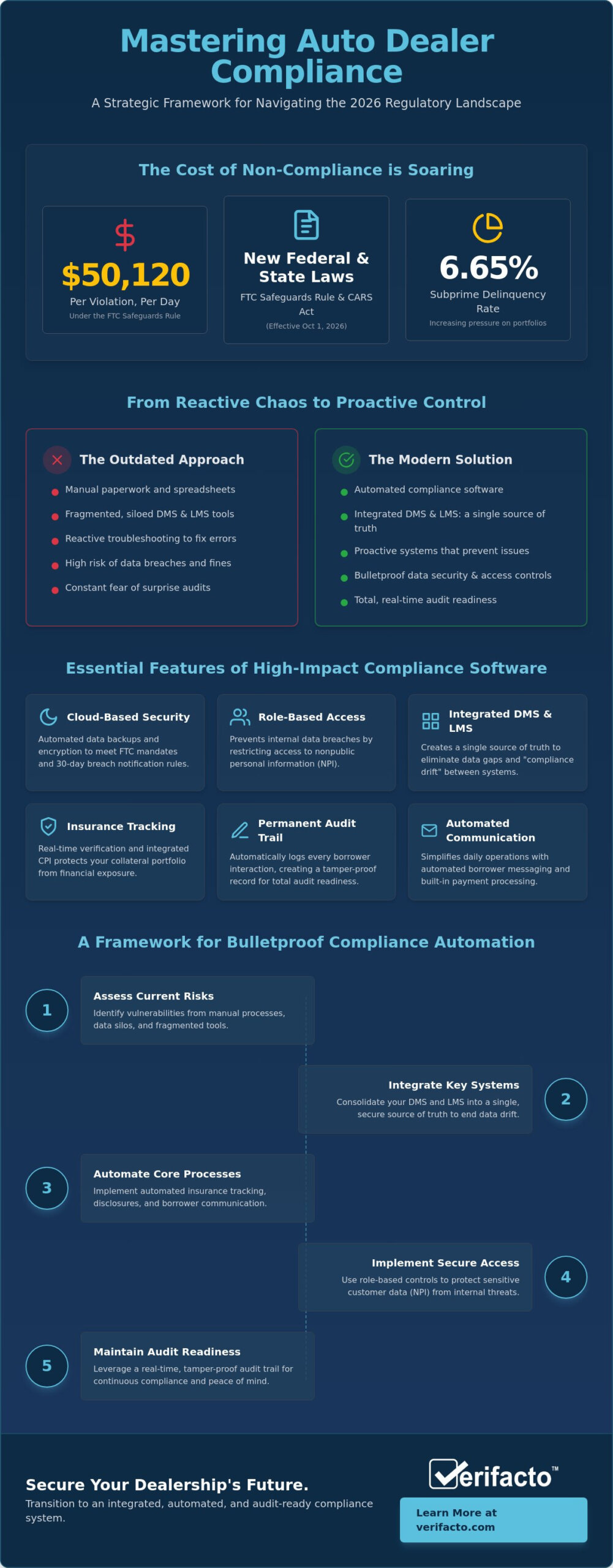
A 5-Step Framework for Implementing Compliance Automation
Transitioning to an automated system doesn’t have to be overwhelming. By following a structured framework, you can move from manual, error-prone logs to a streamlined operation that meets every federal requirement. This process ensures you’re prepared for the October 1, 2026, CARS Act deadline and the ongoing demands of the FTC Safeguards Rule. Implementing the right compliance software for independent car dealers is the foundation of this transformation.
- Step 1: Audit your current data storage and borrower communication methods. Identify where physical files or unsecured digital folders create risk. If your staff texts borrowers from personal phones, you’ve already found a major TCPA liability.
- Step 2: Consolidate your DMS and LMS into a single cloud-based source of truth. Choosing the right compliance software for independent car dealers ensures this consolidation happens without disrupting your current sales flow.
- Step 3: Enable real-time insurance tracking for all active loans. Stop relying on manual verification calls and shift to a system that alerts you the moment a policy lapses.
- Step 4: Automate your payment reminders and collection notifications. Professional, automated messages ensure you stay compliant with FDCPA guidelines while improving your collection rates.
- Step 5: Schedule monthly compliance reporting to identify portfolio leaks. Regular reviews allow you to spot trends in delinquency or insurance lapses before they impact your bottom line.
Consistency is the key to risk mitigation. When these five steps are integrated into your daily routine, you create a “no-nonsense” environment where compliance happens automatically. You can see how these steps function together by exploring Verifacto’s unified platform.
Evaluating Your Current Tech Stack
When evaluating your stack, determine if your current DMS is an anchor. An outdated system that lacks cloud-based encryption is a liability in 2026. If your software requires manual workarounds to meet the $50,120-per-violation Safeguards Rule standards, it’s time to upgrade. Use our Auto Finance Compliance Management Checklist to identify where your current setup falls short and where cloud security can provide the most immediate relief.
Training Your Team for Modern Compliance
Technology alone isn’t enough; your software is only as good as the people using it. Effective training transforms your staff from risk factors into reliable guardians. Transitioning from manual logs to automated systems requires a shift in mindset. Focus on creating a culture of security where every employee understands that following digital protocols isn’t just about checking a box. It’s about protecting the dealership’s assets and reputation through precision and reliable guardianship.
Verifacto: The Integrated Solution for Modern Dealers
Managing the shifting regulatory demands of 2026 requires more than just a digital filing cabinet. It demands a unified compliance engine that works as hard as you do. Verifacto provides a comprehensive LMS and DMS platform designed to serve as your dealership’s single source of truth. By integrating your management systems, you eliminate the data gaps that lead to compliance drift and legal exposure. This is the definitive compliance software for independent car dealers who prioritize stability and security in a high-stakes market.
Our platform handles the heavy lifting of federal mandates through a sophisticated problem-solution framework. We’ve built insurance tracking and CPI solutions directly into the workflow, ensuring your collateral remains protected without requiring constant manual oversight. This mastery over complexity extends to automated borrower communication. By using pre-configured, legally compliant notification sequences, you maintain professional, supportive contact with your customers while strictly adhering to TCPA and FDCPA standards. You don’t have to choose between operational speed and regulatory safety.
Real-Time Portfolio Protection
Manual verification is a bottleneck that your business can no longer afford. Verifacto replaces tedious phone calls and spreadsheets with real-time alerts and automated workflows. This shift protects your portfolio from the 1 in 7 motorists who drive without insurance. When you pair this with our integrated payment solutions, you create a seamless environment where compliance and cash flow support each other. You gain the peace of mind that comes from knowing every transaction and interaction is logged, encrypted, and audit-ready.
Efficiency and Profitability as the Goal
Compliance shouldn’t be a hurdle that slows your growth. Instead, think of it as a tool for optimization. A secure, automated dealership is a more profitable one because it spends less time on administrative errors and more time on strategic expansion. We invite you to partner with an innovator that understands the no-nonsense requirements of daily operations. Verifacto is the industry standard for cloud-based independent dealer risk management, providing the stability you need to lead your market with confidence. Reach out to our team today to see how our unified platform can transform your dealership into a model of modern efficiency.
Take Command of Your Portfolio Protection
We’ve explored how 2026 regulations like the CARS Act and the FTC Safeguards Rule have transformed compliance from a manual checklist into a real-time data requirement. You’ve seen that siloed tools and manual tracking create dangerous gaps, while integrated systems provide a single source of truth that protects your assets. By shifting to a proactive framework, you move beyond the fear of audits and into a position of total operational control.
Implementing high-impact compliance software for independent car dealers is about more than just avoiding daily fines. It’s about building a scalable, efficient business that thrives in a high-stakes environment. Verifacto serves as your reliable guardian, offering cloud-based LMS/DMS integration, real-time insurance tracking, and automated CPI solutions to secure your bottom line. You don’t have to navigate these complex requirements alone when you have a partner dedicated to your stability.
Streamline your compliance and protect your portfolio with Verifacto today. You have the tools to turn regulatory complexity into a strategic competitive advantage. Let’s move your dealership forward with the confidence and security you deserve.
Frequently Asked Questions
What is the most important compliance rule for independent car dealers in 2026?
The FTC Safeguards Rule remains the most critical regulation because it mandates how you protect nonpublic personal information (NPI). In 2026, the focus has shifted to strict encryption and multi-factor authentication. Additionally, the California Consumer Auto Retail Sales (CARS) Act introduces new price disclosure requirements that many dealers must follow starting October 1, 2026. Failing to meet these standards can lead to fines of up to $50,120 per violation.
Can compliance software help me pass an FTC Safeguards audit?
Yes, high-quality compliance software for independent car dealers creates the tamper-proof audit trail necessary to prove your dealership follows required protocols. The software automates the logging of borrower interactions and data access, which is exactly what regulators look for during an audit. Instead of scrambling to find paper files, you can present a digital history that demonstrates consistent adherence to security standards and encryption mandates.
How does integrated insurance tracking reduce my dealership risk?
Integrated insurance tracking reduces risk by providing real-time alerts the moment a borrower’s policy lapses or changes. With approximately 1 in 7 drivers on the road lacking insurance, waiting for manual verification is dangerous for your portfolio. Automation ensures that you can remediate lapses immediately, either through borrower contact or by placing Collateral Protection Insurance (CPI) according to the strict legal notification timelines required by federal law.
Is cloud-based dealer software safer than on-premise systems?
Cloud-based systems are generally safer because they utilize advanced encryption and security protocols that are difficult to maintain on-premise. Physical servers at a dealership are vulnerable to theft, fire, or unauthorized local access. Modern cloud platforms provide automatic security updates and role-based access controls. This ensures your customer data remains protected by the latest defensive technologies without requiring you to hire a full-time IT staff to manage hardware.
Does compliance software for independent dealers include collection tools?
Yes, comprehensive compliance software for independent car dealers often integrates collection tools to ensure every outreach follows TCPA and FDCPA guidelines. These tools automate payment reminders and notifications, removing the risk of manual errors during the collections process. By using professional, automated communication, you maintain a supportive relationship with borrowers while ensuring your staff never violates debt collection laws that could result in heavy legal exposure.
How much does it cost to implement a new compliance-focused DMS?
Implementation costs vary based on the specific features you select and the size of your vehicle portfolio. Most modern providers use a subscription-based model or a usage-based approach where fees scale alongside your operations. While it’s important to find a solution that fits your budget, you should weigh the software cost against the $50,120-per-day fines associated with non-compliance. Investing in a robust system is a proactive measure that protects your long-term profitability.
Will compliance software automate my borrower notifications?
Automation is a core feature of modern compliance platforms. The software can handle everything from payment reminders to the specific legal notices required before placing CPI. This ensures that every borrower receives the correct information at the right time, documented in your system for audit purposes. Automation removes the burden of manual tracking from your team, allowing them to focus on sales and higher-level operations while the system maintains your legal standards.
What is the difference between a DMS and a compliance platform?
A standard Dealership Management System (DMS) typically focuses on inventory management and the initial sales transaction. In contrast, a compliance-focused platform or an integrated LMS and DMS ecosystem prioritizes ongoing risk mitigation and data security. While a DMS records the deal, a compliance platform ensures that every disclosure, insurance policy, and borrower interaction meets federal and state standards throughout the entire life of the loan, not just at the point of sale.