
What if the biggest automation gap at your dealership isn’t a missing feature, but the handoff between systems? A lead may enter your CRM, move through a sale and underwriting, then become a loan account with payments, insurance updates, and collections to manage. When each stage relies on separate tools or manual coordination, it becomes harder to follow the customer and loan lifecycle. Workflow automation for used car dealers should connect those steps, not add another disconnected system.
Dealership teams know that follow-ups and servicing tasks need consistent attention. The challenge is keeping work, operational data, and human decisions aligned as a customer moves from first inquiry through loan servicing. Missed handoffs can create operational friction and financial risk, even when staff are working hard to keep processes moving.
This guide explains how to compare automation platforms using practical workflow and integration criteria, and how automation can support staff without replacing their judgment. You’ll see how connected DMS, LMS, and CRM workflows can improve visibility across lead follow-up, sales, payments, collections, and insurance tracking. Verifacto’s AI-powered operating platform brings dealership and lending workflows together, with AI agents designed to support routine tasks and informed decisions.
Key Takeaways
- Map where leads, deal details, and payment tasks pass between people and systems to identify gaps in continuity.
- Assess workflow automation by coverage, connected data, human oversight, integrations, and reporting, not by feature count alone.
- Trace a customer’s journey from inquiry through loan servicing to see whether staff can follow activity across sales and servicing records.
- Start your software evaluation with one recurring cross-team workflow. Document its triggers, owners, handoffs, decisions, and next actions.
- Consider how connected DMS, LMS, CRM, inventory, payments, insurance tracking, and analytics could improve operational visibility while keeping staff involved in decisions.
Why used car dealer workflows break down across disconnected systems
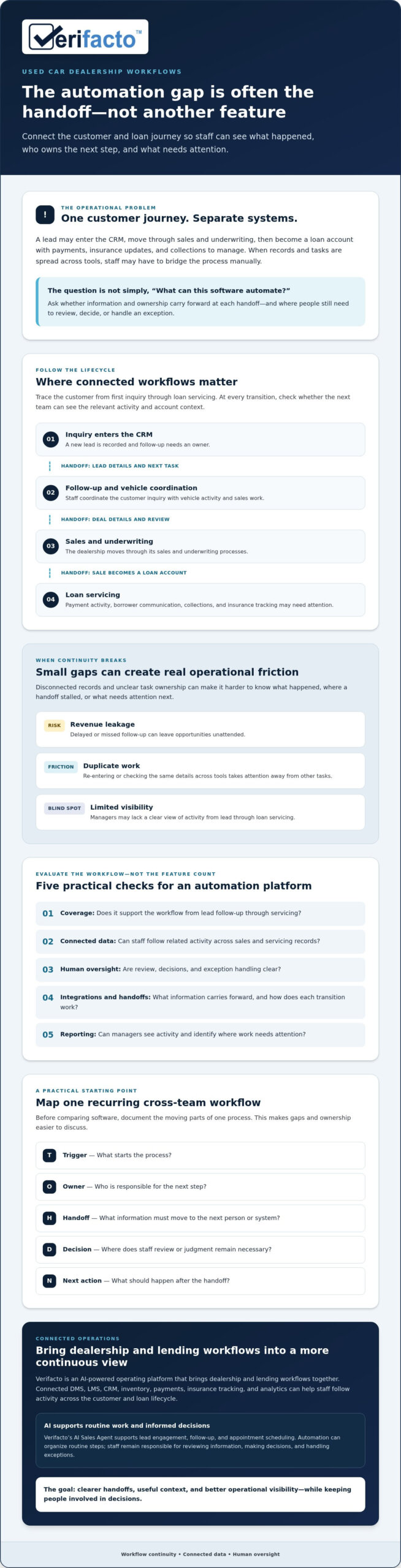
Where do leads, deal details, and payment tasks lose continuity in your dealership? A new inquiry may be recorded in a CRM, vehicle details tracked elsewhere, and loan or payment activity managed in separate tools. When staff must bridge those systems manually, it can be difficult to see what has happened, who owns the next step, or whether the customer record reflects the latest activity.
A workflow is the sequence of steps, responsibilities, and information needed to complete a process. In practical terms, workflow automation uses software to support that sequence through task routing, reminders, information flow, and repeatable processes. The goal isn’t to automate every decision. It’s to clarify the next action and give accountable staff useful context.
What does workflow automation mean at a used car dealership?
When a new lead comes in, for example, software might route it to the appropriate person and create a follow-up task—or, as seen with AI lead desk tools from Memphis Web Solutions, capture initial customer inquiries around the clock. That’s task automation. A broader operating platform connects activity across dealership and lending workflows, helping staff follow a record beyond the first interaction. Assess workflow automation for used car dealers by how well it supports this continuity, not just by the number of tasks it can trigger.
Automation can organize routine steps, but people remain responsible for reviewing information, making decisions, and handling exceptions. The right balance depends on the process and how the dealership configures it.
Where do disconnected dealership workflows create operational risk?
When CRM, inventory, deal, loan, and payment records sit in separate systems, a status check can require staff to search several places or reconcile information manually. A lead may appear active in one tool while a related task or sale update hasn’t carried into another. During servicing, payment activity and insurance information may also be harder to view alongside the borrower’s loan record.
- Revenue leakage: Delayed or missed follow-up can leave opportunities unattended.
- Duplicate work: Re-entering or checking the same details across tools takes attention away from other tasks.
- Limited visibility: Managers may lack a clear view of activity from lead through loan servicing.
Connected DMS and LMS workflows can bring dealership and lending activity into a more continuous view. That gives staff better context for the next action while keeping decisions in human hands.
Which dealership workflows can automation connect from lead to loan servicing?
Think of the customer lifecycle as a connected sequence, not a set of isolated tasks. A shopper makes an inquiry, staff follow up and coordinate a vehicle, and the dealership moves through its sales and underwriting processes. The account may then require payment processing, borrower communication, collections, and insurance tracking. A platform can help keep related records in view across these stages, but that doesn’t mean every step is automated or every decision is made by software.
When assessing workflow automation for used car dealers, check what information carries forward, which actions software supports, and where staff review or approval remains necessary. For example, a lead record can provide context for follow-up, while a connected loan record can help staff reference servicing activity after a sale. Ask a vendor to show how each handoff works and what its platform actually automates.
How can automation support lead management and vehicle sales?
Verifacto’s AI Sales Agent supports lead engagement, follow-up, and appointment scheduling. CRM and inventory context can help staff coordinate a customer inquiry with vehicle activity, while people remain responsible for conversations, evaluating the opportunity, and moving the deal forward. Review the AI Sales Agent capabilities to understand the scope of this support.
As the process moves toward a sale, underwriting and deal decisions should remain subject to the dealership’s established review. A connected operating platform is intended to make relevant information easier to follow, not to imply that every sales or lending step runs without staff involvement.
How do payment, collections, and insurance workflows fit together?
After a sale, payment processing and borrower communication become part of ongoing account servicing. Verifacto includes built-in payment processing and automated borrower communication. Connected LMS activity can help staff see servicing information alongside the loan record, while collections remains a workflow that requires appropriate staff oversight. For additional context, see these FTC Used Car Rule resources and consult qualified guidance for questions about specific obligations.
Insurance tracking and CPI solutions can support monitoring coverage-related activity. Before relying on automation for a particular process, confirm how records, alerts, and follow-up responsibilities are configured. Payment activity is another important part of the lifecycle to assess. See these integrated payment workflows and collection efficiency strategies for further context.
Verifacto brings dealership and lending workflows together through an AI-powered operating platform with DMS, LMS, CRM, inventory, payments, borrower communication, insurance tracking, reporting, analytics, and AI capabilities. Consider how these connected capabilities could fit your operation as you evaluate platforms.
How to compare workflow automation software for used car dealers
Compare how a platform handles an actual dealership process, not just its feature count or AI label. Trace one record from customer inquiry through vehicle selection, deal activity, payment, and loan servicing. Ask vendors to show what information carries forward, what requires another system, and where a staff member must review or act.
| Evaluation area | Questions to ask |
|---|---|
| Workflow coverage | Does the platform support the stages your dealership needs, from lead management and inventory through DMS, LMS, payments, communications, and servicing? |
| Data continuity | Which customer, vehicle, deal, and loan records are shared across modules? Where must staff re-enter or reconcile information? |
| Oversight | Which tasks run automatically, and where can staff review, approve, correct, or handle exceptions? |
| Integrations | Which connections are available for your current systems, including accounting tools? Confirm the exact scope and any dependencies on separate systems. |
| Reporting and access | What dashboards and reports are available? Ask how dealership data can be accessed and exported, and what documentation is available for actions and changes. |
Does the platform connect dealership and lending workflows?
Look for continuity across customer, inventory, deal and underwriting activity, payments, and loan management. A product may list a CRM, DMS, or LMS without connecting the records staff need to follow a transaction across those functions. Ask the vendor to demonstrate a realistic workflow and identify which steps happen in its platform, which depend on integrations, and which remain manual. Clear, usable handoffs matter more than feature counts.
Can managers maintain control over automation and dealership data?
Ask how rules are configured, who can change them, and what happens when information is incomplete or a process needs an exception. Confirm whether the provider offers dashboards, reporting, action histories, and data export rather than assuming these controls are included. Request documented answers about data portability, integration scope, and reliance on other vendors. Those details give managers a practical basis for assessing visibility and vendor dependence.
Evaluate AI by the specific work it supports. Ask for examples of the tasks an agent can perform, the information it uses, and where staff oversight applies. A clear demonstration of lead follow-up or reporting support is more useful than a broad AI claim. Compare platforms against your dealership’s documented workflow, then verify each capability before making a selection.
How to map a used car dealership workflow before choosing software
Don’t start with a full operational overhaul. Choose one recurring process that crosses teams or systems, such as moving a new lead from first contact through vehicle selection and payment activity. Map how the process works today before deciding which steps software should support. This gives your team a concrete basis for evaluating workflow automation for used car dealers.
What should a practical lead-to-payment workflow map include?
Follow one customer journey and record the trigger, owner, information used, decision, handoff, and next action at each stage. For example, a lead arrives, a staff member follows up, inventory details inform the conversation, and the deal progresses through the dealership’s established review. After a sale, payment activity becomes part of servicing. Keep staff decisions and customer communication visible in the map instead of assuming software can handle them independently.
- Lead capture: Where is the inquiry recorded, and who takes responsibility for the next action?
- Follow-up and inventory: What customer and vehicle information does staff need, and where is it stored? For example, consider whether factory vehicle data from VinSignal connects directly to inventory records or requires manual lookups.
- Deal progression: Which decisions or reviews must happen before the process advances?
- Payment activity: How does relevant deal information connect to the payment and servicing record?
- Exceptions: What happens when details are missing, a customer needs additional help, or the process pauses?
For each step, note the system currently used and whether a proposed platform capability is confirmed, requires an integration, or still involves manual work. This distinction helps prevent a buying decision based on assumed functionality.
How should a dealership evaluate rollout readiness?
Assign an owner for the process and ask the people involved to validate the map. Note duplicated entry, unclear responsibility, delayed follow-up, and points where managers lack status visibility. Set baseline measures that match the workflow, such as time between lead receipt and follow-up, incomplete handoffs, or unresolved payment tasks. Use these measures to assess the process over time, not as a promise of a particular result.
Before configuration, confirm data sources, user responsibilities, available integrations, training needs, and where human review applies. Start with a limited workflow test. Track exceptions and staff feedback, then adjust the process before considering broader use. Automation works best when the dealership understands what it is asking the system to support.
Use your workflow map to assess whether a connected DMS, LMS, CRM, and payment process fits your operation. Explore how Verifacto can support connected dealership workflows.
Connect used car dealer automation with one operating platform
Dealerships operate one business but may have to manage it through disconnected systems. Verifacto brings operations, data, and AI together in one cloud-hosted platform. It is designed to connect dealership and lending activity, helping teams follow work across the customer and loan lifecycle rather than relying only on separate tools.
How does Verifacto bring dealership operations and lending together?
Verifacto combines DMS and LMS capabilities with dealership CRM, inventory, payment processing, borrower communication, insurance tracking, CPI solutions, reporting, analytics, and AI agents. These capabilities give dealerships a framework for assessing how operational information may carry from customer management into sales and ongoing loan servicing. Confirm the specific records, workflows, and integrations relevant to your business rather than assuming every outside system is supported.
Consider a practical example: a lead receives follow-up supported by the AI Sales Agent, staff progress the deal using relevant customer and inventory context, and payment activity becomes part of the loan-servicing picture. Dealership staff continue to make and review decisions. The platform can help connect the information they need along the way.
AI is most useful when tied to defined work and connected operational data. Verifacto’s AI Sales Agent supports lead engagement, follow-up, and appointment scheduling. Its AI-powered analytics can provide dashboards, predictive insights, custom reporting, and performance analytics. These tools support staff activity and decision-making, not universal autonomous execution. Review Verifacto AI capabilities and confirm which functions fit your intended workflow.
What should dealers confirm in a workflow automation demonstration?
Ask to see a process that matters to your operation, from customer management and deal activity through payment and servicing. Use the demonstration to clarify:
- Connected information: Which customer, vehicle, deal, and loan details are visible across the relevant workflows?
- Human review: Which tasks can automation support, and where do staff review, decide, or handle exceptions?
- Reporting: What dashboards or reports can help managers monitor the process?
- Configuration: Which steps need setup, and which depend on integrations or separate systems?
These answers help you judge whether the platform matches your process, not just its feature list. For workflow automation for used car dealers, the practical test is whether connected tools improve operational visibility while preserving staff oversight.
Book a platform demonstration to explore how Verifacto’s connected DMS, LMS, payment, communication, insurance tracking, and AI capabilities may fit your dealership.
Choose automation that keeps your dealership connected
Effective workflow automation for used car dealers is about continuity, not a longer feature list. Map a recurring process, compare how platforms connect information from customer management through servicing, and confirm where staff review and decision-making remain essential.
Verifacto is a cloud-hosted, AI-powered operating platform that connects DMS and LMS capabilities with dealership and lending workflows. Its AI Sales Agent supports lead engagement, follow-up, and appointment scheduling. Verifacto also offers QuickBooks accounting integration. Confirm the integration’s scope and fit during your evaluation.
Use a demonstration to walk through a workflow that matters to your dealership. Ask how records connect, which steps require configuration, what reporting is available, and where human oversight applies. That practical review can help you assess whether the platform fits your operation without assuming every task is automated.
Book a demonstration to explore how the platform fits your dealership workflows. A clearer view of your processes is a strong place to begin building connected operations.
Frequently Asked Questions
What is workflow automation for used car dealers?
Workflow automation for used car dealers uses software to support repeatable tasks, information handoffs, and follow-up across dealership operations. For example, a new inquiry could be routed for staff follow-up, with the next action made visible in the dealership CRM. Automation can also connect dealership and loan activity through DMS and LMS workflows. Staff remain accountable for reviewing information, making decisions, and handling exceptions.
Which dealership workflows should a used car dealer automate first?
Start with a recurring workflow that crosses people or systems and has clear steps, such as lead follow-up or the handoff from a completed sale into payment servicing. Map its trigger, owner, information, decision points, and next action. Then identify duplicated entry or unclear status checks. This gives you a practical place to evaluate automation without trying to change every dealership process at once.
Can workflow automation connect sales and auto loan servicing?
Yes. A platform with connected dealership and lending capabilities can help staff follow activity from customer management and deal progression into loan servicing. Verifacto provides cloud-hosted DMS and LMS capabilities alongside CRM, inventory, payment processing, borrower communication, and insurance tracking. Available records and handoffs depend on platform capabilities and configuration, so ask a provider to demonstrate the workflow your dealership needs.
How does AI help automate used car dealership workflows?
AI can support defined tasks and help staff work with connected operational information. Its AI Analytics Agent provides dashboards, predictive insights, custom reporting, and performance analytics. These capabilities are designed to assist dealership workflows and decision-making, not replace accountable employees or independently handle every process. Confirm task scope and staff review points during evaluation.
What should I compare in dealership workflow automation software?
Compare workflow coverage, data continuity, human oversight, integrations, reporting, and data access. Ask whether CRM, inventory, DMS, LMS, payments, borrower communication, and servicing records connect, or require separate systems and manual entry. For BHPH software or auto finance software, clarify which tasks run automatically, where staff review is needed, what reports are available, and which accounting integrations are supported.
Can workflow automation help reduce missed follow-ups?
Depending on the platform and configuration, it can make follow-up tasks and ownership more visible by routing work, supporting reminders, or organizing lead activity. For example, a lead engagement workflow may help staff see that an inquiry needs attention and identify the next step. Automation can support consistency, but it can’t guarantee that every follow-up happens or replace staff oversight of customer communication.
Does workflow automation replace dealership employees?
No. Treat workflow automation as support for staff, not a substitute for accountable people. Software can assist with repetitive steps, organize information, and surface activity for review. Employees still bring judgment to customer conversations, deal decisions, exceptions, and servicing matters. Before adopting a workflow, define who owns each step, what the system handles, and when a person must review or make a decision.
Book a demonstration to explore how Verifacto fits your dealership workflows.