
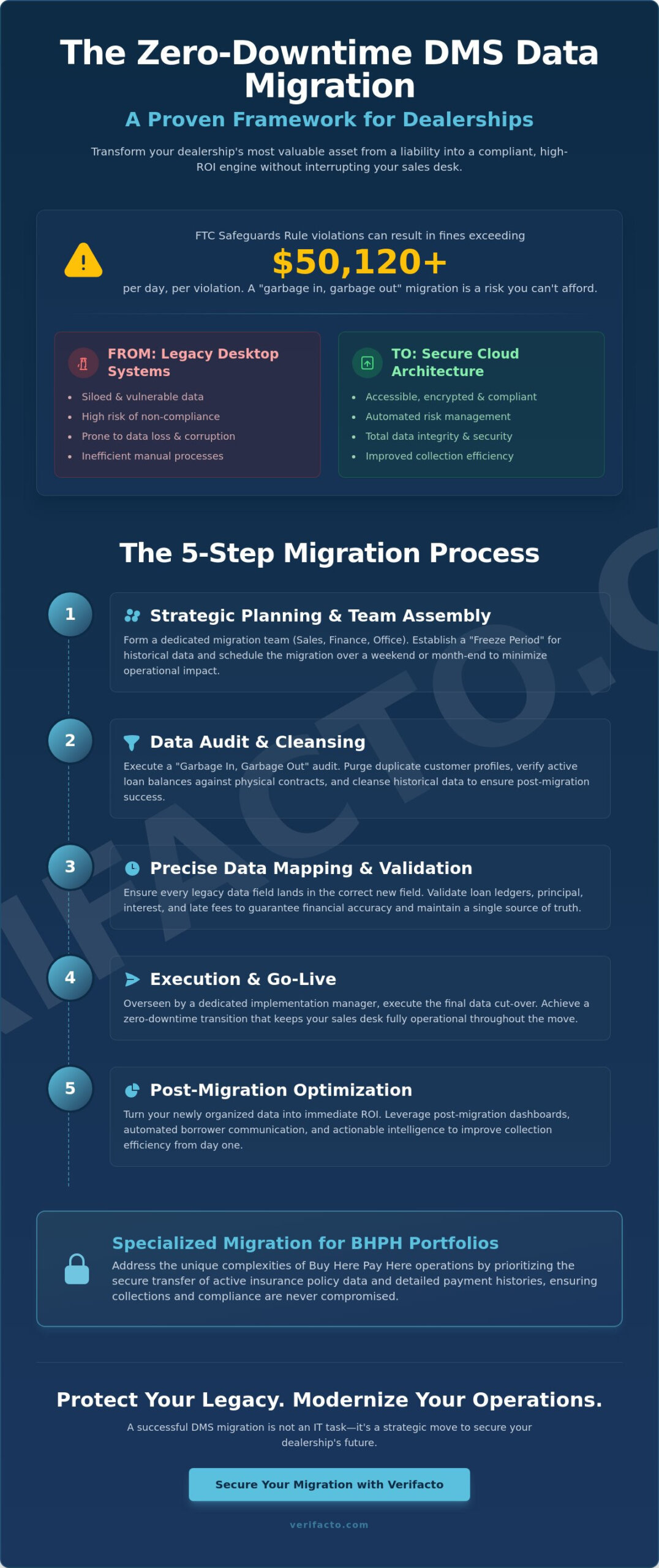
If your DMS migration feels like a high-stakes gamble with your dealership’s most valuable asset, you’re right to be cautious. Your portfolio data is the lifeblood of your operation. Many dealers treat moving it as a simple IT task rather than a strategic audit. With FTC Safeguards Rule violations now reaching over $50,120 per day, you can’t afford a “garbage in, garbage out” scenario. Mastering dms data migration best practices is no longer just about organization; it’s about transforming stale records into a proactive risk management engine while keeping your sales desk running at full speed.
We understand the anxiety of potentially losing integrated insurance tracking history or seeing collections stall during a transition. You’ve worked hard to build your business, and your software should protect that legacy, not complicate it. This guide provides a proven framework to transition to a cloud-based DMS with zero downtime and total data integrity. We’ll show you how to automate the migration of active loan balances and insurance records, ensuring your new database is clean, compliant, and ready to deliver immediate ROI through improved collection efficiency.
Key Takeaways
- Shift from legacy desktop hosting to a secure cloud architecture to meet modern security standards and protect your dealership’s portfolio.
- Implement dms data migration best practices through precise field mapping and validation testing to ensure your customer records and loan ledgers remain accurate.
- Address the unique complexities of BHPH portfolios by prioritizing the secure transfer of active insurance policy data and payment histories.
- Execute a structured five-step migration process to achieve a zero-downtime transition that keeps your sales desk operational throughout the move.
- Leverage post-migration dashboards and automated borrower communication to turn your newly organized data into immediate collection efficiency and ROI.
Strategic Planning: Setting the Stage for a Seamless DMS Transition
Strategic planning isn’t just a technical checkbox. It’s the foundation of your dealership’s digital future. At its core, data migration is the process of securely transferring your entire operational history, including dealership records, complex loan ledgers, and customer data, to a modern platform. In 2026, the shift from legacy desktop hosting to a secure cloud architecture is a survival requirement. Desktop systems are often siloed and vulnerable. Moving to a cloud based environment like Verifacto DMS ensures your data remains accessible, encrypted, and compliant with the latest security standards.
You need a dedicated “Migration Team” to lead this charge. This isn’t just an IT project. It requires active participation from your sales, finance, and office managers. Sales teams ensure customer contact accuracy. Finance managers verify the integrity of loan balances. Office managers oversee the reconciliation of physical paperwork against digital records. Everyone has a stake in the outcome. To keep the process orderly, you must establish a “Freeze Period.” This is a specific window where you stop making changes to historical data while it’s being ported. Managing new deals during this time requires a clear protocol to ensure nothing falls through the cracks during the final cut over.
The ‘Garbage In, Garbage Out’ Audit
The success of your transition depends on the quality of the information you move. Use this time to identify and purge duplicate customer profiles that have cluttered your system for years. It’s also vital to verify active loan balances against your physical contracts. Discrepancies here can lead to collection nightmares later. Data cleansing is the primary factor in post-migration success. If you don’t clean your database now, you’ll simply move your old problems into a faster, more expensive environment. Adhering to these dms data migration best practices prevents operational friction on day one.
Setting Your Migration Timeline
Timing is everything when it comes to cash flow. Migrating over a weekend or during a month-end close is a strategic necessity. This minimizes the impact on your daily operations and ensures your books are clean for the new period. You should expect a brief window of downtime during the final data cut-over phase, but a well-planned schedule keeps this to a minimum. A dedicated implementation manager is essential here. They act as your primary point of contact, keeping the timeline on track and ensuring all dms data migration best practices are followed. Their role is to anticipate hurdles before they stop your sales desk, providing the professional authority needed to navigate the move safely.
Data Mapping and Integrity: Ensuring Precision Across Systems
Precision is the difference between a seamless transition and a portfolio nightmare. While some generic tech providers claim automated tools handle 100% of the mapping, seasoned dealers know that auto-specific forms and state-level compliance requirements demand a human touch. Field mapping is the granular process of ensuring your legacy data lands exactly where it belongs. If your old system labeled a field as ‘Buyer Name’ but your new one uses ‘Primary Account Holder,’ a mismatch can break your search functions or title applications. Adhering to dms data migration best practices means validating every field before the final transfer occurs.
Unstructured data presents a unique hurdle for modern dealerships. Scanned PDFs, handwritten deal notes, and digital deal jackets don’t always fit neatly into database rows. You must decide which documents move to the cloud and which stay in your archive. Maintaining a single source of truth across your sales and collections departments prevents conflicting data from stalling your operations. Understanding what is dms functionality in a modern context is essential. It allows you to map workflows that reflect how your dealership actually functions, rather than forcing your team to adapt to rigid software limitations. If you’re evaluating your platform options before committing to a migration, reviewing a detailed DealerCenter vs Verifacto comparison for auto finance professionals can help you understand the architectural differences that will affect your data strategy long after the move is complete.
Mapping the Loan Ledger
Financial accuracy is non-negotiable. Your new system must perfectly replicate principal, interest, and late fee breakdowns to avoid legal disputes. If your amortization schedules shift even by a few cents during the move, your entire portfolio’s valuation could be called into question. Don’t overlook historical payment notes. These records provide the context your collectors need to manage difficult accounts. When you modernize your LMS and DMS, preserving this history ensures you don’t lose the momentum you’ve built with your borrowers.
Compliance and Document Retention
Software transitions are a prime time for state audits. You must ensure that e-signatures and digital deal jackets remain legally binding after they’re moved. Cloud-based systems offer superior document security compared to localized servers, which are prone to hardware failure and unauthorized physical access. Utilizing dms data migration best practices for document retention protects you against future litigation. It ensures that every record, from the initial credit app to the final lien release, is encrypted and easily retrievable during an inspection. Staying ahead of evolving regulations requires a comprehensive approach to auto finance compliance management that goes beyond the migration itself and addresses the full regulatory landscape your dealership faces in 2026.
The 5-Step Migration Process: From Legacy to Cloud
Moving your dealership’s data doesn’t have to be a blind leap. A structured roadmap turns a potentially chaotic event into a controlled transition. While some generic cloud providers suggest migration is a simple three-step sync, a truly successful move requires a more comprehensive strategy to protect your sales floor and collections department. Following a proven sequence ensures that your data remains accurate and your team stays productive.
Step 1: Data Extraction. Pull clean files from your legacy desktop environment. This is your chance to leave legacy clutter behind and start fresh in a modern environment. Step 2: Validation Testing. Run a small subset of data through the new system first. This is one of the most critical dms data migration best practices because it allows you to catch mapping errors before they impact your entire portfolio. Step 3: Staff Training. Your team needs to master the new UI before the switch. Whether they’re using Verifacto DMS for sales or our integrated LMS for collections, hands-on experience builds confidence. Step 4: The Final Cut-Over. This is the point of no return. The old system is locked, and the new cloud environment goes live for all users. Step 5: Post-Migration Audit. Reconcile every active loan and vehicle in inventory. Verify that your balances and insurance records match your legacy records exactly to ensure total data integrity.
Running Parallel Systems: The Safety Net
Running parallel systems acts as a vital safety net during the initial transition. It allows you to operate your old and new DMS simultaneously for a short window, typically three to five days. While this requires temporary double entry for your office staff, it provides an absolute backup if a reconciliation error occurs. You’ll know it’s time to decommission your old hardware once you’ve successfully reconciled several consecutive days of transactions without a single discrepancy. This overlap period eliminates the fear of a “failed” migration and keeps your sales desk moving.
Staff Buy-In and Change Management
Resistance is common when you change the tools your team uses every day. Long-term employees often prefer the “way we’ve always done it,” even if the old way is slow and prone to errors. You can overcome this by identifying “Super Users” in each department. These individuals act as local experts who can troubleshoot minor issues and demonstrate the new system’s speed. Once your sales team sees how quickly they can push a deal through a cloud-based Verifacto DMS compared to their old desktop software, their skepticism usually vanishes. Focus on the immediate benefits: faster credit decisions, built-in payment processing, and automated borrower communication.
Specialized Migration for BHPH: Loan Data and Insurance
BHPH dealers face a unique set of challenges that standard retail dealerships never encounter. While a typical migration focuses on inventory and basic customer contact info, a BHPH transition requires moving an entire financial institution’s worth of data. This includes complex loan ledgers, payment histories, and real-time insurance status. Migrating a BHPH portfolio is significantly more complex because every record is tied to an active, evolving financial contract. Precision is mandatory. Success depends on your ability to port this data without losing the thread of your collections strategy.
Establishing improving collection efficiency auto loans starts the moment you begin your data transfer. You must ensure that active insurance policy data, including carrier names and expiration dates, moves seamlessly into the new system. If this data is lost or corrupted, your risk increases immediately. Following dms data migration best practices ensures that your automated payment reminders sync perfectly with the new loan schedule. This prevents missed payments and borrower confusion during the switch. It’s about maintaining control over your assets while providing a seamless experience for your customers.
Collateral Protection Insurance (CPI) Integration
Maintaining continuous coverage is the highest priority for any BHPH operator. You need to migrate active CPI policies without creating coverage gaps that leave your assets vulnerable. A sophisticated platform like Verifacto DMS automatically triggers insurance verification upon migration, flagging accounts that require immediate attention. Failing to verify these records creates a high risk of untracked collateral during the first 30 days of using a new system. This proactive approach to insurance tracking mitigates the professional anxiety of “flying blind” after a software change and ensures your portfolio remains protected from day one.
Payment Processing Migration
Your cash flow depends on your ability to accept money without interruption. Ensuring integrated payment solutions for dealers are active immediately is a non-negotiable requirement. You must handle recurring ACH authorizations with extreme care during the system switch to avoid double-charging or missing a scheduled pull. Clear communication is your best tool here. Send your borrower base new payment portal links well before the go-live date. This transparency maintains trust and ensures your collection rhythm remains unbroken. To see how these systems work in tandem, schedule a walkthrough of Verifacto’s integrated payment and tracking tools to secure your next migration.
Post-Migration: Turning Data into Actionable Intelligence
Once the final cut-over is complete, the focus shifts from preservation to performance. You’ve followed dms data migration best practices to ensure your records are secure and your mapping is precise. Now, it’s time to put that data to work. Set up real-time dashboards immediately to monitor your portfolio’s health. These visual tools allow you to see collection trends, inventory turns, and insurance compliance at a glance. You should also deploy automated borrower communication to introduce your customers to the new platform. This proactive step keeps them informed and significantly reduces the volume of inbound “how do I pay?” calls to your office staff.
Validation doesn’t end on day one. Audit your first month’s reports with surgical precision to ensure 100% data accuracy. Reconcile your new digital ledger against your bank statements and legacy records. This final check confirms that every principal payment, interest accrual, and late fee is landing exactly where it should. Your designated “Super Users” should lead this audit, as they’re now the most familiar with the new interface. Because your data is now in a cloud environment, you gain the freedom to manage your lot and collections remotely. Whether you’re at a different rooftop or away from the office, your entire operation remains at your fingertips.
The ROI of Modern Data Architecture
The financial impact of a successful migration is immediate and measurable. Think about the time your team currently wastes on manual insurance verification calls. By automating this process through Verifacto’s insurance tracking and CPI solutions, you eliminate hours of repetitive administrative burden every week. Real-time data access also reduces the “Time to Repo” for delinquent accounts. When you can see a coverage lapse or a missed payment instantly, you can act before the asset disappears. Compare your legacy delinquency rates to your new, automated results. Most dealers see a sharp improvement in collection efficiency as soon as the manual guesswork and paper-shuffling are removed. Building a resilient post-migration operation also means pairing your clean data with a robust auto finance compliance management checklist to protect your portfolio against the tightening regulatory requirements of 2026.
Ready for a Risk-Free Migration?
A professionally managed data migration is a massive competitive advantage. It transforms your dealership from a reactive shop into a data-driven powerhouse. Choosing a partner like Verifacto minimizes the technical burden on your shoulders, allowing you to focus on selling cars and managing your team. We handle the heavy lifting of dms data migration best practices so you don’t have to worry about “garbage in, garbage out” ruining your portfolio value. Modernize your dealership-Schedule a Verifacto demo and data audit today to see how we protect your data and your bottom line.
Secure Your Dealership’s Digital Future Today
Transitioning to a cloud-based environment is more than a simple software upgrade; it’s a strategic move to protect your most valuable assets. By adhering to dms data migration best practices, you eliminate the risks of data loss and operational downtime that often plague less structured transitions. You’ve seen how precise mapping and a structured five-step process turn a complex technical hurdle into a streamlined transition for your entire team. Strategic planning ensures your data remains clean, compliant, and ready for growth.
Don’t let the fear of messy data hold your business back from modernization. With expert-led data conversion from legacy systems and an integrated LMS/DMS for real-time portfolio tracking, you can maintain total control over your collections and inventory. Verifacto provides the security of built-in automated insurance verification to ensure your collateral stays protected from the moment you go live. You now have the framework to lead your dealership into a more efficient, data-driven era.
Start Your Seamless Migration-Schedule a Verifacto Demo
The path to a modernized dealership is clear. We’re here to ensure your move is secure, successful, and ready to deliver immediate results for your bottom line.
Frequently Asked Questions
Will I lose my historical loan data when I switch to a new DMS?
You won’t lose your historical data if you partner with a provider that specializes in expert-led data conversion. Verifacto ensures that your entire loan ledger, including past payment notes and balance histories, moves securely to the new platform. This preserves the “Single Source of Truth” your collections department needs to manage accounts effectively from day one. We treat your historical records as a vital asset, not just a technical file.
How long does a typical DMS data migration take for an independent dealer?
A typical migration usually takes between two and four weeks from the initial planning stage to the final go-live date. While the actual data transfer happens relatively quickly, the timeline accounts for essential steps like data cleansing and staff training. This structured approach ensures that when you finally flip the switch, your team is confident and your data is 100% accurate.
Can I migrate my data from a desktop system like Frazer to the cloud?
Yes, moving from legacy desktop hosting to a secure cloud architecture is a standard upgrade for modern dealers. Our team handles the extraction from your local server and maps those fields to the cloud-based Verifacto DMS. This transition eliminates the risks associated with localized hardware failure and gives you the flexibility to manage your dealership and collections from any remote location.
Do I need to stop selling cars during the migration process?
You don’t need to stop your sales desk from operating during the migration. While we establish a “Freeze Period” for historical data to ensure a clean transfer, your team can continue to close new deals as usual. These new transactions are simply captured and synced during the final cut-over phase, ensuring a zero-downtime transition that protects your dealership’s cash flow and momentum.
How does Verifacto ensure my borrower’s insurance data is migrated correctly?
Verifacto uses automated insurance verification to cross-reference migrated records with real-time carrier data. This process identifies any coverage gaps or expired policies immediately after the move. By following dms data migration best practices, we prioritize the integrity of your insurance tracking and CPI records to ensure your collateral is never left unprotected during the software switch.
What is the most common mistake dealers make during data migration?
The most frequent error is failing to perform a thorough “Data Cleansing” audit before the migration begins. Moving duplicate customer profiles or unverified loan balances into a new system leads to “garbage in, garbage out” results. Purging old records and reconciling active balances against physical contracts before the move is the most effective way to ensure long-term post-migration success.
Is it possible to migrate my existing ACH and payment authorizations?
Yes, you can migrate existing payment authorizations, provided you coordinate closely with your processor. Verifacto’s built-in payment processing is designed to handle recurring ACH pulls safely. We recommend notifying your borrowers of the new portal links early. This proactive communication ensures their payment rhythm remains unbroken and your collection efficiency stays high during the transition to the new platform.
How do I verify that my data was migrated accurately?
You verify accuracy by conducting a post-migration audit that reconciles your new digital ledger against your legacy reports and physical contracts. Check a subset of active loans to confirm that principal, interest, and late fee breakdowns are identical. Adhering to dms data migration best practices during this audit phase confirms that your first month’s reports are accurate and your portfolio health is stable.