
How much revenue did your portfolio lose last quarter because a total loss vehicle was discovered to be uninsured only after the accident? For many auto finance executives, uninsured collateral risk for lenders feels like an unavoidable cost of doing business, buried under piles of manual data entry and disconnected vendor systems. You know the frustration of seeing your collections team waste hours on insurance verification instead of recovering assets, only to find out your data is already thirty days out of date.
It’s time to stop accepting operational friction as the status quo. In this guide, you’ll learn how to eliminate revenue leakage by transitioning from fragmented manual tracking to a unified, AI-powered operating platform. We’ll show you how real-time visibility into your portfolio’s insurance status allows for automated CPI placement and borrower notifications through the LoanApp. We will explore how leveraging embedded AI agents can protect your collateral while significantly reducing the manual labor that currently slows down your team, moving your operation from a reactive stance to a position of total control.
Key Takeaways
- Identify the hidden financial impact of manual verification gaps and how revenue leakage occurs when vehicles are totaled without active coverage.
- Discover how AI-powered monitoring provides real-time visibility to mitigate uninsured collateral risk for lenders by tracking policy changes automatically.
- Learn how automated Collateral Protection Insurance (CPI) placement is designed to reduce the manual workload on your collections team.
- Understand the benefits of unifying your DMS and LMS into a single operating platform to eliminate data silos and duplicate entry.
- Explore how the LoanApp and automated communication tools can help improve borrower transparency throughout the loan lifecycle.
The Financial Reality of Uninsured Collateral Risk in 2026
Lenders often treat insurance tracking as a secondary administrative task. This perspective is a costly mistake. In reality, managing your portfolio’s insurance status is a core financial function. When a vehicle is totaled and the policy has lapsed, the remaining loan balance often becomes an uncollectible loss. This specific type of revenue leakage is a direct result of uninsured collateral risk for lenders who rely on outdated, manual processes. By the time a collector realizes a policy was canceled, the damage is usually already done.
Manual verification is a labor-intensive drain on your operational budget. When your team spends 20% of their week calling insurance agents or logging into carrier portals, they aren’t focusing on high-value collection activities. Human error is inevitable in these scenarios. A single missed digit in a policy number or a misfiled cancellation notice can leave a $20,000 asset completely unprotected. For Buy-Here-Pay-Here (BHPH) operations, the risk is even higher. Operating with disconnected systems means your insurance data is likely thirty days behind the real-world status of the driver.
Identifying Revenue Leakage in Your Portfolio
Revenue leakage isn’t always a single large event; it’s often a slow bleed of profits through net charge-offs that could have been prevented. Every month that a vehicle remains uninsured represents a window of total loss exposure. Manual tracking processes inevitably lag behind real-world policy cancellations, often leaving lenders exposed for weeks before a lapse is even detected. This lag time is where the majority of collateral loss occurs. Automated alerts and real-time monitoring are designed to close this gap, providing the visibility needed to take action before an accident happens.
The Operational Friction of Fragmented Data
Dealerships and finance companies often fall into the “disconnected system” trap. You might manage leads in a CRM, payments in an LMS, and insurance in a separate third-party portal. This fragmentation forces your staff to engage in duplicate data entry, which is a silent profit killer. Beyond the labor cost, disconnected systems lead to vendor lock-in. When your data is siloed across multiple platforms, you lose the ability to export and analyze your own business intelligence effectively.
A unified platform is necessary to manage Collateral Protection Insurance (CPI) without creating a compliance nightmare. Verifacto is designed to bring these disparate elements together. By unifying your DMS and LMS functions with embedded insurance tracking, you eliminate the friction that leads to data errors. This integration ensures that when an AI agent detects a lapse, the system can help initiate borrower notifications or CPI placement immediately, protecting the asset and your bottom line simultaneously.
Defining AI-Powered Insurance Monitoring for Modern Lenders
Modern insurance monitoring is no longer a checklist item performed by a clerk once a week. In a high-stakes lending environment, it’s a real-time system that tracks borrower insurance status and automates lender-placed coverage the moment a lapse occurs. This technology shifts the burden of risk management from human staff to autonomous systems that monitor policy changes 24/7. By moving from reactive tracking to proactive mitigation, you effectively eliminate the window of exposure that leads to uninsured collateral risk for lenders.
Security and compliance are the foundations of this transition. Safeguarding sensitive borrower data requires more than just a password; it demands SOC II compliance and bank-level encryption. These standards ensure that your data handling aligns with the rigorous expectations found in the CFPB Auto Finance Examination Procedures. When your insurance monitoring is embedded within a secure operating platform, you gain a level of stability and control that disconnected vendor systems simply cannot provide.
Real-Time Data Integration vs. Batch Processing
The technical difference between nightly batch reports and real-time API feeds is the difference between being protected and being exposed. Batch processing is a relic of the past that leaves you vulnerable to “silent” cancellations for up to 24 hours or more. By 2026, the industry standard requires instant notification of policy lapses to prevent losses. Verifacto is designed to provide this immediacy, maintaining a 99.99% uptime guarantee to ensure your portfolio is monitored without interruption. This continuous flow of data allows your team to act on facts, not outdated reports.
Embedded AI Agents in the Insurance Lifecycle
AI agents are not a standalone novelty; they are embedded tools that support human judgment by handling high-volume, routine tasks. For instance, an AI Operational Assistant can manage the entire notification lifecycle when a policy lapses, sending automated alerts to borrowers through the LoanApp or SMS. This automation reduces the operational friction that typically slows down a collections department. Learn more about Verifacto’s AI capabilities and how they integrate with your daily operations.
Beyond simple notifications, these agents use connected business data to identify patterns in borrower behavior. If a borrower repeatedly switches carriers or frequently allows policies to enter a grace period, the system flags these as high-risk indicators. This allows your team to prioritize outreach before a total loss occurs. You can explore how these agents fit into your specific workflow by scheduling a brief consultation with our team.
Manual vs. Automated Tracking: A Performance Comparison
Manual tracking might seem manageable when you’re managing fifty units. You can handle the occasional phone call or letter. But as your portfolio grows beyond 500 units, manual processes inevitably fail. The sheer volume of insurance renewals, cancellations, and policy changes creates a backlog that your team can’t clear. This administrative bottleneck is where uninsured collateral risk for lenders becomes a systemic threat rather than an occasional nuisance. You can’t scale a business on spreadsheets and sticky notes.
Automation transforms insurance monitoring from a labor-intensive chore into a background utility. Instead of hiring additional staff to chase down insurance binders, an integrated platform handles the heavy lifting. This shift allows your collections team to focus on high-priority accounts while the system maintains continuous oversight. Automated systems don’t get tired, and they don’t overlook a cancellation notice buried in a stack of mail. This transition is designed to provide greater visibility into the health of your entire portfolio without increasing your headcount.
Cost-Benefit Analysis of Automation
Hiring a dedicated employee for insurance tracking involves more than just a salary. You’re paying for benefits, training, and the high cost of human error. An integrated operating platform provides a more efficient alternative. When a policy lapses, automated CPI placement can help protect a lender’s interest immediately upon policy lapse, ensuring there’s no gap in coverage. This proactive approach aligns with OCC Risk Management Principles, which emphasize the importance of robust oversight in loan portfolios. You also gain audit-ready logs that simplify state-level compliance during examinations.
Reducing Borrower Friction with Transparency
Automation isn’t just about protecting the lender; it’s about improving the borrower experience. Fragmented systems often lead to “false positives” where borrowers receive notices for insurance they already have. This friction damages the relationship and increases the workload for your staff. By using the LoanApp mobile application, borrowers gain direct transparency into their insurance status. They can upload new binders or view coverage requirements in real-time, which reduces the need for aggressive outreach.
Direct communication via SMS and email ensures that borrowers are notified of potential issues long before lender-placed coverage becomes necessary. This level of clarity helps maintain a positive relationship while mitigating uninsured collateral risk for lenders. To see how these tools work together, you can explore Verifacto’s AI capabilities and how they streamline the entire borrower communication lifecycle. Moving to an automated model means fewer phone calls, fewer disputes, and a more secure portfolio.
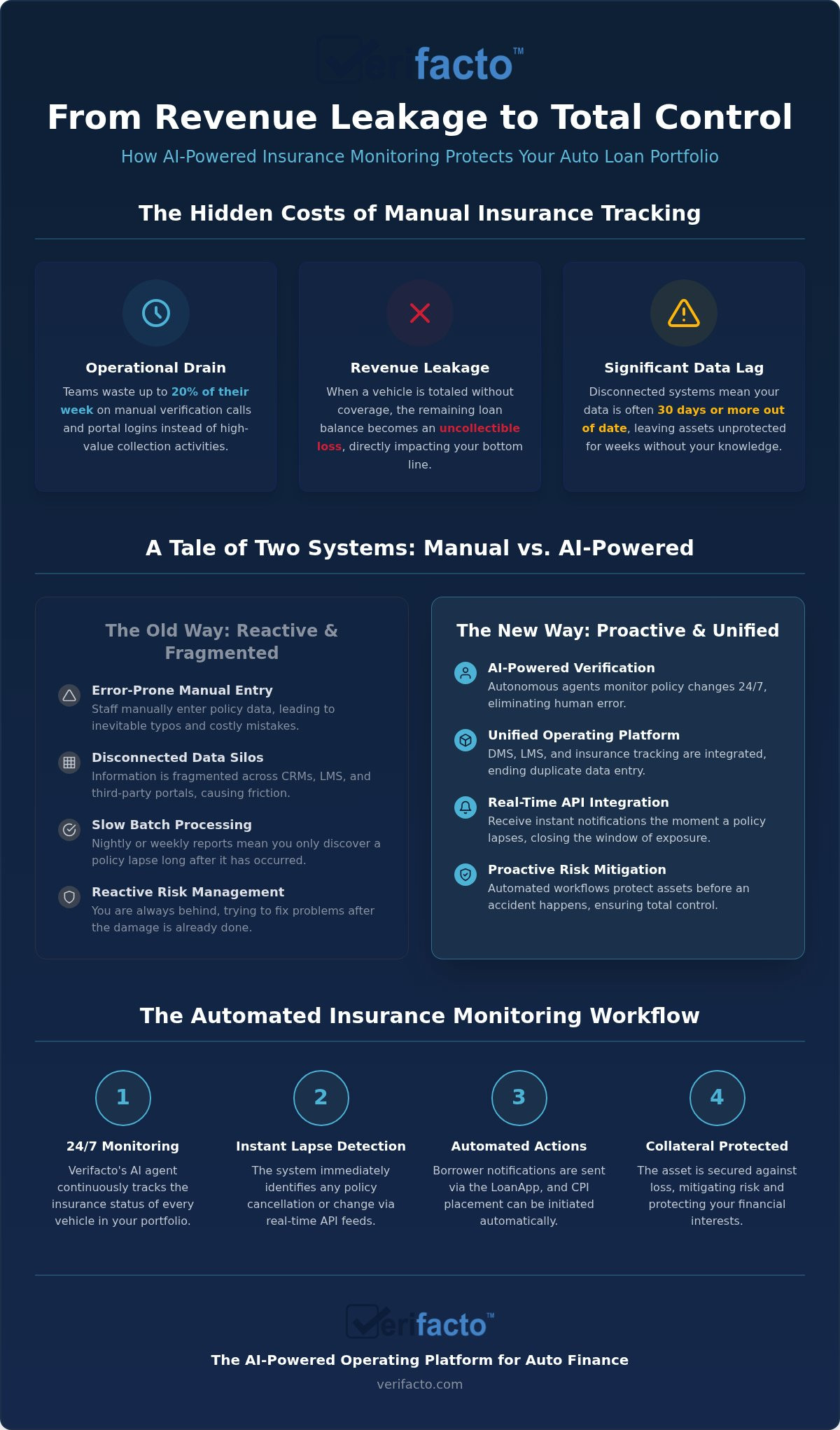
A Practical Workflow for Automated Insurance Monitoring
Transitioning from manual tracking to an automated system requires a methodical approach to ensure no assets are left exposed. Start by auditing your current insurance tracking gaps. You need to identify exactly where revenue leakage occurs by reviewing your last twelve months of net charge-offs. Determine how many total loss vehicles lacked active coverage at the time of the accident. This data provides the financial justification for upgrading your protocols and helps quantify the specific uninsured collateral risk for lenders within your current operation.
Consolidation is the next pillar of a secure workflow. Dealerships operate one business but are often forced to manage it through disconnected systems. Verifacto brings the operation, data, and AI together in one platform. By consolidating your DMS and LMS into a single cloud-based operating platform, you eliminate the data silos that hide risk. Once unified, you can set automated triggers that initiate policy lapse notifications and CPI placement without manual intervention. Finally, train your team to use AI agents as support for complex judgment calls, allowing the technology to handle routine verification while humans manage high-stakes borrower interactions.
Setting Up Automated Triggers
Automation works best when it’s tailored to your specific risk appetite. You can customize notification sequences for different risk tiers, ensuring that high-risk borrowers receive more frequent touchpoints. Verifacto is designed to integrate insurance tracking with your existing accounting tools like QuickBooks, ensuring that CPI premiums and payments stay synchronized across your ledger. Automated borrower communication through the LoanApp and SMS keeps the borrower informed, which is a critical component of a modern collection cycle. This transparency often encourages borrowers to reinstate their own policies before lender-placed coverage becomes necessary.
Managing CPI Placement and Compliance
Managing lender-placed insurance requires strict adherence to state-specific regulations to avoid legal friction. Verifacto’s platform helps you follow best practices for force-placed insurance to maintain compliance while protecting your assets. You can use the Analytics Agent to monitor the impact of CPI on your overall portfolio health, identifying whether certain segments are showing higher rates of lapse. This data-driven approach ensures that your risk mitigation strategies are both effective and sustainable. Improving collection efficiency for auto loans starts with these integrated workflows that remove the guesswork from collateral protection.
To see how these automated workflows can protect your assets, book a demonstration to explore how the platform fits your business.
Scaling Risk Management with the Verifacto Operating Platform
Scaling a portfolio requires a fundamental shift in how you view your technology stack. If you’re still managing a separate DMS, a separate LMS, and a separate insurance tracker, you’re building on a foundation of data silos. Verifacto is designed to solve this by connecting the entire lending lifecycle within a single interface. From the moment a lead enters your system to the final payment, the platform provides a continuous stream of data that helps mitigate uninsured collateral risk for lenders. This unified approach ensures that risk management isn’t a separate department; it’s embedded in every transaction you process.
The advantage of using an AI-powered operating platform lies in its ability to support human judgment at scale. AI agents, such as the Analytics Agent and Collections Agent, process massive amounts of portfolio data to identify risks that would be impossible for a human to track manually. By automating the routine, your team is free to handle the exceptions. This creates long-term business value by improving financial performance and reducing the operational overhead that typically balloons as a portfolio grows. You aren’t just tracking insurance; you’re optimizing the entire financial health of your business.
Beyond Tracking: A Complete Operating Solution
Verifacto is an operating platform, not just a standalone tracker. It’s built to modernize the entire operation, starting with the first interaction. This includes the AI Sales Agent, which is designed to ensure high-quality originations from the very beginning. By verifying insurance and borrower information during the sales process, you set a standard of transparency that carries through the life of the loan. This front-end diligence is your first line of defense against future lapses, significantly reducing the uninsured collateral risk for lenders before the vehicle even leaves the lot.
Future-Proofing Your Auto Finance Business
Maintaining control over your business means having easy access to your own data. Verifacto emphasizes dealer control by providing straightforward data export and reporting features, ensuring you’re never trapped by vendor lock-in. As regulatory environments evolve, having automated compliance logs and a 99.99% uptime guarantee ensures your business remains stable and audit-ready. This level of reliability is essential for protecting your capital and ensuring consistent growth. You gain the security of an authoritative expert and the agility of a bold innovator, all within one system.
See how Verifacto connects your operation from the first lead to the final payment. Book a demonstration to explore how the platform fits your business.
Securing Your Portfolio for 2026 and Beyond
Manual insurance tracking is no longer a viable strategy for lenders who want to scale. Relying on disconnected systems and human data entry creates a window of exposure that leads to avoidable revenue leakage. By unifying your DMS and LMS functions into a single operating platform, you eliminate the data silos that hide risk. You gain the security of SOC II compliant data handling and the reliability of a 99.99% uptime guarantee.
The future of auto finance belongs to those who leverage embedded AI agents for sales, analytics, and operations to protect their assets. This shift from reactive tracking to proactive risk management is the only way to effectively mitigate uninsured collateral risk for lenders at scale. It’s about moving from uncertainty to total control over your portfolio’s health.
Are you ready to stop the slow bleed of profits and modernize your operation? Book a demonstration to explore how the platform fits your business and see how Verifacto connects your operation from the first lead to the final payment.
Frequently Asked Questions
What is uninsured collateral risk for lenders?
Uninsured collateral risk for lenders is the financial exposure that occurs when a borrower’s physical damage insurance lapses. If a vehicle is totaled or stolen while coverage is inactive, the lender loses the underlying asset value that secures the loan. This often results in a total loss with zero recovery, creating significant revenue leakage in auto finance portfolios.
How does automated insurance tracking reduce lender risk?
Automated tracking provides real-time visibility by connecting directly to insurance data feeds rather than relying on manual mail processing. This technology flags policy cancellations or expirations the moment they occur. By identifying lapses instantly, lenders can use automated workflows to notify borrowers or initiate lender-placed coverage, which significantly shortens the window of financial exposure.
What is the difference between VSI and CPI insurance?
Vendors Single Interest (VSI) is a blanket policy that typically covers an entire portfolio against specific risks like repossession damage or skips. Collateral Protection Insurance (CPI) is lender-placed coverage applied to specific individual loans when a borrower fails to maintain their own policy. CPI is designed to protect the specific asset and the premium is usually charged back to the borrower’s account.
Can I integrate insurance tracking with my existing DMS or LMS?
Many lenders struggle with disconnected systems that require manual data syncing. Verifacto is designed as a unified operating platform that brings DMS, LMS, and insurance tracking into a single interface. This integration eliminates the need for duplicate data entry and ensures that your insurance status is always synchronized with your loan servicing data without using external spreadsheets.
What happens if a borrower’s insurance policy lapses?
When a lapse is detected, the platform initiates an automated notification sequence through the LoanApp and SMS. This keeps the borrower informed and provides a transparent way for them to upload new coverage documents. If the borrower doesn’t reinstate their policy within the required timeframe, the system can help facilitate CPI placement to ensure the lender’s interest remains protected.
How do AI agents help with insurance verification?
AI agents handle the high-volume, routine tasks of monitoring policy statuses 24/7 and processing incoming binders. The Operational Assistant manages borrower communication, while the Analytics Agent identifies patterns in your portfolio that signal high risk. These tools support human judgment by providing accurate, real-time data, allowing your team to focus on high-stakes collection calls instead of administrative paperwork.
Is borrower data secure in a cloud-based monitoring platform?
Data security is a foundational requirement for modern lenders. Verifacto uses SOC II compliant security and bank-level encryption to safeguard sensitive borrower information. This level of protection is designed to meet the rigorous standards of auto finance regulatory oversight, ensuring that your business data remains secure and your operation stays audit-ready at all times.
Does automated tracking help reduce net charge-offs?
Automated tracking is designed to provide greater visibility into the insurance health of your portfolio, which can help prevent uncollectible losses from total loss events. By closing the gap between a policy cancellation and the lender’s awareness, you reduce the likelihood of facing a total loss on an uninsured vehicle. This proactive approach helps stabilize your financial performance by protecting your collateral value.