
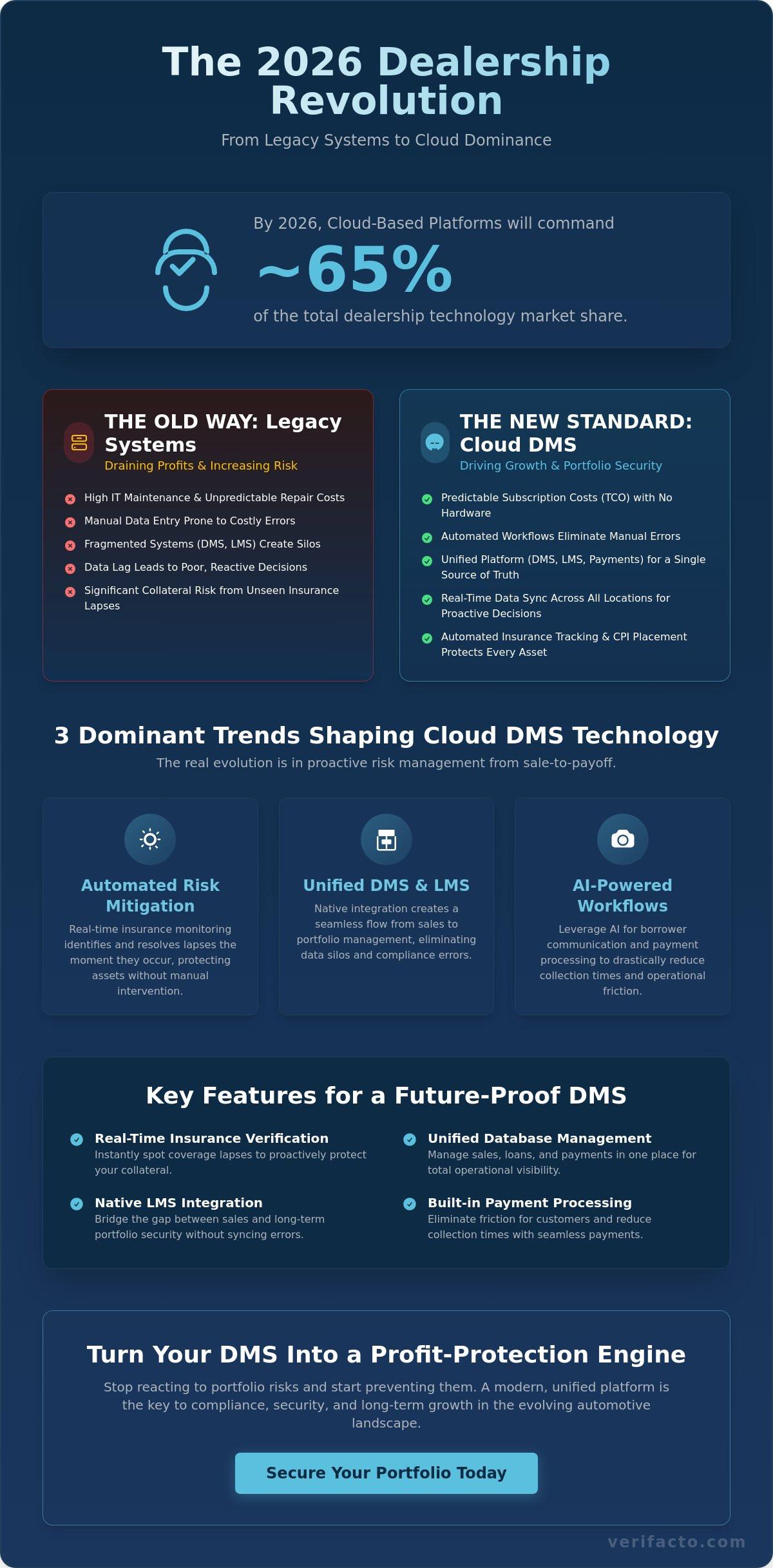
By the end of 2026, cloud-based platforms will command nearly 65% of the total market share, making the traditional on-site server a relic of the past. If you’re still wrestling with manual data entry errors between your DMS and LMS, you’re likely feeling the strain of operational friction and high IT maintenance costs. Relying on a legacy setup often means flying blind when it comes to real-time borrower insurance status, which leaves your collateral at risk. Transitioning to a modern cloud based dealer management system is no longer just a technical upgrade. It’s a fundamental shift toward protecting your bottom line.
You need a solution that works as hard as you do to maintain compliance and security. We understand that the pressure to adapt is mounting, especially with the California CARS Act taking effect on October 1, 2026. This article demonstrates how cloud-native architecture revolutionizes dealership profitability through real-time risk mitigation and automated workflows. You’ll discover how to bridge the gap between sales and long-term portfolio security by leveraging integrated insurance tracking and seamless payment processing to eliminate errors and drive growth.
Key Takeaways
- Understand why passive legacy systems are draining your profits and how active SaaS ecosystems provide the agility needed for 2026.
- Discover how AI-powered borrower communication and automated workflows drastically reduce collection times and operational friction.
- Learn to evaluate a cloud based dealer management system based on its ability to provide real-time insurance verification and unified database management.
- Quantify the hidden costs of manual data syncing and see how native LMS integration protects your dealership from costly compliance errors.
- See how a unified platform with built-in payment processing and insurance tracking creates a proactive risk-mitigation engine for your portfolio.
The Evolution of Dealership Operations: Defining the 2026 Cloud DMS
The definition of a dealer management system has undergone a radical transformation. In the past, these tools were essentially digital filing cabinets; they were passive repositories where you stored sales data and customer records. By 2026, the industry has moved toward a sophisticated cloud-based software model that functions as an active SaaS ecosystem. A modern cloud based dealer management system doesn’t just sit there waiting for input. It’s a proactive engine that drives your entire operation by automating workflows and identifying risks before they become financial losses.
True cloud architecture serves as the foundation for every modern auto finance innovation we see today. We’ve moved past the era of fragmented software silos where your DMS didn’t talk to your LMS, and your insurance tracking was a separate, manual mess. The 2026 standard is a unified operational hub. This shift allows you to manage every aspect of your dealership, from the initial sale to the final payment, within a single, secure environment. It’s about mastery over complexity, replacing disjointed processes with a streamlined flow that protects your portfolio.
Cloud vs. On-Premise: The Final Verdict
The debate between local servers and cloud architecture is over. Security is the primary driver. Professional cloud data centers offer levels of encryption, redundancy, and physical security that a local dealership server simply can’t match. When you move to the cloud, you’re shifting the burden of data protection to experts, which significantly reduces your professional anxiety regarding cyber threats.
The total cost of ownership (TCO) also favors the cloud. Instead of unpredictable repair costs and expensive IT maintenance for local hardware, you have a predictable subscription. Perhaps the biggest win is the “Update Advantage.” Cloud users never deal with version obsolescence. Your software improves automatically in the background, ensuring you’re always compliant with the latest regulations without needing a manual install or a technician visit.
The Role of Real-Time Data in 2026
Data lag is a silent profit killer in multi-lot operations. If your team is looking at information that’s even an hour old, they’re making decisions based on the past. A cloud based dealer management system provides instant synchronization across every location. Whether a customer makes a payment at Lot A or updates their insurance information online, that data is immediately visible to your collections team at Lot B.
This instant availability transforms your decision-making speed. You can spot a lapse in insurance or a missed payment trigger immediately, allowing for proactive outreach rather than reactive recovery. For a deeper look at how these systems have evolved to meet these demands, consult our Ultimate Guide to Dealer Management Systems (DMS). Real-time data isn’t a luxury; it’s the standard for any dealership focused on long-term stability and growth.
3 Dominant Trends Shaping Cloud DMS Technology
The industry landscape has shifted significantly. While many competitors still focus strictly on the sales funnel and inventory management, the real evolution in 2026 is happening in the “sale-to-payoff” phase. A modern cloud based dealer management system now acts as a comprehensive risk-management engine. It combines predictive analytics with frictionless payment processing to ensure your portfolio remains healthy long after the customer drives off the lot. This proactive stance is what separates market leaders from those struggling with high default rates.
Trend 1: Automated Risk Mitigation and Insurance Tracking
Manual insurance verification is a liability you can’t afford. In 2026, top-tier platforms have replaced phone calls and paper trails with real-time insurance monitoring. This technology identifies lapses the moment they occur, allowing for immediate intervention. By integrating automated CPI (Collateral Protection Insurance) placement, dealerships can protect their assets without the administrative headache. This automation drastically reduces the manual labor required by compliance officers, letting them focus on high-level strategy rather than chasing down policy documents. If you want to see how this looks in practice, you might consider how Verifacto’s unified platform automates these essential safeguards.
Trend 2: The Unified DMS and LMS Ecosystem
Operating with separate systems for sales and lending creates dangerous operational blind spots. When your DMS and LMS don’t share a single database, data lag leads to missed collection opportunities and compliance errors. The trend for 2026 is hyper-integration. A unified ecosystem provides a single source of truth for borrower data, ensuring that every department has access to identical, real-time information. This synergy is a major factor in improving collection efficiency for auto loans. It eliminates redundant data entry and ensures that payment processing is built directly into the core workflow, creating a seamless experience for both the dealer and the borrower.
Trend 3: Mobile-First Management for a Remote Workforce
The dealership of 2026 isn’t confined to a physical office. Modern cloud based dealer management system platforms empower field agents and remote managers by offering full functionality on mobile devices. We aren’t talking about “lite” versions or limited apps. We mean the ability to manage accounts, track insurance status, and process payments from anywhere. Security remains the top priority in this mobile shift. Platforms now utilize advanced protocols like multi-factor authentication (MFA) and biometrics to protect cloud access. This ensures that your data remains secure even when your team is working from the field, providing the flexibility needed to stay competitive in a fast-paced market.
The High Cost of Staying Local: Why Legacy Systems Drain Profit
Many dealers cling to legacy software because they believe that if it ain’t broke, don’t fix it. This logic is a dangerous trap in 2026. If your current system forces your team to manually sync data between your sales and lending desks, it is already broken. You’re losing dozens of hours every month to redundant entry and human error. A modern cloud based dealer management system eliminates this friction by unifying your entire operation. Beyond simple efficiency, legacy servers are sitting ducks for modern ransomware. One successful attack on a local server can wipe out your entire portfolio history, leaving you with no way to track payments or verify insurance status.
Scaling across multiple locations becomes a logistical nightmare with on-premise hardware. Local systems create data silos that prevent real-time oversight. You can’t manage what you can’t see, and legacy setups keep you in the dark about lot-to-lot performance. Moving to a cloud based dealer management system isn’t just about following a trend. It’s about removing the bottlenecks that prevent your dealership from growing into a high-volume, multi-location enterprise.
The Compliance Gap in Legacy Software
Outdated systems struggle to keep up with the rapid pace of regulatory changes. For example, the California Combating Auto Retail Scams (CARS) Act (SB-766) takes effect on October 1, 2026. This law introduces strict requirements for price transparency and add-on product regulations. Legacy software often lacks the flexibility to update forms and workflows quickly enough to meet these deadlines. This leaves you vulnerable to audit failure and heavy fines. Cloud platforms offer compliance by design, pushing mandatory updates to your system automatically so you stay ahead of federal and state requirements without lifting a finger.
Opportunity Cost: Missing the 2026 Tech Wave
Legacy systems act as a barrier to innovation. They simply cannot integrate with the modern fintech and insurance APIs that your competitors are already using. While other dealers are automating their insurance tracking and payment processing, your team is likely still making phone calls to verify coverage. This slow system performance creates friction during the deal, frustrating customers who expect a seamless, digital experience. The agility of cloud-based competitors allows them to close deals faster and manage risk more effectively. If you’re bound to a legacy system, you aren’t just staying still; you’re falling behind an industry that is moving at lightning speed.
Critical Features for Evaluating a Modern Cloud DMS
Selecting a cloud based dealer management system requires you to look past basic inventory tools and focus on the architecture that drives long-term profitability. In 2026, the most vital feature is native LMS integration. Many vendors claim their systems are integrated, but they often rely on fragile APIs that only sync data periodically. You need a unified database where sales and lending data exist in the same space. This eliminates the risk of data mismatches that lead to costly compliance errors. High-performance dealerships also prioritize real-time insurance verification. This is your primary defense against collateral loss; if your system doesn’t flag a policy lapse the moment it happens, your asset is at risk.
Scalability depends on DMS with automated workflows that handle borrower communication and payment triggers without manual intervention. Look for built-in borrower communication tools that handle text and email outreach automatically based on payment triggers. When this is paired with integrated payment processing, you reduce friction from the first down payment to the final payoff. Finally, ensure the platform offers customizable reporting. Raw data is useless without context. Your DMS should turn that data into actionable insights, showing you exactly where your portfolio is thriving and where risk is creeping in. To see these features in action, you can explore Verifacto’s unified DMS and LMS solution and experience the benefits of a truly integrated ecosystem.
Evaluating Integration Depth
When you’re comparing DMS software for used car dealers, you must distinguish between “connected” and “unified” systems. A connected system merely pushes data back and forth between different programs, which often leads to “data lag.” A unified system uses a single source of truth for every borrower. Ask vendors specifically if their LMS is a third-party add-on or a native component of the platform. If it’s not native, you’ll likely struggle with redundant data entry and synchronization gaps that hinder your collection efficiency. Independent operators looking for tailored guidance on this decision can also benefit from reviewing how to choose the best DMS for independent dealers in 2026, which covers the specific risks and evaluation criteria most relevant to smaller, owner-operated lots.
Security and Reliability Standards
Your data is your most valuable asset, so its protection is non-negotiable. Verify that your provider utilizes enterprise-grade cloud hosting like AWS or Azure and maintains SOC 2 compliance. These standards ensure your sensitive deal data is protected by the same security protocols used by major financial institutions. Reliability is equally important. Demand a 99.9% uptime guarantee and verify the presence of redundant backups. You should also look for role-based access controls. This allows you to restrict sensitive information to specific team members, ensuring that your data remains secure even as your staff grows.
Future-Proofing Your Dealership with Verifacto’s Unified Platform
Verifacto isn’t just another software vendor; we represent the industry’s most advanced triad. Our cloud based dealer management system integrates natively with a robust Loan Management System (LMS) and sophisticated insurance tracking. This unified approach allows you to move beyond the traditional “buy-to-sold” mindset. You gain mastery over complexity by managing the entire lifecycle of a loan within one ecosystem. By automating workflows and removing the need for third-party insurance tracking, you transition from being a simple dealer to a data-driven lender. You finally gain total control over every variable of your portfolio risk.
The shift to a modern cloud based dealer management system is about more than just technology. It’s about professional security and reliability. While competitors focus on the inventory journey, Verifacto focuses on the “sale-to-payoff” phase where your profit is actually realized. We eliminate the friction that typically exists between sales, lending, and risk mitigation. This creates a streamlined environment where data flows effortlessly, and your team can focus on growth rather than administrative firefighting.
Seamless Transition to Modernity
Switching platforms often feels daunting, but we prioritize a seamless transition to modernity. Our team supports the migration process to ensure your data moves safely and your operations don’t miss a beat. You’ll see an immediate impact on collection efficiency as automated borrower communication takes over the repetitive tasks that once bogged down your staff. Productivity soars when your team no longer has to toggle between windows or manually verify coverage. A major part of this efficiency comes from our integrated payment solutions for dealers, which are built directly into the core workflow to reduce friction and accelerate cash flow.
The Verifacto Advantage: Protection Meets Profit
The Verifacto advantage is rooted in the combination of protection and profit. By utilizing real-time CPI and insurance tracking, you eliminate the blind spots that lead to charge-offs. You don’t have to wait for a disaster to discover a lapse in coverage. The system identifies the risk and triggers the solution automatically. This proactive management delivers a long-term ROI that legacy systems simply can’t match. It’s time to stop reacting to problems and start preventing them. Secure your portfolio and streamline your operations today. Take the first step toward total operational transformation by upgrading to a unified platform designed for the realities of 2026.
Securing Your Portfolio for 2026 and Beyond
Staying competitive in the current market requires a shift from reactive management to proactive protection. We’ve explored how the move toward a cloud based dealer management system eliminates the dangerous data silos that lead to compliance failures and financial loss. By integrating your sales and lending operations, you gain a single source of truth that ensures every decision is backed by real-time data. Automation is no longer a luxury; it’s the engine that drives collection efficiency and scales your communication without adding to your payroll.
You have the power to transform your dealership into a data-driven enterprise that prioritizes portfolio health as much as sales volume. Verifacto provides the tools to master this complexity through integrated LMS and DMS architecture, real-time insurance tracking, and built-in payment processing. Don’t let legacy hardware hold your growth hostage or leave your assets vulnerable to unmonitored risks. It’s time to choose a platform that offers the security and reliability your business deserves. Transform your dealership operations with Verifacto’s unified cloud DMS today. We’re ready to help you navigate these operational challenges with confidence.
Frequently Asked Questions
What is the difference between a cloud based dealer management system and a web-based DMS?
A cloud based dealer management system utilizes a decentralized network of servers to provide high availability and automatic scaling. While “web-based” often refers to any software accessed via a browser, a true cloud platform offers superior redundancy and seamless background updates. This ensures your dealership always operates on the latest version without manual installs or hardware downtime.
Is a cloud-based DMS secure enough for sensitive financial data?
Security in the cloud is typically much stronger than local server setups. Leading platforms use enterprise-grade encryption and SOC 2 compliance to safeguard sensitive financial records and borrower information. These professionally managed data centers protect your business from local hardware failures and the growing threat of ransomware attacks that target on-site servers.
Can a cloud DMS handle BHPH loan management and collections?
Yes, a modern cloud based dealer management system is ideal for BHPH because it unifies sales and lending data into a single source of truth. This integration allows you to manage collections, automate borrower outreach, and track payment history in one place. It eliminates the data lag that often happens when using separate, disconnected systems for sales and loan management.
How long does it take to migrate from a legacy DMS to a cloud-based system?
Most dealerships complete the migration process within two to four weeks. This timeline depends on the complexity of your existing data and the volume of records being transferred to the new platform. Professional migration teams handle the mapping and validation to ensure your transition is smooth and your staff is trained for immediate productivity.
Do I need special hardware to run a cloud-based dealer management system?
You don’t need any specialized hardware or expensive on-site servers to run a cloud DMS. Any device with a modern web browser and a stable internet connection will work perfectly. This shift removes the burden of IT maintenance costs and allows your team to access the platform securely from desktops, tablets, or mobile phones.
Can a cloud DMS help with insurance tracking and collateral protection?
Insurance tracking is a primary benefit of modern cloud architecture. The platform monitors policy status in real-time and can automate CPI placement the moment a lapse is identified. This proactive approach replaces manual phone calls and paper trails; it ensures your collateral is always protected without constant administrative oversight.
What happens to my data if the internet goes down at my dealership?
Your data remains secure and current even if your local internet service is interrupted. Because the system is cloud-native, you can simply switch to a mobile hotspot or access the platform from a different location to continue working. Your records are stored in redundant data centers, so no information is ever lost during local outages.