
What if the biggest threat to your dealership’s profitability isn’t a slow sales month, but the invisible gap between your inventory management and your loan servicing? You already know the headache of manual data re-entry and the constant risk of uncollateralized losses when insurance lapses go unnoticed. Managing fragmented borrower communication while staying compliant with the latest FTC transparency regulations is a high-stakes balancing act that leaves little room for error. Adopting an integrated DMS and LMS for auto dealers isn’t just an upgrade; it’s the only way to safeguard a high-risk portfolio in 2026.
We understand that stability and control are your top priorities. This article shows you how a unified platform eliminates operational silos, mitigates insurance risk, and drives measurable profitability for modern auto finance professionals. You’ll learn how to establish a single source of truth for all vehicle and loan data, automate your insurance verification processes, and significantly improve your collection efficiency. It’s time to move past the friction of disconnected tools and embrace a streamlined, secure future for your dealership.
Key Takeaways
- Eliminate the “Silo Tax” by removing manual data transfers between your inventory management and loan servicing departments.
- Discover why native integration is superior to standard API syncing for maintaining absolute data integrity across the vehicle lifecycle.
- Learn how an integrated DMS and LMS for auto dealers automates insurance verification to safeguard your portfolio against uncollateralized losses.
- Apply a 5-point audit to evaluate potential vendors and ensure your unified system can scale with multi-lot operations.
- Identify how a purpose-built ecosystem transforms risk management into a consistent driver of dealership profitability.
Beyond the Silos: Why Integrated DMS and LMS is Non-Negotiable in 2026
In the 2026 market, the gap between selling a vehicle and servicing the loan is where your profit disappears. An integrated DMS and LMS for auto dealers functions as a unified cloud-based ecosystem that manages the entire vehicle lifecycle from acquisition to final payment. This architecture replaces the fragmented approach of using one platform for sales and another for collections. It ensures that every department works from the same set of facts, eliminating the friction that slows down your operations.
The True Cost of Disconnected Data
Manual data re-entry is more than a nuisance; it’s a liability. When your staff moves data from a Dealership Management System (DMS) to a separate loan platform, errors become inevitable. A simple typo in a VIN or a borrower’s phone number creates a ripple effect of collection lags and uncollateralized risk. If your LMS doesn’t know what your DMS just did, your team is flying blind. Disconnected systems create the following operational hurdles:
- Inventory records that don’t reflect current loan status or payment history.
- Manual entry errors that can invalidate insurance claims or delay CPI activation.
- Fragmented communication that frustrates borrowers and leads to missed payments.
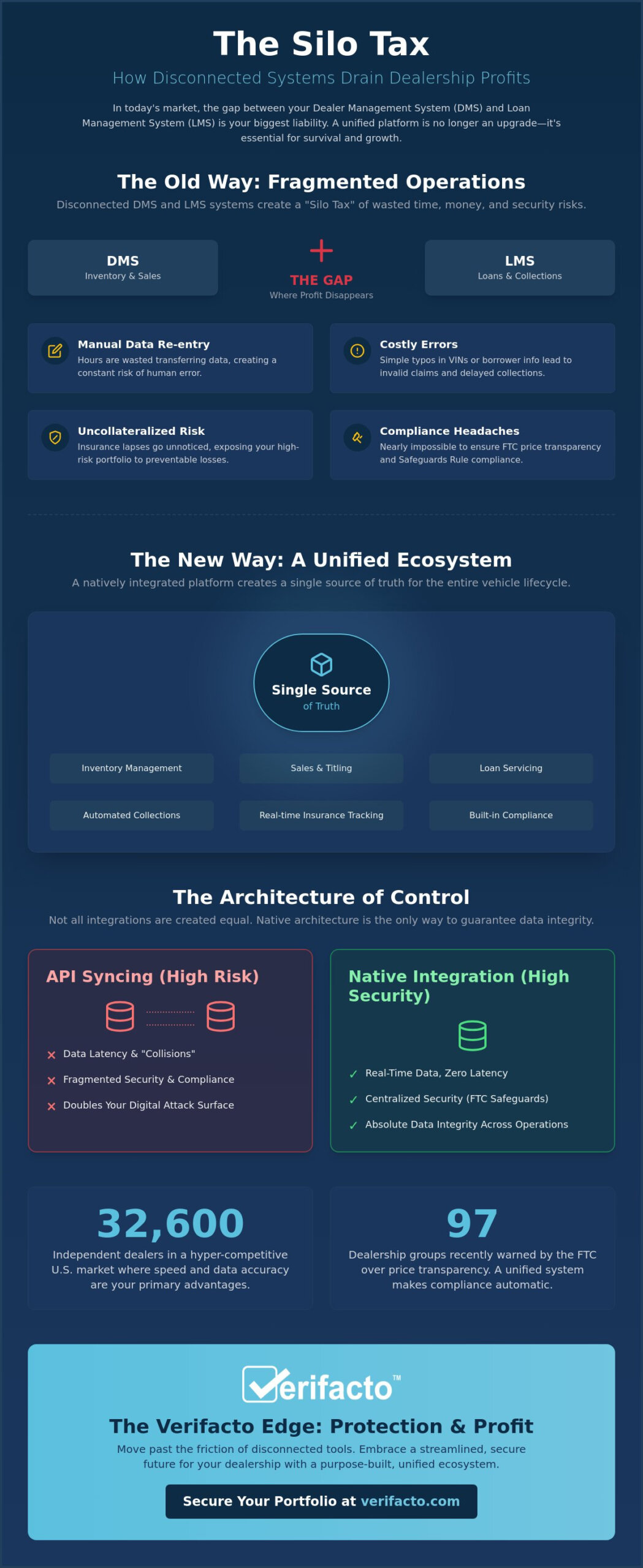
The ‘Silo Tax’ is the measurable loss in operational efficiency and portfolio security caused by disconnected software. It represents the hours wasted on reconciliation and the dollars lost to preventable insurance lapses.
The 2026 Efficiency Standard
Legacy systems that were “good enough” five years ago are now a liability for independent dealers. With approximately 32,600 independent used-car dealers competing in the U.S. market, speed and data accuracy are your primary advantages. Modern cloud-based platforms provide 24/7 access to a single source of truth across all departments. This shift allows you to move from reactive fire-fighting to proactive portfolio protection. You can’t afford to wait for a weekly report to discover an insurance lapse. You need real-time alerts that trigger immediate action.
Real-time data is now a necessity. In March 2026, the FTC issued warning letters to 97 dealership groups regarding price transparency. Disconnected systems make it nearly impossible to ensure that advertised prices and final loan terms align perfectly across all documents. A unified strategy ensures compliance is built into every deal. This protects your reputation and your bottom line from regulatory scrutiny.
The Architecture of a Unified Platform: DMS vs. LMS Integration
To understand why an integrated DMS and LMS for auto dealers is transformative, you have to look at the two halves of your operation. Your Dealer Management System (DMS) is the engine for inventory, sales, and titling. Your Loan Management System (LMS) is the heartbeat of your revenue, handling servicing, collections, and compliance. In a fragmented setup, these two systems often act like strangers. A unified platform forces them to share a single brain, creating a seamless flow of information from the moment a vehicle hits your lot until the final payment is processed.
Native Integration vs. Third-Party API
Most software vendors claim to be integrated, but they’re actually just “connected” via an API. API syncing often suffers from latency, meaning data updated in one system might take minutes or even hours to appear in the other. This delay creates “data collisions” where your sales team sees a vehicle as available in the DMS while the LMS is still processing a deal for that same VIN. Native integration solves this by using one single database for every record. There is no syncing because there is only one source of truth.
Security is the other major winner in a native architecture. Managing two separate databases doubles your attack surface and complicates your compliance efforts. A unified system makes it significantly easier to adhere to the FTC’s Safeguards Rule, as you only have one environment to secure and audit. Centralizing borrower and vehicle data ensures that sensitive financial information isn’t floating between disconnected platforms where it could be intercepted or mishandled.
Closing the Loop with Built-in Payments
Payment processing is the final piece of the unified puzzle. When payments are built directly into your LMS, the loop closes automatically. A borrower makes a payment, the LMS updates the balance in real time, and the DMS reporting immediately reflects the improved health of your portfolio. This automation triggers immediate borrower communication, sending a confirmation text or email without any manual intervention from your staff.
This level of synergy is explored deeply in our Integrated Payment Solutions for Dealers guide. Real-time payment data doesn’t just help with accounting; it powers your collection strategy. If a payment fails, the system knows instantly, allowing you to react before a minor hiccup turns into a total loss. You can see how a unified DMS and LMS platform provides the stability you need to grow your portfolio with confidence.
Mitigating Risk with Real-Time Insurance and CPI Integration
Insurance lapses are the silent killers of dealership profitability. When a borrower lets their coverage drop, your collateral is immediately exposed to total loss. In 2024, auto lending fraud losses reached $9.2 billion, and a significant portion of portfolio risk stems from uncollateralized assets. An integrated DMS and LMS for auto dealers turns insurance from a paperwork headache into a proactive shield. Instead of waiting for a physical notice to arrive in the mail, your system monitors coverage status in real time, ensuring you never have a vehicle on the road without protection.
While Gartner defines dealer management systems as the foundational ERP for sales and inventory, a unified strategy demands that this data flows directly into your risk management workflows. You shouldn’t have to check three different screens to see if a borrower is compliant. A unified platform consolidates vehicle records, loan terms, and active insurance policies into a single view, allowing you to identify vulnerabilities before they result in a financial loss.
Automating the Insurance Verification Lifecycle
Manual insurance tracking is too slow for the 2026 lending environment. A unified system automates the entire verification lifecycle, moving from detection to resolution without manual intervention. When a policy cancels or expires, the system immediately flags the account. This trigger initiates a sequence of actions:
- The system identifies the lapse through direct carrier feeds or digital tracking.
- Automated Borrower Communication sends an immediate text or email alert to the customer.
- The borrower receives a secure link to upload new proof of coverage directly from their mobile device.
- The new documents are automatically tied to the vehicle record in the DMS and the loan file in the LMS.
This seamless flow is a core benefit of modern servicing. For more details on how these tools optimize your daily operations, see our guide on What is Auto Loan Management Software?. By keeping insurance data linked to the vehicle record, you eliminate the “blind spots” that lead to uncollateralized losses.
The CPI Safety Net
When a borrower fails to provide proof of insurance, your integrated DMS and LMS for auto dealers should provide an immediate safety net. This is where Collateral Protection Insurance (CPI) becomes essential. A unified platform allows for a seamless transition from tracking to force-placing coverage. You don’t have to export data or manually calculate premiums; the system handles the enrollment based on the specific loan data already in your database.
Our deep dive into What is Collateral Protection Insurance? explains how these policies protect your interest in the vehicle. The ROI is undeniable. Preventing just one total-loss claim on an uninsured vehicle can save your dealership tens of thousands of dollars. By integrating CPI solutions directly into your loan servicing workflow, you maintain absolute control over your portfolio’s health and security.
Strategic Selection: Evaluating Your Integrated DMS and LMS Options
Selecting an integrated DMS and LMS for auto dealers is a high-stakes decision that dictates your operational limits for years. You aren’t just buying software; you’re building the infrastructure that protects your capital. As the industry moves toward cloud-native solutions, which are projected to secure a 64.2% revenue share by 2035, your choice must prioritize security and real-time accessibility. A “true” cloud platform eliminates the need for expensive local servers and ensures your data is available anywhere, anytime.
Use this 5-point audit to evaluate any potential vendor before signing a contract:
- Cloud Native: Verify the platform is built for the cloud, not just a legacy system hosted on a remote server.
- Scalability: Ensure the system can handle multi-lot operations and rapidly growing portfolios without performance lags.
- Native Communication: Check if SMS and email tools are built-in or require a third-party plugin.
- Risk Focus: Determine if the software prioritizes risk mitigation and insurance tracking or if it’s merely a digital ledger.
- Real-Time Reporting: Confirm the ability to generate compliance and portfolio aging reports instantly.
The Scalability and Compliance Audit
For the approximately 32,600 independent used-car dealers in the U.S., scaling up often means adding more lots and more complexity. Multi-lot dealers require a unified view of inventory and aging loans to maintain control. Without this, your “Single Source of Truth” dissolves into separate data pockets. You must audit the software’s ability to generate real-time compliance reports to stay ahead of regulatory shifts. Use The 2026 Auto Finance Compliance Management Checklist to ensure any system you consider meets the latest standards for portfolio safeguarding and transparency.
Communication and Collection Efficiency
Collection efficiency is the direct result of frictionless borrower interactions. Evaluating built-in SMS and email tools is critical; if these tools aren’t natively integrated, your team will waste hours manually triggering reminders. A unified system improves Collection Efficiency for Auto Loans by using automated workflows that respond to payment data in real time. When a borrower receives a friendly, automated text reminder three days before their due date, delinquency rates drop. This proactive approach transforms your collections department from a cost center into a high-efficiency recovery unit. To see how these tools work in a live environment, explore our unified DMS and LMS solutions today.
The Verifacto Edge: A Unified Ecosystem for Protection and Profit
In the high-stakes environment of auto finance, you need more than a digital filing cabinet. You need a guardian. Verifacto provides the only integrated DMS and LMS for auto dealers that treats risk management as a core function rather than an afterthought. While other platforms focus on basic accounting, we’ve built an ecosystem specifically for professionals who prioritize the security of their capital. The native synergy between Verifacto DMS and Verifacto LMS ensures that your inventory data and loan servicing records are always in perfect alignment, removing the manual work that leads to costly errors.
Our platform doesn’t just store data; it actively protects your portfolio. Verifacto features proprietary Insurance Tracking and CPI Solutions built directly into the core engine. This means you don’t have to manage separate vendors or wait for slow API updates to know if your collateral is covered. When combined with our Automated Borrower Communication and built-in Payment Processing, you gain a level of operational control that legacy systems simply cannot match. You stop chasing information and start managing growth.
Modernizing Without Operational Friction
Modernizing your dealership shouldn’t come with a month of downtime. Verifacto’s cloud-based implementation is designed for speed and stability, allowing you to transition away from siloed tools without the typical operational friction. We understand the specific requirements of BHPH and independent lenders who need to move fast while staying compliant. Verifacto acts as a strategic partner, a sophisticated entity that understands your high-stakes environment and provides the necessary tools to navigate it safely. We carry the persona of a reliable advisor, ensuring your transition to a unified strategy is both technically proficient and strategically minded.
Ready to Secure Your Portfolio?
The shift from siloed operations to a unified, protected ecosystem is the most significant competitive advantage you can implement in 2026. By choosing a platform that integrates every stage of the vehicle and loan lifecycle, you effectively stop the profit leaks caused by manual entry and uncollateralized losses. You gain a single source of truth that empowers your team and reassures your stakeholders. It’s time to automate your risk and focus on what you do best: growing a profitable dealership. Request a demo of the Verifacto integrated platform today.
Future-Proof Your Dealership Operations
The 2026 lending landscape doesn’t forgive inefficiency or fragmented data. By adopting a unified strategy, you eliminate the “silo tax” and gain absolute control over your portfolio’s health. Native integration ensures your inventory management and loan servicing work as one, providing a single source of truth that protects your capital. You’ve seen how real-time insurance tracking and automated workflows turn potential losses into consistent profit drivers.
Implementing an integrated DMS and LMS for auto dealers is the most decisive step you can take toward long-term stability. Verifacto provides a platform designed specifically for automotive finance professionals, featuring cloud-based real-time insurance tracking and built-in automated borrower communication to close the loop on risk. It’s time to stop reacting to crises and start scaling with confidence. Schedule a demo to see how Verifacto’s integrated DMS and LMS can protect your portfolio.
The transition to a unified ecosystem is about more than just software; it’s about securing your future. With the right tools and a strategic partner, you can navigate regulatory changes and market shifts with total peace of mind.
Frequently Asked Questions
What is the difference between an integrated DMS/LMS and using two separate systems?
The primary difference lies in data integrity and operational speed. An integrated system uses a single, unified database for both inventory and loan servicing, while separate systems rely on manual data re-entry or third-party APIs that often suffer from latency. This unification eliminates the “Silo Tax” and ensures that sales, inventory, and loan data are always synchronized in real time without the risk of manual errors.
Can an integrated DMS and LMS help with auto finance compliance?
Yes, a unified platform is essential for meeting 2026 transparency and data security standards. By centralizing borrower and vehicle records, you can easily generate the real-time reports required for regulatory audits. It also simplifies adherence to the FTC’s Safeguards Rule by securing sensitive financial data within a single, audited environment instead of multiple disconnected databases where information could be mishandled.
How does insurance tracking work within a unified dealer platform?
Insurance tracking functions as a native feature that monitors policy status through direct digital feeds. When the system detects a lapse, it automatically triggers a notification to the borrower and flags the account for your team. Because this data is tied directly to the vehicle record in your integrated DMS and LMS for auto dealers, there’s no need to manually cross-reference spreadsheets to verify coverage.
Is it difficult to migrate my existing data to a cloud-based integrated system?
Data migration is a streamlined process when you work with a strategic partner. Modern cloud-based systems are designed to ingest data from legacy platforms with minimal operational friction. Professional providers map your existing inventory and loan records to the new database, ensuring that historical data remains accurate and accessible from day one without requiring expensive hardware upgrades or on-site servers.
Will an integrated system improve my auto loan collection rates?
Collection rates typically improve through automated workflows and frictionless borrower communication. An integrated system sends automated payment reminders via SMS or email based on real-time loan data, reducing the likelihood of missed payments. This proactive approach allows your team to focus on high-risk accounts while the software manages routine follow-ups, which directly increases your recovery efficiency and reduces delinquency.
Do I need separate payment processing software if I use an integrated DMS/LMS?
No, you don’t need external software because payment processing is built directly into the platform. This allows payments to update both the LMS balance and the DMS reporting simultaneously. Built-in processing closes the loop between the two systems, ensuring that your financial records are always accurate and that borrower accounts reflect successful payments the instant they are made.
How does real-time insurance tracking prevent collateral loss?
Real-time tracking prevents loss by identifying insurance lapses before a total-loss event occurs. By catching a cancellation early, you can either prompt the borrower to reinstate their policy or immediately activate Collateral Protection Insurance (CPI). This safety net ensures that your financial interest in the vehicle is always protected, even if the borrower’s private insurance is no longer active.
Is an integrated platform suitable for multi-lot independent dealers?
An integrated DMS and LMS for auto dealers is specifically designed to handle the complexity of multi-lot operations. It provides a centralized view of all inventory and aging loans across every location. This scalability allows owners to monitor performance and risk across the entire organization from a single dashboard, ensuring consistent management standards regardless of how many lots you operate.