
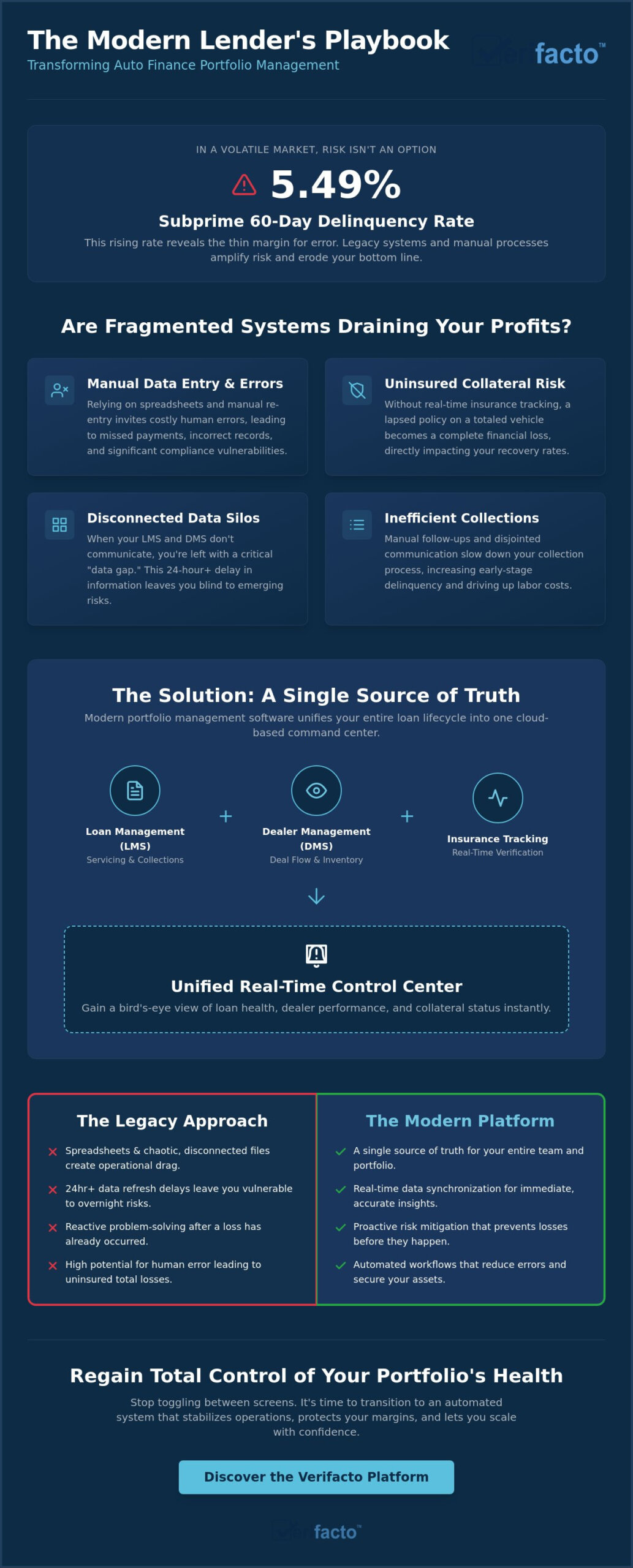
With subprime 60-day delinquency rates hitting 5.49% in May 2026, the margin for error in your lending operations has never been thinner. If your team is still toggling between disconnected screens to verify coverage or track payments, you’re likely feeling the strain of rising manual labor costs and unnecessary risk. Scaling your performance in this volatile market requires more than just hard work. It demands modern auto finance portfolio management software that synchronizes every aspect of your loan lifecycle in real time.
You probably agree that the friction in the collection process and the constant threat of uninsured collateral are the biggest drains on your bottom line. We’ll show you exactly how to eliminate these pains by automating insurance monitoring and centralizing your DMS and LMS data into a single, high-impact workflow. This guide explores how leveraging integrated technology reduces charge-offs, maximizes your recovery rates, and helps you regain total control over your portfolio’s health. We will walk through the specific tools you need to build a more resilient and profitable lending operation today.
Key Takeaways
- Learn how to transition from fragmented legacy systems to a centralized cloud environment that manages the full loan lifecycle.
- Discover how integrating your LMS and DMS eliminates data gaps and provides real-time visibility into dealer performance.
- Identify the specific tools needed to implement real-time insurance tracking and prevent the financial impact of uninsured collateral losses.
- Optimize your recovery rates using auto finance portfolio management software that leverages automated borrower communication to reduce early-stage delinquency.
- Understand the critical role of cloud-native security and compliance in protecting sensitive borrower data while scaling your lending operations.
What is Auto Finance Portfolio Management Software in 2026?
In 2026, auto finance portfolio management software serves as the digital command center for modern lending operations. It is a centralized, cloud-based platform designed to oversee the entire lifecycle of a vehicle loan, from the initial funding to the final payment. Managing a financial portfolio in the automotive sector has evolved far beyond simple record-keeping; it now requires a high-performance environment where data is synchronized across all departments in real time.
The industry is moving away from legacy, siloed systems that rely on batch processing. These older methods often leave lenders in the dark for 24 hours or more while waiting for data to refresh. In a market where subprime volatility is high and regulatory scrutiny is intense, waiting is a risk you can’t afford. Modern auto finance portfolio management software eliminates these delays, providing stakeholders with an immediate, accurate view of their assets. This technology serves several critical roles:
- Finance Companies: Gain a bird’s-eye view of loan health and risk exposure.
- Dealers: Streamline deal structuring and inventory management.
- Compliance Officers: Maintain ironclad audit trails to meet evolving federal reporting requirements.
The Core Components of a Modern System
A truly integrated platform doesn’t just store data; it connects the dots between different operational stages. The first pillar is the Loan Management System (LMS), which handles the heavy lifting of servicing and collections. This is paired with a Dealer Management System (DMS) that manages inventory and the front-end deal flow. The final, and often most overlooked, component is integrated insurance tracking. By linking these three elements, you ensure that physical collateral is protected from the moment it leaves the lot. If a borrower’s coverage lapses, the system identifies the gap instantly, allowing for proactive risk mitigation rather than reactive recovery.
Why Spreadsheets are a Liability for Your Portfolio
Relying on manual spreadsheets in 2026 is a recipe for operational failure. The hidden costs of manual data entry are staggering, often leading to human errors that result in missed payments or uninsured total losses. Fragmented borrower records also create significant compliance risks, making it difficult to produce accurate documentation during an audit. Using modern auto loan management software provides a single source of truth for your entire team. It replaces chaotic, disconnected files with a streamlined workflow that protects your margins and secures your assets. Transitioning to an automated system isn’t just an upgrade; it’s a necessary step to stabilize your operations and scale your performance without increasing your headcount.
The Power of Integrated LMS and DMS for Portfolio Control
Many lenders struggle with a persistent “data gap” between their sales floor and their servicing department. When your sales team closes a deal, the clock starts ticking on the first payment. If your systems don’t talk to each other, you’re forced to manually export data or re-enter borrower information into a separate platform. High-performance auto finance portfolio management software solves this by bridging the divide between your Dealer Management System (DMS) and Loan Management System (LMS). This synergy ensures that every funded deal transitions into an active, monitored loan without a single keystroke of manual effort.
Gaining immediate insight into dealer performance and overall loan health is non-negotiable in 2026. If a specific dealer consistently produces high-delinquency loans, you need to know before the next funding cycle, not weeks later during a quarterly review. Mitigating Risk with Real-Time Data allows you to make informed decisions that protect your capital. By consolidating your tech stack, you also reduce the massive software overhead associated with maintaining multiple vendor subscriptions. It’s time to stop paying for overlapping tools that don’t talk to each other.
Unified Data: From Inventory to Payoff
Understanding what is DMS technology is the first step in building a solid foundation for your sales data. A modern system automatically syncs vehicle details, borrower profiles, and contract terms directly into your servicing environment. This seamless flow eliminates the risk of human error during deal structuring. When your executive team pulls a report, they’re seeing a unified version of the truth that spans from inventory acquisition to the final payoff. This transparency is vital for maintaining a healthy and profitable auto finance portfolio management software ecosystem.
Operational Efficiency Gains
Every minute your team spends cross-referencing records between systems is a minute they aren’t spent on collections or customer service. Integration improves your “funding to first payment” success rate by ensuring that automated reminders and payment portals are active the moment a deal is finalized. True integration is the seamless flow of data between sales and servicing without manual exports. This level of automation is why many top-tier lenders choose to unify their operations with a single, comprehensive platform. By removing technical friction, you empower your staff to focus on high-value tasks that drive growth and maximize recovery rates.
Mitigating Risk with Real-Time Insurance Tracking and CPI
The most dangerous period for any lender isn’t the initial credit check; it’s the weeks following funding. While many systems focus strictly on credit scores, the real threat to your bottom line is a borrower’s insurance policy lapsing. Without active coverage, a single collision turns your collateral into a total loss. High-performance auto finance portfolio management software must treat insurance tracking as a core pillar of risk management. By integrating real-time monitoring directly into your workflow, you move from reactive recovery to proactive asset protection.
Industry standards, as highlighted by the National Automotive Finance (NAF) Association, emphasize that maintaining physical collateral protection is essential for portfolio stability. Automating the verification process removes a massive administrative burden. Instead of your team spending hundreds of hours on the phone with insurance agents, the software handles the heavy lifting. When the system detects a lapse, it triggers immediate action, ensuring your assets remain covered without draining your staff’s resources.
The ROI of Automated Insurance Monitoring
The financial math is simple: the cost of a single charge-off far outweighs the investment in a comprehensive protection program. Understanding what is collateral protection insurance (CPI) is vital for any lender looking to stabilize their portfolio’s value. CPI acts as a critical safety net, providing coverage for the lender’s interest when a borrower fails to maintain their own policy. Beyond just protecting the vehicle, automated reminders improve borrower compliance by keeping them informed of their obligations, reducing the need for lender-placed intervention in the first place.
Lender-Placed Insurance Best Practices
Managing lender-placed insurance requires a delicate balance of firmness and professional courtesy. You must maintain strict compliance with state and federal regulations during CPI placement to avoid legal friction. Clear borrower communication is the most effective tool here. Your auto finance portfolio management software should send automated, transparent notifications regarding coverage requirements before a lapse occurs. If you must move forward with force-placed insurance, do so with a focus on protecting the relationship. Explain the necessity of the coverage clearly, and offer a seamless path for the borrower to reinstate their private policy and have the CPI charges removed. This approach preserves your collateral while maintaining a positive borrower experience.
Boosting Collection Efficiency Through Automated Workflows
Effective collections in the subprime market rely on consistency rather than aggression. With the 90-day auto loan delinquency rate reaching 5.60% in early 2026, there’s no room for a passive approach to recovery. When a borrower falls behind, the most successful strategy is to maintain a steady, helpful presence that keeps the obligation top-of-mind. Modern auto finance portfolio management software transforms this philosophy into a repeatable process through automated workflows. Instead of your team spending their day on manual outreach, the system handles multi-channel notifications across SMS, email, and IVR, ensuring no account is overlooked during the critical early stages of delinquency.
Building an Automated Collection Sequence
A structured collection sequence is essential for maintaining a healthy cash flow. By automating these touchpoints, you reduce the emotional friction often associated with debt recovery while keeping your team focused on accounts that require human intervention.
- Step 1: Send automated payment reminders 3 days before the due date to prevent accidental oversights.
- Step 2: Trigger immediate ‘missed payment’ notifications via SMS the moment a deadline passes.
- Step 3: Deploy escalation workflows for accounts reaching 15 or more days past due to prioritize high-risk assets.
- Step 4: Maintain real-time tracking of communication history to ensure your team has the full context for improving collection efficiency auto loans.
Integrated Payment Solutions
Reducing friction in the actual payment process is just as important as the reminder itself. If a borrower has to call your office during limited business hours to make a payment, you’ve created an unnecessary barrier. Utilizing a DMS with built-in payment processing allows you to offer 24/7 self-service portals. This enables borrowers to settle their accounts at their convenience, capturing payments outside of standard business hours. True integration is the seamless flow of data between sales and servicing without manual exports.
These integrated solutions also help reduce ACH returns through automated validation and balance checks before a transaction is ever processed. By removing these technical hurdles, your auto finance portfolio management software acts as a partner in your borrower’s success, making it easier for them to stay current. If you’re ready to modernize your recovery strategy and protect your margins, explore our automated collection tools today.
Choosing the Right Platform: Why Verifacto is the Standard
Selecting the right auto finance portfolio management software is the most critical decision you’ll make for your lending operation this year. In a market defined by tight margins and shifting regulations, you don’t just need a software vendor; you need a strategic partner. Verifacto stands apart by offering a cloud-native platform designed specifically for the unique pressures of the auto finance industry. We move beyond basic record-keeping to provide a high-performance environment that scales alongside your ambition without forcing you to scale your overhead.
Security and compliance are no longer optional “add-ons” in 2026. Protecting sensitive borrower data requires a sophisticated infrastructure that legacy systems simply can’t provide. Verifacto is built on a foundation of ironclad security protocols, ensuring that your data is safe and your audit trails are always ready for regulatory review. This proactive stance on protection alleviates professional anxiety, allowing you to focus on growth while we act as the reliable guardian of your digital assets.
A No-Nonsense Approach to Portfolio Protection
Verifacto’s true strength lies in its unified ecosystem. By combining the Verifacto LMS, Verifacto DMS, and integrated insurance tracking into one seamless interface, we eliminate the technical friction that slows down most lending teams. This isn’t just about convenience; it’s about real-world impact. Our partners consistently report reduced delinquency rates and improved profitability because they finally have a single source of truth. Unlike siloed platforms that require constant manual exports, Verifacto provides the real-time visibility needed to make high-stakes decisions with confidence. If your organization also handles complex investment evaluations or M&A activities, you can learn more about SaaS Subscription for AI Deal Room and Analysis Tools to further optimize your data analysis. It’s a modern solution for lenders who are tired of the “death by a thousand spreadsheets” approach.
Getting Started with Modern Portfolio Management
We understand that transitioning to a new platform can feel daunting. That’s why Verifacto prioritizes a streamlined implementation process designed to minimize downtime. Our team guides you through every step, from data migration to staff training, ensuring maximum software adoption across your entire organization. We don’t just hand you the keys and walk away; we provide the expert support necessary to turn our technology into your competitive advantage. Whether you’re managing a small local portfolio or a large-scale regional operation, we have the tools and the expertise to help you master your operational challenges. If you’re ready to see the difference that a truly integrated system can make for your bottom line, schedule a demo of Verifacto’s integrated platform today.
Master Your Portfolio Performance in 2026
Scaling your lending operation in 2026 doesn’t have to mean increasing your headcount or your professional stress. By unifying your sales and servicing data, you eliminate the critical gaps that lead to delinquency and collateral loss. Mastering your auto finance portfolio management software is the most effective way to secure your assets while maintaining a seamless borrower experience. You’ve seen how real-time insurance tracking and automated communication workflows can transform a reactive collection department into a proactive profit center. These tools provide the stability you need to navigate market volatility with absolute confidence.
Verifacto provides a comprehensive, cloud-native ecosystem that features real-time insurance tracking, an integrated LMS and DMS platform, and sophisticated automated borrower communication tools. It’s time to move beyond legacy limitations and embrace a system built for the modern lender. Book a Demo to See How Verifacto Protects Your Portfolio and discover how a true technology partner can help you optimize every aspect of your lifecycle. Take control of your data today and build a more resilient, profitable future for your business.
Frequently Asked Questions
What is the difference between an LMS and a DMS in auto finance?
A Dealer Management System (DMS) focuses on the front-end sales process, including inventory management and deal structuring. In contrast, a Loan Management System (LMS) handles the back-end servicing, such as payment processing and collections. Modern auto finance portfolio management software bridges this gap by integrating both functions into a single platform. This ensures that data flows seamlessly from the moment a vehicle is sold to the day the final payment is made.
How does portfolio management software help with auto finance compliance management?
The software automates the creation of ironclad audit trails and ensures consistent borrower communication, which are essential for federal compliance. It helps you adhere to regulations like the Truth in Lending Act (TILA) and the Fair Debt Collection Practices Act (FDCPA). By centralizing documentation, your team can quickly produce accurate interest statements or communication logs during regulatory reviews, reducing the risk of costly legal friction or penalties.
Can I track insurance in real-time with my current DMS?
Most standard DMS platforms don’t offer native real-time insurance tracking. They often rely on manual data entry or delayed batch updates; this leaves you vulnerable to uninsured total losses. To achieve real-time visibility, you need an integrated solution that monitors policy status constantly. Verifacto provides this capability, alerting you the moment a borrower’s coverage lapses so you can take immediate action to protect your physical collateral.
Is Collateral Protection Insurance (CPI) legal in all states?
Collateral Protection Insurance is legal across the United States, but each state has specific regulations regarding its implementation. These rules often govern how you notify borrowers and how premiums are calculated. It’s vital to use a platform that automates these compliant notice sequences. This ensures you satisfy legal requirements while protecting your interest in the vehicle when a borrower fails to maintain their own private insurance policy.
How much does auto finance portfolio management software typically cost?
Pricing for auto finance portfolio management software typically follows a subscription-based model that scales with your portfolio size. While industry rates vary, Verifacto offers a unique “DMS is FREE” model when bundled with insurance tracking and payment processing services. This allows you to modernize your entire tech stack while keeping your operational overhead predictable. You should evaluate platforms based on the total value of risk mitigation and efficiency gains they provide.
Does Verifacto offer GPS tracking hardware for vehicle recovery?
Verifacto does not sell or provide GPS tracking hardware for vehicle recovery. Our focus is on providing sophisticated software solutions, such as LMS, DMS, and automated insurance tracking, to manage risk through data and communication. We believe that real-time visibility into insurance status and automated borrower outreach are the most effective ways to protect your portfolio’s value without relying on physical hardware installations.
How does automated borrower communication improve my recovery rates?
Automation improves recovery by ensuring every borrower receives a consistent sequence of reminders via SMS, email, and IVR. Since subprime collections rely on consistency, these automated touchpoints keep the payment obligation top-of-mind without requiring manual staff intervention. This proactive approach catches early-stage delinquency before it escalates, allowing your team to focus their energy on high-risk accounts that actually require a personal phone call.
Can this software help reduce my portfolio’s charge-off rate?
Yes, integrated software is a powerful tool for reducing charge-offs. By catching insurance lapses instantly and automating the early stages of the collection process, you prevent the two biggest causes of portfolio loss. The software ensures that your collateral is always protected and that delinquent borrowers are engaged immediately. This combination of risk mitigation and operational efficiency leads to higher recovery rates and a significantly healthier bottom line for your lending business.