
In 2026, compliance is no longer a back-office chore; it’s the invisible engine that powers your entire lending operation. You’ve likely felt the mounting pressure of manual insurance tracking and the nightmare of fragmented data sitting between your DMS and LMS. With new regulations like the FTC CARS Rule and the July 2026 Connecticut “junk fee” laws requiring more documentation than ever, legacy systems simply can’t keep up. Relying on outdated, manual processes doesn’t just invite human error, it puts your entire portfolio at risk.
We understand that you need a way to automate these complex requirements without slowing down your business. By implementing a modern auto lending compliance management system, you can finally transition from reactive firefighting to proactive growth. This guide will show you how to build a robust framework that automates regulatory adherence and shields your assets from costly fines. You’ll learn how to create a “set-and-forget” compliance environment that offers real-time visibility into risk and integrates your loan servicing directly with your reporting needs.
Key Takeaways
- Understand the evolution of a modern auto lending compliance management system from reactive reporting to a proactive, automated framework that monitors risk in real time.
- Identify essential features like automated TILA disclosures and insurance tracking that eliminate manual errors and protect your portfolio from regulatory scrutiny.
- Discover why a unified LMS and DMS platform is superior to fragmented systems for maintaining a single source of truth and closing dangerous data gaps.
- Follow a streamlined five-step implementation plan to transition your current manual processes into a modernized, compliance-first lending workflow.
- Learn how to leverage unified cloud-based tools to automate borrower communication and CPI placement, creating a secure and scalable environment for your assets.
What is an Auto Lending Compliance Management System (CMS)?
An auto lending compliance management system is far more than a simple digital checklist or a repository for legal documents. It’s a comprehensive, integrated framework that unites software, internal policies, and operational processes into a single cohesive shield. In the high-stakes environment of 2026, a CMS doesn’t just record what happened in the past. It actively monitors every stage of the loan lifecycle to prevent violations before they occur. This shift from reactive reporting to proactive, automated monitoring is the hallmark of a modern lending operation that prioritizes stability and long-term growth.
The regulatory environment is becoming increasingly complex. Lenders must now satisfy a multi-layered hierarchy of oversight, including the Consumer Financial Protection Bureau (CFPB), the Federal Trade Commission (FTC), and a growing list of state-level authorities. Relying on a standalone compliance tool often creates dangerous data silos. A truly effective compliance engine is built directly into your LMS and DMS, ensuring that your data remains consistent across every disclosure, calculation, and borrower interaction. This integration eliminates the “Frankenstein” approach where disparate tools fail to communicate, leaving your portfolio vulnerable to oversight gaps.
The Three Pillars of a Modern Auto Finance CMS
A robust CMS rests on three essential foundations that ensure total operational control. First, Board and Management Oversight provides leadership with digital dashboards for real-time visibility into risk levels across the entire portfolio. You can’t manage what you can’t see; these tools provide the clarity needed for decisive action. Second, the Compliance Program itself automates critical tasks like TILA calculations, SCRA checks, and disclosure generation. This removes the variable of human error from high-risk calculations. Finally, the Compliance Audit pillar transforms the nightmare of an examination into a streamlined process. With one-click reporting, you can produce the exact documentation regulators require without weeks of manual data mining.
Why 2026 is a Turning Point for Auto Lenders
This year marks a significant escalation in regulatory expectations. Authorities have intensified their focus on “junk fees” and the transparency of add-on products under UDAAP (Unfair, Deceptive, or Abusive Acts or Practices) standards. Additionally, the FTC CARS Rule has fundamentally changed the requirements for dealer disclosures and record-keeping, demanding a level of precision that legacy systems simply cannot provide. Lenders must now prove they have total control over their data and their partners. A comprehensive CMS is the guardian of the lender’s license to operate. Without it, the risk of heavy fines and reputational damage becomes an inevitability rather than a possibility.
Essential Features of an Auto Lending Compliance Management System
Building a resilient auto lending compliance management system requires moving beyond static documents into active operational features. Regulators don’t just look for a policy manual; they want to see how your software enforces those policies daily. Effective systems prioritize automation to remove the risk of human error, especially in high-stakes areas like interest calculations and borrower contact. By embedding these features directly into your workflow, you create a defensive perimeter around your portfolio that functions without constant manual intervention.
Automation for TILA and Regulation Z
Precision is the only acceptable standard for Truth in Lending Act (TILA) and Regulation Z requirements. Manual entry errors in APR or finance charge calculations are common triggers for regulatory action. A sophisticated auto loan management software acts as your immutable system of record, calculating these complex figures automatically. This ensures every borrower receives a compliant, written disclosure at the exact moment required by law. Aligning your software with the CFPB Auto Finance Examination Procedures allows you to prove your math is sound and your timing is perfect during any audit.
Beyond disclosures, your system must handle specialized protections like the Military Lending Act (MLA) and the Servicemembers Civil Relief Act (SCRA). Automated scrubbing of your database against military records prevents you from inadvertently violating the rights of those on active duty. To keep your data secure, role-based access controls are essential. These controls protect sensitive Non-Public Information (NPI), ensuring that only authorized personnel can view or edit borrower details, which is a critical requirement for maintaining consumer trust and regulatory standing.
Communication Compliance: Texting and Automated Notifications
Managing borrower interactions is a legal minefield governed by the TCPA, FDCPA, and UDAAP. You need to manage consent for SMS and automated calls with surgical precision. Modern automated borrower communication systems maintain a permanent, unalterable log of every interaction. This creates a transparent audit trail that can quickly debunk harassment claims and prove your team followed all contact frequency guidelines. If you’re looking to modernize your operations, implementing a unified compliance framework can significantly reduce your exposure to litigation.
Real-time insurance tracking is another non-negotiable feature. Fragmented data leads to wrongful CPI (Collateral Protection Insurance) placements, which are a primary target for UDAAP enforcement in 2026. An integrated auto lending compliance management system monitors insurance status constantly and triggers automated borrower notifications the moment a lapse is detected. This proactive approach ensures that CPI is only placed when absolutely necessary, protecting both your collateral and your reputation with regulators.
Integrated LMS vs. Fragmented Compliance Tools
Many lenders unknowingly operate what we call a “Frankenstein” system. They use one platform for loan servicing, a separate tool for insurance tracking, and perhaps a series of spreadsheets to manage regulatory reporting. These disparate tools create dangerous compliance gaps where data can easily fall through the cracks. In a high-stakes audit, these gaps are exactly what regulators look for. A truly effective auto lending compliance management system replaces this patchwork with a single source of truth, ensuring that every piece of data is consistent across your entire operation.
The difference in efficiency is staggering when you compare manual processes to an integrated framework. During an examination, a team using fragmented tools might spend 48 hours or more frantically pulling data from different sources to reconstruct a loan history. An integrated system allows you to generate that same report in under five minutes. This speed doesn’t just save time; it projects a level of mastery and control that builds immediate trust with examiners. Beyond the audit, this automation allows you to scale your portfolio from 500 to 5,000 units without significantly increasing your compliance headcount.
Eliminating Data Silos Between LMS and DMS
Data silos are the primary cause of operational friction. For example, if your payment data doesn’t sync perfectly with your insurance status, you risk “force-placing” insurance on a loan that’s already been paid off. This is a major UDAAP violation that can lead to heavy fines. Utilizing integrated payment solutions for dealers ensures that your ledgers are always accurate and up to date. This real-time synchronization is your best defense against wrongful repossessions, as it ensures that every department is working from the same live data set.
The Compliance Advantage of Cloud-Based Architecture
The regulatory environment moves fast, and your software needs to move faster. Cloud-based systems offer a distinct advantage because they can adapt to new regulations overnight. When a new state law takes effect, a cloud-based auto lending compliance management system can push updates across your entire organization instantly. This architecture also provides superior security standards, including SOC 2 compliance and robust data encryption both at rest and in transit. You gain the peace of mind that comes with knowing your borrower’s sensitive information is protected by cutting-edge security while your system remains perfectly aligned with the latest legal requirements.
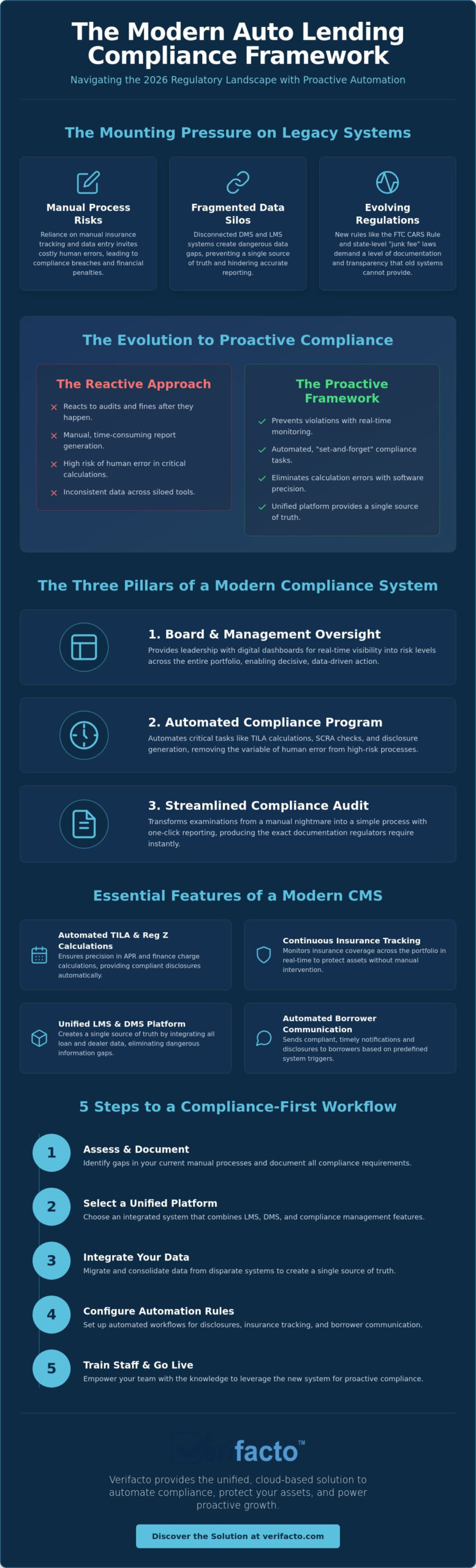
5 Steps to Implement a Compliance-First Lending Workflow
Modernizing your operations requires more than just buying new software; it requires a structural shift in how your team handles data. Transitioning to a compliance-first workflow means building a system where regulatory adherence is an automated byproduct of your daily tasks. By moving away from legacy on-premise tools and manual spreadsheets, you eliminate the human variables that lead to costly fines. Follow these five steps to transition your portfolio into a secure, modernized environment that prioritizes risk mitigation and operational speed.
Performing a Compliance Gap Analysis
Your first move is to identify exactly where manual data entry is most likely to fail in your current setup. Start by reviewing your auto finance compliance management checklist against your existing software capabilities. You need to be honest about the “audit readiness” of your current file storage system. If a regulator asks for a specific borrower’s communication history or a precise APR calculation from three years ago, can you produce it in seconds? If the answer is no, your manual processes are a liability that needs immediate attention.
After identifying your gaps, select a platform that integrates your LMS, DMS, and insurance tracking into a single ecosystem. This integration prevents the data fragmentation that often leads to “wrongful repossessions” or incorrect fee applications. Once your platform is in place, automate your “Day 1” disclosures and borrower onboarding. By standardizing the intake process, you ensure that every borrower receives the necessary TILA and Regulation Z notices without exception, creating a consistent legal paper trail from the very first interaction.
Automating the Insurance and CPI Lifecycle
Real-time monitoring is the only way to effectively manage collateral risk in 2026. You need an auto lending compliance management system that sets up automated triggers for insurance expiration notices. This ensures you aren’t manually checking thousands of policies every month. Integrating collateral protection insurance (CPI) directly into your LMS allows for seamless placement the moment a lapse is confirmed. This reduces the administrative burden on your staff and ensures your assets are never left unprotected due to an oversight.
Finally, schedule recurring internal audits using system-generated reports. Don’t wait for a formal examination to find a flaw in your workflow. Use your auto lending compliance management system to run monthly checks on your portfolio’s health, including payment triggers and communication logs. This proactive habit ensures your team remains disciplined and your data remains clean. If you’re ready to secure your portfolio and eliminate manual errors, explore Verifacto’s unified compliance solutions to see how automation can transform your risk management strategy.
Verifacto: The Unified Solution for Auto Lending Compliance
Verifacto isn’t just another software vendor; it’s a strategic partner that transforms compliance from a burden into a competitive advantage. Our auto lending compliance management system unifies Verifacto LMS and Verifacto DMS into a single, cloud-based platform, ensuring that your data flows seamlessly from the initial contract through the final payment. By eliminating the disconnect between your dealer management and loan management tools, you create a synchronized environment where errors don’t have room to hide. Every interaction, from automated borrower communication to built-in payment processing, is logged and recorded, providing you with a perfect audit trail that is ready for examination at a moment’s notice.
This level of integration is essential for maintaining a high-velocity lending operation. When your payment processing is built directly into the system of record, you eliminate the reconciliation errors that often lead to regulatory red flags. You gain a real-time view of your portfolio’s health, allowing you to make data-driven decisions with confidence. Verifacto provides the necessary tools to navigate high-stakes environments safely, ensuring that your business remains both cutting-edge and dependable as regulations continue to evolve.
Mastering Insurance Compliance with Verifacto
Verification and monitoring of borrower coverage shouldn’t take up your team’s entire afternoon. Verifacto provides real-time insurance tracking that identifies lapses the moment they occur, effectively eliminating the “insurance gap” that leaves your assets exposed. When a policy falls off, our system triggers seamless CPI solutions that protect your collateral without requiring manual intervention from your staff. This proactive approach ensures your portfolio remains secure while maintaining strict adherence to UDAAP standards regarding force-placed insurance. Verifacto’s sophisticated platform reduces risk for finance professionals without the need for expensive or intrusive GPS hardware.
Streamlining Operations and Profitability
The true value of automation lies in the freedom it gives your team to focus on high-value tasks like collections and portfolio growth rather than drowning in repetitive paperwork. Verifacto acts as a reliable guardian for your business, a sophisticated entity that understands the high-stakes requirements of daily operations. We protect your portfolio from both financial loss and regulatory fines by ensuring every disclosure is sent, every consent is logged, and every calculation is accurate. This modernization isn’t just about safety; it’s about building a scalable foundation where your business can thrive in a complex regulatory environment.
Schedule a demo of Verifacto’s integrated compliance platform and discover how our unified approach to risk mitigation can secure your portfolio’s future.
Modernize Your Risk Management Strategy Today
Transitioning to a modern auto lending compliance management system is the most decisive step you can take to protect your business in 2026. You’ve seen how fragmented tools create dangerous data silos and why manual tracking is a liability you can no longer afford. By unifying your LMS and DMS, you don’t just simplify audits; you build a proactive environment where risk is managed automatically. This shift ensures that your operation remains agile and compliant as regulations evolve.
Success in this high-stakes landscape requires the right tools to maintain absolute control. Verifacto delivers this through real-time insurance tracking and CPI automation that eliminates coverage gaps without manual staff intervention. Our automated borrower communication keeps you within TCPA and FDCPA guidelines, while built-in payment processing ensures your ledgers are always audit-ready. It’s time to move beyond reactive firefighting and embrace a strategy built for long-term stability and growth.
Secure your portfolio with Verifacto’s integrated LMS & DMS platform
Frequently Asked Questions
What is the FTC CARS Rule and how does it affect auto lending software?
The FTC CARS Rule mandates that dealers provide clear disclosures regarding the total cost of a vehicle and prohibits misrepresentations about financing terms. Modern auto lending software must now include automated document generation features that create a permanent, timestamped record of these disclosures. This ensures that every borrower interaction remains transparent and that the lender can prove compliance during a regulatory audit.
How does an integrated LMS/DMS improve compliance for BHPH dealers?
An integrated LMS and DMS platform eliminates the data discrepancies that often lead to regulatory red flags for Buy Here Pay Here (BHPH) dealers. By syncing payment data with vehicle inventory and borrower records, dealers avoid the risk of wrongful repossessions or incorrect fee applications. This unified approach ensures that every department works from the same live data, significantly reducing the likelihood of human error in high-stakes operations.
Can automated insurance tracking really replace manual verification?
Automated insurance tracking is significantly more reliable than manual verification because it monitors coverage status in real time. Manual processes are prone to human error and often result in an “insurance gap” where vehicles remain unprotected for weeks. An automated auto lending compliance management system identifies lapses instantly and triggers notifications to borrowers, ensuring your collateral stays protected without the administrative burden of manual spreadsheet updates.
Is cloud-based loan management software secure enough for sensitive borrower data?
Modern cloud-based systems are often more secure than legacy on-premise servers due to enterprise-grade encryption and SOC 2 compliance. These platforms protect sensitive borrower data by encrypting information both at rest and in transit. Leading providers also implement role-based access controls, ensuring that only authorized personnel can view Non-Public Information (NPI), which is a critical requirement for maintaining consumer trust and satisfying data privacy regulations.
What are the biggest compliance risks for auto lenders in 2026?
The most significant compliance risks in 2026 involve “junk fees” and the lack of transparency in add-on products under UDAAP standards. Regulators are also closely monitoring how lenders handle military personnel under the SCRA and MLA. Failing to maintain an integrated auto lending compliance management system makes it difficult to track these variables across large portfolios, increasing the likelihood of systemic errors that lead to heavy fines.
How often should an auto finance company conduct a compliance audit?
You should conduct a formal compliance audit at least once a year, though high-volume lenders often benefit from quarterly reviews. Implementing automated reporting tools allows for monthly internal “spot checks” to identify potential issues before they become systemic. Regular monitoring of your communication logs and interest calculations ensures that your team remains disciplined and that your data stays clean between formal examination cycles.
What is the difference between lender-placed insurance and CPI in a compliance context?
Collateral Protection Insurance (CPI) is a specific type of lender-placed insurance designed to protect the lender’s interest when a borrower’s policy lapses. From a compliance perspective, the key difference lies in the notification process and fee transparency. A compliant system ensures that CPI is only placed after multiple automated warnings are sent to the borrower, preventing the “wrongful placement” claims that often trigger UDAAP investigations.
Does Verifacto help with UDAAP compliance regarding add-on products?
Verifacto helps mitigate UDAAP risks by ensuring that all add-on products and fees are clearly disclosed and accurately calculated within the loan contract. Our integrated platform maintains a transparent record of every borrower’s consent and the specific terms of each add-on. This level of documentation is essential for proving that your dealership or finance company isn’t engaging in deceptive practices or charging hidden fees that regulators are currently targeting.