
Did you know that 1 in 7 motorists on the road in 2026 are driving without insurance? For a Buy Here Pay Here dealer, this isn’t just a statistic; it’s a constant threat to your collateral. You likely feel the daily pressure of manual insurance verification eating up your staff’s time, especially when your LMS and DMS systems refuse to talk to each other. It’s exhausting to manage high delinquency rates when your tools feel like they’re working against you rather than providing the clarity you need to stay profitable.
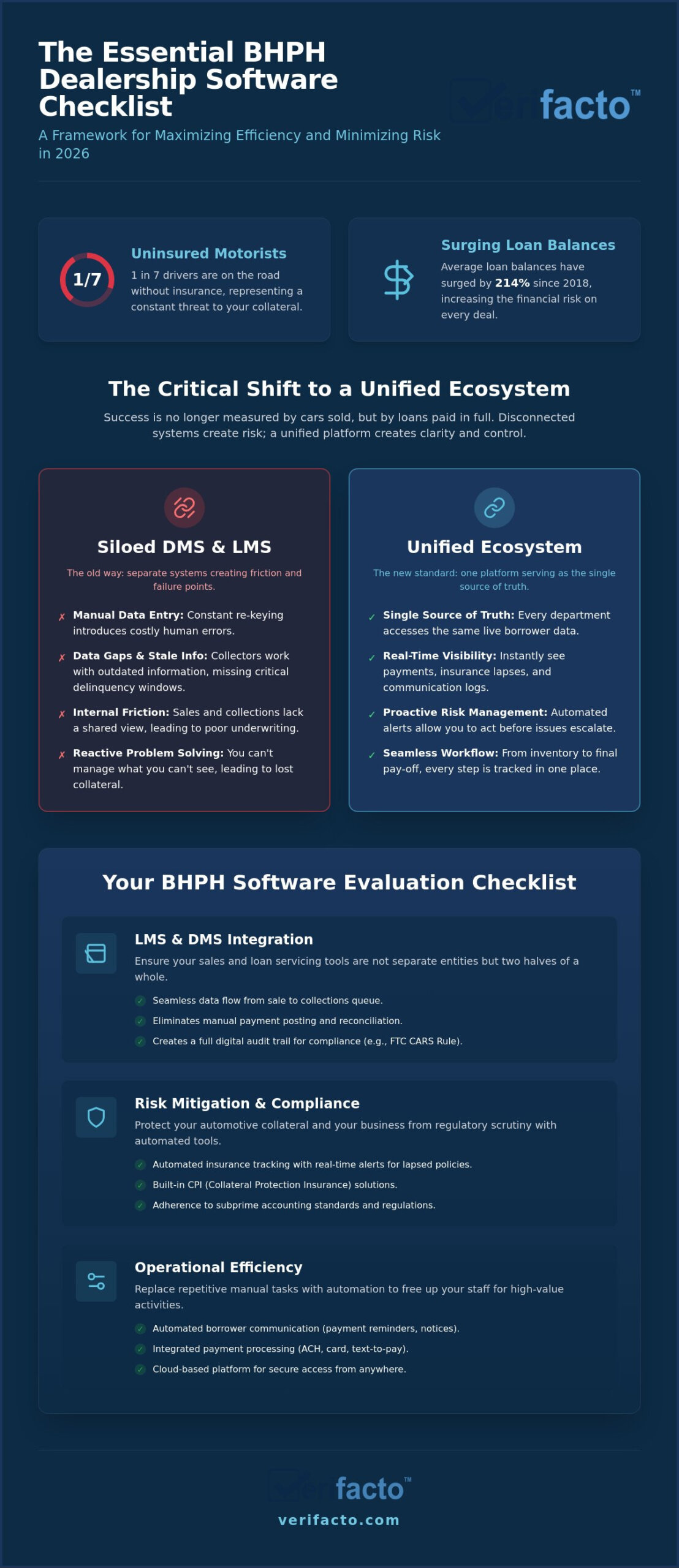
This BHPH dealership software checklist provides a professional framework to evaluate your technology stack and ensure your dealership maximizes efficiency while minimizing risk. We’ll show you how to move toward a unified ecosystem that creates a single source of truth for all your loan and dealership data. You’ll learn how to leverage automated risk mitigation, such as CPI solutions and integrated payments, to stabilize your cash flow and protect your portfolio in an era where loan balances have surged 214 percent since 2018. It’s time to replace manual hurdles with a streamlined, secure operation.
Key Takeaways
- Understand the critical shift from siloed tools to a unified ecosystem that fuses DMS and LMS into a single source of truth for your entire operation.
- Use this BHPH dealership software checklist to identify dangerous data gaps in your current technology stack and ensure compliance with subprime accounting standards.
- Learn to mitigate risk through automated insurance tracking and real-time monitoring to protect your automotive collateral from uninsured motorists.
- Optimize your daily operations with automated borrower communication and integrated payment processing that eliminates repetitive, manual staff tasks.
- Discover why a cloud-based, integrated platform is the essential foundation for dealership growth and portfolio security in the 2026 market.
Beyond Inventory: Why Your 2026 BHPH Software Must Be a Unified Ecosystem
The traditional Buy Here, Pay Here (BHPH) business model once focused almost exclusively on moving inventory. If a car left the lot, the day was a success. In 2026, that mindset is a liability. Your dealership isn’t just a car lot; it’s a financial institution. This shift means your technology must prioritize the loan lifecycle as much as the initial sale. When you evaluate your current setup against a modern BHPH dealership software checklist, the first requirement is a unified ecosystem.
A unified ecosystem is the seamless fusion of a Dealer Management System (DMS) and a Loan Management System (LMS). Legacy software often keeps these two functions in separate silos, creating dangerous data gaps that lead to missed payments and lost collateral. To maintain profitability today, you need real-time visibility that bridges the gap between the sales floor and the collections desk. Success no longer comes from the volume of cars sold, but from the percentage of loans that reach pay-off.
The High Cost of Disconnected Systems
Relying on separate systems for sales and servicing forces your staff into a cycle of manual data entry. Every time a team member re-keys information from your DMS into your LMS, the risk of error grows. A simple typo in a phone number or an address can result in weeks of “stale data,” leaving your collectors unable to reach a borrower during a critical delinquency window. When your data is out of sync, your risk grows exponentially.
Disconnected tools also create internal friction. Your sales team might see a clean record in the DMS, while the LMS shows a history of late payments or lapsed insurance. This lack of transparency leads to poor underwriting decisions and inconsistent borrower communication. If your systems don’t talk to each other, your team is essentially flying blind. You can’t manage what you can’t see, and in a high-stakes lending environment, what you don’t see will eventually cost you your collateral.
Mastering the Full Lifecycle: From Lot to Pay-Off
A truly integrated approach tracks a vehicle from the moment it hits your inventory through reconditioning, sales, and eventually, the final pay-off. By maintaining a single source of truth for borrower records, you ensure that every department has access to the same live data. This transparency is the foundation of modern risk management. It allows your team to move from a reactive posture to a proactive one.
When you use a BHPH dealership software checklist to audit your operations, look for a platform that eliminates the need for third-party bridges or manual exports. A Unified Ecosystem is a platform that handles both the sale and the servicing within one cloud-native database. This structure ensures that as soon as a payment is made or an insurance policy expires, every corner of your business knows about it instantly. This level of synchronization is no longer a luxury; it’s the standard for dealerships that intend to grow in 2026.
LMS vs. DMS: The Integration Checklist
Many operators mistake a standard DMS for a complete solution, but a professional BHPH dealership software checklist must distinguish between sales tools and loan management. While your DMS handles the “now” of a sale, your LMS manages the “next” of your portfolio. In 2026, where the average interest rate for a BHPH loan sits at 25.39 percent, even minor accounting errors can snowball into significant compliance risks and lost revenue. A unified system ensures that payment data flows instantly from the point of sale to the collection queue, eliminating the friction of manual posting.
The regulatory environment has also intensified. Compliance with the Federal Trade Commission’s CARS Rule requires meticulous transparency regarding fees and financing terms. Integrated systems provide a digital audit trail that standalone products simply cannot match, protecting your dealership from costly scrutiny while improving the borrower experience. By choosing a system that links every deal to its long-term performance, you create a feedback loop that informs better underwriting decisions.
Critical DMS Features for Independent Dealers
Speed on the front end is vital for maintaining a competitive edge. Your DMS should offer VIN scanning and decoding to get inventory onto your lot and online in minutes. Look for automated deal jacket creation and digital document storage. This isn’t just about convenience; it is about security. Since dealers are considered financial institutions under the FTC Safeguards Rule, having a secure, digital repository for consumer data is an operational necessity. If a security event occurs, you must be prepared to notify the FTC within 30 days, and a digital system makes that discovery process much faster.
Essential LMS Capabilities for High-Risk Portfolios
With subprime delinquency rates reaching 6.65 percent at the end of 2025, your LMS must be built for aggressive risk management. It needs flexible amortization schedules to handle complex subprime structures and automated late fee calculations that respect state-specific caps. Real-time delinquency reporting and aging analysis allow your team to prioritize high-risk accounts before they become write-offs. A robust LMS turns your data into a defensive shield for your capital, ensuring that you aren’t chasing payments on vehicles that are no longer on the road.
Cloud-based accessibility is the final piece of the puzzle. It allows your management team to monitor portfolio health from anywhere, ensuring that remote collections or multi-lot operations stay synchronized. Choosing an integrated solution like Verifacto’s unified platform allows you to manage the entire lifecycle without the headache of disjointed software. This approach ensures your accounting is always accurate and your staff is focused on growth rather than data entry.
Risk Mitigation Checklist: Insurance Tracking and Compliance
Protecting your capital in 2026 requires more than just a GPS device. With 1 in 7 motorists driving without insurance, your collateral is constantly exposed to uninsured loss. This makes automated insurance tracking the single most important item on your BHPH dealership software checklist. A unified system doesn’t just store a policy number; it actively monitors the status of that policy to ensure your interest remains protected throughout the loan term. Given the inherent risks in the subprime auto lending market, relying on manual verification is no longer a viable strategy.
When evaluating potential platforms, ensure your checklist includes these three non-negotiable risk features:
- Real-time monitoring: Does the software provide instant alerts when a borrower’s coverage is cancelled or lapses?
- Built-in CPI solutions: Are Collateral Protection Insurance tools integrated to provide immediate backup coverage?
- Regulatory alerts: Does the system trigger automated warnings for state-specific requirements, such as the 10-day right-to-cure notice required in Texas?
Automating Collateral Protection
Manual insurance verification is a drain on resources and prone to human error. Transitioning to automated CIMS™ tracking allows your team to stop chasing paper and start managing by exception. Industry experts note that automating these workflows can reduce staff overhead by as much as 40 percent, as the system handles the heavy lifting of carrier communication. When a total-loss event occurs, having integrated CPI solutions ensures your dealership isn’t left with an uncollectible balance. This automation turns a high-stakes vulnerability into a controlled, predictable process.
Navigating the 2026 Regulatory Landscape
Compliance is a moving target that requires a sophisticated digital audit trail. Under the FTC Safeguards Rule, dealers must notify the Commission within 30 days if a security event exposes the data of 500 or more consumers. Your software must offer built-in features that secure borrower data and log every interaction to meet these federal standards. For a deeper dive into protecting your operation, review our guide on auto finance compliance management. By maintaining a transparent record of all borrower communications and insurance updates, you shield your dealership from the scrutiny of the CFPB and state regulators. This proactive stance is the hallmark of a secure, modern portfolio.
Operational Efficiency: Automation and Integrated Payments
Operational efficiency in 2026 is no longer a goal; it is a survival requirement. With the average BHPH loan term now reaching 55 months, your staff cannot spend four and a half years manually chasing every installment. A comprehensive BHPH dealership software checklist must prioritize tools that remove friction from the payment process and automate borrower touchpoints. When your technology handles the routine, your team can focus on the exceptions that threaten your portfolio’s health.
Manual reconciliation is a silent profit killer. If your staff spends hours matching bank deposits to loan accounts, they aren’t managing risk or closing deals. Your platform should support integrated ACH and credit card processing to ensure that every dollar collected is reflected in your ledger instantly. This real-time synchronization prevents the “stale data” issues discussed earlier and provides a clear, up-to-the-minute view of your cash flow.
Boosting Recovery with Automated Communication
Text messaging has emerged as the most effective channel for loan collections, often yielding response rates that phone calls simply cannot match. Borrowers are more likely to engage with a quick SMS reminder than a voice call from an unknown number. However, automation must be balanced with compliance. Your software should manage opt-in and opt-out preferences automatically to keep your dealership on the right side of communication regulations. Effectively improving collection efficiency auto loans relies on consistent, automated touchpoints that keep your dealership top-of-mind without increasing your headcount.
Streamlining the Payment Experience
Modern borrowers expect the same convenience from their auto lender that they get from their utility company. A self-service online payment portal is essential for reducing the burden on your front-office staff. By providing a 24/7 channel for payments, you capture revenue even when your lot is closed. Utilizing integrated payment solutions for dealers eliminates the need for double-entry and ensures that borrower balances are updated across the entire ecosystem in real-time. This level of service improves the customer experience and accelerates your capital recovery. To see how these tools work in a live environment, schedule a demonstration of Verifacto’s integrated payment suite today.
The Final Verdict: Why Verifacto is the Standard for BHPH in 2026
Choosing the right technology determines whether your dealership scales or stalls. As you review your BHPH dealership software checklist, the conclusion becomes clear: legacy, fragmented systems are a liability you can no longer afford. In an era where loan balances have grown by 214 percent, your infrastructure must be as resilient as the capital you’re protecting. A cloud-based, integrated DMS and LMS isn’t just a convenience; it’s the only path to sustainable growth and portfolio security.
Verifacto positions itself as the guardian of your operation. We understand that your profit is tied to the long-term performance of your loans, not just the initial sale. Our platform provides a no-nonsense approach to modernization, replacing manual friction with automated precision. By consolidating your data into a single source of truth, you gain the stability and control needed to navigate a high-stakes lending environment. Transitioning from a legacy system might feel daunting, but the risk of remaining stagnant is far greater.
Mastery Over Complexity
Success in 2026 requires mastery over the variables that threaten your collateral. Verifacto’s deep integration of real-time insurance tracking and CPI solutions ensures that you’re never left vulnerable to uninsured motorists. We don’t just provide software; we offer proactive assistance and a secure environment for your most sensitive data. Our commitment to reliability means your team can stop worrying about technical gaps and start focusing on high-value collections and customer service. It’s time to see how a results-oriented platform can transform your daily operations. We invite you to see the platform in action with a focused, professional demo that highlights exactly how we mitigate your specific risks.
Next Steps for Your Dealership
The first step toward modernization is an honest audit of your current technology. Identify where data is being re-keyed, where insurance verification is falling through the cracks, and where your staff is losing time to manual tasks. If your current tools don’t meet every requirement on your BHPH dealership software checklist, your portfolio is at risk. For a deeper understanding of how these tools function in a professional environment, read our guide on auto loan management software. Don’t let outdated systems cap your potential or expose your capital. Modernize your BHPH operations with Verifacto today.
Secure Your Portfolio for the Road Ahead
The landscape of 2026 demands a decisive departure from disjointed tools and manual workflows. By prioritizing a unified ecosystem, you eliminate the dangerous data gaps that lead to delinquency and collateral loss. This BHPH dealership software checklist serves as your roadmap to a more resilient operation, where real-time insurance tracking (CIMS™) and automated CPI solutions act as your primary line of defense. When your DMS and LMS function as a single cloud-native platform, your team finally gains the clarity needed to manage high-risk portfolios with professional precision.
Don’t let legacy systems hold your growth hostage while your competitors modernize. It’s time to replace administrative friction with streamlined automation that protects every asset on your lot and in your portfolio. Request a Verifacto Demo to Secure Your Portfolio and discover how built-in payment processing and automated borrower communication can transform your bottom line. You’ve built your business on hard work; now it’s time to let your technology work just as hard for you. Your path to a more secure and profitable future starts with a single, smart transition.
Frequently Asked Questions
What is the difference between a BHPH DMS and a standard DMS?
A BHPH DMS focuses on the long-term loan lifecycle, whereas a standard DMS often stops at the point of sale. A dedicated BHPH system includes a robust Loan Management System (LMS) to handle years of servicing, interest calculations, and collections. This ensures that your inventory data and borrower payment history live in one unified database for more accurate risk assessment and portfolio management.
Why is integrated insurance tracking necessary for BHPH dealers?
Integrated insurance tracking provides real-time alerts when a borrower’s coverage lapses, protecting your collateral from uninsured losses. With 1 in 7 motorists driving without insurance in 2026, manual checks are too slow to prevent financial exposure. Automated tracking ensures your interest is always verified without requiring constant staff intervention, which is a vital part of a modern BHPH dealership software checklist.
Can I switch from my legacy software to a cloud-based DMS without losing data?
You can transition from legacy software to a cloud-based platform through structured data migration processes that preserve your historical records. Modern providers specialize in mapping old data fields into new, unified ecosystems to ensure no borrower history or payment records are lost. This move is a critical step for dealerships looking to improve security and accessibility across multiple locations.
How does automated borrower communication improve my collection rates?
Automated borrower communication improves collection rates by using high-engagement channels like SMS to deliver consistent, timely payment reminders. SMS often sees higher response rates than voice calls, allowing your team to reach borrowers where they are most active. This automation ensures no account is overlooked, maintaining a steady rhythm of contact that encourages on-time payments and reduces total delinquency.
What compliance features should I look for in 2026?
In 2026, you should look for features that support FTC Safeguards Rule compliance and the Federal Trade Commission’s CARS Rule transparency requirements. Essential tools include secure digital document storage, encrypted data handling, and automated audit trails for every borrower interaction. Having these tools built-in reduces your legal exposure and simplifies the reporting process during mandatory regulatory audits.
Does BHPH software include payment processing?
Yes, professional BHPH software includes integrated payment processing for both ACH and credit card transactions. This integration allows payments to post to the borrower’s ledger in real-time, which eliminates the need for manual reconciliation at the end of the day. It also enables the use of self-service online payment portals, providing 24/7 convenience for your customers while accelerating your cash flow.
Is CPI insurance integrated into the Verifacto platform?
Yes, CPI solutions are fully integrated into the Verifacto platform to provide a seamless safety net for your loan portfolio. When a borrower fails to maintain their own insurance, the system can automatically trigger collateral protection insurance to mitigate your financial risk. This ensures that your interest in the vehicle remains protected even if the borrower’s primary policy is cancelled or expires.
How much time can automation save my dealership staff?
Automation can save your dealership staff significant time, with some operators reporting a reduction in manual insurance verification tasks by as much as 40 percent. By automating routine communications and payment reminders, your team can pivot away from repetitive data entry and “stale data” management. This allows your staff to focus on high-priority collections and improving the overall quality of your underwriting.