
With a 90-day delinquency rate hitting 5.60% in early 2026, can your portfolio afford even a 5% error in collateral valuation? When you’re calculating loan to value for used cars, relying on static data is no longer a viable strategy in a market where prices dropped 6.1% year-over-year. You’re likely feeling the pressure of manual tracking and the constant threat of over-advancing on vehicles that lose value faster than the loan balance decreases. It’s a stressful balancing act to maintain growth while preventing negative equity from eroding your margins.
This guide provides the blueprint to master used car LTV nuances, allowing you to mitigate risk and safeguard your lending portfolio against market volatility. We’ll explore standardized calculation processes, the impact of 2026 regulatory shifts like the California CARS Act, and how automated monitoring transforms depreciating assets into secure collateral. By the end of this article, you’ll have the tools to replace manual guesswork with a precise, modern valuation framework that protects your bottom line.
Key Takeaways
- Master the standard formula for calculating loan to value for used cars by prioritizing actual cash value over misleading retail sticker prices.
- Navigate the hierarchy of industry valuation guides to ensure your collateral assessments remain grounded in current wholesale market realities.
- Recognize the critical warning signs of high-LTV loans and implement strategies to prevent negative equity from outpacing your principal reduction.
- Shift toward proactive risk management by using LTV heatmaps to identify and mitigate portfolio vulnerabilities before they lead to defaults.
- Leverage integrated Verifacto DMS and Verifacto LMS technology to automate the real-time tracking of vehicle values and loan balances for total operational control.
The Fundamentals of Calculating Loan-to-Value (LTV) for Used Cars
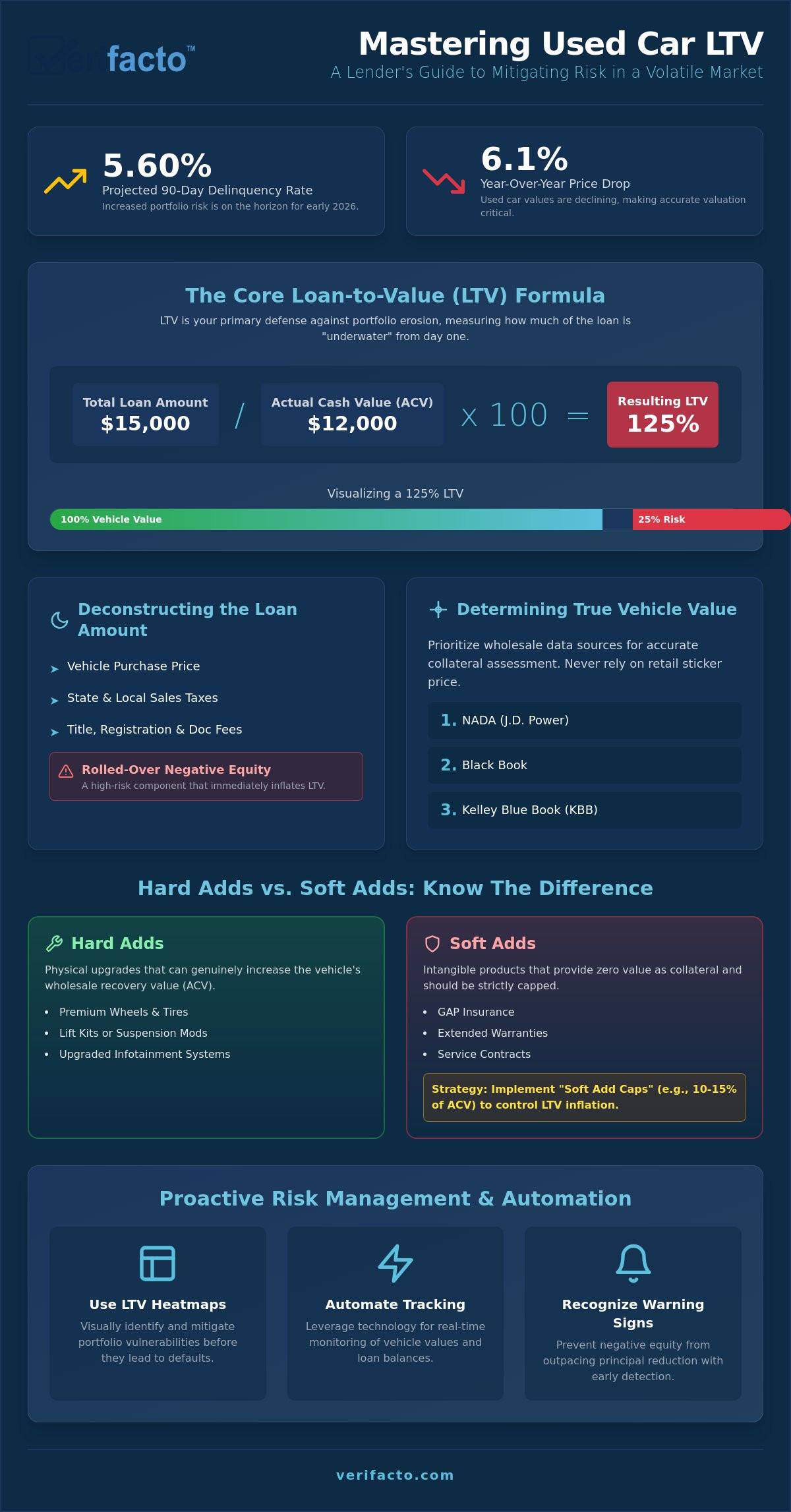
For any subprime or independent lender, the Loan-to-Value (LTV) Ratio represents the primary line of defense against portfolio erosion. It’s a simple percentage that tells a complex story about risk, collateral coverage, and borrower equity. At its core, LTV is the ratio of the total loan amount to the vehicle’s Actual Cash Value (ACV). When you’re calculating loan to value for used cars, you’re essentially measuring how much of the loan is “underwater” from the moment the contract is signed.
The standard formula is: (Total Loan Amount / Vehicle Value) x 100. While this seems elementary, the variables involved in used car transactions are far more volatile than those in the new car market. New car LTVs rely on a static Manufacturer’s Suggested Retail Price (MSRP). In contrast, used car values fluctuate based on mileage, regional demand, and condition. A mistake in the denominator can lead to over-advancing, leaving you with a loan that far exceeds the recoverable value of the asset.
The Mathematical Breakdown
Let’s look at a practical example. If a borrower needs a $15,000 loan for a vehicle with an ACV of $12,000, the calculation is (15,000 / 12,000) x 100. This results in an LTV of 125%. This “over-advance” usually occurs because the loan amount includes more than just the purchase price. The numerator often includes:
- State and local sales taxes.
- Title and registration fees.
- Documentation fees.
- Rolled-over negative equity from a trade-in vehicle.
Negative equity is particularly dangerous. If a borrower owes $2,000 more on their trade-in than it’s worth, that $2,000 is added to the new loan. This immediately inflates the LTV, making the loan more susceptible to default if the borrower’s financial situation shifts. Precise math here is non-negotiable for maintaining a healthy portfolio.
Hard Adds vs. Soft Adds
Professional lenders must distinguish between physical improvements and intangible products when calculating loan to value for used cars. Hard adds refer to physical upgrades that stay with the vehicle, such as premium wheels, lift kits, or upgraded infotainment systems. While these can increase the ACV, you should only credit them if they truly enhance the wholesale recovery value.
Soft adds include products like GAP insurance, extended warranties, and service contracts. These provide value to the borrower but offer zero protection as collateral. Most disciplined lenders set “soft add caps,” often limiting these items to 10% or 15% of the vehicle’s value. If soft adds push the total LTV beyond your internal threshold, it’s a clear signal to restructure the deal or require a larger down payment to bring the ratio back into a safe range.
Determining Vehicle Value: Wholesale, Retail, and the Used Car Variable
The denominator of your LTV equation is only as strong as the data source behind it. While a dealership might list a 2022 SUV for $28,000, that “sticker price” is functionally irrelevant when you’re calculating loan to value for used cars. It represents a target profit margin, not the recoverable value of the asset. As a lender, your focus must remain on the Actual Cash Value (ACV), specifically the price the vehicle would command at a dealer-only auction if you were forced to liquidate it tomorrow.
Standardizing your valuation hierarchy is the first step toward consistency when calculating loan to value for used cars. Most modern lenders prioritize NADA (J.D. Power) for its comprehensive data, followed by Black Book for its real-time wholesale insights, and Kelley Blue Book (KBB) for consumer-facing benchmarks. In 2026, where used car prices have declined by approximately 6.1%, relying on outdated or inflated retail data introduces a critical risk to your portfolio.
Wholesale vs. Retail: The Lender’s Perspective
Wholesale value is the only safe floor for collateral. Retail values include marketing costs and dealer overhead that vanish the moment the car leaves the lot. If you advance based on retail prices in a depreciating market, you’re essentially financing air. When explaining valuation adjustments to borrowers, focus on transparency. Show them how high mileage or a negative vehicle history report from a provider like Deals on Carfax impacts the loan’s structure. It isn’t about denying a deal; it’s about ensuring the loan is sustainable for both parties.
Automating the Valuation Process
Manual data entry is a relic that invites human error. A single mistyped digit in a VIN or a missed “Premium Trim” checkbox can skew your LTV by thousands of dollars. The solution lies in integrating valuation API feeds directly into your auto loan management software. This creates a standardized environment where every underwriter uses the same live data.
By automating these checks, you ensure that mileage, condition, and regional market trends are factored in instantly. This level of precision is exactly what Verifacto helps lenders achieve, transforming a complex manual hurdle into a streamlined, automated workflow. Consistent valuation rules across your team don’t just save time; they protect your capital from the volatility of the 2026 used car market.
Why High LTV Ratios Pose a Critical Risk to Your Portfolio
High Loan-to-Value (LTV) ratios are often the silent killer of independent lending portfolios. When you’re calculating loan to value for used cars, any figure exceeding 120% should trigger immediate scrutiny. There is a direct, documented correlation between high LTV ratios and increased default frequency. When a borrower is significantly “upside down,” their financial stake in the asset vanishes. This creates a “moral hazard” where the borrower feels less incentive to prioritize payments, especially when faced with a major mechanical failure or a personal financial setback. They aren’t just walking away from a car; they’re walking away from a debt that far exceeds the vehicle’s utility.
Negative equity represents a structural vulnerability. If the collateral no longer covers the cost of recovery, you’re essentially holding an unsecured signature loan masquerading as an auto loan. In the event of a default, the gap between the auction proceeds and the outstanding balance becomes a pure loss. When calculating loan to value for used cars in your current pipeline, remember that every percentage point over 100% is a dollar you’re unlikely to recover through traditional liquidation. This risk profile also dictates your requirements for collateral protection insurance (CPI), as the stakes of a total loss are significantly higher on an underwater asset.
The Threshold of Risk
Risk thresholds vary by portfolio type, but the math remains consistent. While prime lenders might cap LTV at 100% or 110%, subprime portfolios often stretch to 125% to accommodate taxes and fees. However, pushing to 130% or higher drastically increases your reserve requirements and stresses your capital health. Consider the cost of repossession. If you repossess a vehicle with a 130% LTV, you’re already starting with a 30% deficit before adding towing fees, storage, and auction commissions. These “hidden” costs can turn a manageable default into a catastrophic charge-off.
LTV and Insurance Vulnerability
High-LTV loans demand real-time insurance tracking to prevent total portfolio erosion. If an underwater vehicle is involved in a total loss without active insurance, the borrower is left with a massive deficiency balance and no transportation. This almost guarantees a default. You should use LTV as a primary trigger for your automated insurance verification workflows. By identifying “at-risk” loans with LTVs over 115%, you can prioritize communication and ensure that these specific assets are never left unprotected. This proactive approach transforms LTV from a static underwriting metric into a dynamic tool for ongoing loss mitigation.
Strategic LTV Management: Beyond the Initial Loan Approval
LTV calculation shouldn’t end at the closing table. Many lenders treat calculating loan to value for used cars as a one-time event, but in reality, it’s a living metric. As the vehicle depreciates and the borrower makes payments, the LTV shifts constantly. In a market where used car prices declined by 6.1% between 2025 and 2026, the gap between the loan balance and the collateral value can widen unexpectedly. If depreciation outpaces principal reduction, your “safe” 100% LTV loan can quickly spiral into a high-risk 115% LTV account without warning.
Visualizing this risk through LTV heatmaps allows you to identify exactly which segments of your portfolio are most vulnerable to market shifts. By segmenting loans by current LTV, you can prioritize resources and drive collection efficiency for auto loans. Automated Borrower Communication plays a vital role here. Sending proactive reminders or value updates to underwater borrowers helps maintain engagement and prevents the loss of motivation that often leads to default. It’s about keeping the borrower invested in the asset even when the equity is thin.
Portfolio-Wide LTV Monitoring
Strategic management requires moving from individual loan assessments to a macro view of portfolio health. Aggregate LTV metrics reveal how sensitive your entire business is to sudden drops in used car values. Setting automated alerts for accounts that cross critical thresholds, such as 125% LTV, allows your team to intervene before a delinquency occurs. This level of foresight is essential for maintaining capital stability and ensuring your reserves are appropriately funded for the 2026 market environment.
Mitigating Loss on High-LTV Accounts
When an account is significantly underwater, a standard collection script won’t suffice. You need tailored strategies that acknowledge the negative equity while reinforcing the necessity of maintaining the asset. This includes verifying that insurance coverage remains active through continuous Insurance Tracking. Protecting the collateral is your priority. Simultaneously, you must utilize robust auto finance compliance management to ensure every interaction remains fair, transparent, and legally sound, especially when dealing with high-risk borrowers.
Stop guessing about your portfolio’s exposure to market volatility. Leverage Verifacto’s real-time monitoring tools to gain total visibility into your collateral value and protect your bottom line today.
Optimising Portfolio Health with Verifacto’s Integrated DMS and LMS
Protecting your margins in a market where off-lease vehicle volumes are projected to rise by 25.7% in 2026 requires more than just a spreadsheet. You need a system that treats risk as a dynamic variable rather than a static snapshot. Verifacto DMS transforms the deal-structuring phase by instantly calculating loan to value for used cars as you build the contract. This ensures that every hard add, soft add, and tax fee is accounted for against live valuation data before you ever commit capital. You don’t have to guess if a loan is over-advanced; the system tells you exactly where you stand.
The real power lies in the seamless transition from sales to servicing. Once a deal is funded, Verifacto LMS takes over the heavy lifting of portfolio maintenance. It provides real-time syncing between fluctuating vehicle values and declining loan balances. This constant data refresh allows you to maintain accurate LTV tracking throughout the entire life of the loan. When market prices shift or mileage accumulates, your dashboard reflects those changes immediately, giving you the foresight needed to manage “at-risk” accounts before they become defaults.
The Power of Integrated Systems
Data silos are the enemy of effective risk management. When your sales team uses one tool and your collections team uses another, critical LTV shifts fall through the cracks. Verifacto eliminates these silos by bridging the gap between your DMS and LMS environments. This integration ensures that your LTV calculations remain compliant with evolving state regulations, such as the 2026 changes in Indiana or Virginia, and consistent across your entire underwriting team. Verifacto automates LTV monitoring by centralizing real-time collateral valuations and loan balances into a single source of truth, ensuring lender profitability remains protected against market depreciation.
Real-Time Risk Mitigation
High-LTV loans are inherently fragile, but you can stabilize them through integrated Insurance Tracking and CPI Solutions. Verifacto’s platform automatically identifies loans that cross your risk thresholds and triggers immediate insurance verification workflows. If a borrower on an underwater vehicle allows their policy to lapse, the system doesn’t wait for a manual report. It initiates Automated Borrower Communication to resolve the issue instantly. If the lapse persists, the bridge to CPI Solutions allows you to protect your collateral without operational friction. This proactive stance closes the gap between risk identification and loss prevention, turning your LTV data into a weapon for portfolio growth.
Future-Proofing Your Portfolio Against Market Volatility
In the 2026 market, precision isn’t a luxury; it’s a survival requirement. Mastering the process of calculating loan to value for used cars ensures that your portfolio remains grounded in recoverable asset values rather than inflated retail figures. You’ve seen how shifting from static underwriting to dynamic monitoring prevents negative equity from spiraling out of control. By prioritizing wholesale data and implementing strict caps on soft adds, you protect your capital from the inherent volatility of the used car sector.
Operational excellence requires the right tools to bridge the gap between risk identification and active mitigation. Verifacto provides the infrastructure to turn these strategic insights into daily reality. With our cloud-based LMS/DMS integration, real-time insurance tracking, and automated borrower communication tools, you can manage high-LTV accounts with total confidence. You don’t have to navigate these complex operational hurdles alone. We are here to help you scale safely.
Request a Verifacto Demo to Automate Your Portfolio Risk Management and take command of your lending future today. Your portfolio’s stability is within reach.
Frequently Asked Questions
What is a typical LTV limit for used car loans in 2026?
Typical LTV limits for used car loans in 2026 generally range between 110% and 125% depending on the borrower’s credit tier. While prime lenders often cap advances at 100% of the wholesale value, subprime portfolios frequently extend to 125% to accommodate taxes and fees. Given the 5.60% delinquency rate reported in early 2026, many institutions are tightening these caps to prevent excessive exposure to negative equity.
How does negative equity from a trade-in affect my LTV calculation?
Negative equity from a trade-in increases the total loan amount without adding any value to the collateral. This effectively inflates the numerator in your calculation, often pushing the LTV ratio well beyond the 120% mark. When calculating loan to value for used cars with rolled-over debt, you’re essentially financing an unsecured loss from a previous transaction, which significantly heightens the risk of default.
Which vehicle valuation book is best for used car lenders?
NADA (J.D. Power) and Black Book remain the gold standards for 2026 used car valuations. Most professional lenders prefer Black Book for its high-frequency wholesale data, which is critical in a market where prices recently declined by 6.1%. Using these guides ensures your LTV denominator reflects actual recovery potential at auction rather than inflated consumer-facing retail expectations.
Can I include GAP insurance in the LTV calculation?
Lenders usually allow GAP insurance as a “soft add” within the LTV calculation, but it’s often subject to a specific internal cap. A common industry standard is limiting soft adds, including service contracts and warranties, to 10% or 15% of the vehicle’s Actual Cash Value. This prevents the total loan balance from becoming dangerously disconnected from the physical collateral protecting the investment.
How does LTV impact the interest rate offered to a borrower?
Higher LTV ratios almost always result in higher interest rates for the borrower to compensate for increased risk. Because the portion of the loan exceeding 100% LTV is effectively unsecured, lenders charge a risk premium to offset the potential for a “short” recovery during liquidation. This pricing adjustment is a fundamental strategy for maintaining a healthy yield across a diverse loan portfolio.
What happens to the LTV ratio as a used car depreciates?
The LTV ratio increases if the vehicle’s market value drops faster than the borrower pays down the loan principal. In 2026, with used car prices stabilizing but still trending downward, many loans risk becoming “underwater” midway through the term. This makes calculating loan to value for used cars a continuous necessity for risk management rather than a one-time underwriting task at the point of sale.
Why is wholesale value preferred over retail value for LTV calculations?
Wholesale value is the only safe benchmark for LTV because it represents what you can actually recover at auction if the loan defaults. Retail prices include dealer markups, marketing costs, and overhead that vanish the moment the car leaves the lot. Relying on retail values creates a false sense of security and almost guarantees significant financial losses during a repossession and subsequent liquidation.
How can I automate LTV tracking across my entire loan portfolio?
You can automate LTV tracking by integrating your sales and servicing data through tools like Verifacto DMS and Verifacto LMS. These systems sync live valuation feeds with real-time loan balances, providing an instant, accurate view of your collateral position. Automation eliminates manual entry errors and allows you to set proactive alerts for accounts that cross high-risk LTV thresholds, enabling faster intervention.