
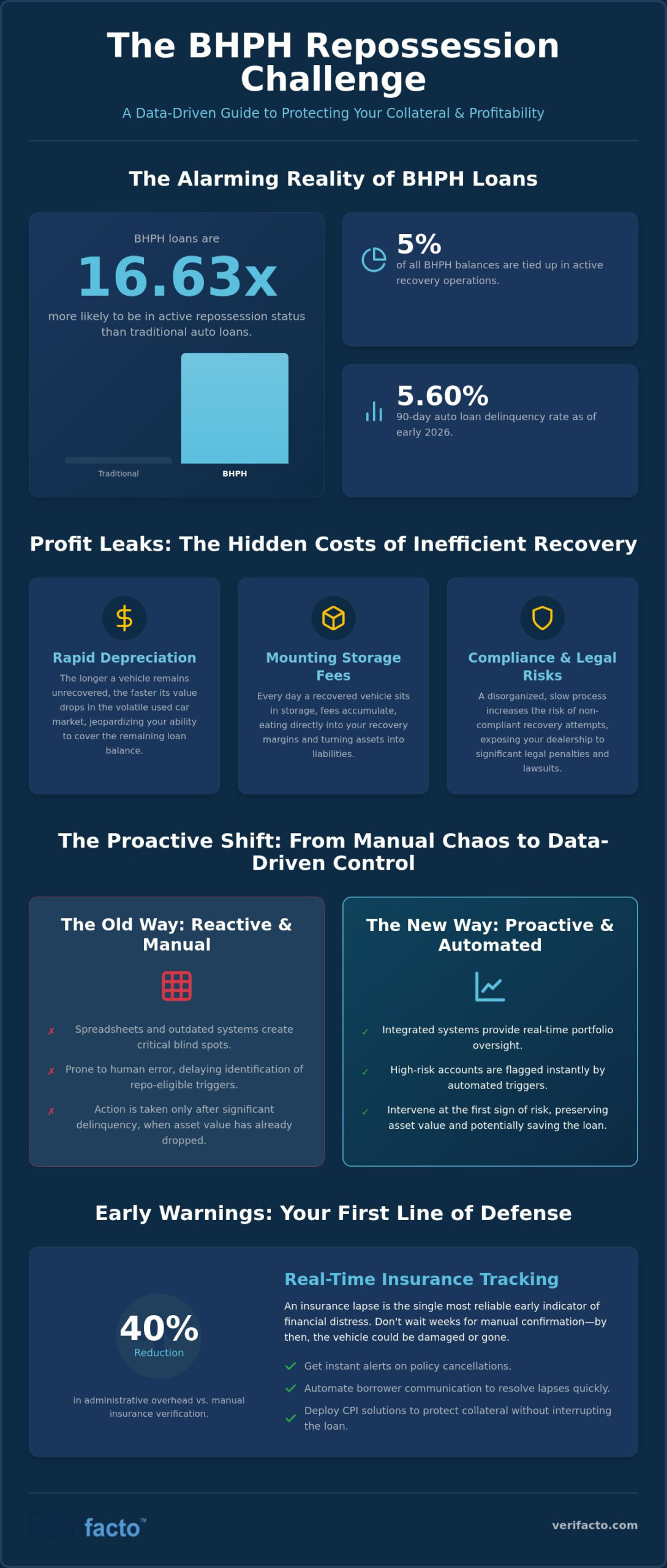
Did you know that buy-here-pay-here loans are 16.63 times more likely to be in active repossession status than traditional auto loans? As of early 2026, roughly 5% of all BHPH balances are tied up in active recovery, creating a massive operational burden for lenders. Successfully managing repossessions for BHPH dealers is no longer just about hiring a tow truck; it’s about protecting your collateral before the asset value vanishes.
You’ve likely felt the sting of high storage fees eating into your margins or recovered a vehicle only to find it in poor condition because the process took too long. It’s frustrating to watch your profits disappear into a chaotic cycle of recovery and repair. We’ll show you how to transform this drain into a structured, data-driven strategy that safeguards your bottom line. This article breaks down the essential steps to improve recovery speed and maintain full compliance with 2026 regulations like the California CARS Act, ensuring your portfolio remains secure and profitable.
Key Takeaways
- Identify the hidden costs of poor recovery management, such as rapid depreciation and storage fees, to stop profit leaks immediately.
- Utilize real-time insurance tracking and CPI solutions as early warning systems to detect potential defaults before they require a tow truck.
- Establish a structured, policy-based workflow for managing repossessions for BHPH dealers that uses clear triggers to speed up recovery times.
- Navigate 2026 compliance requirements with ease while using data-driven decision trees to maximize the remarketing value of recovered assets.
- Leverage an integrated, cloud-based DMS and LMS to maintain total portfolio oversight and automate borrower communication to prevent delinquency.
The Financial Impact of Repossession Management for BHPH Dealers
Repossession management is the systematic process of identifying, recovering, and remarketing collateral to minimize financial loss. For those operating in the Buy Here, Pay Here (BHPH) industry, this isn’t just a back-office task; it’s a survival strategy. Effective managing repossessions for BHPH dealers requires you to recognize that every hour a non-performing asset sits on the street, its value is evaporating. Poor management invites “hidden costs” that quickly exceed the original loan balance, including rapid vehicle depreciation, mounting daily storage fees, and the looming threat of legal liabilities from non-compliant recovery attempts.
As of early 2026, the 90-day auto loan delinquency rate has climbed to 5.60%. This surge puts immense pressure on your recovery-to-remarketing cycles. You can’t afford a sluggish process. A direct correlation exists between recovery speed and the physical state of the vehicle. The longer a borrower avoids a repo, the more likely the vehicle is to return with mechanical issues or significant body damage. Fast recovery is the only way to preserve the asset’s remaining equity.
Quantifying the Cost of Delinquency
Stop viewing delinquency as a waiting game. Every day a vehicle remains unrecovered, you’re losing money on two fronts. First, consider the daily depreciation rate of your typical inventory. In a volatile 2026 used car market, that value drops faster than you might think. Second, calculate the opportunity cost of capital. Money tied up in a non-performing loan is money you can’t use to floor new, profitable inventory. If you wait too long to initiate recovery, your charge-off rates will skyrocket because the auction value won’t cover the remaining balance.
Why Traditional Manual Tracking Fails
Relying on spreadsheets or outdated DMS systems is a recipe for disaster. Manual tracking is prone to human error, especially when your team is trying to monitor complex insurance lapses across hundreds of accounts. When your data is fragmented, you develop blind spots that hide critical “repo-eligible” triggers. By the time a staff member notices a 60-day delinquency or a cancelled insurance policy, the asset might have already disappeared. Modernized managing repossessions for BHPH dealers requires a seamless, automated flow of data to ensure you act the moment a risk is identified.
Leveraging Real-Time Data to Reduce Repossession Rates
Many lenders treat the recovery process as a purely reactive measure. This is a mistake. Data-driven managing repossessions for BHPH dealers starts long before a payment is missed. By monitoring behavioral triggers in real time, you can intervene when a “soft” delinquency occurs, potentially saving the loan and avoiding the high costs of physical recovery. Lenders who wait for a 30-day delinquency to take action are often already behind the curve.
Integrated data streams allow you to move from a defensive posture to a proactive one. When your loan management system (LMS) is synchronized with real-time monitoring, high-risk accounts are flagged instantly. This visibility provides you with the stability and control needed to navigate a volatile market. It shifts the focus from chasing assets to maintaining performing loans, which is the most effective way to protect your bottom line.
Insurance Tracking: The Proactive First Step
An insurance lapse is rarely an isolated incident. It is frequently the first indicator that a borrower is facing financial distress. When a policy is cancelled, the risk of an uncollateralized loss spikes immediately. Utilizing real-time insurance tracking allows you to see these lapses as they happen, not weeks later when the car might already be damaged. This proactive approach is essential for staying within the boundaries of Vehicle Repossession laws, as it gives you a documented reason to contact the borrower before a total default occurs. Automated verification processes are highly efficient. These systems can reduce administrative overhead by 40% compared to manual phone calls to insurance agents. If the borrower fails to secure their own policy, integrated CPI solutions can be deployed to protect the collateral while keeping the account active.
Automated Communication Strategies
Speed is your greatest ally in loss mitigation. Automated SMS and email triggers remind borrowers of their obligations the moment a lapse or missed payment is detected. This approach is assertive yet helpful. It provides a path to resolution rather than just a demand for payment. You want to be a partner who helps them keep their vehicle. By linking these communication logs directly to your auto loan management software, you create a full audit trail that proves you followed proper procedures. This transparency is vital for compliance and helps you identify which accounts are worth saving. Integrating these tools into Verifacto’s unified platform ensures that your team spends less time on data entry and more time on high-value portfolio management.
Building a Structured Repossession and Recovery Workflow
Chaos is the enemy of recovery. When you lack a structured workflow, your staff wastes time on manual follow-ups while assets continue to depreciate on the street. Effective managing repossessions for BHPH dealers depends on a sequence of events that triggers automatically when specific delinquency thresholds are met. You need a system where the decision to recover is based on firm policy, not a gut feeling or a staff member’s memory.
A structured handoff from collections to recovery ensures that no account falls through the cracks. This process protects your collateral and ensures that your dealership remains compliant with federal and state laws. By defining clear “repo-eligible” triggers, you eliminate the ambiguity that often leads to costly delays. Once a vehicle is recovered, your workflow must move it immediately into reconditioning and remarketing to recapture its remaining value.
The Repo-Eligible Playbook
Establishing a standard operating procedure (SOP) is essential for maintaining control over your portfolio. Use these three steps to streamline your decision-making and reduce recovery times:
- Automated Flagging: Your LMS should instantly flag accounts that exceed pre-set delinquency thresholds or lack active insurance coverage. This removes the “guesswork” from your collections department.
- Compliance Verification: Before assigning the file, perform a final check of “Right to Cure” notices. Following FTC guidelines on vehicle repossession helps you avoid “breach of peace” violations and potential legal blowback.
- Assignment: Send the file to your recovery agent immediately. Provide them with all necessary collateral data, including vehicle location history and verified insurance status.
Vendor Coordination and Asset Recovery
Managing multiple recovery agents can become a logistical nightmare if you’re still using fragmented phone calls and emails. A centralized platform allows you to manage agents efficiently and track recovery notes in real time. This visibility is crucial for managing repossessions for BHPH dealers because it prevents dual-tracking issues. You don’t want two agents attempting to recover the same vehicle simultaneously, as this creates a massive liability risk and wastes your recovery budget.
Insist that your agents follow your “no-nonsense” operational standards. They represent your dealership in the field. Once the agent secures the asset, the workflow must trigger the next phase: reconditioning. Speeding up the transition from the recovery lot to the sales floor allows you to remarket the vehicle faster. This prevents the asset from sitting idle and incurring daily storage fees that eat into your eventual resale profit.
Navigating Compliance and Maximizing Asset Recovery Values
Compliance isn’t just about avoiding fines; it’s about protecting your right to collect. In 2026, federal and state regulators have placed the BHPH sector under a microscope, with the FTC and CFPB focusing heavily on transparency. Effective managing repossessions for BHPH dealers requires a rigorous adherence to auto finance compliance management standards. One misstep in a post-repo notice or a “breach of peace” violation can lead to costly litigation that wipes out the value of the collateral entirely. You need a process that is both legally sound and financially optimized.
Maximizing recovery value requires a data-driven remarketing decision tree. You must decide whether to wholesale an asset or recondition it for your own lot based on real-time market data. This choice shouldn’t be a guess. By analyzing deficiency balances and recovery metrics, you can refine your future lending criteria to avoid high-loss segments. Tracking your loss data helps you understand the true cost of every recovery, allowing you to make smarter decisions about which assets are worth the effort of physical recovery. Secure your portfolio with Verifacto’s integrated compliance tools to ensure every recovery is handled by the book.
Staying Compliant in a High-Stakes Environment
Standardized, time-stamped documentation is your best defense against legal challenges. Every step of the recovery process must be recorded to prevent the nightmare of a “wrongful repossession” claim. Automated workflows ensure that notices are sent on time and that all state-specific requirements, such as Oklahoma’s updated delinquency charges effective July 1, 2026, are met. You must also understand the nuances between the ‘Right to Redeem’ and the ‘Right to Reinstate.’ These rights vary significantly by jurisdiction. Failing to provide the correct notice can result in the loss of your right to a deficiency judgment, making a structured compliance checklist essential for every file. For legal professionals who assist with these complex documentation and practice requirements, platforms like Aequivio provide the structure needed to maintain an airtight defense, particularly for firms operating within the Canadian legal landscape.
Remarketing for Maximum Recovery
When a vehicle returns, evaluate reconditioning costs against the projected retail value immediately. Don’t spend money on a car that won’t net a positive return. Use historical data from your DMS to identify which recovered models sell fastest in your local market. If a specific make typically sits for 60 days, it might be better to wholesale it and free up the cash for better inventory. The most critical metric to track is ‘Net Recovery.’ This is the final amount remaining after subtracting recovery fees, storage, and reconditioning from the sale price. If your Net Recovery is consistently low, it’s time to re-evaluate your recovery partners or your initial underwriting standards to better mitigate managing repossessions for BHPH dealers.
Optimizing Your Portfolio with Verifacto’s Integrated Platform
In the high-stakes environment of subprime lending, fragmented systems are your biggest liability. Effectively managing repossessions for BHPH dealers in 2026 requires a platform that bridges the gap between loan servicing and asset recovery. When your DMS and LMS don’t communicate, critical data points like insurance lapses or missed payments get buried in the noise. Verifacto’s cloud-based platform eliminates these silos, providing the real-time oversight you need to make fast, informed decisions about your collateral.
Modernizing your repo process is the fastest way to improve BHPH liquidity. By utilizing integrated payment solutions for dealers, you can prevent delinquency before it starts. This proactive approach keeps borrowers on the road and keeps your cash flow steady. When recovery becomes necessary, our system ensures the transition is seamless, compliant, and data-driven, protecting your bottom line from the chaos of manual tracking.
A Single Source of Truth for Collateral
Success in loss mitigation depends on having a single source of truth. Verifacto combines insurance tracking, payment history, and borrower communication into one unified interface. This integration removes the friction that typically slows down the recovery process. Our “no-filler” operational dashboard gives portfolio managers a clear view of which accounts are performing and which ones require immediate intervention. We act as a reliable guardian for your business, simplifying complex operational hurdles so you can focus on growth rather than chasing paperwork. Having all your data in one place ensures that you never miss a repo-eligible trigger again.
Taking Control of Your Recovery Strategy
Stop making reactive tow-truck calls based on 30-day-old data. Take control by moving toward a strategy of proactive risk mitigation. Verifacto’s automated reporting tools allow you to identify trends in your default portfolio that might otherwise go unnoticed. Use these insights to refine your strategy:
- Identify specific vehicle models with higher-than-average recovery costs.
- Track borrower communication patterns that correlate with successful payment restructures.
- Analyze the time-to-recovery metrics to evaluate the performance of your third-party agents.
Your next step is to audit your current repo workflow for 2026 efficiency. Identify the bottlenecks where information is lost and replace them with automated triggers. By modernizing your approach today, you transform your recovery department from a financial drain into a structured, profit-protecting asset that ensures the long-term stability of your dealership.
Securing Your Portfolio for 2026 and Beyond
The landscape of subprime auto finance is shifting. To thrive, you must move beyond reactive recovery and embrace a lifecycle approach to loss mitigation. Success in managing repossessions for BHPH dealers requires you to identify risks the moment they appear, whether through an insurance lapse or a missed payment. By implementing a structured, data-driven workflow, you stop profit leaks and ensure every recovery is handled with surgical precision and full legal compliance.
Verifacto provides the tools you need to master these complex operational challenges with cloud-based automation. Our platform protects your collateral through real-time insurance tracking and integrated CPI solutions, while built-in payment processing works to reduce delinquency before it even starts. You don’t have to navigate these high-stakes environments alone. Take the first step toward a more stable and profitable future by modernizing your operations today. Streamline your repossession workflow with Verifacto’s integrated DMS/LMS today. Your bottom line deserves the security of a reliable guardian.
Frequently Asked Questions
What are the most common compliance mistakes BHPH dealers make during repossession?
The most frequent errors include failing to provide timely “Right to Cure” notices and ignoring state-specific fee updates. In 2026, many dealers stumble by not documenting “breach of peace” standards or missing new disclosure requirements under laws like the California CARS Act. Standardized, time-stamped documentation is your best defense. It ensures you have a clear audit trail to combat costly legal challenges or wrongful repossession claims.
How can real-time insurance tracking actually prevent a vehicle repossession?
It acts as an early warning system by flagging financial distress before a payment is even missed. When a borrower cancels their policy, it often signals an upcoming default. By intervening early with automated communication or CPI solutions, you can resolve the insurance lapse and keep the borrower on the road. This proactive approach keeps the loan performing and effectively avoids the need for expensive physical recovery.
When is the right time to transition a delinquent account to ‘repo-eligible’ status?
Transition occurs the moment an account hits your pre-defined delinquency threshold or loses active insurance coverage. Successful managing repossessions for BHPH dealers requires following a strict, policy-based playbook rather than waiting for a gut feeling. Speed is critical because asset value evaporates daily. The longer you wait to trigger the recovery process, the more the collateral depreciates and the higher the risk of mechanical damage.
What documentation is required to legally initiate a repossession in 2026?
How do integrated payment portals help reduce the need for asset recovery?
Integrated portals lower the barrier to payment by offering convenient, automated options like SMS-pay or recurring ACH. When payments are frictionless, borrowers are far less likely to fall into deep delinquency. Real-time integration with your LMS ensures that you see every transaction instantly. This allows your team to focus their collection efforts only on the high-risk accounts that actually require manual intervention or recovery planning.
Can automated borrower communication really improve my recovery rates?
Yes, it ensures that every delinquent borrower receives immediate, consistent reminders about their obligations. Automated SMS and email triggers remove the risk of human error or forgotten follow-ups. This persistent but professional communication often encourages borrowers to return the vehicle voluntarily or settle their debt. Voluntary returns are significantly less expensive than hiring a recovery agent for a forced tow, directly protecting your bottom line.
What is the difference between a DMS and an LMS when it comes to managing repossessions?
A DMS focuses on inventory and sales, while an LMS handles loan servicing and collections. For managing repossessions for BHPH dealers, the LMS is the engine that tracks delinquency and triggers repo-eligible flags. Using an integrated platform that combines both ensures that your data flows seamlessly. This prevents operational blind spots, such as your sales team accidentally trying to sell a vehicle that is still in active recovery status.
How should a BHPH dealer handle remarketing a repossessed vehicle for maximum ROI?
Evaluate the reconditioning costs against the projected retail value immediately upon recovery. Use historical sales data from your DMS to decide whether to wholesale the asset or put it back on your lot. Focus on the “Net Recovery” metric, which accounts for all fees, storage, and repairs. If a vehicle won’t turn a profit after reconditioning, wholesaling it quickly preserves your cash flow and prevents further depreciation.