
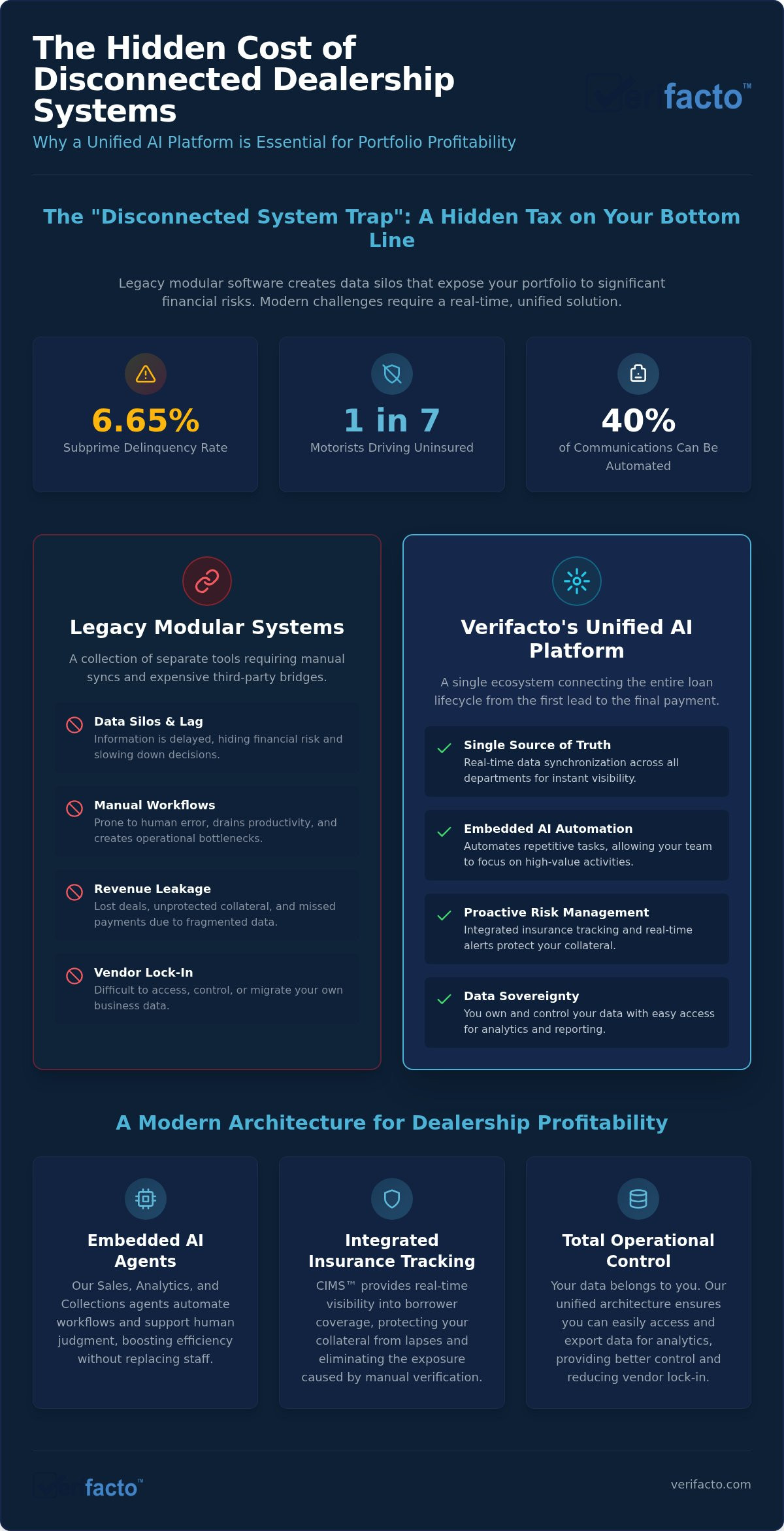
With subprime delinquency rates hitting 6.65% and one in seven motorists driving without insurance, the modular software of the past has become a liability. You’ve likely felt the daily friction of managing a single business through disconnected systems that refuse to talk to each other. When evaluating a unified AI operating platform, the choice isn’t just about a checklist of features. It’s about whether your technology architecture supports aggressive growth or imposes a hidden “integration tax” that erodes your bottom line.
You need a platform that provides total visibility without the headache of manual data entry or constant employee follow-up. This guide demonstrates why modernizing to a unified AI-powered operating platform is the essential move to maximize portfolio profitability in 2026. We’ll explore how connecting the entire loan lifecycle, from the first lead to the final payment, allows you to automate insurance verification and eliminate the revenue leakage caused by fragmented data.
Key Takeaways
- Understand how a unified operating platform eliminates the revenue leakage caused by the “disconnected system trap” found in legacy modular software.
- Discover how integrated CIMS™ insurance tracking provides real-time visibility into borrower coverage lapses to protect your collateral more effectively.
- Learn why embedded AI agents are designed to automate repetitive workflows like lead engagement and collections without replacing human judgment.
- Evaluate the long-term architectural differences of verifacto vs dealercenter to determine which system offers better data sovereignty and operational control.
- Explore a practical roadmap for modernizing your dealership operations from the first lead to the final payment within a single, secure ecosystem.
Beyond the Feature Checklist: The Cost of Disconnected Dealership Data
Dealerships operate one business but are often forced to manage it through disconnected systems. This is the “Disconnected System Trap.” When your CRM doesn’t communicate with your LMS, or your DMS requires manual data syncing to track insurance, you aren’t just dealing with a minor inconvenience. You’re experiencing revenue leakage. In the 2026 economy, where subprime delinquency rates have reached 6.65% and 60-day delinquencies have climbed to 1.00%, relying on delayed data is a high-stakes gamble. You need a platform that acts as a single source of truth.
The financial impact of duplicate data entry is often underestimated. Every time an employee manually moves a lead from a sales tool into a loan management system, the risk of human error increases. A mistyped phone number or a missed insurance expiration date can lead to thousands of dollars in losses. When evaluating verifacto vs dealercenter, the primary question isn’t about a list of features. It’s about which architecture prevents your data from living in silos that hide financial risk. Verifacto brings the operation, data, and AI together in one platform, ensuring that data flows seamlessly from the first lead to the final payment.
Identifying Revenue Leakage in Modular Workflows
Manual borrower communication is a massive time sink that drains your staff’s productivity. Industry data suggests that a unified platform is designed to help automate up to 40% of borrower communications, yet many dealerships still rely on manual outreach. This inefficiency creates a bottleneck that prevents your team from focusing on high-value tasks. Disconnected leads often fail to convert into active loans because the handoff between sales and finance is fragmented. If your sales agent doesn’t have real-time visibility into the lender’s requirements, the deal slows down, and the customer walks away.
Risk management also suffers in a modular environment. With 1 in 7 motorists driving without insurance and the national average cost for full coverage reaching $2,932, the stakes for collateral protection have never been higher. Fragmented verification tools often miss insurance lapses because they rely on static fields that require manual updates. This delay creates a window of exposure where your collateral is unprotected, potentially leading to significant financial loss if an accident occurs during a coverage gap.
The Verifacto Advantage: A Unified Operating Ecosystem
Verifacto eliminates the “integration tax” associated with modular systems. Instead of paying for expensive third-party bridges or spending hours on manual data syncing, you gain an ecosystem where every module is built on a unified database. This architecture provides 360-degree visibility into your portfolio health, allowing you to spot trends and risks before they become crises. You don’t have to wait for a weekly report to see your delinquency rates; the data is available in real time, supporting better human judgment and faster decision-making.
Bringing the operation, data, and AI together provides greater visibility into every aspect of your business. This transition from modular tools to a connected lifecycle is the key to maintaining stability in a volatile market. To understand how these systems function at a fundamental level, you can explore our resource on What is DMS? The Complete Guide to Dealer Management Systems in 2026. Choosing between verifacto vs dealercenter ultimately comes down to whether you want a collection of separate tools or a single, secure operating platform that protects your capital.
Cloud-Native Intelligence vs. Legacy Modular Systems
The architectural difference between a modular system and a unified platform isn’t just technical; it’s operational. When comparing verifacto vs dealercenter, many dealers find that modular legacy systems create a “lag” in data. In a modular setup, information often flows through bridges or scheduled syncs. In 2026, this delay is unacceptable for risk management. A unified, cloud-native platform ensures that when a lead is captured or a payment is processed, every department sees the update instantly. This real-time synchronization is critical for protecting your capital and making informed origination decisions.
Security and compliance are no longer optional add-ons. Lenders must adhere to strict regulations, including the FTC’s Safeguards Rule. Verifacto prioritizes this through SOC II compliance and bank-level encryption, providing a level of security that legacy modular systems often struggle to match. By centralizing your data in a secure, cloud-hosted environment, you reduce the surface area for potential breaches while maintaining a clear audit trail for every transaction. Choosing between verifacto vs dealercenter often comes down to how much “integration tax” you are willing to pay in the form of manual reconciliation and security risks.
Accessibility and the “Anytime, Anywhere” Mandate
Managing a multi-location operation requires flexibility. The Verifacto platform is designed to provide complete control from a mobile device using the LoanApp. This allows managers to review portfolio performance or approve deals while away from the desk. Remote sales teams can access cloud-hosted CRM tools to engage leads without being tethered to a physical lot. With a 99.99% uptime guarantee, the platform ensures your business remains operational around the clock, providing the stability needed to handle high-stakes environments.
Scalability Without Operational Bloat
As your portfolio grows, your technology should not become a burden. Cloud-native systems are built to scale effortlessly, allowing you to add more accounts or locations without increasing your IT overhead. This approach reduces vendor lock-in by offering a flexible platform that supports diverse integrations through a unified database. If you want to understand how this fits into the broader lending landscape, see our 2026 Guide for Modern Lenders. Transitioning to a unified system is designed to provide greater visibility into your daily operations. See how Verifacto connects your operation from the first lead to the final payment.
Protecting Your Portfolio: Integrated Insurance Tracking vs. Third-Party Add-ons
Relying on manual insurance tracking is one of the most significant financial liabilities a dealership can carry in 2026. Spreadsheets and static data fields are inherently reactive; they only tell you a policy was active at the time of the last manual update. With 1 in 7 motorists driving without insurance and the national average cost for full coverage reaching $2,932, borrowers are more likely than ever to let policies lapse. If your collateral is damaged during a coverage gap, the financial loss falls directly on your balance sheet. Choosing verifacto vs dealercenter requires a look at how each platform handles this risk. While modular systems often rely on third-party marketplace add-ons that require manual reconciliation, a unified platform provides a more streamlined approach.
Verifacto’s integrated Collateral Insurance Management System (CIMS™) is designed to provide real-time visibility into coverage status. This isn’t just about recording a policy number; it’s about an automated workflow that detects cancellations or expirations the moment they happen. By centralizing this data within the same database that manages your loans, you eliminate the “integration tax” of managing disconnected vendor systems. This architecture provides the stability and control needed to navigate high-stakes environments safely, ensuring your capital remains protected without constant manual oversight.
Mitigating Risk with Real-Time Monitoring
Automating the verification process is the only way to stay ahead of high-risk accounts. When insurance behavior patterns indicate a likely lapse, the platform provides the necessary tools to intervene before the risk becomes a loss. This proactive stance is essential for maintaining compliance with the FTC Safeguards Rule, which mandates strict oversight of customer data and risk mitigation strategies. To ensure your operation stays aligned with these evolving requirements, refer to The 2026 Auto Finance Compliance Management Checklist. Automated detection creates an audit-ready log that simplifies regulatory reporting and reduces compliance friction.
Seamless Collateral Protection Insurance (CPI) Integration
Manual force-placement of insurance is a slow, error-prone process that often leaves gaps in protection. Modern lenders are moving toward automated CPI solutions that trigger placement the instant a lapse is confirmed. Managing the entire insurance lifecycle within the LMS interface ensures that your staff doesn’t have to toggle between disconnected tools. For a deeper look at protecting your capital, read our guide on What is Collateral Protection Insurance (CPI)? A 2026 Lender’s Guide. This level of integration is what separates a unified operating platform from a collection of bolted-on modules, allowing you to maximize portfolio profitability while minimizing manual labor.
Driving Profitability with Embedded AI Agents: Sales, Analytics, and Collections
Many dealerships invest in AI as a standalone novelty, only to find it adds another layer of disconnected data to their workflow. For AI to be effective, it must be an embedded tool that supports human judgment rather than a separate module requiring manual oversight. When looking at verifacto vs dealercenter, the difference lies in how intelligence is integrated. While modular systems often rely on basic email triggers, Verifacto utilizes specific embedded AI agents that leverage your real-time business data to automate complex workflows.
The platform’s architecture allows the Sales Agent, Analytics Agent, and Collections Agent to work in harmony. These aren’t just automated scripts; they are assistants designed to provide greater visibility into every stage of the customer lifecycle. The Analytics Agent, for instance, identifies trends in your portfolio that might otherwise go unnoticed, such as specific borrower behaviors that correlate with higher insurance risk or payment default. By connecting the operation, data, and AI in one platform, you can transform raw portfolio data into predictive insights that drive capital preservation and growth.
Boosting Closing Rates with the AI Sales Agent
The AI Sales Agent is designed to handle routine inquiries 24/7, ensuring that no lead is left behind because of a slow human response. It manages initial engagement and appointment scheduling, allowing your sales team to focus on high-value deal closing rather than chasing cold leads. This automation helps prevent the revenue leakage often seen in disconnected systems where leads fail to transition smoothly from the CRM to the loan origination phase. By automating the first touch, you create a seamless experience that keeps borrowers engaged from the moment they express interest.
Improving Collection Efficiency and Recovery
With subprime delinquency rates climbing, your collections strategy must be both precise and persistent. The AI Collections Agent uses structured borrower communication to drive higher payment performance without increasing staff workload. These AI operational assistants manage task scheduling and repossession triggers based on real-time data, ensuring that your team intervenes at exactly the right moment. This proactive approach is designed to help reduce the manual effort required for constant follow-up.
For a deeper look at maximizing recovery, see our resource on Improving Collection Efficiency for Auto Loans: The 2026 Strategy Guide. Book a demonstration to explore how these agents fit your business and help protect your bottom line from the first lead to the final payment.
Modernizing Your Operation: Data Sovereignty and Seamless Migration
Many dealership owners hesitate to modernize their technology because they fear the disruption of a major migration. It’s a valid concern. Moving years of records from legacy modular systems to a unified platform feels like a high-stakes surgery. However, staying tethered to fragmented tools creates a different kind of risk: vendor lock-in. When your data is buried in proprietary silos that are difficult to export, you lose the ability to perform independent analysis or switch providers if your needs change. When evaluating verifacto vs dealercenter, you must consider who truly controls your business data.
Data sovereignty is a core principle of the Verifacto platform. We believe you deserve easy access to your own information. The platform is designed to allow for seamless data exports, ensuring you can pull analytics for external reporting or audit requirements whenever necessary. This transparency reduces the friction of migration and gives you the flexibility to grow your portfolio on your own terms. Instead of a “rip and replace” approach that stops your business in its tracks, we offer a logical path to modernization that starts with the modules you need most.
Accounting and QuickBooks Integration
Financial accuracy is the backbone of any successful auto finance operation. A unified system ensures a seamless sync with QuickBooks, eliminating the need for manual ledger entries that invite human error. When you utilize integrated payment solutions, every transaction feeds directly into your financial reporting in real time. This covers the entire spectrum of processing:
- Automated ACH scheduling for consistent cash flow.
- Real-time card processing with instant ledger updates.
- Structured cash handling protocols to maintain a clear audit trail.
By streamlining these workflows within a single interface, you provide your accounting team with the visibility they need to maintain accurate financial health without chasing disconnected vendor reports. This connectivity ensures that your final payments are as visible and secure as your first leads.
Foundation for Long-Term Dealership Growth
The 2026 market presents unique challenges that legacy tools weren’t built to handle. High interest rates and shifting risk profiles require a level of operational agility that modular systems simply can’t provide. Positioning your dealership to thrive in this environment means moving away from the “integration tax” of the past. A unified AI-powered operating platform brings your operation, data, and AI together, creating a stable foundation for capital preservation and growth. It’s time to stop managing software and start managing your business. Book a demonstration to explore how the platform fits your business and see how Verifacto connects your operation from the first lead to the final payment.
Securing Your Dealership’s Financial Future
Modernizing your operation in 2026 requires more than just adding new software features. It demands a fundamental shift from modular legacy systems to a unified ecosystem that protects your capital. By integrating real-time CIMS™ insurance tracking and specific AI-powered Sales and Collections Agents, you eliminate the “integration tax” that drains your profitability. This transition is designed to provide greater visibility into every stage of the loan lifecycle, ensuring that risk is managed proactively rather than reactively.
The comparison of verifacto vs dealercenter highlights a clear choice for growth-minded lenders: a collection of disconnected modules or a single operating platform built on a secure, SOC II compliant cloud architecture. Your data belongs to you, and your technology should work as hard as your team does to maintain stability in a high-stakes environment. Book a demonstration to explore how the platform fits your business and see how Verifacto connects your operation from the first lead to the final payment. We are ready to help you build a more secure and efficient future for your portfolio.
Frequently Asked Questions
What is the primary difference between Verifacto and DealerCenter in 2026?
The main difference lies in the underlying architecture of each platform. Verifacto is a unified AI-powered operating platform built on a single database, while DealerCenter uses a modular design that often requires third-party integrations. When comparing verifacto vs dealercenter, dealers find that Verifacto’s unified approach eliminates the “integration tax” and data silos common in modular systems, providing a more seamless flow from lead to final payment.
Does Verifacto include integrated insurance tracking like DealerCenter?
Yes, but Verifacto provides a more automated solution through its integrated CIMS™ (Collateral Insurance Management System). Unlike systems that rely on static fields and manual updates, Verifacto offers real-time visibility into coverage lapses. The platform is designed to trigger automated workflows for verification and CPI placement, ensuring your collateral is never left unprotected due to human oversight or delayed data syncs.
Can Verifacto help reduce my dealership’s delinquency rates through AI?
Verifacto is designed to provide greater visibility into portfolio risks and can help manage delinquencies through the Collections Agent. This embedded AI tool handles structured borrower communication and consistent follow-ups that might be missed by human staff. By automating these repetitive tasks and using predictive analytics to identify high-risk accounts, the platform supports your team in maintaining a healthier, more profitable portfolio.
Is it difficult to migrate my existing data from DealerCenter to Verifacto?
Migration is a streamlined process designed to minimize operational disruption. Verifacto prioritizes data sovereignty, meaning we help you transition your records securely while ensuring you maintain full control over your information. The platform’s flexible architecture supports importing data from modular systems, and our team provides the technical guidance needed to move your entire customer and loan lifecycle into a single, unified ecosystem.
Does Verifacto integrate with QuickBooks for dealership accounting?
Yes, Verifacto features a deep, real-time sync with QuickBooks to ensure your financial reporting is always accurate. Payments processed through the platform, whether via ACH, card, or cash, feed directly into your ledger. This integration eliminates the need for duplicate data entry and reduces the risk of accounting errors, providing your team with a clear and reliable audit trail for every transaction.
What specific AI agents are available on the Verifacto platform?
The platform features three specific AI agents: the Sales Agent, the Analytics Agent, and the Collections Agent. These aren’t standalone novelties; they are embedded tools that leverage your business data to automate workflows. The Sales Agent manages lead engagement 24/7, the Analytics Agent identifies predictive portfolio trends, and the Collections Agent handles automated borrower outreach to ensure consistent payment performance across your entire portfolio.
Is Verifacto SOC II compliant for data security and protection?
Verifacto maintains SOC II compliance and utilizes bank-level encryption to protect sensitive borrower and dealership data. This high standard of security is essential for meeting federal regulations and maintaining the trust of your financial partners. By centralizing your operations on a secure cloud platform, you gain a level of protection and reliability that legacy modular systems often struggle to provide in today’s high-stakes environment.
Can I manage multiple dealership locations through Verifacto’s cloud platform?
Yes, Verifacto’s cloud-native architecture is specifically designed for multi-location operations. You can manage every branch, lead, and loan from a single interface or via a mobile device using the LoanApp. This provides owners and managers with “anytime, anywhere” visibility into total portfolio performance, ensuring business continuity and consistent operational standards across all your locations without the need for additional IT overhead.