
With auto loan fraud exposure reaching a record $10.4 billion in 2026, the financial stakes for your dealership have never been higher. It’s no longer just about a single lost unit. With 60% of lenders now demanding buy-backs on fraudulent originations, one sophisticated scam can wipe out a month of profit. You’re likely seeing first-party fraud and AI-generated fake documents that bypass traditional credit checks with ease. Understanding how to prevent loan fraud in a dealership requires moving past manual verification and fragmented workflows that leave your business vulnerable.
We agree that the current environment is frustrating, especially when 1 in 7 motorists is driving without insurance and synthetic identities remain a persistent threat. This article provides a 2026 operational strategy to secure your dealership against income misrepresentation and collateral loss. You’ll learn how to leverage AI-powered automation and unified data to verify every borrower in real time. We’ll show you how an integrated operating platform can automate identity and insurance verification, protecting your portfolio from the first lead through the final payment.
Key Takeaways
- Discover how to replace manual ID checks with automated digital authentication to stop synthetic identities before they hit your books.
- Learn how to prevent loan fraud in a dealership by implementing a 2026 operational strategy that unifies CRM, DMS, and LMS data.
- Understand the risks of “insurance lapse” fraud and how real-time tracking can protect your portfolio from collateral loss post-funding.
- Explore how AI agents and mobile tools like LoanApp can streamline borrower communication while providing greater visibility into high-risk applications.
- Mitigate the risk of costly lender buy-backs by closing the data blind spots that allow fraudulent income and employment claims to slip through.
The Rising Cost of Auto Loan Fraud in 2026
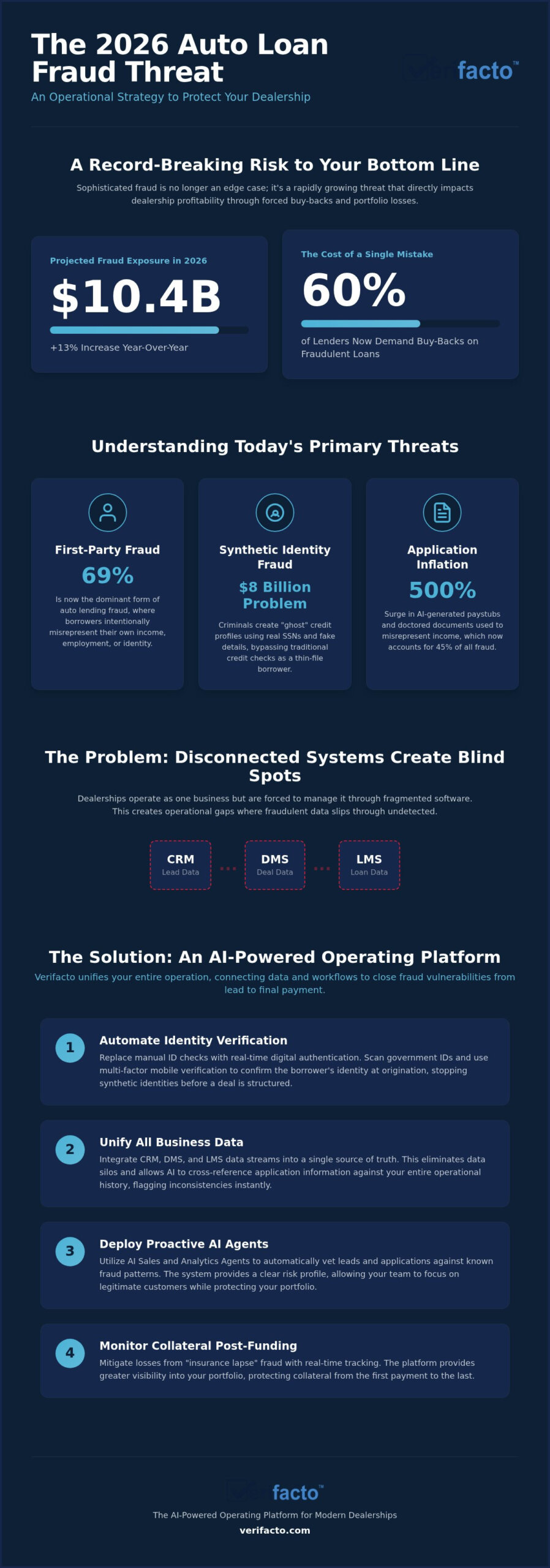
Auto loan fraud exposure has reached a record $10.4 billion, representing a 13% increase over the previous year. This surge is driven by a fundamental shift in how criminals operate. While third-party identity theft used to be the primary concern, first-party fraud, where the borrower misrepresents their own information, now accounts for 69% of all auto lending fraud. For many managers, the pressure to move inventory can lead to missed red flags, but the financial consequences are immediate. Approximately 60% of lenders now require dealerships to buy back fraudulent loans, meaning your store is left holding the bag when a deal goes south. Learning how to prevent loan fraud in a dealership is no longer a back-office luxury; it’s a requirement for survival.
The tools available to fraudsters have evolved rapidly. In 2025, the use of AI-generated paystubs in fraudulent applications surged by 500%. These documents are no longer crude “Photoshopped” attempts. They are sophisticated, data-accurate fabrications that can bypass traditional manual reviews. Beyond the immediate financial loss of a buy-back, dealerships face significant reputational damage with their lending partners and increased regulatory scrutiny. By understanding the different types of fraudulent loans, you can better identify where your current verification process is failing.
Synthetic Identity: The $8 Billion Problem
Synthetic identity fraud is the fastest-growing threat in 2026 auto finance. Thieves combine real Social Security numbers, often belonging to minors or deceased individuals, with fake names and addresses to build “ghost” credit profiles. Because these identities have no history of default, traditional credit scores often fail to flag them. They look like perfect “thin-file” borrowers until the vehicle disappears. This type of fraud is particularly dangerous because it bypasses standard credit checks, requiring AI-driven verification that can cross-reference data points in real time to confirm a borrower’s true existence.
Application Inflation and Income Misrepresentation
Income and employment misrepresentation represents 45% of all auto lending fraud and grew by 21% year-over-year. This often manifests as application inflation, where borrowers or “straw” buyers pad their income to qualify for better lender tiers. Digital document tampering has become a low-cost, high-volume service for fraudsters. When a dealership relies on disconnected systems, these discrepancies are easy to miss. The result is a portfolio plagued by early-term delinquency and charge-offs that could have been avoided with unified data. Dealerships operate one business but are often forced to manage it through disconnected systems. Verifacto brings the operation, data, and AI together in one platform to close these blind spots.
Strengthening Identity Verification at Origination
Manual identity checks are a significant operational vulnerability in a high-speed showroom. When a salesperson is juggling multiple deals, a sophisticated fake driver’s license can easily slip through. Relying on “gut checks” is no longer sustainable; especially since record auto finance fraud exposure is now a daily reality for every store. Digital authentication is the only way to scale security without adding friction to the customer experience. By automating the scan of government IDs, you replace human error with real-time data cross-referencing. This transition is the foundation of how to prevent loan fraud in a dealership in 2026.
Modern verification involves more than just looking at a plastic card. It requires multi-factor authentication via the borrower’s mobile device to ensure the person in front of you matches the identity on the application. This process happens instantly, scanning for micro-inconsistencies in the ID’s security features that the naked eye would miss. This automated approach ensures that your store isn’t left holding the bag on a buy-back demand because of a missed red flag during the Saturday rush.
Leveraging AI Sales Agents for Secure Origination
The AI Sales Agent serves as a proactive guardian at the very start of the customer journey. Instead of waiting for a lead to arrive on the lot, the agent engages them through secure, digital channels to capture identity data and verify intent. This automation reduces the risk of manual data entry errors and ensures every application is vetted against current fraud patterns. It provides your team with a clear risk profile; allowing them to focus on closing deals while the system handles the heavy lifting of verification. This setup ensures every lead is vetted before they even step onto the lot.
The Role of Mobile Technology in Verification
The LoanApp provides a secure, direct link between the borrower and your operating platform. It allows applicants to upload documents directly, which the system then analyzes for digital tampering. Beyond simple document collection, the app utilizes device fingerprinting and geofencing to verify the applicant’s location and device history. This creates a secure digital paper trail that manual systems simply cannot replicate. These tools are designed to provide greater visibility into the borrower’s true profile before the contract is signed. You can book a demonstration to see how these mobile and AI tools fit into your specific dealership workflow.
While these systems provide a technological shield, your sales staff still plays a role. They can focus on behavioral red flags, such as applicants who are unusually aggressive about skipping verification steps or those who seem unfamiliar with their own employment details. Combining human intuition with AI-powered verification creates a robust defense for your store’s bottom line.
Beyond Identity: Preventing Insurance and Collateral Fraud
Preventing fraudulent originations is only half the battle. For many dealers, the real financial damage occurs after the customer drives off the lot. A common tactic in 2026 involves “insurance lapse” fraud, where a borrower provides valid proof of insurance to secure the loan, only to cancel the policy minutes after leaving the dealership. With the national average cost for full coverage reaching $2,932, the incentive for borrowers to drop coverage is high. If you are focused on how to prevent loan fraud in a dealership, you must look beyond the initial ID check and address the ongoing risk to your collateral.
Manual insurance tracking is a major operational vulnerability, especially for Buy Here Pay Here (BHPH) dealers. Attempting to verify hundreds of policies through phone calls and spreadsheets is inefficient and prone to error. Fraudsters rely on these manual gaps to remain uninsured while the dealership remains unaware of the risk. In an environment where 1 in 7 motorists is driving without insurance, relying on disconnected systems is a recipe for revenue leakage. Verifacto brings the operation, data, and AI together in one platform to ensure insurance status is never a mystery.
Real-Time Insurance Tracking and Automated CPI
Automated tracking identifies insurance lapses the moment they occur by connecting directly to carrier data. This proactive approach eliminates the “blind spot” between policy cancellation and dealership notification. When a lapse is detected, the system can automatically initiate borrower communication to request updated proof of coverage. If the borrower remains non-compliant, managing risk with Seguro de Protección Colateral (CPI): becomes the next logical step. By automating the placement of lender-placed insurance, you reduce manual labor and ensure the asset is protected without requiring constant staff intervention.
Monitoring Collateral Post-Funding
Asset protection requires real-time visibility into the status of every vehicle in your portfolio. By linking insurance status directly to your loan management workflow, you create a unified defense against collateral loss. This integration ensures that your collections and servicing teams have the most current data when engaging with borrowers. Real-time tracking can help mitigate the financial impact of a total loss by providing the visibility needed to ensure continuous coverage or immediate CPI placement. This level of oversight is designed to provide greater visibility into the health of your portfolio, moving from reactive recovery to proactive risk mitigation. See how Verifacto connects your operation from the first lead to the final payment by integrating these essential safeguards into your daily workflow.
Unifying Data to Close Fraud Blind Spots
Dealerships operate one business but are often forced to manage it through disconnected systems. This fragmentation creates the very blind spots that allow “bust-out” fraud and synthetic identities to flourish. When your CRM, DMS, and LMS don’t share a real-time data stream, you’re essentially running three different operations with three different versions of the truth. Learning how to prevent loan fraud in a dealership in 2026 requires moving beyond these silos and unifying your entire operation into a single source of truth.
Disconnected systems often require duplicate data entry, which is an open door for both human error and intentional deception. If a borrower provides one set of employment details to a salesperson and a different set to the finance manager, a fragmented system won’t flag the discrepancy. By the time the loan is funded and the data is manually reconciled, the fraudster has already disappeared with the asset. Unifying these systems ensures that every piece of information is cross-referenced instantly across the entire lifecycle.
The Danger of Disconnected Vendor Systems
A standalone DMS or LMS is no longer enough to protect your bottom line. These tools often exist in a vacuum, making it impossible to maintain a clear audit trail. Robust auto finance compliance management is only possible when data flows seamlessly from the first lead to the final payment. When your platform is unified, you eliminate the need for manual re-entry, reducing the risk that fraudulent data is accidentally “cleaned” as it moves between systems. This connectivity provides a comprehensive view of the borrower’s journey, making it much harder for red flags to go unnoticed during the funding process.
AI-Driven Predictive Analytics
Unifying your data allows the Analytics Agent to scan your entire portfolio for patterns that indicate systemic fraud. Unlike manual reviews that look at one deal at a time, Verifacto AI is designed to provide greater visibility by identifying high-risk applications before they are funded. It looks for anomalies in borrower behavior, document metadata, and historical trends across your entire data set. This shifts your fraud strategy from reactive recovery to proactive mitigation, catching potential losses before they impact your capital.
Beyond security, a unified platform provides the business value of data portability. You shouldn’t be restricted by vendor lock-in that prevents you from accessing your own information for external analysis. Verifacto gives you full control, allowing you to easily export and analyze your data to improve overall financial performance. This transparency is vital for modern dealers who need to make fast, data-driven decisions without being held back by proprietary data silos. To see how a unified platform can secure your store, book a demonstration to explore how Verifacto fits your business.
Securing Your Portfolio with the Verifacto Platform
Dealerships operate one business but are often forced to manage it through disconnected systems. Verifacto brings the operation, data, and AI together in one platform. This isn’t just another tool added to an already crowded tech stack; it’s a comprehensive operating system designed for the modern dealer. By unifying your DMS and LMS with built-in AI, you establish a defensive perimeter that addresses how to prevent loan fraud in a dealership while simultaneously improving your store’s financial performance. This unified approach ensures that the data used to sell the car is the same data used to service the loan.
Security is the foundation of this platform. Verifacto maintains SOC II compliance, providing bank-level security as a standard feature for every partner. This level of protection is essential for managing sensitive borrower data and maintaining trust with your lending partners. Our AI agents are designed to support human judgment rather than replace it. They act as a sophisticated layer of oversight, automating the repetitive tasks of verification and monitoring so your team can focus on high-value decision-making. This combination of human expertise and machine precision is the most effective way to mitigate risk in a high-stakes environment, much like how specialized matching desks at dealdeed.ae connect motivated sellers with vetted buyers in the Dubai real estate market.
Streamlining the Entire Lending Lifecycle
The integration of our DMS and LMS ensures total data integrity from the first lead to the final payment. When a borrower interacts with the Sales Agent or uploads documents via the LoanApp, that information is instantly available across all modules. This connectivity prevents the manual entry errors that fraudsters often exploit. Once a loan is funded, the Collections Agent takes over, managing automated borrower communication and identifying potential delinquencies before they become charge-offs. Every interaction is logged, providing an audit-ready trail that simplifies state and federal compliance requirements.
Building a Future-Proof Dealership
A cloud-based operating platform ensures your store always has access to the latest fraud-prevention tools without the need for manual updates or hardware replacements. As fraud tactics evolve, the platform’s AI agents adapt, identifying new patterns of synthetic identity and document tampering in real time. This proactive stance reduces operational hours spent on manual verification while increasing your closing rates and overall security. You’re not just buying software; you’re investing in a scalable infrastructure that grows with your business and protects your capital from modern threats.
The transition to a unified, AI-powered operation is a strategic move that pays dividends in both security and efficiency. It eliminates revenue leakage and provides the visibility needed to manage a healthy, profitable portfolio. Book a demonstration to explore how the platform fits your business and see how Verifacto connects your operation from the first lead to the final payment.
Protecting Your Portfolio in a High-Stakes Market
The record fraud levels seen in 2026 aren’t just a challenge; they’re a signal that traditional manual processes have reached their limit. Mastering how to prevent loan fraud in a dealership requires a fundamental shift toward unified data and AI-driven automation. By closing the silos between your CRM, DMS, and LMS, you eliminate the blind spots where synthetic identities and misrepresented income hide. Real-time insurance tracking and automated CPI placement ensure your collateral remains protected long after the borrower drives off the lot.
Verifacto provides an AI-powered operating platform designed specifically for modern dealerships. With SOC II compliance and a 99.99% uptime guarantee, we offer the stability and security required to manage a high-performing portfolio safely. Our platform is designed to provide greater visibility into every deal, from the initial lead through the final payment. You can take control of your data and secure your bottom line starting today. See how Verifacto connects your operation from the first lead to the final payment and build a more resilient business.
Frequently Asked Questions
What is the most common type of loan fraud in dealerships today?
First-party fraud is the most prevalent threat, specifically involving income and employment misrepresentation which now accounts for 45% of auto lending fraud. Borrowers often use AI-generated documents to inflate their earnings or falsify work history to qualify for better lender tiers. Synthetic identity fraud is also a major concern, where criminals combine real Social Security numbers with fake names to create entirely new, “clean” credit personas.
How can AI help prevent synthetic identity fraud?
AI identifies synthetic identities by cross-referencing vast datasets in real time to find anomalies that traditional credit scores miss. It analyzes behavioral patterns and document metadata to ensure the applicant is a real person with a verifiable history. This automated oversight is designed to provide greater visibility into “thin-file” profiles that might otherwise appear legitimate to a manual reviewer, stopping “ghost” identities before funding.
Is it possible to automate insurance verification for every loan?
Yes, you can automate insurance verification by integrating real-time tracking directly into your operating platform. This system connects to carrier data to confirm coverage at the point of sale and monitors for lapses post-funding. If a policy is canceled, the platform can automatically trigger borrower alerts or initiate CPI placement to protect the asset. This removes the burden of manual phone calls from your staff while ensuring continuous collateral protection.
What are the legal risks of a dealership failing to prevent fraud?
Dealerships face significant financial and regulatory risks, including mandatory lender buy-backs and potential FTC enforcement actions regarding deceptive practices. Beyond immediate losses, failing to implement robust verification can lead to a loss of lending partners and increased scrutiny during state audits. Utilizing a secure platform with SOC II compliance helps establish a clear, audit-ready trail that supports your store’s overall compliance strategy and risk management.
How does a unified DMS and LMS platform improve fraud detection?
A unified platform eliminates the data silos that fraudsters exploit to hide discrepancies between sales and financing departments. When your DMS and LMS share a single source of truth, the system can instantly flag inconsistent employment or identity data across the lifecycle. This connectivity is a core component of how to prevent loan fraud in a dealership by ensuring data integrity from the first lead to the final payment.
Can fraud prevention tools speed up the car-buying process?
Automated verification tools actually accelerate the car-buying process by replacing manual “gut checks” and phone calls with instant digital authentication. Borrowers can use the LoanApp to upload documents securely from their own devices, which reduces the time spent in the F&I office. This efficiency allows sales teams to move through the paperwork faster while maintaining high security standards, improving the overall customer experience without sacrificing safety.
What should a dealership do if they suspect an identity is stolen?
If identity theft is suspected, the dealership should immediately pause the transaction and flag the application for a comprehensive review by the compliance manager. The store must follow its internal Red Flags Rule protocols, which may include requesting additional government-issued documentation or verifying the identity through out-of-wallet questions. Using AI agents during the lead phase can help identify these red flags before the applicant even arrives on the lot.
How does SOC II compliance protect dealership data?
SOC II compliance ensures that a platform meets strict industry standards for data security, availability, and privacy. For a dealership, this means borrower information and financial records are protected by bank-level encryption and rigorous operational controls. This standard reduces the risk of data breaches and provides necessary assurance to lending partners that your store handles sensitive consumer data responsibly and maintains high uptime for daily operations.