
A software invoice is easy to measure. Its return is harder to pin down. Measuring ROI of dealership software becomes especially challenging when manual work, duplicate processes, and broader business changes blur the picture.
A new DMS, LMS, dealership CRM, or auto finance software may improve a workflow, but vendor claims alone can’t show whether it created financial value for your operation. You need a baseline, relevant operational measures, and a consistent way to connect changes to results.
This framework provides a repeatable formula and measurement plan for comparing current and prospective software. You’ll learn how to account for total costs, track workflow indicators, and distinguish software’s contribution from other factors affecting performance. Dealerships operate one business but are often forced to manage it through disconnected systems. Verifacto brings operations, data, and AI together in one platform, providing greater visibility across connected workflows. The goal is a defensible decision grounded in your dealership’s own numbers, not assumptions.
Key Takeaways
- Start by defining the operational problem and the financial outcomes the software is expected to influence.
- Make measuring ROI of dealership software repeatable by setting a baseline, tracking attributable benefits, and including total costs in the calculation.
- Compare current and prospective systems using the same time period and assumptions. Distinguish measured savings from estimated capacity gains.
- Assign an owner, data sources, and a review cadence so the evaluation stays consistent from baseline through follow-up.
- Connected DMS, LMS, payment, insurance tracking, reporting, and AI workflows can provide greater visibility into how operational changes relate to business results.
Why measuring dealership software ROI starts with the business problem
A payment is recorded in one system, account details are updated in another, and a manager later pieces together a report. When considering new software, the first question shouldn’t be which platform has the longest feature list. Start with the business problem the investment needs to address.
Disconnected workflows can hide operating costs. Duplicate entry, delayed follow-up, manual payment handling, and fragmented reporting can consume time and make it harder to trace what happened. This is a process challenge, not a reason to blame employees. Without a defined problem, measuring ROI of dealership software can become a vague search for improvement instead of an evidence-based investment decision.
Which dealership problem should the ROI case answer?
Choose one primary operational issue before selecting metrics or comparing platforms. Describe where the process begins, where it stalls or repeats, and which teams or records are involved. If payment information moves across disconnected tools, for example, document the steps required to record and reconcile it. A focused problem gives the dealership a practical starting point for measurement.
Keep the first case narrow. To improve follow-up, define the workflow and the outcome you want to observe. If reporting is the issue, identify which information takes too long to assemble or is difficult to compare. Other benefits may emerge, but don’t count every possible improvement as a result of the software.
What counts as dealership software ROI?
Dealership software ROI is the financial benefit reasonably attributable to a software investment, compared with the investment’s total cost. This builds on the general concept of Return on Investment (ROI), with the dealership’s analysis focused on benefits it can connect to a specific change.
Separate realized financial benefits from projections. A reduction in a documented expense may be measurable. Staff capacity released by fewer manual steps may also be valuable, but it isn’t automatically a realized cash saving. Record it as an operational or estimated benefit unless you can show how it affected costs or revenue. Greater visibility is useful too, but track it as an operational improvement rather than presenting it as financial return on its own.
Vendor claims and industry averages can help frame questions, but they can’t establish the return for your store. Your processes, transaction mix, staffing, and starting performance shape the result. Set a baseline using actual records from before the change, then compare against it over a consistent period. This helps distinguish software-related movement from other business changes.
Verifacto’s AI-powered operating platform connects dealership and auto-finance workflows across DMS, LMS, payments, insurance tracking, reporting, analytics, and AI agents. That connected view can help you examine how a workflow changes while keeping the ROI case grounded in your own evidence and financial measures.
Build a dealership software ROI model with baselines and attributable benefits
A defensible ROI model starts before implementation. Record how the process works now, identify the data that describes it, and choose a consistent period for reviewing results after the change. If lead follow-up is the focus, document current follow-up activity and appointment outcomes using records the dealership already maintains. Compare like with like, and note other changes that could affect performance.
Then calculate ROI using the same time frame for benefits and costs:
ROI = (attributable benefits − total software costs) ÷ total software costs
Express the result as a percentage to make comparisons easier. The crucial word is “attributable.” Include financial value only when dealership records and a clear method reasonably connect it to the software change. Frameworks for measuring the ROI of custom software also emphasize evaluating tangible and intangible benefits. For a dealership ROI case, keep financial benefits distinct from operational improvements that are useful but not yet tied to dollars.
Which metrics can connect dealership operations to financial value?
Choose indicators that follow the business problem through to a documented financial outcome. Depending on the case, review lead follow-up and appointment activity, payment processing steps, collection workflows, insurance-tracking tasks, or time spent compiling reports. A metric is a signal, not proof of return by itself. Pair it with financial records or a defensible estimate of capacity released, and explain how you made that connection.
For example, fewer manual steps may represent recovered staff capacity. Don’t count that as cash savings unless you can show a corresponding reduction in expense or explain how the capacity was put to productive use. Likewise, a change in payment handling is an operational result. Connect it to documented financial impact before including it as a benefit in the formula.
How should you account for costs and payback?
Subscription expense is only one part of the investment. Consider implementation, integration, training, and internal change costs when applicable, alongside recurring charges over the comparison period. Account for the work required to transition processes and maintain the new workflow during the evaluation period. Include costs only where they apply, and use consistent assumptions across the options being assessed.
Calculate payback separately from ROI. Payback estimates how long it takes for cumulative attributable benefits to cover the investment. ROI compares net attributable benefit with total cost over a defined period. State the period and assumptions for both. If benefits are estimates, label them as projections, not realized returns. This keeps the analysis useful while you validate assumptions.
- Baseline: Record current performance and source records before the change.
- Costs: Include applicable setup, subscription, integration, training, and internal change expenses.
- Benefits: Separate documented financial effects from capacity gains or visibility improvements.
- Review: Use the same comparison period and explain assumptions or outside influences.
Verifacto’s connected DMS, LMS, payment processing, insurance tracking, reporting, and analytics can provide greater visibility into related workflows. This context can help you assess how the platform fits the operational problem and measures in your evaluation.
Compare dealership software options using consistent ROI criteria
A fair comparison keeps the measurement rules fixed. Evaluate the current process and each candidate platform against the same baseline, review period, and assumptions. Otherwise, one option may appear stronger simply because its benefits were estimated generously or its costs were counted narrowly.
A practical software ROI framework can help structure an evaluation around the business problem, baseline, and follow-up measurement. For a dealership, ground the comparison in actual workflows and records. Rate the strength of the evidence as well as the expected change: a benefit supported by transaction history is different from a possible capacity gain that still needs validation.
How do you compare fragmented tools with a connected platform?
Map each current workflow from the point information enters to the point it’s used. Note repeated data entry, handoffs, and records that staff must reconcile across systems. Then assess whether each candidate can provide the data access and reporting needed for that workflow. Define required connections in the context of your operation and evaluate them alongside the other criteria in your comparison.
Consider accounting connections, reporting access, data control, and dependence on separate vendors alongside measurable cost and performance. Reduced vendor dependence may be a strategic advantage, but don’t count it as a financial saving unless you can document an actual cost change.
How should collections and payment effects be assessed?
Use your own payment and collection records to establish the starting point, then compare equivalent periods after a workflow changes. Track relevant activity and outcomes, but account for other influences on payments or accounts. A shift in collection performance isn’t automatically caused by software alone. Assess the collection workflow alongside the other measures in your ROI comparison.
Use a consistent scorecard. Fill in the baseline and evidence before estimating what a platform might change, and assign confidence based on how directly records support the estimate.
| Metric | Baseline | Evidence source | Expected change | Confidence level |
|---|---|---|---|---|
| Repeated entry in a selected workflow | Current recorded steps or instances | Workflow review or system records | Fewer repeated steps, if supported | High, medium, or low |
| Payment handling activity | Current process and recorded outcomes | Payment records | State a measurable change only if justified | High, medium, or low |
| Collection workflow | Current activity over the chosen period | Collection records | Estimate separately from other account changes | High, medium, or low |
| Reporting access | Current reporting process | Report preparation records | Potential time or visibility improvement | High, medium, or low |
This disciplined comparison makes measuring ROI of dealership software more credible. It shows executives where the decision rests on verified financial evidence, where it depends on estimates, and which assumptions need closer review before selecting a platform.
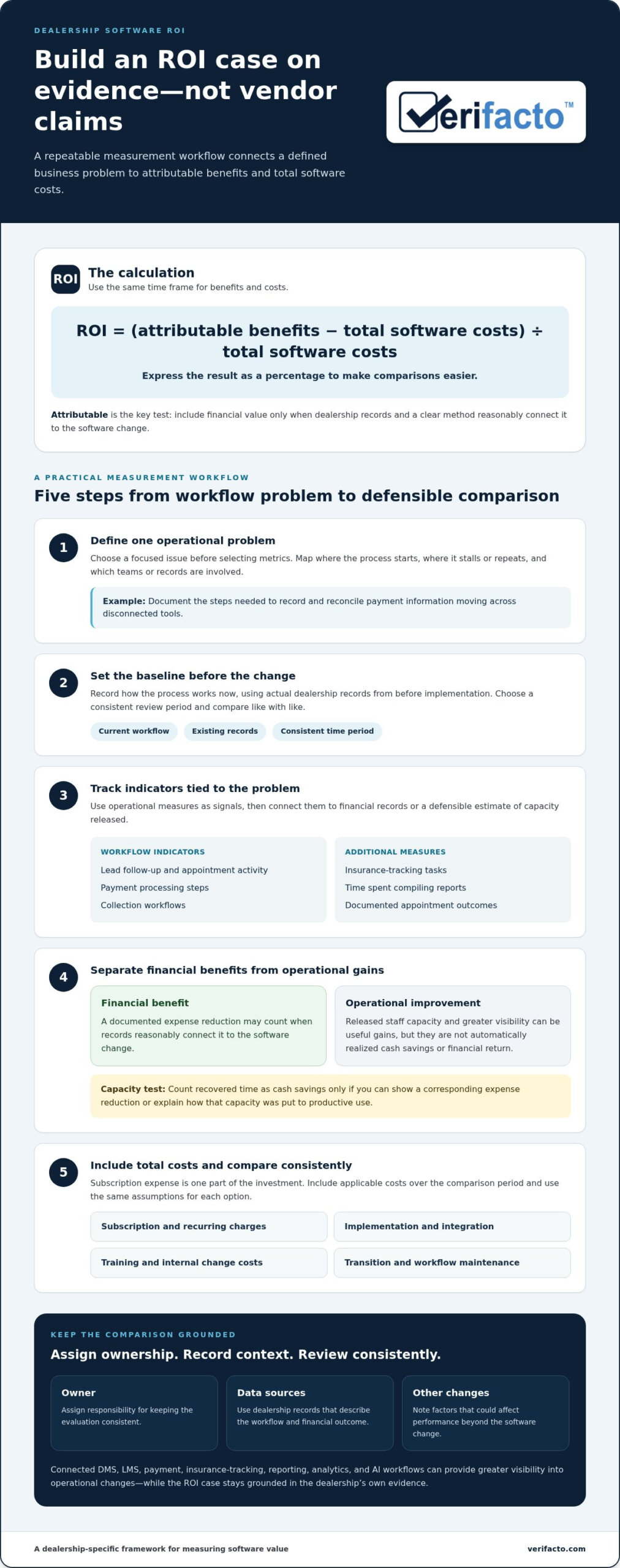
Measure dealership software ROI through a practical evaluation workflow
An ROI review needs an owner, a defined business problem, reliable records, and a regular review cadence. Without clear responsibility, teams may use different metric definitions or interpret changes differently. Assign one person to coordinate the review, with input from managers responsible for the workflow and the records behind its measures.
Use a simple evaluation plan:
- State the business problem. Keep the scope focused, such as repeated steps in payment handling or delays in assembling a report.
- Name the owner and evidence. Identify who will gather records and which reports, accounting data, or documented workflows will support the review.
- Set the review cadence. Choose regular checkpoints that match the business process and comparison period, then use them consistently.
- Log relevant changes. Record process adjustments, staffing changes, seasonality, or other external factors that could affect the same indicators.
- Revisit the assumptions. Compare observed evidence with the original business case and revise estimates when the facts change.
What evidence should an ROI review use?
Use the strongest available dealership records, such as operational reports, accounting records, and documented staff workflows. Keep definitions stable: if a measure tracks time to complete a task, use the same start and end points in each review. If records are incomplete or the process changes, flag that limitation. An estimate can guide further review, but it shouldn’t be reported as a proven financial outcome.
How can AI analytics support measurement without replacing judgment?
Dashboards and analytics can make performance patterns easier to see across connected workflows. Verifacto provides real-time dashboards, custom reporting, and performance analytics. Its AI platform capabilities can support analysis of operational data. AI agents can assist with analysis and workflow, while dealership leaders interpret context, assess attribution, and decide what action to take.
What does a practical dealership review look like?
Consider a hypothetical dealership assessing whether a new workflow could make payment handling easier to track. Before implementation, the review owner documents the existing steps, identifies available payment and accounting records, and agrees on how each indicator will be defined. The team also notes any gaps that could limit comparison. This sets up the review without assuming the software will produce a particular result.
At each checkpoint, the owner gathers the same evidence and records changes to the process or business environment. If payment activity shifts during the period, the team examines whether other factors may explain it before attributing any part to software. If reporting definitions change or records are incomplete, the review marks the comparison accordingly. Measuring ROI of dealership software is more credible when uncertainty stays visible rather than being hidden inside a confident-looking estimate.
Use what the review shows to refine the next decision. The dealership might continue tracking an operational indicator, adjust the workflow, or update the benefit estimate if stronger evidence becomes available. A business case should evolve with the evidence, not defend its original assumptions at all costs.
Connect measurable dealership software value to Verifacto’s operating platform
Dealerships operate one business but are often forced to manage it through disconnected systems. Verifacto brings the operation, data, and AI together in one platform. For an ROI review, the value of that connection isn’t an assumed financial result. It’s the ability to evaluate workflows and related information with greater visibility, then measure any operational or financial change against the dealership’s own business case.
Verifacto is an AI-powered operating platform for dealership and lending workflows, including CRM, inventory, DMS, LMS, payment processing, collections, insurance tracking, reporting, analytics, and AI agents. Rather than evaluating a single system in isolation, executives can consider where connected processes might reduce duplicated effort or make performance easier to review. Results depend on the dealership’s starting point, implementation, and operating context.
Where can a connected platform support an ROI case?
Map the workflow being evaluated to the relevant records. For lead follow-up, compare the dealership’s existing process and available activity records with the desired change. The AI Sales Agent details can help executives understand the platform’s sales-agent offering. For lending and payments, consider how LMS, payment processing, collections, and insurance tracking relate to the operational measures in the business case. The Analytics Agent and other AI agents can support analysis, while dealership leaders assess attribution.
These connections can help bring customer, loan, payment, and operational workflows into a more visible picture. They don’t establish ROI on their own. Compare relevant evidence before and after a change, account for other influences, and distinguish a measured financial effect from a potential efficiency gain.
What should executives do before deciding?
Use the same framework to assess Verifacto against current operational needs. Keep the decision grounded in the business problem, baseline, total costs, attributable benefits, and unresolved assumptions. Identify which workflows matter, what evidence is available, and how the dealership will judge progress. If a benefit can’t yet be tied to a reliable record, keep it as a hypothesis rather than counting it as a realized return.
Before selecting a platform, bring the case into one decision view:
- Business need: Name the workflow or operating issue the investment should address.
- Evidence: Identify baseline records, post-change measures, and any data limitations.
- Financial case: Separate documented benefits and total costs from estimated gains.
- Open questions: Note dependencies, process changes, or assumptions that need review.
This approach keeps measuring ROI of dealership software tied to dealership evidence, not promises. Verifacto can provide a connected view of relevant workflows, while the return depends on how the platform fits the operation and what the dealership can substantiate.
Make ROI a repeatable operating discipline
Software value shouldn’t be judged only at purchase or renewal. Make measuring ROI of dealership software an ongoing management practice: revisit the original business problem, check whether the targeted workflow changed, and determine which benefits the dealership can support with evidence. That turns an investment decision into a clearer basis for future priorities.
A consistent review can also reveal when assumptions need to change. If operating conditions shift or records prove incomplete, update the business case rather than treating early estimates as established results. Keep potential gains distinct from realized financial impact, and use the findings to guide the next evaluation.
Verifacto’s cloud-hosted platform connects dealership and loan workflows. Its security and reliability capabilities can inform an operational-fit evaluation, but they don’t replace dealership-specific evidence or establish a financial outcome.
Bring your business problem and measurement criteria into the next conversation. Explore how Verifacto could fit your ROI measurement plan, and book a demonstration to see how the platform connects your operation from the first lead to the final payment.
Frequently Asked Questions
How do you calculate ROI on dealership software?
Subtract total software costs from attributable financial benefits, then divide the result by total software costs. Multiply by 100 to express the result as a percentage. For example, if a dealership evaluates a change to its reporting process, it should include only documented financial effects it can reasonably connect to that change. Keep estimated benefits separate. This makes measuring ROI of dealership software more useful than treating every operational improvement as cash value.
What costs should be included when measuring dealership software ROI?
Include the costs required to adopt and use the system, not just the recurring subscription. Depending on the project, account for implementation, integration, training, internal staff time, and any period when existing and new processes run in parallel. Use the same timeframe for costs and benefits, and avoid counting the same expense twice under different categories. If a cost is uncertain, record the assumption clearly so executives can see how it affects the calculation.
Which metrics should a dealership track to measure software ROI?
Choose measures tied to the workflow under review, then connect them to financial records where possible. For example, a dealership evaluating lead management might track response activity and appointments, then examine documented sales outcomes without assuming every change came from software. A finance operation could review payment processing steps or collection activity alongside accounting records. Pick a small set of relevant measures. Tracking unrelated KPIs can obscure whether the investment addressed its original purpose.
How long does it take to see ROI from dealership software?
There’s no single reliable timeline. The review period depends on the workflow, how often the relevant activity occurs, implementation timing, and how soon useful records are available. Decide in advance when to conduct initial and later reviews, based on the operating cycle. Early results may indicate process adoption or data quality rather than realized financial return. Keep monitoring until the evidence supports a fair comparison, and label preliminary findings accordingly.
Can dealership software ROI be measured without a clean baseline?
Yes, but the result will carry more uncertainty. Reconstruct a starting point from available reports, accounting records, or documented procedures, and note missing periods or changes in definitions. If no reliable historical measure exists, begin tracking the process now and treat the first review as a provisional reference point. Don’t present a rough estimate as proven impact. Decision-makers should understand how the limitation affects confidence in the business case.
How should a dealership compare software ROI across vendors?
Apply the same business problem, review period, cost categories, and evidence standards to each option. Compare what each platform can support in the dealership’s actual workflow, including reporting access and relevant data connections, rather than relying on feature counts alone. Separate documented financial effects from estimated time savings or strategic value. Record assumptions consistently, and identify where evidence is incomplete. A shared scorecard helps executives see meaningful differences without treating vendor projections as equivalent to verified results.