
What if the first sign of repayment trouble didn’t have to be a missed payment? For lenders asking how to reduce auto loan delinquencies, the challenge is often seeing payment friction early enough to respond. Payment activity may sit in one system, communication history in another, and portfolio reporting somewhere else. By the time staff pull those pieces together, they may already be reacting to an overdue account.
That makes prevention a workflow issue as much as a collections issue. Lenders need timely, connected information and a clear process for reviewing it, assigning follow-up, and tracking what happens next. A practical approach can help staff spot issues sooner and respond with relevant context, without assuming every borrower needs the same response.
This article outlines a borrower-aware prevention framework, from reviewing payment activity and simplifying payment workflows to coordinating outreach and improving portfolio visibility. Verifacto connects dealership and lending operations across DMS, LMS, payments, collections, messaging, reporting, analytics, and embedded AI agents. Connected data can help staff act with better context while keeping human judgment at the center.
Key Takeaways
- Separate an individual missed payment from portfolio-level delinquency measures so account reviews and portfolio reporting answer distinct questions.
- Look for observable changes in payment activity and communication. Treat them as prompts for review, not proof of a borrower’s financial circumstances.
- Compare prevention steps by timing, owner, and information required. Keep origination decisions distinct from servicing actions.
- To understand how to reduce auto loan delinquencies, establish a repeatable process for reviewing account activity, assigning human follow-up, and tracking next steps.
- Connected DMS, LMS, payment, messaging, and collections workflows can help reduce manual handoffs and provide clearer portfolio visibility.
Why auto loan delinquencies require action before an account falls behind
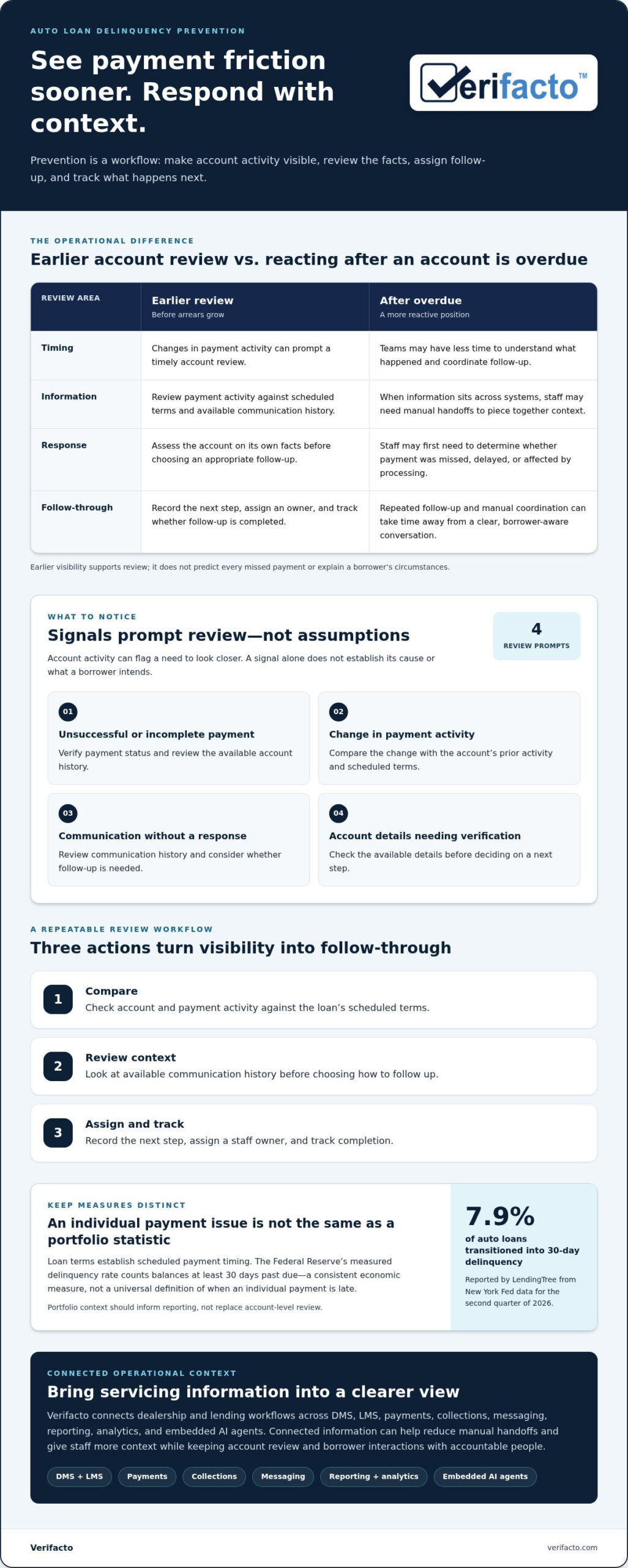
A payment can become a servicing concern before it appears as delinquent in a portfolio report. If teams only review risk after an account is overdue, they may have less time to understand what happened, communicate with the borrower, and coordinate follow-up. Earlier attention does not mean assuming a payment will be missed. It means making account activity visible in time for staff to assess it.
Arrears can affect more than an individual account. They may delay expected cash flow, add follow-up work, and change how managers view portfolio performance. Teams benefit from distinguishing an account-level payment issue from a portfolio metric, so they can handle the immediate case while accurately monitoring broader trends.
What lenders mean by auto loan delinquency
Auto loan delinquency describes a payment that has not been made by the time required under the borrower’s loan terms, but there is no single reporting threshold that applies to every lender or measure. A missed payment and a portfolio delinquency statistic are related, but they are not interchangeable. Loan terms establish the scheduled payment timing. Reporting measures group account or balance status according to a defined threshold.
For example, the Federal Reserve’s measured delinquency rate counts balances at least 30 days past due. That threshold is useful for tracking a consistent economic measure, but it does not define the first moment a payment is late under every loan agreement or servicing process. In a September 2026 summary of New York Fed data, LendingTree reported that 7.9% of auto loans transitioned into 30-day delinquency in the second quarter of 2026. This is portfolio context, not a rule for handling an individual account.
Why waiting for a missed payment narrows response options
Once an account is overdue, staff may need to determine whether a payment was missed, delayed, or affected by a processing issue, then decide on an appropriate next step. If payment activity and prior communication are hard to review together, resolving those questions can involve manual handoffs and repeated follow-up. That leaves less time for a clear, borrower-aware conversation.
Earlier visibility gives a team a chance to review observable signals without drawing conclusions about a borrower’s finances. An unsuccessful payment attempt, a change in payment activity, or an unanswered message can prompt review. None explains the cause on its own. A borrower may face a temporary disruption, encounter payment friction, or have another circumstance entirely.
- Compare account and payment activity with the loan’s scheduled terms.
- Review available communication history before choosing how to follow up.
- Record the next step, assign an owner, and track whether the follow-up is completed.
This is a practical starting point for how to reduce auto loan delinquencies: make relevant account information easier to review before arrears grow, then leave decisions and borrower interactions with accountable staff. The aim is not to predict every missed payment. It is to give the team a clearer, earlier view so it can assess each account on its own facts.
What causes auto loan delinquencies, and what lenders can notice earlier
A missed payment can have different causes, and account activity alone rarely explains which one applies. A borrower’s circumstances may change, a payment may not go through as expected, or a communication may not reach its intended recipient. Treating every late payment as evidence of unwillingness to pay can lead to an unsuitable response. Start with what the account shows, confirm the available context, and then decide what to do.
Separate repayment friction from assumptions about borrower intent
Consider an unsuccessful payment attempt. It confirms that the payment was not completed, but it does not explain why. An unanswered account communication shows that a message received no response, not that the borrower is unwilling to engage. Staff can review the account history, verify payment status, and use an appropriate communication channel before selecting a next step. Each signal needs context.
An account signal should prompt a timely review, not an unsupported conclusion. That distinction helps keep borrower interactions factual and consistent. It also helps staff determine whether the issue may involve payment friction, a change in circumstances, or a communication gap without treating any explanation as certain.
Useful signals to review may include:
- A payment attempt that appears unsuccessful or incomplete.
- A change in payment activity compared with the account’s prior history.
- Communication that has not received a response or may need follow-up.
- Account details that staff need to verify before acting.
These are prompts for review, not a scorecard that predicts a borrower’s next action. A team can document what it observes, check available account context, and assign a staff member to determine appropriate follow-up. Borrower-focused information from the Consumer Financial Protection Bureau on auto loans can also help frame conversations around clear, practical information without presuming a borrower’s circumstances.
Use portfolio patterns as context, not individual predictions
Portfolio data can help managers see whether repayment pressure is changing across groups, but it cannot explain an individual account. The Federal Reserve’s household debt reporting described an increase in auto delinquency among lower-income households in the third quarter of 2025. That group-level pattern can inform portfolio review. It does not establish why a particular borrower missed a payment or what will happen next.
Use aggregate trends to guide questions, then examine your own account activity and servicing records. Compare patterns across relevant segments and periods, while grounding individual decisions in verified account information. This helps teams avoid turning a broad trend into an assumption about a specific borrower.
For lenders considering how to reduce auto loan delinquencies, the practical value lies in connecting observable signals to a clear review process. Connected payment and communication information can support that visibility. Verifacto’s AI-powered platform is designed to help teams work with connected operational data while keeping staff responsible for judgment and borrower interactions.
Compare prevention levers that can help reduce auto loan delinquencies
Prevention is not one action applied to every account. The right lever depends on when an issue appears, who owns the next step, and what information that person needs. Origination review, payment access, borrower communication, and account servicing address different points in the loan lifecycle. Used thoughtfully, these steps can help reduce avoidable friction, but none can guarantee that a borrower will make every payment.
Compare the options by their role in the workflow:
- Origination and account setup: Before the first due date, lending or operations staff review repayment terms and account information through established processes.
- Payment processing: Servicing teams make available payment methods clear and review transaction activity when a payment issue appears.
- Borrower communication: The responsible team uses lender-approved timing and channels to share relevant account information or follow up.
- Account review: Servicing staff assess the account context, document the decision, and own any follow-through.
This comparison helps teams choose a response based on the account stage and available evidence, rather than treating every warning sign as the same problem.
Evaluate origination and account setup before the first due date
Origination is distinct from servicing an active account. Before repayment begins, teams can review the terms, scheduled payment details, and account information using their established underwriting and setup processes. This does not mean changing credit decisions or applying new thresholds. It means ensuring that the information passed into servicing supports clear account management.
For example, staff can confirm that the account record reflects the applicable payment schedule and the communication details available to the lender. Clear, accurate records can help servicing teams explain account information without having to resolve avoidable discrepancies later.
Balance payment access, proactive contact, and account review
Payment access addresses process friction. Communication helps borrowers understand account information. Staff-led review determines what an observed issue means in context. These levers complement one another, but they are not interchangeable. Verifacto’s built-in payment processing supports ACH, cards, cash, and recurring payments. Offering payment methods can make the process more accessible, but it does not establish why a payment was missed or ensure repayment.
Automated borrower communication can support servicing workflows, while staff remain responsible for account decisions and borrower interactions. Outreach timing and channel choices should follow the lender’s own policies. A practical sequence is to review payment status, check the available account information, and assign an appropriate follow-up instead of sending the same response to every account.
To assess how to reduce auto loan delinquencies, review where each lever fits and what information it relies on. Verifacto connects lending workflows across payment processing, messaging, and servicing, which can help reduce manual handoffs and provide clearer operational visibility. Lenders can explore how these connected workflows fit into their operation through Verifacto’s platform.
Build a repeatable workflow for preventing auto loan delinquencies
A prevention process is useful only if teams can apply it consistently. Define what account activity triggers a review, who owns that review, how the next action is recorded, and when the team checks that it was completed. The sequence should fit lender policy and available resources, while giving staff enough context to handle each account individually.
Keep the workflow straightforward:
- Surface accounts for review. Use the lender’s established criteria to identify payment activity or account changes that warrant attention.
- Review the account context. Check payment status and relevant communication history before deciding on follow-up.
- Assign an owner. Make one staff member responsible for the next action and its completion.
- Communicate and document. Follow the lender’s policy for outreach, then record the attempt and any resulting account action.
- Check follow-through. Confirm the assigned task is complete and route unresolved issues for further review.
This creates a consistent path from visibility to action without assuming that every account needs the same intervention.
Turn account activity into prioritized human review
Prioritization should reflect the lender’s own policies, staffing, and servicing capacity. A team might review accounts with an unsuccessful payment status before accounts that simply need a routine check, but it should use its defined criteria rather than treat that example as a universal rule. Automated prompts can bring activity to staff attention. They should not be confused with a decision about a borrower or account.
Give reviewers a clear handoff: what prompted attention, what information they should assess, and who has authority to determine the next step. This reduces ambiguity while keeping decisions and borrower interactions with accountable staff.
Document outreach and measure process performance
Record relevant contact attempts, account actions, assigned ownership, and follow-up status in the lender’s workflow. Consistent records can help the next staff member understand what has already happened and avoid unnecessary repeat work. Keep documentation focused on pertinent account activity and decisions. Set retention and handling practices through the lender’s own policies.
Measure the operation, not just the final account status. Useful process indicators can include whether assigned follow-ups were completed, whether payment processing shows a completed or unresolved transaction, and how many accounts remain open for review. Review these measures consistently to identify workflow bottlenecks. They can improve operational visibility, but they do not establish that a specific action caused a change in repayment.
A repeatable workflow gives teams a practical foundation for how to reduce auto loan delinquencies while preserving human judgment. Connect this process with the lender’s collection-efficiency approach, and define how unresolved issues move between teams. To discuss connected account and servicing workflows, contact the Verifacto team.
How Verifacto connects auto loan delinquency prevention workflows
Dealerships operate one business but are often forced to manage it through disconnected systems. Verifacto brings the operation, data and AI together in one platform. Its cloud-hosted platform connects dealership and lending workflows across the customer and loan lifecycle, combining DMS and LMS capabilities with payments, collections, messaging, reporting, analytics, and AI agents. This connected approach can support lenders and dealerships using auto finance software, BHPH software, or a dealership CRM in their day-to-day operation.
Connect account visibility with payments and borrower communication
Verifacto LMS supports lending workflows, while built-in payment processing supports ACH, cards, cash, and recurring payments. Automated borrower communication tools support collection workflows. Connected operations can help staff review account and payment information alongside communication activity, reducing reliance on disconnected handoffs and supporting clearer follow-through. Staff remain responsible for account decisions and borrower interactions.
For example, a team reviewing an account can assess payment status and relevant communication activity through its established process, then determine who owns the next action. The platform is designed to provide greater operational visibility, not to guarantee a repayment outcome. Lenders can explore how an AI-powered operating platform may support their account management practices.
Use embedded AI to support, not replace, team decisions
AI is embedded across Verifacto to support work with connected operational data. The AI Analytics Agent provides dashboards, predictive insights, and custom reporting. The AI Sales Agent, Personal Assistant, Collections Agent, and execution agents can support relevant workflows, while staff retain oversight of decisions and borrower communication. These tools support analysis and workflow execution. They do not replace account review or human judgment.
For instance, analytics can help decision-makers examine portfolio information, while staff assess account context and determine whether follow-up is appropriate. An insight can bring information forward, but it is not an independent decision about a borrower. Connecting operational data can also help reduce manual handoffs and give managers a clearer view of workflow activity.
For lenders considering how to reduce auto loan delinquencies, connected systems can make payment, servicing, and communication workflows easier to review together. Verifacto is designed to support operational efficiency and visibility without promising a specific delinquency or financial result.
Explore whether the platform fits your lending workflow. Book a demonstration with Verifacto to see how connected operations can support your team.
Make the next improvement visible
Choose one point in your servicing workflow where teams need clearer information or a smoother handoff. Map who reviews the account, what context they need, and how the next action is tracked. That focused review can help identify where connected data may support better visibility and more consistent follow-through, without assuming technology alone will change repayment outcomes.
Verifacto’s cloud-hosted platform connects DMS and LMS workflows with payment processing and borrower communication tools. Its AI Analytics Agent provides dashboards, predictive insights, and custom reporting to support portfolio review and staff decisions. These capabilities are designed to support the operation, while your team remains accountable for borrower interactions and lending decisions.
Build a prevention process that fits your lending operation, then assess where connected workflows could make it easier to manage. Explore how to reduce auto loan delinquencies with a practical, borrower-aware approach and greater operational visibility.
See how Verifacto connects your operation from the first lead to the final payment.
Frequently Asked Questions
Can lenders prevent all auto loan delinquencies?
No. A borrower’s circumstances and ability to repay can change, so no operating process can ensure every account stays current. Set realistic expectations for prevention work: focus on whether procedures are usable, consistently applied, and adjusted when recurring operational issues emerge. For example, if staff repeatedly encounter unclear account instructions, refine those instructions and assess whether the change improves the process. Evaluate trends over time rather than treating one result as proof of success or failure.
When should a lender contact a borrower about a possible late payment?
Follow the lender’s established policies and applicable requirements. Define how staff should handle time-sensitive account questions, such as a borrower reporting that a payment was submitted but is not reflected in the account record. A clear escalation path can route that question to the appropriate person and help prevent conflicting responses. Keep internal guidance current, and have the lender’s own reviewers assess communication practices before putting them into use.
Can automated reminders reduce auto loan delinquencies?
Automated reminders may support consistent communication, but they cannot ensure timely payment. Before relying on them, test the message workflow against ordinary and exception cases: an account with updated contact information, a borrower who responds with a question, or a message that needs staff attention. Decide who reviews those exceptions and how the team avoids sending a response that no longer fits the account. Lender policy and appropriate legal review should guide messaging practices.
How can lenders distinguish a temporary payment issue from a longer-term problem?
No single account event establishes whether a problem will continue. Set a review cadence for open cases and define what new information warrants another assessment. For example, a case might return to review after a borrower provides an update or the payment record changes. Staff should document what is known, what remains unresolved, and what would trigger another review, rather than assigning a lasting label based on limited evidence.
Which metrics should auto lenders review when monitoring delinquency prevention?
Choose measures with stable definitions so teams can compare periods meaningfully. Document what counts as a completed follow-up, an unresolved payment status, or a reopened case, and note any changes to those definitions. Managers can also sample records to see whether the recorded status matches the underlying account activity. Use findings to identify process questions, such as inconsistent categorization, rather than assuming a metric alone explains borrower behavior or proves cause and effect.
Does a loan management system guarantee lower auto loan delinquencies?
No. Software cannot control borrower circumstances or guarantee a portfolio result. During an internal review, assess whether the system supports the team’s defined work: can authorized staff understand account status, find relevant records, and identify unresolved tasks? These are operational questions, not promises about repayment. A lender can also review how staff use the system over time and whether its workflows remain aligned with the organization’s servicing practices.
What is the difference between preventing delinquency and collecting a past-due loan?
They address different account stages. Prevention aims to make repayment and servicing processes workable before an account becomes past due, while collections handles an account that has already entered a past-due status. To make the transition clear, define the internal event that moves an account into the collections process and specify which team owns that handoff. This helps avoid ambiguity in case assignment without prescribing a particular treatment or outcome for an individual borrower.