
Dealerships operate one business but often manage it through disconnected systems. When loan information, borrower communication, and staff workflows are separated, applications can stall between teams. To streamline auto lending operations, connect people, processes, and technology around a clear application journey.
Separate tools can make it difficult to see who owns the next step or where a file is delayed. A coordinated workflow gives teams shared visibility while keeping underwriting judgment with the people responsible for it.
This guide covers practical ways to improve origination, handle conditional and declined applications, assess borrowers, and decide which tasks to automate. It also explains how to align workflow design with technology so operational improvements support clearer oversight and more consistent lending processes.
Key Takeaways
- Map each origination step to an owner, a required input, and a clear next action to keep applications moving.
- Turn conditional and declined decisions into structured workflows with tracked follow-up and appropriate human review.
- Assess borrower information consistently by organizing supporting documents and surfacing details for underwriting review.
- Automate repeatable administrative tasks while keeping credit judgment and exception handling under human control.
- Connect lending workflows with Verifacto’s DMS and LMS to improve operational visibility across dealership and loan-management processes.
Auto loan origination opportunities
Origination slows when lenders re-enter borrower details, wait for documents, or move applications between disconnected tools. Streamlined workflows connect data retrieval, document review, underwriting, and funding while keeping decision points visible.
Loan Workflow Integration
Map each application from submission to funding, then identify where staff transfer information between systems. Connect the loan origination workflow with document management and borrower communication so, for example, a missing pay stub triggers a clear follow-up rather than an untracked delay. Intelligent document processing can connect through APIs or custom integrations. Check that information moves accurately and teams can see the next required action.
Real-time auto-loan data retrieval can reduce repeated entry and give reviewers a current view of an application. Build a workflow that collects submitted information, organizes supporting documents, and flags gaps for review. Intelligent document processing combines AI, large language models, optical character recognition, and natural language processing to extract information from scanned forms and digital submissions. One auto finance provider reported a 30% reduction in application processing times and a 20% decrease in error rates after integrating this technology.
Approval and Funding Times
Lenders can reduce approval and funding delays by removing avoidable handoffs. Set a clear sequence: capture the application, retrieve relevant data, check document completeness, route exceptions, and prepare approved files for funding. Use borrower messages to request missing information promptly. Track where applications pause, such as during document collection or manual review, and improve that step rather than automating every decision.
Refinancing operations also benefit from a clear process. For a borrower seeking to refinance a vehicle loan, collect current loan details, review the vehicle and borrower information, and route the application for assessment. Organize payoff information and funding steps in the same workflow to avoid repeated requests. Review factors such as outstanding obligations, vehicle details, submitted documents, and the lender’s credit criteria.
Security and fraud risks can arise when sensitive borrower data moves across systems or documents contain inconsistencies. Limit access to appropriate roles, maintain clear handling procedures, and route suspicious items for human review. Document processing tools can flag missing or malformed signatures and possible signs of alteration or tampering. These flags support review but do not replace lender judgment or established controls.
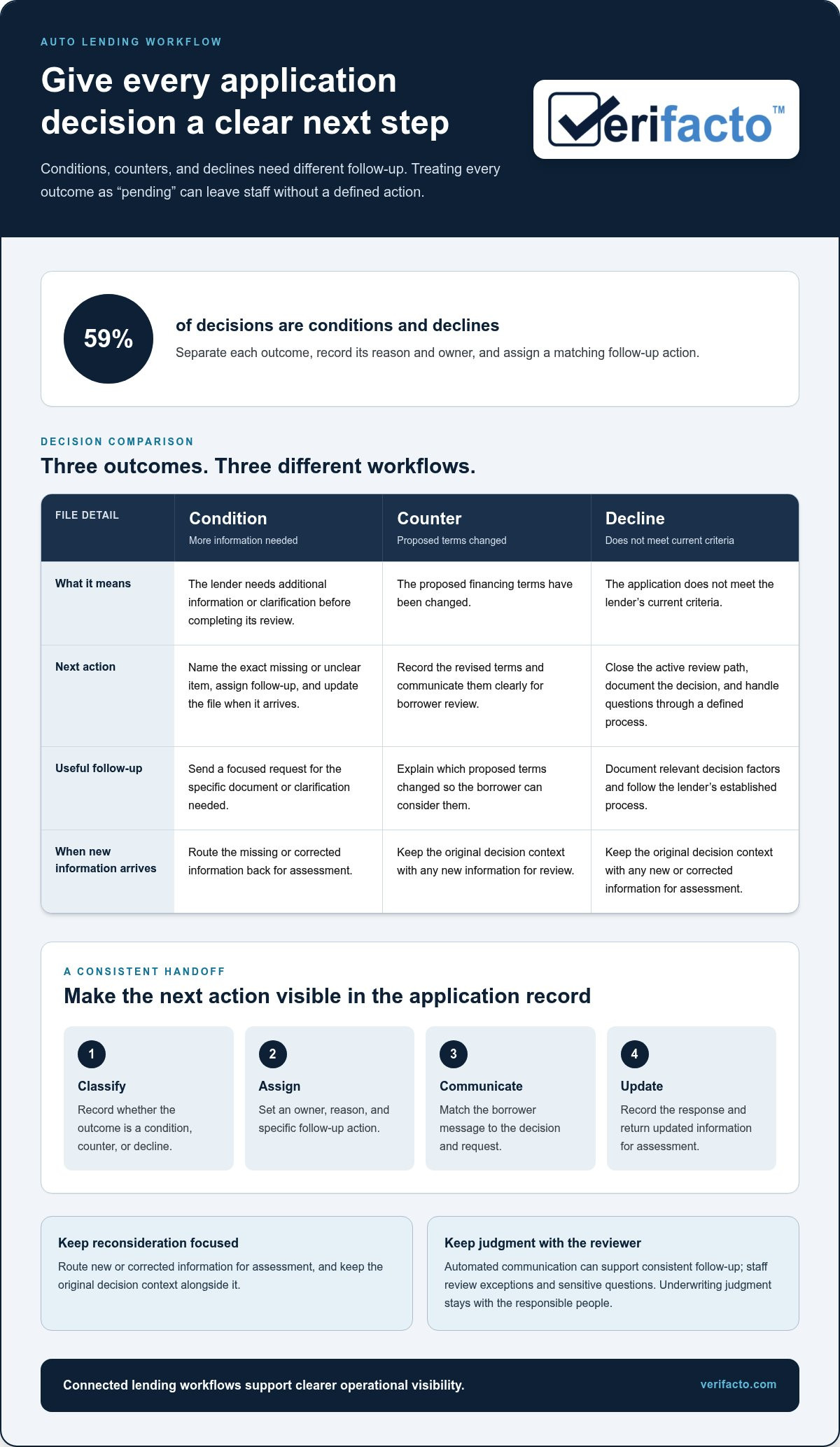
A condition means the lender needs additional information or clarification before completing its review. For example, a file may need a clearer income document or an explanation of a mismatch. A counter changes proposed terms, while a decline means the application does not meet the lender’s current criteria. Record the decision type, reason, owner, and follow-up action in the application record.
Conditioned, countered, and declined applications
Conditions and declines account for 59% of decisions, so every application needs a defined next step. Separate requests for missing information from revised financing terms and decisions that cannot proceed; each outcome calls for a different response.
That distinction makes reconsideration more useful. For a conditioned file, identify the exact item required and send a focused request. For a counter, explain which proposed terms changed and what the borrower needs to consider. For a declined application, document the relevant decision factors and follow the lender’s established process. Avoid marking every outcome as generic “pending,” which leaves staff without a clear next step.
Eligibility reconsideration should focus on new or corrected information that could affect the original review. If a borrower submits a corrected application detail or a previously missing document, route it back for assessment. Keep the original decision context alongside the new information. This gives reviewers a clear comparison and helps prevent repeated requests for the same item.
- Condition: List the missing or unclear item, assign follow-up, and update the file when it arrives.
- Counter: Record the revised terms and communicate them clearly for borrower review.
- Decline: Close the active review path, document the decision, and handle further questions through a defined process.
Eligibility reconsideration should focus on new or corrected information that could affect the original review. If a borrower submits a corrected application detail or a previously missing document, route that material back for assessment. Keep the original decision context alongside the new information. This gives reviewers a clear comparison and helps prevent repeated requests for the same item.
Borrower communication should match the decision. A condition notice needs a specific request; a counter needs a clear explanation of revised terms. Automated borrower communication can support consistent follow-up, while staff remain responsible for reviewing exceptions and sensitive questions. A practical workflow routes each decision to the matching message, records the response, and returns updated information to the application queue.
Borrower communication should match the decision. A condition notice needs a specific request; a counter needs a clear explanation of revised terms. Automated Borrower Communication can support consistent follow-up, while staff retain responsibility for reviewing exceptions and sensitive questions. A practical workflow routes each decision to its matching message, records the response, then returns updated information to the application queue.
When reviewing where AI may support these handoffs, explore AI-supported operational workflows as one part of a controlled process. Clear categories, documented reasons, and assigned next actions help teams manage reconsideration without obscuring human review.
Borrower qualification and underwriting
Underwriting depends on the quality, completeness, and context of borrower information. A consistent review process helps dealers assess applications while keeping credit decisions under human control.
Borrower Qualification Review
Group relevant credit details for review, including credit scores, payment history, outstanding debts, and credit utilization ratios. Compare those details with the application and supporting documents. For example, if an income document and the application show different figures, route the discrepancy for review instead of allowing an automated workflow to treat either figure as final.
Use document flags as prompts for investigation. Processing tools can identify missing or malformed signatures and possible signs of alteration or tampering. A reviewer can examine the source document, confirm whether the information is usable, and record the resolution. This keeps exceptions visible and gives underwriting teams a defined path for incomplete or inconsistent files.
Use document flags as prompts for investigation. Processing tools can identify missing or malformed signatures and possible signs of alteration or tampering. A reviewer can then examine the source document, confirm whether information is usable, and record the resolution. This approach keeps exceptions visible and gives underwriting teams a defined path for incomplete or inconsistent files.
Rules for Automated Lending Decisions
In the United States, automated auto-lending decisions operate within applicable consumer-credit, fair-lending, credit-reporting, and privacy requirements. Which requirements apply depends on the lender’s role, the data used, and how the decision process works.
Document the inputs and review path for each application. A practical process records the source of borrower information, flags conflicting details, routes exceptions to an assigned reviewer, and preserves the final decision context. This helps teams understand how a file moved through underwriting and where human judgment shaped the outcome.
Before using automation, map each decision point and test how the workflow handles missing or inconsistent data. If an application lacks a required document, the process should route it for follow-up rather than silently treating the gap as a positive or negative qualification factor. Clear routing supports consistent review without handing credit judgment to software.
Before using automation, map each decision point and test how the workflow handles missing or inconsistent data. If an application lacks a required document, the process should route it for follow-up rather than silently treating the gap as a negative or positive qualification factor. Clear routing supports consistent review without handing credit judgment to software.
Method says lenders can access borrower liabilities with a single connection. This information can be considered alongside the borrower’s submitted details, with any discrepancies left for human review rather than treated as an automatic decision. Streamline reports that 41% of decisions are approvals. That reported share provides context about decisions, but it does not determine the outcome for an individual applicant. Underwriters can assess each file on its own information and apply the lender’s established criteria, keeping borrower-level evidence separate from an aggregate approval figure.
People, processes, and technology working together
Lenders improve efficiency when employees, defined workflows, and technology support the same application journey. To streamline auto lending operations, start by finding handoffs that create repeated work, unclear ownership, or stalled files.
Processes to Automate
Choose automation by tracing an application from intake through funding. If staff repeatedly transfer a document or send the same status update, define the task’s trigger, destination, and exception path. Keep a person responsible for reviewing unusual records, borrower questions, and decisions that require context.
To implement improvements, map the current workflow, identify delays, assign process owners, and test a revised sequence with a defined application type. Review the results with the employees handling those files, then refine unclear steps. This lets lenders improve processes without changing every workflow at once.
Process Improvement Steps
For example, map how an application moves from intake to underwriting. Mark each handoff, the required information, and who acts when a document is missing. Remove duplicate entry where possible, then document the revised route and train the teams using it. Review exceptions with staff before extending the process to other application types.
Set ownership before changing software or procedures. An operations lead can maintain workflow definitions, while underwriting staff clarify review points and servicing teams identify downstream information needs. When a change affects borrower notifications, define who approves message content and who handles replies that need individual attention.
Measure performance with indicators tied to specific workflow stages. Track application cycle time, time waiting in each queue, document rework, manual handoffs, condition-resolution time, and time from approval to funding. Compare results for the same application type and period to see where process changes affect workload or delays.
Operational Efficiency KPIs
Approval rates alone do not show operational efficiency because applicant mix and credit criteria also shape outcomes. Pair decision outcomes with processing measures, such as incomplete-file frequency and exception volume. Review borrower response patterns alongside follow-up workload so teams can distinguish process delays from cases needing more information.
Use a consistent review rhythm: assign an owner to each KPI, examine the trend, and select one process change to test. For example, if document rework rises, inspect the intake instructions and the files returned for correction. Record the change and review the same measure afterward. This ties process decisions to observable operating data and helps lenders streamline auto lending operations without relying on a single metric.
Use a consistent review rhythm: assign an owner to each KPI, examine the trend, and select one process change to test. For example, if document rework rises, inspect the intake instructions and the files returned for correction. Record the change and review the same measure afterward. This connects process decisions to observable operating data and helps lenders streamline auto lending operations without treating a single metric as the full picture.
Which auto lending processes are best to automate?
Start with frequent administrative handoffs. Identify tasks staff perform repeatedly, then define the trigger, destination, and exception path for each one. Suitable candidates include recording application receipt, assigning a file to a queue, sending routine status updates, and creating a reminder when a requested document has not arrived.
Communication is a practical starting point because routine updates follow recognizable events. For example, after a lender records a condition, a message can explain the requested item and how to respond. Set rules for which events trigger messages, who reviews their content, and how staff handle borrower replies that need individual attention.
- Application intake: Check required fields and flag incomplete submissions for follow-up.
- Task routing: Assign files by workflow stage, such as initial review or funding preparation.
- Borrower notifications: Send a consistent message when an application changes status or needs information.
- Queue monitoring: Surface files waiting for staff action, borrower input, or a defined next step.
Automated borrower communication supports this kind of structured follow-up. Map each message to an application status, such as received, awaiting information, or under review. Keep a clear handoff for questions outside the standard message. This helps teams communicate consistently without treating every borrower’s situation as identical.
Data movement also deserves attention. If employees enter the same application detail in separate systems, identify the authoritative record and remove unnecessary duplicate steps. Define how to handle conflicting updates. A routing rule can flag a mismatch for review instead of overwriting a value without context.
Do not automate a process simply because software can perform a step. First confirm that the workflow has a clear owner, stable inputs, and an exception route. For example, an automated reminder is useful only when the requested document, recipient, and follow-up action are defined. Poorly designed triggers can send irrelevant messages or leave an application in the wrong queue.
Do not automate a process simply because software can perform a step. First confirm that the workflow has a clear owner, stable inputs, and an exception route. For example, an automated reminder is useful only when the requested document, recipient, and follow-up action are defined. Poorly designed triggers can send irrelevant messages or leave an application in the wrong queue.
Measure each change against its purpose. If a new routing rule aims to reduce manual transfers, track handoffs and queue delays before and after implementation. Review exceptions with the employees who handle them, then adjust the workflow. Explore AI-supported workflow automation as part of a controlled operating process.
Dealerships can move parts of the sales process online by offering online trade-in tools, F&I education and offerings, and access to qualified salespeople via chat.
Verifacto: Verifacto DMS
Verifacto is an AI-powered operating platform that connects dealership and loan workflows across the customer and lending lifecycle. Verifacto DMS and Verifacto LMS work alongside Insurance Tracking and CPI Solutions, with connected data supporting visibility across operations.
AI agents, including Sales, Analytics, Personal Assistant, Collections, and execution agents, support teams by working with operational data and helping coordinate tasks. They’re designed to assist, not replace human judgment: staff remain involved in lending decisions and exceptions. This connected approach can help dealerships and lenders manage information across customer activity, loans, servicing, and reporting with greater operational control.
To discuss how Verifacto may fit your operation, contact the team or visit verifacto.com.
Make the next improvement measurable
Operational change works best when it has a clear owner and a defined business purpose. Choose a priority that matters to your lending operation, then decide how leaders will assess progress and who will review exceptions. This keeps process design tied to management decisions, not just software changes.
It means coordinating the work, information, and decisions involved in handling an auto loan. To streamline auto lending operations, lenders can define how an application moves between teams, assign an owner to each stage, and use connected tools to reduce duplicate entry. For example, matching each application to its borrower and vehicle record helps staff locate the right file as it moves from origination into account management.
Explore how Verifacto could fit your operation and priorities. Contact Verifacto to discuss your needs, and take the next step toward a more connected lending workflow.
Frequently Asked Questions
What does streamlining auto lending operations involve?
Dealership management systems support dealer-side activity, while loan management systems organize loan accounts and servicing workflows. A dealership may also use a CRM for customer interactions and separate tools for payments, insurance, messaging, and reporting. Verifacto’s DMS and LMS support dealership and loan-management operations within its cloud-based platform. Assess whether each system supports the teams’ actual workflows and provides useful visibility across handoffs.
What software platforms streamline auto loan origination and servicing?
Automated systems can organize information and apply configured steps consistently, while manual underwriting lets a reviewer weigh context and resolve exceptions directly. For example, software may identify an inconsistency between an application and a supporting document, but a human underwriter can assess its significance. A practical approach uses automation for repeatable preparation and routing, with people responsible for credit judgment and unusual cases.
How do automated underwriting systems compare with manual underwriting?
Begin by mapping which information needs to move between the lender, dealer, origination system, and credit bureau connection. Define a source of truth for applicant and vehicle details, then map fields and decision-status updates to receiving systems. Test the workflow with incomplete records and corrected information before using it in production. Clear ownership for errors helps teams resolve mismatches without creating duplicate files.
How can auto lenders integrate loan origination systems with dealers and credit bureaus?
Begin by mapping which information needs to move between the lender, dealer, origination system, and credit bureau connection. Define a source of truth for applicant and vehicle details, then map fields and decision-status updates to their receiving systems. Test the workflow with incomplete records and corrected information before relying on it in production. Clear ownership for errors helps teams resolve mismatches without creating duplicate files.
What are typical costs and ROI of auto lending automation?
Verifacto’s cloud-based DMS and LMS connect loan and dealership workflows with insurance tracking, CPI solutions, automated borrower communication, and built-in payment processing. For a practical next step, contact Verifacto to discuss how its platform can support your operation.