
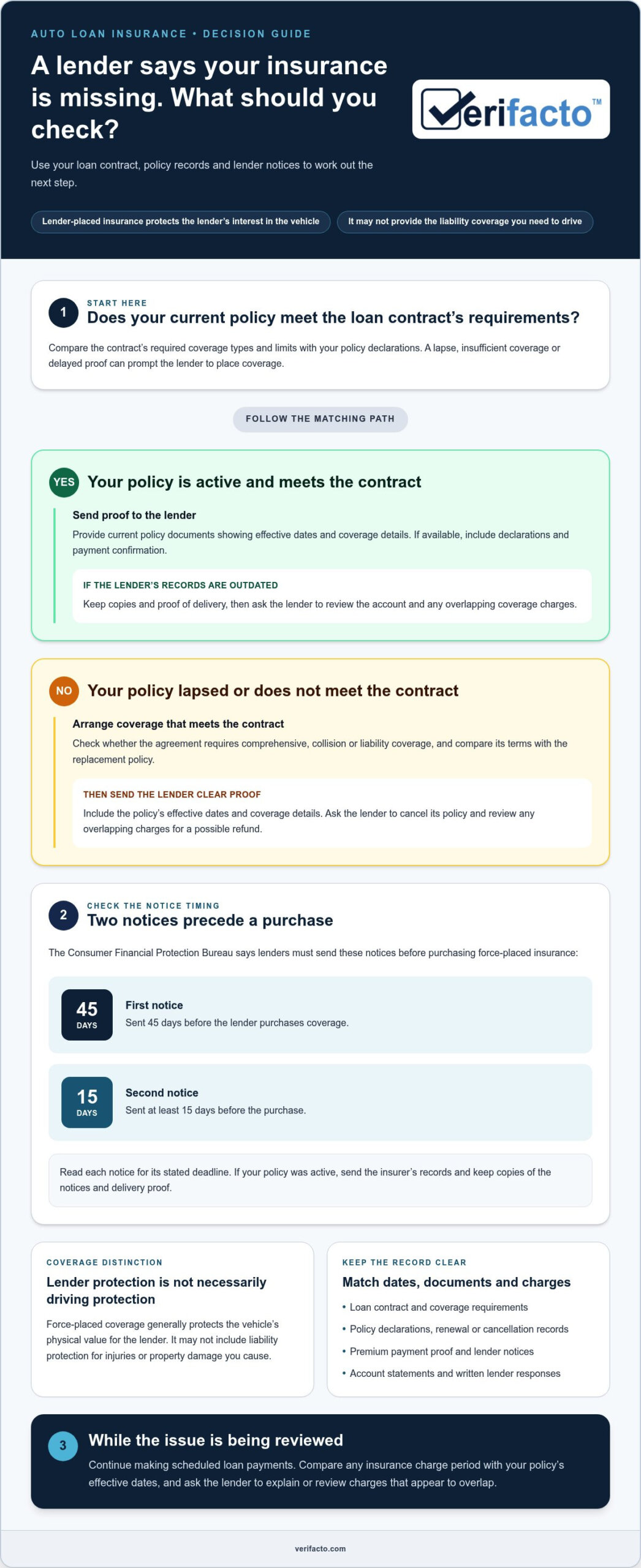
Force-placed insurance for auto loans can be added when your coverage lapses or your lender doesn’t receive acceptable proof. The lender may buy coverage and add its premium to your loan payment; you can seek removal by getting insurance that meets your contract’s requirements and sending proof to the lender. The Consumer Financial Protection Bureau says lenders must send a notice 45 days before purchasing coverage and a second notice at least 15 days beforehand.
This coverage protects the lender’s interest in the vehicle, not your own insurance needs. It may not include the liability protection required to drive, so a lender-placed policy doesn’t necessarily mean you’re fully insured on the road.
Review your loan contract to understand why a lender may place coverage and how to address removal or overlapping charges. Keep clear records of your policy dates, coverage and payment proof. These can help you resolve a lapse, late paperwork or insurance-tracking error with your lender.
Key Takeaways
- Review your loan contract to understand the required coverage, including any comprehensive, collision, or liability requirements.
- A lapse, insufficient coverage, or delayed proof can lead a lender to place coverage and add its premium to your loan payment.
- Lender-placed coverage is intended to protect the lender’s interest in the vehicle and may not provide the liability protection you need to drive.
- To seek removal, arrange coverage that meets the contract’s requirements and send the lender clear proof, including policy dates and coverage details.
- Keep making loan payments while you resolve the issue, and ask the lender to review any overlapping coverage charges.
How does force-placed insurance work?
When an auto lender lacks proof of required insurance, it may buy a policy to protect its interest in the vehicle and charge you for it. Understanding the notices, coverage limits and steps to restore your own policy helps you respond before charges continue.
Coverage Lapses and Missing Proof
Force-placement can begin if your policy lapses, falls below the loan contract’s requirements or isn’t documented with the lender. A missed renewal notice or delayed proof can cause the same problem, even if you believe your coverage is still active.
For example, your insurer may renew your policy while the lender’s records still show an expired term. Ask your insurer for current declarations and payment confirmation, then send them to the lender. Keep copies and proof of delivery so you can document what coverage was in force and when.
When Lenders Purchase Coverage
A lender may purchase force-placed coverage after identifying a lapse or deciding that the policy on file doesn’t meet the contract’s requirements. It may add the premium to your loan payment, so respond to a notice rather than assume the charge will disappear.
The trigger may be a coverage gap, inadequate limits or proof that arrived too late to update the lender’s records. Compare the notice with your policy dates and contract terms. If the lender’s information is outdated, submit current proof promptly and ask how it will review your account while you continue making loan payments.
Coverage Limits and Reinstatement Options
Force-placed auto insurance generally covers physical damage to the vehicle, often through collision and comprehensive coverage. It protects the lender’s collateral, but may not provide the liability coverage needed for injuries or property damage you cause.
That distinction matters: a lender-placed policy doesn’t necessarily replace the insurance you need to drive. To seek reinstatement of your own coverage, obtain a policy that meets the loan contract’s requirements and send proof to the lender, including effective dates and coverage details. Ask the lender to cancel its policy and review overlapping charges for a possible refund.
Notices Before Coverage Is Purchased
In the United States, federal law requires a lender to send a notice 45 days before purchasing force-placed insurance, according to the Consumer Financial Protection Bureau. The notice gives you time to address a reported gap or provide proof before the lender places coverage.
The Consumer Financial Protection Bureau also says federal law requires a second notice at least 15 days before the purchase. Read both notices carefully, note the stated deadline, and respond with your insurer’s documents if your policy was active. If you’re paying for overlapping coverage, keep your notices and proof together when asking the lender to review charges.
Insurance requirements in auto loan contracts
An auto loan contract specifies the insurance borrowers must maintain on a financed vehicle. Yes, a lender may assess premiums retroactively for months when it believes required coverage was missing or insufficient.
Contract Insurance Requirements
The insurance clause sets out your obligations and explains when the lender may protect its interest in the vehicle. Auto lenders may require comprehensive and collision coverage, as well as liability limits above the state minimum.
Review the contract itself, not just your insurance card. Compare its coverage types and limits with your policy declarations, and note any requirements for notifying the lender about policy changes. For example, replacing a policy may create a paperwork gap if the new insurer’s records haven’t reached the lender. Keep the agreement, declarations and change confirmations together to establish what coverage applied during each period.
Federal and State Rules
Federal consumer-protection rules and state insurance requirements address different parts of the process. Regulation X governs force-placed insurance for residential mortgage loans, so its mortgage provisions shouldn’t be treated as auto-loan rules.
For a vehicle loan, the agreement and applicable state insurance requirements are key references. State requirements can affect the coverage needed to drive, while the lender’s contract may require additional protection for its collateral. If a notice questions your coverage, identify whether it concerns driving liability, the lender’s collateral requirements or both. Keeping these categories separate helps clarify what the lender says is missing and which policy document addresses it.
Retroactive Insurance Charges
A lender may assess force-placed premiums for past months when it believes the vehicle lacked coverage required by the contract. Compare the charged period with your policy’s effective dates and the lender’s stated reason for placing coverage.
Compare the account statement with insurer documents, such as cancellation notices, renewal confirmations and proof of premium payment. If the policy was active, send records showing the covered dates and ask the lender to review the billed period. If there was a genuine gap, ask which months the charge covers and how it was applied to the account. Continue making scheduled loan payments while seeking clarification, and keep written responses with the relevant statements.
For example, if your insurer confirms a policy remained active after the lender recorded a cancellation, request a review and include that confirmation and the corresponding declarations. Dated records help distinguish an actual lapse from a reporting or processing error, without confusing the lender’s collateral requirements with state driving rules.
Meaning of force-placed and lender-placed insurance
“Force-placed” and “lender-placed” describe coverage arranged by a creditor after an auto-loan insurance condition appears unmet. The terms describe how the policy is added to the account, not a separate type of borrower-selected auto policy. The distinction matters because the lender, rather than the vehicle owner, selects the policy and determines how its premium is billed.
A placed policy is generally tied to the financed vehicle and the loan’s insurance clause. The creditor may rely on an insurer’s cancellation notice, an expired policy term or coverage limits it considers inadequate. These records can trigger placement even when you believe your insurance is active, so check what the lender’s file shows for the dates in question.
Force-placed coverage generally costs more than a standard policy you obtain independently. Borrowers typically have little control over its options, limits or premium. Compare the policy’s billed period with your insurance documents and account statement instead of treating the premium as an ordinary change to your loan payment.
To address an active placed policy, ask the creditor what documents it needs to recognize your current insurance and what date it will use to end the placed coverage. Request written confirmation of the cancellation and account adjustment. This gives you a clear record without relying only on a phone conversation or an updated monthly statement.
If a charge overlaps with a period covered by your own policy, request a billing review for those dates. Include the policy’s effective period and payment record, then ask the creditor whether it will correct the balance or issue a refund. A lender may cancel coverage and refund charges when appropriate. Keep its account response with the relevant billing records.
To dispute an unexplained charge, separate the issue into two questions: why was the policy placed, and how was the premium calculated for the billed period? Ask the lender to address each in writing. For an ongoing insurance complaint, you can contact your state insurance department or commissioner. These steps create a focused record for reviewing the charge without assuming that every placement or billing decision is incorrect.
How to remove force-placed insurance from a car loan
Start with the lender’s notice, your loan agreement and the insurance policy covering the vehicle. Send proof that meets the contract’s requirements, request cancellation, and keep making scheduled loan payments while the lender reviews your account.
Reviewing the Loan Agreement
Your loan agreement explains the coverage the lender requires and what may happen after a lapse. Before sending documents, compare those requirements with your policy’s coverage types, limits and effective dates.
If the notice says your coverage is insufficient, identify the specific requirement it cites. For example, check whether your policy includes the comprehensive and collision coverage required by the contract. Keep the relevant contract section and policy declarations together so your request addresses the stated gap directly.
Refusing Insurance Charges
Refusing a force-placed insurance charge doesn’t cancel the policy or remove the amount from your loan account. The amount may remain due under the loan agreement, so dispute it in writing while continuing scheduled payments.
Ask the lender to explain the charge and identify the period it covers. If you believe the policy overlaps with your own insurance, attach your policy dates and proof of payment. Keep copies of the notice, dispute and payment records to track the account while the lender reviews your request.
Use a clear document package to support cancellation:
- Include the current declarations page, showing the vehicle and coverage dates.
- Attach proof of premium payment or confirmation from your insurer.
- Identify the lender’s notice and explain which requirement your documents address.
- Keep a copy of everything submitted and note when you sent it.
After sending proof, ask the lender to confirm receipt and update its records. The lender may need to review the policy dates and coverage limits against the loan terms. Ask it to cancel the placed policy and correct charges for any overlapping period. After providing proof, follow up with the lender and ask it to cancel the placed policy; response timing may vary.
Continue paying the regular loan amount on time while the dispute is open. If the lender’s bill includes a separate insurance charge, request written instructions for handling that disputed amount instead of withholding the entire payment. Missing a scheduled payment can create a separate loan-account problem while you challenge the insurance charge.
If your policy actually lapsed, arrange replacement coverage that meets the contract and provide updated proof promptly. Ask the lender to explain the billed dates and any remaining balance. If your insurer confirms there was no lapse, send its confirmation and request a correction. Keep the lender’s written response with your records until the account reflects the decision.
Force-placed insurance for auto and vehicular loans
Auto-loan force-placement concerns a vehicle pledged as collateral, not a home securing a mortgage. The lender obtains coverage when it believes you haven’t maintained the insurance required by the loan agreement. You pay the premium, while the policy primarily protects the lender’s financial interest in the vehicle.
That connection to the collateral shapes the policy’s purpose. A lender wants protection if collision damage or theft reduces the vehicle’s value before the loan is repaid. Force-placed coverage typically addresses physical damage through collision and comprehensive protection. It doesn’t necessarily provide broad protection for injuries or damage to another person’s property.
That example shows why a placed policy shouldn’t automatically be treated as a substitute for your personal auto insurance.
The contract gives the lender a basis to protect its collateral if required insurance lapses or falls short. It may learn of a problem through an insurer’s cancellation notice, missing proof or your confirmation of a lapse. A lender may also charge premiums retroactively for months when it believes the vehicle was inadequately insured. Review the billed period and supporting records.
Payment handling depends on the lender’s process. The premium may be added to loan payments or collected another way determined by the lender. Review each statement for a separate insurance charge, its dates and any account adjustment. Keep those billing documents with your agreement and insurer records.
Auto loans and mortgages aren’t interchangeable. Regulation X’s force-placed insurance provisions concern residential mortgage loans, while a vehicle loan is governed by its contract terms and applicable auto-insurance requirements. A mortgage policy protects a home securing the debt; an auto policy concerns the financed vehicle. The shared principle is collateral protection, but the property, contract and coverage differ.
As a borrower, evaluate two questions separately: does the vehicle have the coverage required by the agreement, and does the policy protect your own liability interests? Compare the loan agreement, insurer declarations and lender notice. If records show continuous coverage, provide them and request review of any overlapping charge. If coverage truly lapsed, restore the required insurance and ask how the lender will update your account.
Verifacto: Verifacto DMS
Verifacto connects dealership and lending operations across the customer and loan lifecycle. Verifacto DMS and Verifacto LMS bring dealer and loan management together with borrower communication, payment processing, insurance tracking and CPI solutions. This connected workflow gives teams shared operational context across customer and loan records, servicing and insurance follow-up.
For example, a dealership can use the platform to keep loan activity and insurance information connected while managing a borrower account. Staff retain oversight of decisions and follow-up. Contact Verifacto to discuss how its platform can fit your operation.
Build a More Connected Insurance Workflow
Managing force-placed insurance for auto loans also requires operational visibility. Dealerships need a clear way to connect loan records, insurance information and follow-up so teams can act with the same account context. A connected workflow can support timely review while keeping staff in control of decisions and borrower communication.
Verifacto brings together Verifacto DMS, Verifacto LMS and Insurance Tracking in an AI-powered operating platform. Dealerships can connect operational and loan information with insurance visibility instead of treating each record as a separate task. The right workflow depends on how your dealership manages its portfolio and insurance information.
Consider how connected data could fit your current operation and where insurance follow-up needs greater visibility. Contact Verifacto to discuss your options and explore a practical next step for your team.
Frequently Asked Questions
What is force-placed insurance for an auto loan?
Force-placed insurance is a policy a vehicle lender obtains after it believes required insurance is absent or inadequate. The lender uses it to protect its financial interest in the financed car, and may add the charge to the account. The key distinction is control: the creditor selects the placed coverage, so it may not match your preferred policy or provide all the protection you need to drive.
When can an auto lender require force-placed insurance?
An auto lender may place coverage when your policy lapses, required proof is missing or coverage falls short of the loan agreement. For example, your policy might remain active but have limits below the lender’s requirements. An insurer’s cancellation notice or delayed renewal documents can also alert the lender to a possible gap. Compare the lender’s stated reason with your contract and policy records.
What coverage does lender-placed auto insurance provide, and what does it exclude?
Lender-placed auto insurance generally covers physical damage to the financed vehicle, commonly through collision and comprehensive coverage. It may protect against events such as a collision or theft, but may not include state-required liability coverage. Any liability protection it does provide may be insufficient for injuries or property damage beyond its limits. Review your policy documents separately from the loan account to understand your protection on the road.
What notices must lenders send before placing insurance on a vehicle?
In the United States, federal law requires a lender to send an initial notice 45 days before purchasing force-placed insurance, according to the Consumer Financial Protection Bureau. The CFPB also says a second notice must arrive at least 15 days before purchase. Read each notice for the reported coverage issue and response deadline. If your policy is active, send current evidence to the lender and keep a copy of your response.
What consumer protections and state-specific rules apply to lender-placed auto insurance?
Federal notice requirements provide advance warning before a lender purchases force-placed coverage. You can raise state-specific insurance concerns with your state insurance department or commissioner. Keep the loan agreement, insurance declarations, payment records and lender notices together when explaining a dispute. These documents help show whether the reported lapse occurred and what coverage was active. Regulation X’s mortgage protections concern home loans, so don’t assume they govern an auto loan.
How much does force-placed auto insurance typically cost compared with standard auto insurance?
Force-placed auto insurance is usually more expensive than a standard policy you obtain independently.