
A one-day car insurance lapse means you have no coverage during that period. Automated insurance lapse notices can flag missed payments, approaching expiration dates, or cancellation, but they do not create a nationwide grace period. Deadlines and penalties depend on the state and the policy.
A missed payment or overlooked email can put coverage at risk, even when the lapse seems brief. Automatic payments and reminders can help prevent missed due dates, but it is still important to understand what a notice means and when coverage may end.
This article explains how lapse deadlines and penalties vary, how automatic payments and reminders fit into the process, and what grace periods and cancellation notices can mean for coverage. It also explains how automated notices support timely follow-up, helping you understand the steps to take when a payment is late or a policy is nearing expiration.
Key Takeaways
- Insurance lapse deadlines and penalties vary by state, so identify the rules that apply where the vehicle is registered.
- Automatic payments and timely billing updates can help prevent missed premiums from interrupting coverage.
- Read payment, renewal, and cancellation notices promptly; a grace period is not the same as guaranteed continued coverage.
- When a notice arrives, look for the policy dates, reason for the lapse or cancellation, and any action needed to address it.
- For dealerships managing insurance records across accounts, insurance tracking within Verifacto’s DMS and LMS can help provide greater operational visibility.
Insurance lapse deadlines and penalties
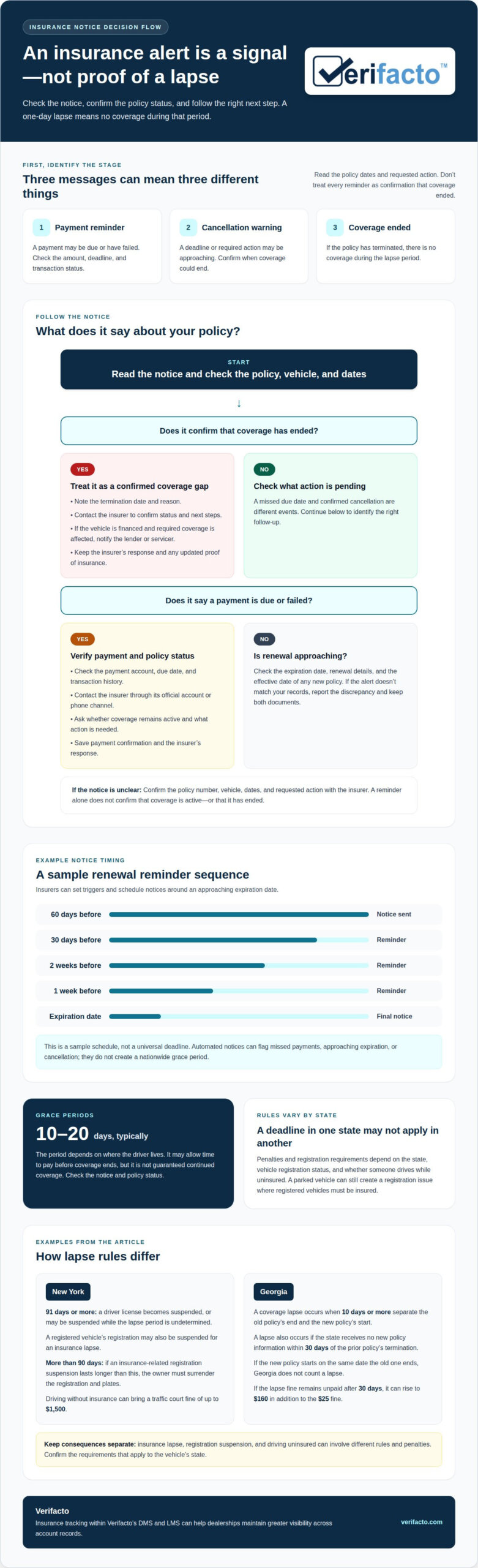
Insurers can set up automated lapse notices by defining a trigger, such as a missed payment or approaching expiration, then scheduling reminders around that date. A sample renewal sequence sends notices 60 days, 30 days, two weeks, and one week before expiration, followed by a final notice on the expiration date. The insurer can then track responses and flag unresolved accounts for follow-up.
A one-day car insurance lapse means the driver has no coverage during that period. The consequences depend on the state, the vehicle’s registration status, and whether someone drives it while uninsured. A parked vehicle can still create a registration issue in states where registered vehicles must be insured. Distinguish a gap in the policy from the separate act of driving without insurance.
New York’s rules show how deadlines can escalate. According to the New York State Department of Motor Vehicles, a driver license becomes suspended when an insurance lapse lasts 91 days or more, or while the lapse period has not yet been determined. New York DMV may also suspend vehicle registration when a registered vehicle has an insurance lapse. If an insurance-related registration suspension lasts more than 90 days, the owner must surrender the registration and plates.
Driving uninsured can bring separate penalties. According to the New York State Legislature, the traffic court fine for driving without insurance or allowing another person to drive an uninsured vehicle can be as much as $1,500. The New York State Department of Motor Vehicles says the $750 DMV civil penalty to restore a driver license revoked for driving without insurance was repealed. These are distinct consequences, so a driver should not treat payment of one penalty as resolving every registration or license issue.
Georgia uses different lapse thresholds. A vehicle coverage lapse occurs when 10 days or more separate the previous policy’s termination and the new policy’s effective date. It also occurs if the state receives no new policy information within 30 days of the prior policy’s termination. When the new policy begins on the same date the old one ends, Georgia does not count a lapse. If that fine remains unpaid after 30 days, the lapse fine can rise to $160 in addition to the $25 fine.
For lenders and dealerships, an automated notice is useful only when its timing connects to a clear account status and follow-up step. Separate a missed-payment alert from confirmed policy termination, record the dates for each, and route unresolved cases for review. This helps staff respond to the actual coverage status instead of treating every reminder as proof of a lapse.
Preventing lapses with automatic payments and reminders
Automated notices use defined triggers and schedules across eligible accounts. Manual notices depend on staff identifying each case and sending a message individually. Automation can make recurring reminders more consistent, while manual follow-up can address exceptions that require judgment. Neither approach prevents a lapse if payment details are outdated, a notice goes unread, or a payment fails. Treat an alert as a prompt to act, not proof that coverage remains active.
Automatic payments can reduce the chance of missing a premium due date. Enroll the correct policy and payment account, then confirm the billing details are current. Check the withdrawal date and account balance before each scheduled payment. If a card expires or a bank account changes, update the payment method with the insurer and verify the change took effect. Keep the confirmation with the policy records so you can compare a later billing alert against the payment history.
Reminders add another layer of awareness. Use the insurer’s renewal and payment messages to note the amount due, deadline, and policy period. Keep the sender’s email address in your inbox, and review spam settings so a billing notice is not filtered out. If an email warns that a payment failed, open the policy account, identify the reason, and arrange payment through the insurer’s available process. Do not assume a scheduled withdrawal succeeded without checking the transaction.
A car insurance grace period after a missed payment typically lasts 10 to 20 days, depending on where the driver lives. That period may give the policyholder time to pay before coverage ends, but it shouldn’t be treated as extra time to ignore a notice. Check the payment deadline and policy status in the insurer’s communication. A missed due date and a confirmed cancellation are different events, and the consequences for insurance coverage and vehicle registration can depend on when coverage actually ends.
After receiving a lapse warning, act promptly: read the notice, confirm the policy and vehicle details, then contact the insurer through its official account or phone channel. Ask whether payment is outstanding, whether coverage remains active, and what action will keep or restore it. Save the response and payment confirmation. If the vehicle is financed, notify the lender or servicer when the notice affects required coverage, and retain any updated proof of insurance.
Incorrect or missed automated notices can create risk in either direction. A mismatched vehicle or policy may cause unnecessary concern, while an outdated email address or failed message may leave a driver unaware of a real payment issue. Review the policy number, vehicle, dates, and requested action before responding. If an alert conflicts with a payment receipt or current policy record, report the discrepancy promptly and retain both documents for follow-up.
Grace periods and cancellation notices
A payment reminder, a cancellation warning, and a notice that coverage has ended describe different stages. Read the dates and required actions carefully: the distinction affects continuous liability coverage and the steps to take next.
Information Included in a Notice
An insurance lapse notice explains a policy issue, the relevant dates, and the action the recipient needs to take. For a useful review, identify the insurer, policy number, covered vehicle, reason for the notice, payment or cancellation date, and any stated deadline. These details help distinguish a billing problem from confirmed termination of coverage.
Compare the notice with the policy record and recent payment confirmation. If the notice names a different vehicle or lists a payment as unpaid after a receipt was issued, retain both records and ask the insurer to resolve the mismatch. Do not treat a payment reminder as proof that the policy has been canceled.
Notice Requirements and Deadlines
In the United States, insurers must provide advance notice before canceling an auto policy, and most states require at least a month’s notice. The notice period and rules depend on the state and policy circumstances, so no single deadline applies uniformly nationwide. Treat the date printed on the notice as an operational deadline, not a rule for every policy.
Notice rules can differ by state and type of insurance, including auto coverage and other forms of insurance. The reason for cancellation, policy terms, and required method of notice can affect what the recipient receives and when. Review the stated effective date and follow the notice instructions: a payment deadline is not automatically the cancellation date.
How Automated Notices Work
An automated notice process uses account information and a defined event, such as a missed premium or approaching policy end date, to generate and send a message. The system can record the notice and whether follow-up occurred. Identify the event named in the notice: a payment issue calls for different action than a cancellation already in effect.
After receiving an alert, match its policy and vehicle details to the current insurance record. Follow the stated payment or response process and retain any confirmation. If a notice says coverage will end on a specified date, act before then and confirm the insurer’s updated status afterward.
Grace Periods
A grace period is time allowed under a policy or process to address a missed payment before a specified consequence occurs. It doesn’t automatically mean coverage remains active in every situation. One example process starts a 30-day grace period on the policy expiration date; that example is not a universal deadline for all insurers or states.
Check the policy terms and notice for the period’s start and end dates and the required action. A grace period can affect when a late payment is accepted or cancellation takes effect, but it does not replace a cancellation notice or restore coverage by itself. If a policy has ended, ask the insurer whether it can be reinstated and confirm the effective dates in writing.
How do automated insurance lapse notices work?
An automated notice process turns an insurance event into a prepared message and follow-up task. The event might be an approaching renewal date, a payment marked overdue, or incomplete policy information. The system uses account and policy records to identify the applicable notice. Staff can then review exceptions instead of building each routine message from scratch.
Reliable notices depend on accurate records. The policyholder’s name, mailing or email address, vehicle details, policy dates, and payment status need to match the account. For an auto lender, linking a notice to the correct borrower and collateral vehicle matters: one borrower may have multiple accounts, and a vehicle record may change during a loan. A mismatch can send an alert to the wrong person or hide the account that needs attention.
A typical workflow follows these steps:
- Identify the trigger. A renewal date approaches, a payment is recorded as missed, or an insurance record requires review.
- Match the account. The process links the policy event to the relevant borrower, loan, and vehicle details.
- Select the message. The notice reflects the event, such as a renewal reminder rather than a statement that coverage has ended.
- Send and record the notice. The account shows the communication and provides a reference for later follow-up.
- Review the response. A payment update, new policy document, or unresolved discrepancy guides the next action.
Distinguishing a reminder from a confirmed lapse is essential. A message about an overdue premium does not, by itself, establish that insurance has ended. Likewise, a borrower’s statement that payment was made does not resolve a record discrepancy until the account information is updated. Automated insurance lapse notices work best when they prompt a clear next step, while staff use judgment to handle conflicting records and unusual cases.
For example, a lender receives an alert that a financed vehicle’s policy may be ending. The account record identifies the borrower and vehicle, but a recently received document shows a different effective date. The right workflow pauses escalation, compares the policy dates, and routes the mismatch for review. If the new document resolves the issue, update the record; if not, follow up with the borrower.
Delivery also matters. An email address may be outdated, or a digital notice may land in spam. A record showing that a message was sent does not mean the borrower read it or restored coverage. Keep delivery status, account notes, and follow-up actions distinct. This helps lenders see which cases need contact, which have supporting documentation, and which still require human review.
What information must an insurance lapse notice include?
A useful lapse notice identifies the policy, explains the issue, and tells the recipient what action to take. No single notice template applies to every U.S. policy, so read the specific dates and instructions rather than assuming every insurer uses identical wording.
Start by matching the notice to the account. Check the named policyholder, insurer, policy number, and covered vehicle, including its vehicle identification details when provided. If a borrower has more than one financed vehicle, the vehicle description helps identify which insurance record needs attention. A mismatched policy or vehicle can send follow-up to the wrong account.
A clear notice should make these details easy to find:
- Policy and vehicle: Identify the insurer, policyholder, policy number, and covered vehicle.
- Reason for contact: State whether the issue is an unpaid premium, upcoming expiration, cancellation, or reported coverage gap.
- Relevant dates: Show the payment due date, policy end date, or effective date associated with the concern.
- Required action: Explain whether the recipient should make a payment, provide updated proof, or contact the insurer.
- Response instructions: Give a usable payment or response channel and explain how to submit supporting information.
- Contact details: Identify the insurer’s service channel for questions about the account or policy status.
Dates need context. A payment deadline is not necessarily the policy cancellation date, and a notice about an upcoming end date does not prove coverage has already stopped. A message that says a premium is overdue should identify the billing issue and requested response. A cancellation notice should distinguish its effective date from any earlier payment deadline.
When reviewing a notice, a lender should compare the borrower, collateral vehicle, policy dates, and stated reason with the account. Record the notice date, requested action, and follow-up result. If a borrower provides a payment receipt or updated policy document, link it to the relevant account and compare its effective dates with the notice. This creates a traceable record without treating an alert alone as confirmation of a lapse.
Use the notice as a practical checklist: identify the vehicle, understand the event, note the deadline, take the specified step, and retain the response. Dealership teams looking to strengthen their insurance-record workflow can discuss insurance notice management.
Notice requirements and follow-up can also depend on the state. In Pennsylvania, auto insurers must notify PennDOT when they cancel an insurance policy, but a new insurer is not required to notify PennDOT of new coverage. In New York, vehicles must have liability coverage from an insurer licensed by the New York State Department of Financial Services and authorized by the New York State DMV; out-of-state coverage is not accepted. A lapse can occur whenever a vehicle remains registered but uninsured, including between registration and the start of new insurance coverage.
New York vehicle owners must surrender their registration and plates before their New York State insurance coverage ends if they will no longer keep insurance on the vehicle. Keeping billing information up to date is a recommended way to help prevent an auto insurance lapse. The Hartford page states that penalties for driving without car insurance may include fines of up to $5,000.
Verifacto: Verifacto DMS
Verifacto connects dealership operations through its DMS, LMS, Insurance Tracking, and CPI Solutions. For auto lenders managing financed vehicles, Insurance Tracking provides real-time visibility into insurance status, helping teams identify records that need attention and follow up with clearer account context.
Verifacto is an AI-powered operating platform that connects customer and loan lifecycle operations. Its DMS and LMS bring dealership and loan-management workflows together, while Insurance Tracking supports coverage monitoring. CPI Solutions provide another way for lenders to address collateral protection, with immediate coverage with no waiting period.
Consider Verifacto when insurance records, borrower accounts, and loan workflows are difficult to manage across disconnected processes. Contact Verifacto to discuss your dealership’s operation.
Make Insurance Follow-Up Part of Your Operating Rhythm
Make insurance follow-up a defined management process, not a task that surfaces only when a notice arrives. Decide who reviews an alert, how account status is recorded, and when an unresolved discrepancy moves to human review. A consistent workflow gives your team a clearer handoff between the notice, borrower record, and next action.
For auto lenders, automated insurance lapse notices are most useful when they connect accurate account records to a practical follow-up process. That structure helps teams distinguish routine reminders from cases that need attention, while keeping decisions tied to the underlying policy information.
Use the next step to assess how insurance follow-up fits your broader dealership operation. Contact Verifacto to discuss your needs and explore an approach that supports clearer visibility across your workflows. With a more deliberate process, your team can move forward with greater control and confidence.
Frequently Asked Questions
What are automated insurance lapse notices?
Automated insurance lapse notices are communications generated by insurance-related account events, such as an approaching renewal or a change in payment status. For a lender, they can organize routine outreach by linking a message to a borrower’s account and prompting the next review step. For example, a renewal reminder can prompt staff to update the loan file when the borrower submits revised policy documents.
Which software providers offer automated insurance lapse notices?
Verifacto serves auto dealers and finance companies with a platform that connects dealership and lending operations. When assessing software, consider how insurance follow-up fits into the broader borrower and loan workflow, including how staff review records and document their actions. This helps determine whether the platform supports your team’s process instead of adding another disconnected step.
To discuss how Verifacto may fit your insurance follow-up workflow, contact Verifacto.