
Disconnected systems split payments, customer questions, and collections into separate tasks. Effective BHPH technology solutions connect these workflows, helping teams track account activity, manage borrower communication, and process payments with fewer manual handoffs.
That connection matters: a missed update or delayed response can make it harder to understand an account’s status and decide what needs attention. Automation can keep routine payment and communication tasks moving, while staff handle customer conversations and decisions that require judgment.
This guide explains how technology can support automated collections and payments, customer service, and technical support in a buy-here-pay-here operation. You’ll also see what to look for in connected systems, how they fit into daily dealership workflows, and where an integrated platform can provide greater visibility across customer and loan activity.
Key Takeaways
- Compare BHPH software by how well it connects customer, vehicle, contract, payment, and account records, not just by its feature list.
- Define which system holds the master record and how updates move between dealership and loan-management workflows.
- Plan for practical limitations, including data quality, staff training, and the operational work involved in adopting new technology.
- Use automation to support payment tracking and borrower communication while keeping people involved in decisions and customer conversations that need judgment.
- Explore how Verifacto DMS and LMS can connect dealership and loan operations with insurance tracking and CPI solutions.
4. How does BHPH Technology Solutions compare with other buy-here-pay-here software providers?
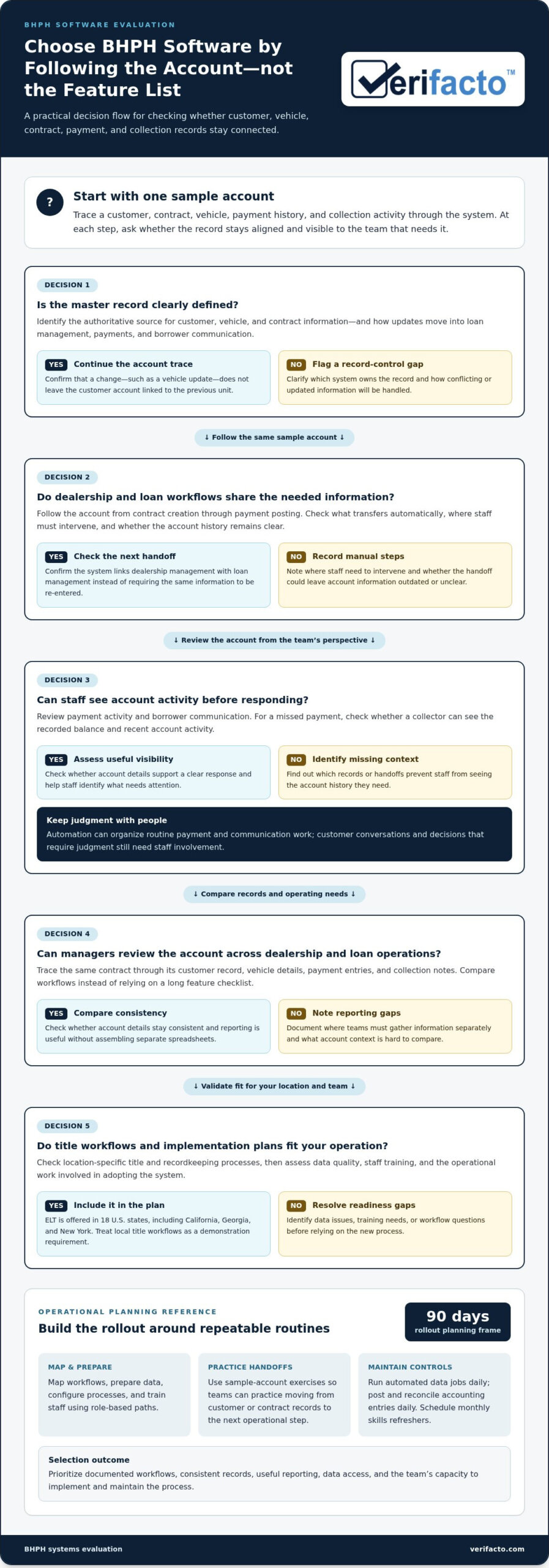
Compare systems by how they handle the full account lifecycle, not by feature count alone. A BHPH dealership needs dependable records for customers, vehicles, contracts, payments, and collections. One platform may focus on dealership sales, while another emphasizes loan servicing. The difference becomes clear when a salesperson updates a customer record but the collections team still sees outdated information. Assess how each system keeps records aligned and makes account activity visible.
Start by defining the master record. A BHPH dealer should identify the authoritative source for customer, vehicle, and contract data, then map how information moves into loan management, payment processing, and borrower communication. For example, a vehicle change should not leave a customer account linked to the previous unit. During a demonstration, follow a sample customer, contract, and payment history through the relevant workflows.
Next, compare how the system connects operational steps. BHPH software should link dealership management with loan management, rather than making employees re-enter the same information. Automated payments, tracking, and digital contract processing can support loan-management operations. In a demonstration, follow a sample account from contract creation through payment posting. Note what transfers automatically, where staff must intervene, and whether the account history remains clear.
Compare collections tools separately. Review how the system tracks payment activity and supports borrower communication, then check whether staff can see relevant account details before responding. For instance, a collector reviewing a missed payment needs a clear view of the recorded balance and recent account activity. Automation can organize routine work, but it should support staff judgment, not make every customer decision independently. Focus on visibility and workflow, not just an automation label.
Reporting is another practical differentiator. Check whether managers can review account information across dealership and loan operations without assembling separate spreadsheets. Trace a sample contract through its customer record, vehicle details, payment entries, and collection notes. Comparing the same account across workflows makes differences between systems easier to spot. Prioritize consistent records and useful reporting over a long feature checklist that does not address daily needs.
Technology selection also affects process control. The Truth-in-Lending Act requires lenders, including U.S. BHPH dealers offering in-house financing, to disclose financing terms clearly and accurately. Required disclosures include the annual percentage rate, total finance costs, associated fees, and repayment schedule. The Fair Debt Collection Practices Act applies to BHPH dealerships when they collect payments. Software can organize records and workflows, but a platform alone does not establish legal compliance.
Electronic lien and title workflows may matter to a dealership’s operating footprint. Eighteen U.S. states, including California, Georgia, and New York, offer electronic lien and title, or ELT. Compare how each system supports the dealership’s title and recordkeeping processes. The right assessment depends on where the dealership operates and how staff handle vehicle and contract information. Treat location-specific workflows as a demonstration requirement, not a generic feature claim.
Implementation deserves equal weight with product capabilities. A 90-day rollout model provides a planning frame for mapping workflows, preparing data, configuring processes, and training staff. Training should use role-based paths for sales, underwriting, funding, collections, and accounting. Those teams use different records and need clear handoffs. Include practical sample-account exercises so staff can practice moving from a customer or contract record to the next operational step.
After launch, schedule monthly skills refreshers that address new features and policy changes. Run automated data jobs daily to reconcile payments, balances, and postings. Post and reconcile accounting entries daily to reduce month-end pressure and audit risk. These routines help managers compare system activity with dealership records and identify exceptions sooner. They also reveal whether the platform supports repeatable controls beyond initial setup.
Finally, compare data access and operational flexibility. Review how the dealership can retrieve its records, manage permissions, and maintain workflows as business needs change. Establish who controls the data and how processes depend on connected systems. Choose based on documented workflows, record consistency, reporting needs, and implementation capacity. This creates a grounded comparison without assuming every system offers identical capabilities.
5. What are the risks or limitations of using BHPH Technology Solutions?
Technology can organize BHPH workflows, but it cannot correct inaccurate source information on its own. If a customer’s address is entered incorrectly, the error may carry into later processes. Before migration, identify authoritative records, remove duplicates, and assign responsibility for resolving conflicting data. A clean starting point helps prevent familiar errors from becoming embedded in new workflows.
Migration can interrupt routine work if teams change processes before testing them. For example, before relying on a new system for payment records, compare sample account histories. Check that customer identifiers, contract details, balances, and payment entries remain correctly associated. Maintain a clear process for handling exceptions as staff learn the system.
Automation has limits. A scheduled borrower message may suit a routine payment reminder, while a disputed balance needs review before anyone responds. Define which events trigger automated communication and which require staff attention. Clear escalation steps help ensure unusual account circumstances are not treated like standard cases.
Payment records require careful reconciliation. If a transaction appears in processor records but not in the account ledger, a collector may act on incomplete information. Establish a routine for comparing transaction status, account balance, and posting records. Document who investigates mismatches and how corrections are recorded. This keeps account histories clear when payment activity does not follow the expected path.
Connected systems bring dependencies as well as convenience. When a DMS and LMS exchange customer or contract data, a changed field or failed transfer can disrupt downstream work. Map each handoff, assign responsibility for exceptions, and test a sample account after configuration changes. Staff should also understand how to continue essential tasks when a connected workflow needs attention.
Reports can be misleading when users interpret fields differently. One manager may count a payment as received when initiated; another may count it only after posting. Agree on definitions before comparing reports, then review a sample account from operational and accounting perspectives. Consistent definitions help leaders distinguish timing differences from actual record discrepancies.
Training gaps can undermine even a well-designed rollout. Salespeople, underwriters, collectors, and accountants use different screens and make different decisions. Give each role practical exercises, such as updating a customer record or investigating a payment exception. When procedures change, explain and document the new steps. Staff should know where to record corrections rather than rely on informal workarounds.
Automation cannot replace judgment in customer interactions. A borrower may call about a payment dispute, hardship, or incorrect account detail. A system can show recorded activity, but staff need to understand the issue and respond appropriately. Set expectations for when a person reviews an account and how the conversation is documented. Technology should support consistent service, not make sensitive decisions without human oversight.
Security and access controls need ongoing attention. An employee who changes roles, for example, may no longer need the same access to customer or financial records. Assign permissions according to job responsibilities, review access when roles change, and follow established procedures for handling account information. Software does not remove the dealership’s responsibility to manage its users and processes carefully.
Finally, assess whether the workflow fits the dealership’s day-to-day operation. A store with frequent manual exceptions may need process changes before automation can help. Pilot a defined workflow, such as recording and reviewing payment exceptions, and gather staff feedback. Compare the intended process with what happens in daily work to identify where configuration, training, or clearer ownership is needed.
Verifacto: Verifacto DMS
Verifacto provides an AI-powered operating platform that connects dealership and loan workflows. Verifacto DMS and Verifacto LMS help teams coordinate operations when customer, vehicle, and account processes are disconnected.
For BHPH operations, Verifacto’s Insurance Tracking supports insurance-related workflows. The platform gives teams greater visibility across dealership and loan operations while staff remain involved in customer decisions and account follow-up.
Explore whether Verifacto fits your dealership’s workflow and priorities. Contact Verifacto to discuss your needs.
Build your next step around operational priorities
Start by identifying where disconnected information creates the most friction in your dealership. Choose a workflow, such as payment follow-up or insurance tracking, and define what staff need to see, record, and act on. This gives your team a practical way to assess whether BHPH technology solutions fit your processes, rather than choosing software by feature count alone.
Verifacto brings together Verifacto DMS, Verifacto LMS, and Insurance Tracking in a platform designed to connect dealership and loan operations. Discuss your workflows with Verifacto to explore how these capabilities fit your priorities and where your team needs clearer visibility.
Contact Verifacto to discuss solutions. A focused conversation can help you take the next step with confidence.