
What happens when a new lead, a missed follow-up, and an overdue account live in separate systems? Staff may have to piece together the context, while managers lack a timely view of what needs attention. AI agents for auto dealerships can help coordinate work, but their value depends on more than a convincing demo. They need relevant operational context and clear human oversight.
Dealership leaders are right to look beyond claims about faster workflows or better results. The practical questions are which agent roles fit the operation, what tasks they can support, and where staff should review or guide their work. This roundup explains those roles and offers a practical way to assess whether an agent addresses a real dealership need.
Verifacto brings dealership and lending workflows together in an AI-powered operating platform. Its Sales, Analytics, Personal Assistant, Collections, and execution agents support tasks across connected operations, alongside capabilities such as a DMS, LMS, and dealership CRM. Here’s how that connected context can support staff from lead follow-up through account servicing, and what to evaluate before adopting AI.
Key Takeaways
- AI agents for auto dealerships can support distinct roles, from sales follow-up to analytics and collections, while staff retain responsibility for judgment.
- Match each agent to a defined task, the operational context it needs, and the staff member responsible for review.
- Consider how connected information across CRM, inventory, DMS, LMS, and servicing can support a more informed workflow.
- Assess agent fit by defining the bottleneck, mapping the workflow, reviewing data access, setting controls, and evaluating results.
- Prioritize one clear use case before expanding automation, and consider how a connected operating platform can provide greater operational visibility.
Why AI agents for auto dealerships are gaining attention
A lead arrives through one tool, inventory details sit in another, and financing or account information lives elsewhere. Staff bridge the gaps with manual handoffs, while managers check multiple screens to understand what is pending. The issue isn’t a lack of effort. Disconnected systems make it harder to maintain context, coordinate the next step, and see where work is stalled.
An AI agent is software that uses available workflow context to support or carry out a defined task within the access and controls it has been given. That boundary matters. An agent might help with lead follow-up or surface a task reminder, but it should not be assumed to access every system or make consequential decisions independently. Staff remain responsible for judgment, review, and customer interactions that need a person’s attention.
What makes an AI agent different from a chatbot?
A chatbot is generally designed to respond in a conversation. An agent may use relevant workflow information to support a bounded next step, such as scheduling an appointment or creating a reminder, when its tools and permissions allow it. The difference is action within a defined process, not unrestricted autonomy. For a foundational explanation of conversational systems, see this overview of a conversational chatbot.
For example, a conversational tool might answer a shopper’s question. A Sales Agent could also support follow-up or appointment scheduling as part of a dealership workflow. That doesn’t mean it should decide how to handle every lead. Staff need a clear way to review activity, guide the process, and step in when a situation calls for human judgment.
Why disconnected dealership systems complicate AI adoption
Lead details, vehicle availability, financing progress, and servicing records may be managed in different places. When context doesn’t carry cleanly between steps, an agent may have limited information to work with, and employees may need to verify details or repeat tasks. AI layered over fragmented records can automate an isolated step without improving visibility across the broader workflow.
Connected operational context can help staff see what has happened and what may need attention next. A dealership CRM, DMS, and LMS each support different parts of the operation. Understanding their roles is a useful starting point for evaluating dealer management system fundamentals. Verifacto takes a connected-platform approach, bringing dealership and lending workflows together with AI agents that support tasks such as lead engagement, reminders, analytics, and collections. The goal is to give staff clearer context and more controlled automation, not to replace the team.
Five AI agent roles shaping dealership workflows
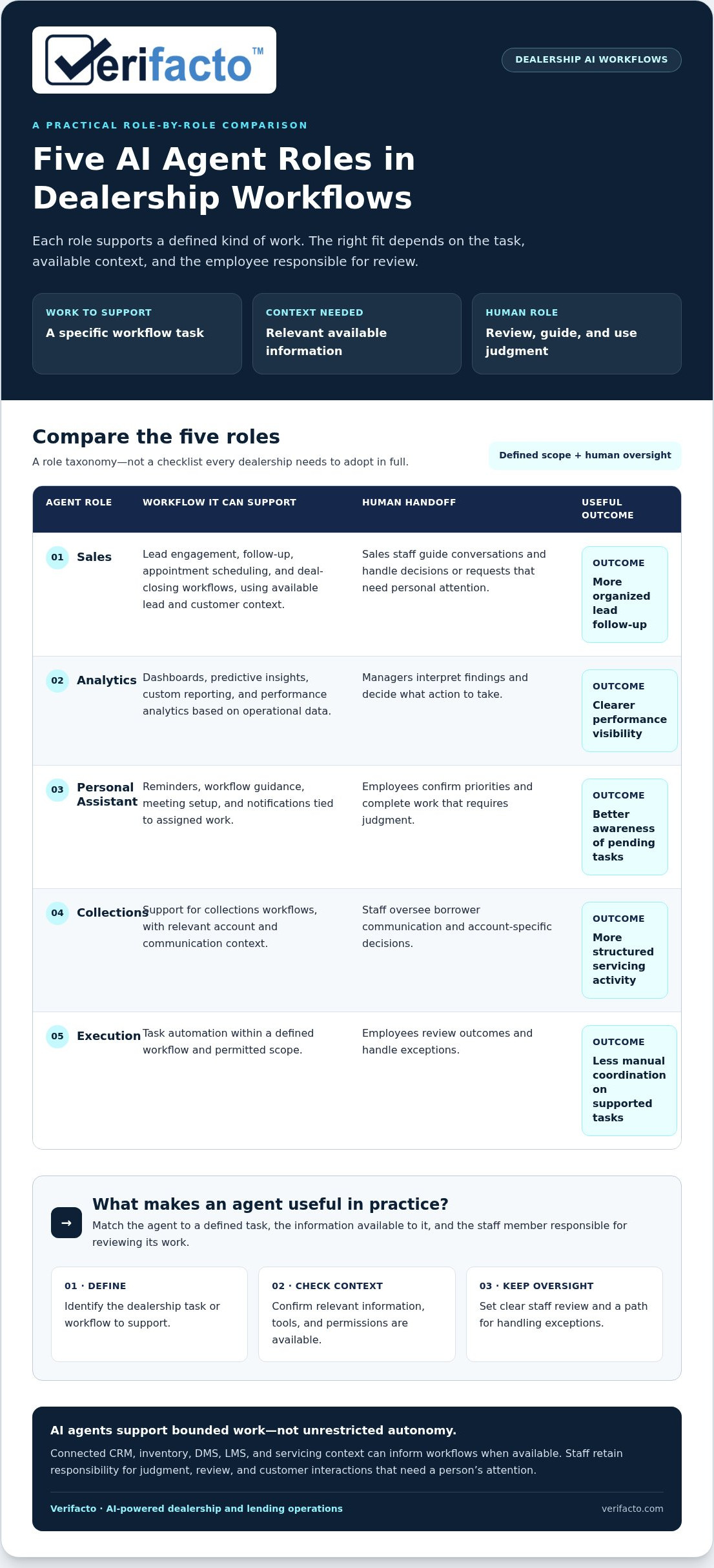
These five roles offer a practical way to assess where ai agents for auto dealerships may fit. They’re a taxonomy, not a checklist every dealership needs to adopt in full. The right fit depends on the work to be supported, the information available to the agent, and the employee responsible for reviewing its output. Cox Automotive also discusses how AI is reshaping dealership operations.
| Agent role | Workflow and context | Human handoff | Useful outcome |
|---|---|---|---|
| Sales | Lead engagement, follow-up, appointment scheduling, and deal-closing workflows, using available lead and customer context. | Sales staff guide conversations and handle decisions or requests that need personal attention. | More organized lead follow-up. |
| Analytics | Dashboards, predictive insights, custom reporting, and performance analytics based on operational data. | Managers interpret findings and decide what action to take. | Clearer performance visibility. |
| Personal Assistant | Reminders, workflow guidance, meeting setup, and notifications tied to assigned work. | Employees confirm priorities and complete work that requires judgment. | Better awareness of pending tasks. |
| Cobranzas | Support for collections workflows, with relevant account and communication context. | Staff oversee borrower communication and account-specific decisions. | More structured servicing activity. |
| Execution | Task automation within a defined workflow and permitted scope. | Employees review outcomes and handle exceptions. | Less manual coordination on supported tasks. |
Sales and Analytics agents: leads, follow-up, and visibility
A Sales Agent can support the sequence from engaging a lead to following up and scheduling an appointment, as well as deal-closing workflows. Relevant context may include lead details and the current workflow stage. The agent supports the sales team; it doesn’t determine how every customer should be handled.
An Analytics Agent provides dashboards, predictive insights, custom reporting, and performance analytics. Managers can use these views to identify patterns or questions that merit attention, then apply their knowledge of the business before acting. The agent informs decisions; it doesn’t make them on the dealership’s behalf.
Personal Assistant, Collections, and execution agents
A Personal Assistant can help staff keep track of reminders, workflow guidance, meetings, and notifications. A Collections Agent supports collections work, while execution agents can assist with task automation inside defined workflows. The task, available context, and permissions should shape the handoff. Automation can support consistent follow-through, but staff remain accountable for review and customer-sensitive judgment.
Verifacto brings these roles together with dealership and lending workflows in an AI-powered operating platform. Explore Verifacto’s AI capabilities to see how agents can support connected operations.
How dealership AI agents use connected data and human oversight
An agent can only work with the context available to it. If a dealership’s customer and account information is scattered across separate workflows, staff may need to fill in the gaps before an automated task makes sense. In a connected operating platform, authorized context from CRM, inventory, origination, DMS, LMS, and servicing can help teams follow a customer’s journey more clearly. That doesn’t mean every agent accesses every record or makes every decision.
From a customer signal to a staff-reviewed next step
Illustrative example: A shopper submits an inquiry about a vehicle. With relevant lead context available, a Sales Agent can support engagement, follow-up, and appointment scheduling. Staff can review the interaction and step in if the shopper has a nuanced question, changes direction, or needs a conversation that calls for personal judgment.
If the customer moves forward, the dealership’s workflow may involve inventory, origination, underwriting, and deal records in the DMS. Later account servicing may involve the LMS, payment processing, borrower communication, collections, insurance tracking, and CPI. Reporting and analytics can give managers a broader view of activity across the operation. These connected workflows provide context for staff. They don’t mean an agent independently approves a deal, determines coverage, or resolves an account.
Verifacto connects dealership and lending workflows in a unified cloud-hosted platform. Its AI agents support defined tasks within that operating context. This is where AI agents for auto dealerships can contribute: by helping carry relevant context and routine actions through a workflow, while people remain responsible for judgment and exceptions.
Connected workflows need clear permissions and review
Before enabling an agent, define what it may access, what it may suggest, and what it may execute. For example, a team might permit a reminder or routine follow-up within an established workflow, while reserving customer-specific account decisions for staff. Set review points and escalation paths so unusual circumstances reach the right person. Teams can also keep clear records of tasks, handoffs, and human review to support operational visibility. Those practices do not guarantee regulatory compliance.
Borrower communication deserves the same deliberate controls as lead engagement. Collections staff should retain oversight of account-specific interactions and next steps. A closer look at auto loan collection workflows can help teams consider where structured communication fits alongside payment activity and servicing context.
How to assess AI agents for an auto dealership
Evaluate the workflow before the technology. A focused assessment helps dealership leaders distinguish a useful operational fit from automation that adds complexity. Start with one well-defined use case, document how the work happens today, and decide what staff need to see and control.
Choose a workflow before choosing an agent
Repeated lead follow-up, task reminders, performance reporting, or structured collection workflows can be practical starting points. Document who owns the work, which information they use, where handoffs happen, and where delays or missed steps tend to occur. Set a practical objective, such as clearer task visibility or more consistent follow-up, rather than assuming automation will guarantee a financial result.
Use this five-step assessment:
- Define the bottleneck. Identify one specific task or handoff that consumes staff attention or limits visibility.
- Map the workflow. Record the current owner, source information, decision points, and exceptions from start to finish.
- Inspect data access and control. Determine what information an agent can use and whether the dealership can access and manage its operational data. Consider whether connecting workflows could reduce reliance on multiple vendors while preserving the dealership’s ability to oversee its information and processes.
- Set controls. Define permitted tasks, access boundaries, staff approval points, and escalation paths. Review documented information about data handling and security rather than assuming protections that haven’t been stated.
- Review results. Record a baseline, then track a relevant workflow measure, such as follow-up completion or time spent on a defined task. Review the measure and handoffs before deciding whether to expand.
Keep automation controlled, observable, and useful
Before an agent supports or executes a task, decide what it can do and what must remain with an employee. For example, a dealership might allow reminders within a defined follow-up workflow while routing customer-specific questions or exceptions to staff. Make sure the team can see relevant activity and understand whether the workflow reached its intended next step. These review practices support operational oversight, but they don’t establish legal compliance.
Assess AI agents for auto dealerships by testing one bounded process, reviewing its data access and controls, and confirming that staff can see what happens. A connected platform can help reduce dependence on separate tools, while giving the dealership a more unified view of its data and operations. Explore AI capabilities across dealership workflows to see how Verifacto brings AI together with dealership and lending operations.
How Verifacto connects AI agents across dealership operations
Dealerships operate one business but are often forced to manage it through disconnected systems. Verifacto brings dealership operations, data, and AI together in a cloud-hosted platform that connects dealer and lending workflows. For independent and BHPH dealers, this approach brings BHPH software and auto finance software into a broader operational context.
A connected operating platform, not a standalone chatbot
Verifacto combines AI agents with workflows supported by dealership CRM, inventory management, DMS, LMS, payments, borrower communication, collections, reporting, and analytics. Insurance tracking and CPI also support account servicing. The AI Sales Agent supports lead engagement, follow-up, appointment scheduling, and deal-closing workflows. Analytics provides dashboards, predictive insights, custom reporting, and performance analytics, while the Personal Assistant supports reminders, workflow guidance, meeting setup, and notifications.
Consider a customer who first contacts the dealership about a vehicle. The Sales Agent can support lead follow-up and scheduling, while staff manage the customer conversation and deal decisions. If the customer later becomes an account holder, payment and servicing activity can continue within connected lending workflows, with collections and insurance tracking providing relevant context. That shared operational view can help staff follow activity across stages instead of treating each handoff as an isolated interaction.
This platform is designed to support routine work and provide greater operational visibility, while employees remain involved in decisions and exceptions. Agents support the operation; they don’t replace staff judgment or independently determine every next step. For a closer look at the lead workflow, explore the AI Sales Agent lead follow-up.
Explore whether connected AI workflows fit your operation
Assess fit by asking four questions: Does the agent address a defined workflow? Is relevant context available? Are permissions and human review points clear? Can staff see activity and understand what needs attention? Starting with one use case, such as lead follow-up or a task reminder, can help the dealership evaluate the workflow before extending automation to other teams.
Verifacto brings AI agents together with DMS, LMS, dealership CRM, payments, borrower communication, insurance tracking, CPI, and reporting capabilities. A demonstration can show how these connected workflows fit together.
Put Connected AI to Work on a Defined Workflow
AI agents for auto dealerships are most useful when they support a clear task, draw on relevant operational context, and leave staff in control of decisions that need human judgment. Start by identifying one workflow to improve, defining what the agent may do, and deciding how your team will review activity and results.
The Sales, Analytics, Personal Assistant, Collections, and execution agent roles each support different dealership needs. Their value depends not just on the task, but on how well customer and lending workflows connect. Verifacto brings dealer and lending operations together through a cloud-hosted platform, helping staff gain a clearer view from lead activity through account servicing without promising a specific financial outcome.
See how Verifacto connects your operation from the first lead to the final payment. Book a demonstration to explore how the platform fits your business and consider where connected workflows could support your team. Starting with one practical use case can make AI adoption more focused, observable, and manageable.
Frequently Asked Questions
What are AI agents for auto dealerships?
AI agents for auto dealerships are software capabilities designed to support or perform defined tasks within dealership workflows. Depending on the platform and permissions, those tasks may include lead engagement, appointment scheduling, reminders, reporting, or structured borrower communication. An agent isn’t automatically an independent decision-maker. Before using one, identify the information it can access, the actions it may take, and where staff review or approval belongs.
Can AI agents follow up with dealership leads?
Yes. Some dealership AI agents support lead engagement, follow-up, and appointment scheduling. Verifacto’s AI Sales Agent is designed to support those tasks as well as deal-closing workflows. Clarify what lead context the agent uses and how staff can monitor the interaction. Human involvement remains important for customer questions, nuanced needs, exceptions, and decisions that require dealership judgment.
Do AI agents replace dealership employees?
No. AI agents are best understood as workflow support, not a replacement for dealership employees. They can assist with defined tasks, such as organizing follow-up activity or surfacing reminders, while staff maintain responsibility for customer relationships, exceptions, and business decisions. A sound implementation gives employees visibility into agent activity and clear ways to review or take over a task. Evaluate whether automation supports your team’s work rather than adding another disconnected tool.
How do AI agents work with a dealership DMS?
An agent can use only the information and actions made available within its platform and authorized workflows. Verifacto connects dealership and lending workflows through a cloud-hosted platform that includes DMS, LMS, and CRM capabilities. Clarify which information supports the agent’s task, what actions it can take, and how staff can review its activity.
What dealership tasks can AI agents help with?
Depending on the platform, agents can support lead engagement, follow-up, appointment scheduling, reminders, workflow guidance, analytics, reporting, and structured borrower communication. Verifacto’s agent roles include Sales, Analytics, Personal Assistant, Collections, and execution agents. Each serves a different operational purpose and may need different context and oversight. Start by identifying a specific bottleneck, then compare it with documented agent capabilities instead of assuming a broad AI label covers every dealership task.
How should a dealership evaluate an AI agent?
Start with one workflow, not a feature list. Map the task, its source information, staff owner, handoffs, and common exceptions. Then assess the agent’s permitted data access and actions, human review points, and how staff will see activity and outcomes. Set a baseline and choose a relevant measure, such as follow-up completion or time spent on the task. Expand only after the dealership understands how the process works in practice.
Are AI agents secure for dealership and borrower information?
Security depends on the platform’s controls and how the dealership configures and uses it. Verifacto’s materials describe SOC II compliance and bank-level data protection. Review current documentation to understand the details and scope of those statements, including relevant data-handling and access controls. Don’t infer specific protections from the term “AI agent,” and don’t treat software descriptions as legal advice or a guarantee that every use or configuration is appropriate.