
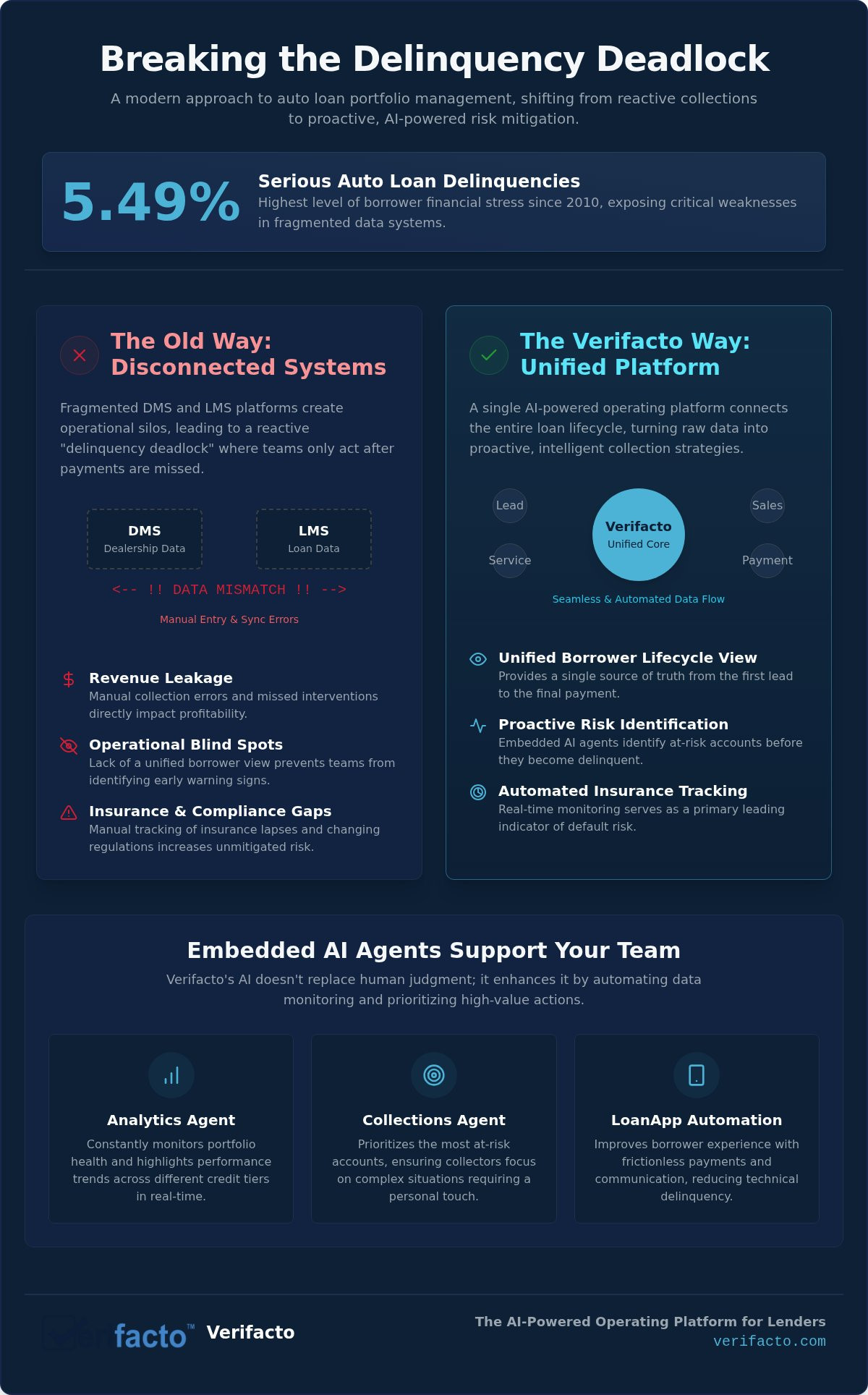
Serious auto loan delinquencies have climbed to 5.49 percent in 2026, marking the highest level of financial stress for borrowers since 2010. For many lenders, this surge exposes a critical weakness: the reliance on fragmented data across separate DMS and LMS systems. You know the frustration of revenue leakage caused by manual collection errors and the constant operational burden of chasing insurance lapses. Managing these risks shouldn’t feel like a losing battle against disconnected spreadsheets and siloes.
We understand that maintaining portfolio health requires more than just reactive phone calls. This guide shows you how to implement delinquency management software for auto loans that actually unifies your data and your team. You’ll learn how to leverage AI-powered automation and predictive tools to identify at-risk accounts before they reach the 90 day mark. We will explore how a single, integrated platform can provide a clear view of the entire borrower lifecycle, automate payment tracking, and significantly improve your collection efficiency.
Key Takeaways
- Unifying disconnected DMS and LMS systems can help eliminate the manual data entry errors that cause revenue leakage and operational blind spots.
- Modern delinquency management software for auto loans is designed to provide a unified view of the borrower lifecycle, from the first lead to the final payment.
- Embedded AI agents can help transform raw data into proactive collection strategies, allowing your team to focus on high-priority accounts.
- Real-time insurance tracking serves as a primary leading indicator of default, offering the visibility needed to intervene before a payment is missed.
- Automation through the LoanApp and frictionless payment processing can help reduce technical delinquency while improving the overall borrower experience.
The Delinquency Deadlock: Why Disconnected Systems Fuel Portfolio Risk
In the second quarter of 2026, serious auto loan delinquencies reached 5.49 percent, the highest level since 2010. This surge highlights a systemic failure in how many lenders manage risk. Dealerships often operate one business but are forced to manage it through disconnected systems. This fragmentation creates a “delinquency deadlock” where staff only react after a borrower enters financial default. Modern delinquency management is a proactive, data-driven lifecycle that begins at origination, not a desperate collection effort that starts after a payment is missed.
Revenue leakage is a direct consequence of this disconnect. When your Dealership Management System (DMS) and Loan Management System (LMS) don’t communicate, manual data entry becomes the only bridge. This creates “blind spots” where missed insurance updates or incorrect contact information prevent early-stage interventions. In a high-volatility subprime market, these manual errors lead to missed opportunities to stabilize a loan before it goes south. Relying on delinquency management software for auto loans that unifies these systems is designed to stop this leak by ensuring data flows seamlessly across the entire operation.
The High Cost of Information Silos
Fragmented vendor systems drain your team’s productivity and increase operational costs. When employees spend hours on duplicate data entry across separate CRM and collection tools, they aren’t actually managing risk. This manual burden results in several high-stakes vulnerabilities:
- Compliance Lag: When state-specific rules aren’t automatically updated across all systems, your dealership faces increased legal exposure.
- Insurance Verification Gaps: Manual tracking is a primary driver of unmitigated risk, as lapses often go unnoticed until a total loss occurs.
- Missed Interventions: By the time a manager exports and analyzes a manual report, the window for a successful early-stage intervention has likely closed.
Moving from Reactive Collections to Proactive Management
Real-time visibility into borrower behavior is the only way to protect your portfolio in 2026. Instead of chasing payments, modern platforms provide a unified view of the borrower lifecycle. This provides greater visibility into high-risk accounts before the first payment is ever missed. It changes the dynamic from a reactive chase to a proactive partnership with the borrower.
Verifacto embeds an AI Analytics Agent to serve as a constant monitor over your portfolio health. This tool doesn’t replace human judgment; it supports it by automating the routine task of data monitoring. By analyzing connected business data in real time, the platform can help highlight performance trends across different credit tiers. This shift ensures your team focuses their energy on the accounts that require immediate, high-value attention to prevent charge-offs.
Predictive Delinquency Management: Leveraging AI and Real-Time Data
Predictive delinquency management shifts the focus from “what happened” to “what is likely to happen.” By utilizing delinquency management software for auto loans, dealerships can transform stagnant data into active intelligence. While traditional systems wait for a missed payment to trigger an alert, embedded AI agents monitor the entire customer lifecycle in real time. These tools process thousands of data points to identify subtle shifts in borrower behavior, allowing your team to intervene before a minor issue becomes a major loss.
The recent dynamics in auto loan delinquency rates suggest that subprime portfolios require more than manual oversight. Predictive insights help identify performance trends across different credit tiers, such as the widening gap between prime and deep subprime recovery rates. Verifacto’s Analytics Agent and Collections Agent don’t replace your staff. Instead, they support human judgment by prioritizing the most at-risk accounts for manual review. This ensures your high-performing collectors aren’t wasting time on low-risk reminders but are instead focused on complex situations that require a personal touch. Explore how our AI agents can help your team manage high-risk portfolios more effectively.
The Role of the AI Operational Assistant
The AI Operational Assistant handles the heavy lifting of routine communication. It automates payment reminders and SMS notifications based on smart triggers, such as a missed check-in on the LoanApp or a detected insurance lapse. This transition from manual scheduling to automated task management reduces the operational burden on your collection team, ensuring no borrower falls through the cracks due to administrative oversight. By setting these triggers based on specific borrower behaviors, you create a guided workflow that keeps your staff focused on high-impact recovery tasks.
Real-Time Visibility and Custom Reporting
Modern lending in 2026 demands enterprise-grade security and absolute data integrity. Verifacto utilizes SOC II compliance and bank-level encryption to ensure dealer control over sensitive information while reducing vendor lock-in. Dashboards provide real-time visibility into roll rates and recovery trends, eliminating the need for manual spreadsheet updates that often lead to “revenue leakage.” For organizations also dealing with the complexities of digital financial fraud, you can visit Prime Asset Recovery for specialized forensic investigation and asset retrieval. These systems also maintain audit-ready logs, providing a clear, chronological trail of all borrower communications and system actions. This level of transparency is essential for maintaining internal standards and providing greater visibility during state audits.
A lapse in auto insurance coverage is rarely an isolated incident. For most subprime lenders, it’s the first signal of financial distress. When a borrower stops paying their insurance premium, they’ve often begun the slide toward a missed payment. Modern delinquency management software for auto loans treats insurance tracking as a predictive tool rather than a clerical task. By monitoring coverage in real time, you gain a critical window of opportunity to intervene before the loan itself becomes delinquent.
The application of AI in debt collection highlights how automated systems can identify these risk patterns more accurately than manual reviews. Dealerships operate one business but are often forced to manage it through disconnected systems. Verifacto brings the operation, data, and AI together in one platform to ensure that an insurance cancellation notice triggers an immediate response. This visibility is designed to protect your collateral while giving your team the data needed to make informed decisions about borrower stability.
Automated Insurance Verification Workflows
The correlation between insurance lapses and loan delinquency is well-documented. If a borrower can’t afford coverage, they likely can’t afford their next payment. Verifacto’s real-time tracking is designed to provide greater visibility into this collateral risk. The system automatically verifies coverage and, if a lapse is detected, can facilitate the placement of Seguro de Protección Colateral (CPI):. This safety net ensures that even if the borrower fails to maintain their obligation, your financial interest in the asset remains protected.
Communication via the LoanApp Interface
Borrowers in 2026 expect mobile-first solutions. The LoanApp interface allows customers to upload insurance documents and communicate with your team without the friction of phone tags. When a lapse occurs, the AI Sales Agent can manage early-stage engagement, prompting the borrower to update their information or providing resources to help them stay compliant. This automation handles the high volume of routine follow-ups, allowing your staff to reserve human intervention for high-balance or high-risk accounts that require a more nuanced approach. By unifying these disconnected communication channels, you ensure that every borrower receives timely, consistent guidance to keep their loan on track.
To learn more about how to manage these risks effectively, see our lender’s guide to CPI for a deeper look at mitigation strategies.
5 High-Impact Delinquency Mitigation Workflows for 2026
Operational inconsistencies are a silent killer of portfolio performance. When collection steps vary from one employee to the next, high-risk accounts inevitably slip through the cracks. Standardizing your response through delinquency management software for auto loans is designed to ensure that every borrower receives the same level of proactive engagement. By moving from manual “to-do” lists to automated, data-driven workflows, your team can focus on resolving issues rather than just identifying them.
Success in improving collection efficiency begins with prevention. Dealerships operate one business but are often forced to manage it through disconnected systems. Verifacto brings the operation, data, and AI together in one platform to create a seamless transition from a performing loan to a mitigated risk. These workflows are designed to reduce technical delinquency and protect your collateral without increasing your headcount.
Workflow 1: The Automated Pre-Due Reminder
Prevention starts 3 to 5 days before the due date. The system sends multi-channel reminders via SMS, email, and the LoanApp mobile interface to keep the payment top-of-mind. These notifications include “one-click” payment links, allowing borrowers to settle their accounts instantly without navigating a complex portal. Automated reminders can help reduce delinquency caused by borrower forgetfulness by keeping the obligation top-of-mind. This frictionless approach is designed to capture payments before the grace period even begins.
Workflow 2: The Insurance Lapse Trigger
The moment an insurance cancellation is detected, the workflow initiates an immediate notification to the borrower. The AI Operational Assistant manages the initial follow-ups to confirm if new coverage has been obtained. If the borrower fails to reinstate their policy within the allowed grace period, the system can automatically initiate the CPI placement process. This ensures your collateral is never left unprotected, transforming a high-risk event into a managed operational step.
Workflow 3: Intelligent Payment Retries and ACH
Failed transactions don’t have to result in a collection call. Integrated payment processing allows for automated retries on failed ACH or card transactions using smart retry logic. This is designed to reduce “NSF” charge-offs by capturing funds when they are most likely to be available. By integrating these real-time collection activities with QuickBooks, your accounting records remain accurate without manual data entry. To see how these automated steps fit your business, explore our AI-powered workflows today.
Unifying the Lifecycle: How Verifacto Connects Lead to Final Payment
Dealerships operate one business but are often forced to manage it through disconnected systems. This fragmentation is the primary source of the “blind spots” and manual errors we’ve explored in previous sections. Verifacto brings the operation, data, and AI together in one secure, cloud-based platform. By unifying the entire customer and loan lifecycle, you eliminate the need for redundant logins and manual data transfers that lead to revenue leakage. This integrated approach ensures that every team member, from sales to collections, works from a single source of truth.
The business value of this unification is clear: improved operational efficiency that provides greater visibility and stronger financial performance. When you utilize delinquency management software for auto loans that is built into your core operating platform, you stop chasing data and start managing risk. This transition is designed to help you scale your portfolio without the proportional increase in headcount traditionally required for subprime lending.
One Platform, Entire Lending Lifecycle
Centralizing inventory, CRM, origination, and collections in a single interface provides a level of clarity that traditional siloed software cannot match. Verifacto connects the first lead to the final payment, ensuring that borrower data captured during the sales process informs the collection strategy later. This integration reduces vendor lock-in by providing easy access to and export of dealer data for custom analytics. You maintain total control over your business intelligence. Furthermore, the cloud-hosted architecture offers an “anytime, anywhere” advantage, allowing modern auto finance teams to monitor portfolio health and manage workflows from any location with total reliability.
A Partner in Modernization
Verifacto acts as a reliable guardian for high-stakes automotive lending environments. We understand that your data is your most valuable asset. That’s why our platform provides enterprise-grade security, featuring SOC II compliance and bank-level encryption to protect sensitive dealer and borrower information. This commitment to security is paired with a 99.99 percent uptime guarantee, providing the foundation for business continuity and reliable collections in a volatile market.
Our platform is designed to support human judgment by automating the routine, high-volume tasks that often overwhelm collection departments. By embedding AI agents directly into the workflow, we help your team focus on the high-value interactions that prevent defaults. See how Verifacto connects your operation from the first lead to the final payment or book a demonstration to explore how the platform fits your business.
Modernize Your Delinquency Mitigation Strategy Today
The rise in serious delinquencies in 2026 makes clear that reactive collection strategies aren’t sufficient anymore. Dealerships operate one business but are often forced to manage it through disconnected systems. By unifying your DMS and LMS functions into a single cloud-based platform, you eliminate the blind spots that lead to revenue leakage. Implementing robust delinquency management software for auto loans is designed to provide greater visibility into borrower behavior while automating the routine tasks that drain your team’s productivity.
Verifacto provides a secure, SOC II compliant environment with a 99.99% uptime guarantee, ensuring your operations remain stable and protected. Our embedded AI agents for sales, analytics, and operations support human judgment by prioritizing the most at-risk accounts. This allows your staff to focus on high-value recovery efforts while automation handles the pre-due reminders and insurance tracking. Transitioning to a unified lifecycle approach is the most effective way to improve your financial performance and protect your collateral in a high-stakes market.
Take the next step in optimizing your portfolio health. Book a demonstration to explore how the Verifacto platform fits your business and see how it connects your operation from the first lead to the final payment. We’re ready to help you build a more resilient and efficient lending operation.
Frequently Asked Questions
What is the most effective strategy for managing auto loan delinquency?
The most effective strategy is a unified lifecycle approach that connects the first lead to the final payment. Dealerships operate one business but often manage it through disconnected systems, which creates data silos. Using delinquency management software for auto loans that integrates your DMS and LMS functions ensures that no information is lost during the transition from sales to servicing. This visibility allows your team to monitor borrower behavior in real time and intervene before a payment is missed.
How does AI help in reducing auto loan default rates?
AI agents support human judgment by processing connected business data to identify high-risk patterns that manual reviews might miss. These tools, such as the Analytics Agent, can help highlight performance trends across various credit tiers. By automating routine task management, AI allows your collectors to focus on complex recovery situations. This data-driven approach is designed to provide greater visibility into portfolio health, helping you engage at-risk borrowers much earlier in the delinquency cycle.
Can automated borrower communication really improve recovery rates?
Automation is designed to reduce technical delinquency caused by borrower forgetfulness. Multi-channel reminders via SMS, email, and mobile apps ensure that payment obligations stay top-of-mind. By incorporating one-click payment links, you reduce the friction that frequently leads to late payments. This standardized workflow ensures consistent engagement across your entire portfolio. It can help improve recovery rates by capturing funds as soon as they’re available, without requiring constant manual effort from your staff.
What is the link between insurance tracking and loan delinquency?
Insurance lapses are a primary leading indicator of upcoming payment defaults. When a borrower stops maintaining coverage, it often signals financial distress that’ll soon impact their ability to make loan payments. Real-time monitoring allows you to detect these lapses immediately. By automating the placement of Collateral Protection Insurance (CPI), you can help protect the asset while simultaneously triggering a proactive outreach to the borrower to address the underlying financial issue before it escalates further.
Is it better to use a standalone LMS or an integrated DMS/LMS platform?
Integrated platforms are superior because they eliminate the revenue leakage caused by manual data entry between disconnected systems. A standalone LMS often lacks the context of the initial sales lead or inventory data. An integrated platform brings the operation and data together in one place. This provides a unified view of the borrower lifecycle, reduces vendor lock-in, and ensures that every department in your dealership works from a single, accurate source of truth.
How can lenders manage delinquency in subprime auto portfolios more efficiently?
Managing subprime portfolios efficiently requires automation and predictive tools that handle high volumes of routine tasks. Since serious delinquencies reached 5.49 percent in 2026, lenders must use delinquency management software for auto loans to prioritize the most at-risk accounts. Using AI agents to automate pre-due reminders and insurance verification allows your team to focus their energy where it’s needed most. This approach provides the scalability required to manage subprime risk without increasing your headcount.
What role does mobile technology like LoanApp play in delinquency management?
Mobile technology like the LoanApp serves as the primary borrower engagement tool for modern lenders. It provides a frictionless interface where customers can make payments, upload insurance documents, and receive automated notifications. This transparency helps build a stronger relationship between the lender and borrower. By offering a convenient way to manage their account, you reduce the likelihood of technical delinquency and ensure that your dealership remains the borrower’s top payment priority throughout the loan term.