
How much revenue is leaking through the gaps in your software stack while your team wastes hours on duplicate data entry? You likely feel the daily frustration of managing a single business through disconnected systems that force staff to jump between a DMS and an LMS just to track one borrower. An integrated dealer management system is no longer a luxury for 2026. It’s a fundamental requirement for any operation that wants to stop the financial drain caused by manual follow-ups and unmonitored insurance lapses.
We understand that your data should work for you, not against you. In this article, you’ll discover how a unified platform eliminates data silos to improve operational efficiency and protect your portfolio profitability. We’ll explore how AI agents and tools like LoanApp connect the entire lifecycle from the first lead to the final payment. You’ll see how embedded AI supports human judgment to streamline workflows and provides the clear analytics needed to scale your business with confidence.
Key Takeaways
- Identify the hidden costs of managing one business through fragmented systems and how it impacts your portfolio’s profitability.
- Learn how a modern integrated dealer management system unifies sales and finance data to eliminate manual entry and human error.
- Discover how embedded AI agents support your staff by automating routine tasks and providing real-time visibility into performance.
- Evaluate your current tech stack against 2026 standards, focusing on essential features like direct QuickBooks sync and data portability.
- Map out a seamless workflow that connects your entire operation, from the first lead captured in LoanApp to the final loan payment.
The Cost of Disconnected Data: Why Traditional DMS Systems Fail Modern Dealers
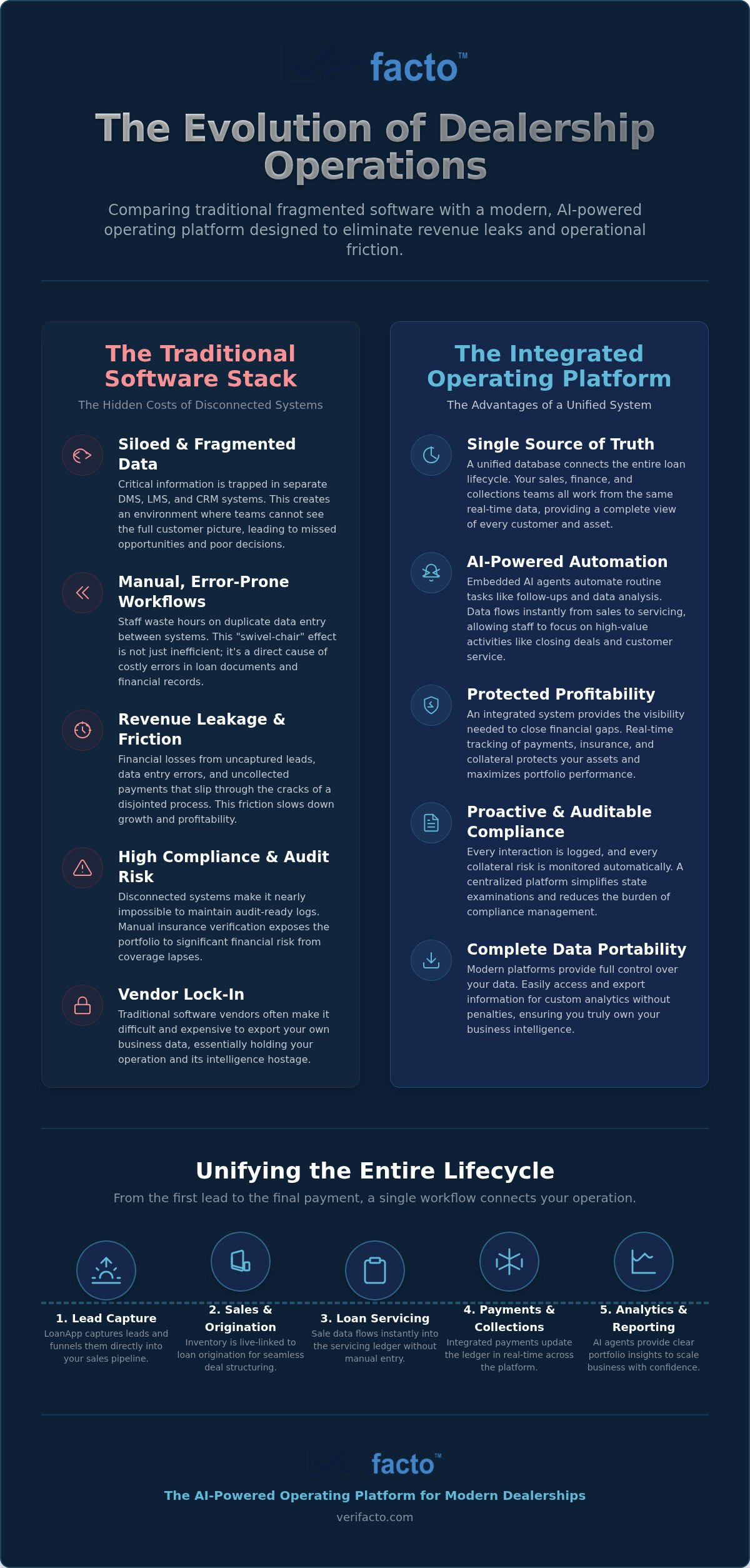
Traditional software vendors often benefit from this fragmentation by creating vendor lock-in. They make it difficult to export your own business data, essentially holding your operation hostage. A modern integrated dealer management system should provide complete transparency and control. You need the ability to access and export your data for custom analytics without jumping through hoops or paying excessive fees. Without this portability, you cannot truly own your business intelligence or pivot when the market changes.
Revenue Leakage and Operational Friction
The Compliance and Audit Risk
Managing state rules and federal regulations across multiple platforms is a high-stakes gamble. Disconnected systems make it difficult to maintain the audit-ready logs required for state examinations. If your insurance verification process is manual, you’re exposed to significant financial risk every time a borrower’s coverage lapses. An integrated dealer management system is designed to provide greater visibility into these compliance gaps by unifying insurance tracking and borrower communication. This centralized approach ensures that every interaction is logged and every collateral risk is monitored in real time, reducing the burden on your team during an audit. It’s about moving from a reactive state of fixing fires to a proactive state of total portfolio control.
What Defines a Truly Integrated Dealer Management System?
A truly integrated dealer management system isn’t just a collection of software modules with a shared login. It’s a unified operating platform that connects the entire customer and loan lifecycle into a single workflow. In this environment, your Dealer Management System (DMS) and Loan Management System (LMS) function as one unit. When a sale is finalized, the data flows instantly into the servicing ledger without human intervention. This eliminates the “swivel-chair” effect where employees manually transfer borrower data between different software screens.
Integration also requires built-in payment processing for ACH, credit cards, and cash. When a borrower makes a payment, the ledger updates in real time across the entire platform. You don’t need to worry about end-of-day reconciliation or manual posting errors. This level of connectivity provides the foundation for real-time collateral protection, ensuring that your assets are monitored from the moment the keys are handed over until the final payment is made.
Unifying the DMS and LMS Lifecycle
Your inventory management must be live-linked to loan origination and servicing. If a vehicle is sold, it should disappear from your marketing feeds and move directly into the borrower’s active loan file. Historically, what is dms software has been viewed as a simple accounting ledger for sales. Today, it has evolved into a comprehensive lifecycle platform. Having a single source of truth allows your sales team to see a borrower’s payment history and your collections team to see the original sales notes. This shared context is vital for making informed decisions on renewals or repossessions. You can book a demonstration to see how this unified approach fits your specific business model.
Embedded Insurance and CPI Tracking
Risk management is often the most neglected part of the dealership tech stack. Real-time insurance monitoring is designed to help mitigate financial risk by identifying lapses before they become total losses. A truly integrated platform automates the workflow for Collateral Protection Insurance (CPI). When the system detects a lapse, it can automatically initiate borrower communication and place coverage if necessary. This protects your portfolio without requiring manual oversight from your staff. By embedding insurance tracking directly into the operating platform, you gain a level of security that disconnected systems simply cannot provide.
Traditional Software vs. AI-Powered Operating Platforms
Legacy “cloud-hosted” software often functions as a passive repository for data. It requires your team to pull information out, analyze it, and then decide on an action. This reactive model is outdated. Modern AI-powered operating platforms transform the integrated dealer management system into an active business partner. Instead of just storing data, these platforms use embedded AI to trigger workflows based on real-time events. This shift from passive storage to active automation is what separates market leaders from those struggling with operational friction.
Security and stability form the backbone of this modern approach. With bank-level encryption and SOC II compliance, your customer data is protected by the same standards used by major financial institutions. A 99.99% uptime guarantee ensures that your team can always access the tools they need to close deals and collect payments. This reliability allows you to focus on growth rather than troubleshooting software outages. By choosing a platform that prioritizes both security and performance, you protect your dealership from the reputational and financial costs of data breaches or system downtime.
The Role of AI Sales and Analytics Agents
An AI Sales Agent acts as a force multiplier for your sales floor. It’s designed to automate lead engagement and appointment scheduling, ensuring no prospect goes cold because of a slow human response. While your staff focuses on closing customers in the showroom, the AI handles initial inquiries across multiple channels. On the finance side, the Analytics Agent provides predictive insights into your portfolio’s health. AI identifies high-risk accounts before they become delinquent by monitoring subtle shifts in borrower behavior and payment patterns. This allows your team to intervene early, supporting human judgment with data-driven clarity rather than guesswork.
Operational Assistant and Workflow Automation
The AI Operational Assistant manages the “busy work” that often leads to human error. It handles smart task reminders and automated email or SMS notifications based on specific triggers. For example, if a borrower misses a payment and fails to respond to initial prompts, the system can assist in automated repossession initiation within your integrated framework. These tools aren’t meant to replace your employees; they’re designed to remove the administrative burden that leads to burnout. By automating routine follow-ups and data entry, you can increase closing rates and reduce delinquency without adding to your headcount. This connectivity ensures that every lead is pursued and every loan is monitored with consistent, high-level precision.
Evaluating Your Tech Stack: A Framework for Choosing an Integrated System
Choosing the right integrated dealer management system requires looking beyond basic features to the underlying architecture of the platform. Many dealers feel trapped by legacy systems that don’t talk to each other, leading to expensive workarounds. It’s about control. You need a platform that provides total visibility without technical barriers. Use the following checklist to evaluate if your current software meets modern 2026 standards:
- Real-time Accounting Sync: Does your data flow directly into QuickBooks without manual exports?
- Data Portability: Can you export your entire database for custom analytics at any time without paying extra fees?
- Mobile Accessibility: Can your team manage the lot and your borrowers manage payments via a native mobile interface like LoanApp?
- Embedded AI: Are AI agents working in the background to engage leads and monitor portfolio risks?
- Security Compliance: Does the vendor maintain SOC II compliance and a 99.99% uptime guarantee?
Accounting Integration and Financial Accuracy
Clean financial records are the lifeblood of any lending operation. A direct sync with QuickBooks is essential because it eliminates the reconciliation errors that plague disconnected systems. When a payment is processed through your integrated portal, the ledger should update instantly. This level of automation ensures that your financial reports are always audit-ready. For borrowers, tools like LoanApp provide a frictionless mobile interface to manage their accounts, view balances, and make payments. This convenience doesn’t just improve the customer experience; it directly supports your collection efforts by removing barriers to payment.
Scalability and Future-Proofing
A unified operating platform allows you to scale from a single rooftop to multiple locations without a linear increase in headcount. Centralized reporting is vital for multi-location operations, giving you the ability to compare performance across sites from a single dashboard. You shouldn’t have to hire a new administrative assistant every time you add 50 units to your portfolio. Instead, automated workflows and AI agents handle the increased volume of borrower communications and task reminders. This architecture ensures your business remains agile and ready for growth. Book a demonstration to explore how the platform fits your business.
Unifying Your Lifecycle: How Verifacto Connects Leads to Final Payments
Dealerships operate one business but are often forced to manage it through disconnected systems. Verifacto brings the operation, data and AI together in one platform. Imagine a lead arriving through your website; the AI Sales Agent engages immediately to qualify the prospect and set an appointment. Once the deal is inked, the data populates the LMS instantly without a single keystroke of duplicate entry. This unified lifecycle ensures that every department, from sales to finance, works from the same live data set, eliminating the gaps where revenue typically leaks.
As the loan matures, the system transitions from origination to active servicing. The Collections Agent monitors payment patterns and triggers automated borrower communication when necessary. By improving collection efficiency, this agent supports your human staff by handling the high-volume, repetitive outreach that often leads to delinquency if neglected. The goal isn’t just to track money; it’s to maintain the health of your entire portfolio through an integrated dealer management system that remains active 24/7. This connectivity provides the operational efficiency required to drive sustained profitability in a competitive market.
The Seamless Borrower Journey
Borrowers today expect a digital-first experience that mirrors the convenience of modern banking. Through the LoanApp interface, they can manage their payments, view balances, and receive automated reminders directly on their mobile devices. This transparency builds trust and reduces the friction that often leads to missed payments. Automated borrower communication can help boost recovery rates by providing consistent, professional nudges before a lapse becomes a crisis. Verifacto acts as a reliable guardian for your business, ensuring that every borrower interaction is logged while protecting your collateral through real-time monitoring.
Getting Started with a Unified Platform
Modernizing your operation doesn’t have to be a disruptive event. Whether you run a Buy Here Pay Here (BHPH) lot or a high-volume finance company, the platform is designed to fit your specific business model. You gain the ability to scale your portfolio without a linear increase in administrative headcount. It’s time to move away from fragmented tools and toward a secure, unified future where you own your data and control your outcomes. Book a demonstration to explore how the platform fits your business.
Secure Your Competitive Advantage for 2026
The transition from fragmented software to a unified operating platform is the most significant step you can take toward long-term stability. By adopting an integrated dealer management system, you eliminate the operational friction that leads to revenue leakage and manual errors. You gain the ability to monitor your entire portfolio in real time, supported by AI Sales and Analytics Agents that provide predictive insights and automate routine engagement. This shift allows your team to focus on high-value decision-making while the platform handles the administrative burden.
Verifacto provides the security and reliability required for modern auto finance operations. With SOC II compliance, bank-level encryption, and a 99.99% uptime guarantee, your data remains protected and accessible around the clock. You don’t have to settle for vendor lock-in or disconnected silos that slow your growth. It’s time to bring your operation, data, and AI together in one secure environment to protect your profitability. See how Verifacto connects your operation from the first lead to the final payment and take control of your business lifecycle today.
Frequently Asked Questions
What is the difference between a DMS and an integrated operating platform?
A standard DMS typically serves as a standalone ledger for sales and inventory. In contrast, an integrated dealer management system functions as a unified operating platform that connects the entire lifecycle from lead to final payment. It unifies your sales, lending, and collections data into one environment. This eliminates the need to jump between disconnected systems, reducing duplicate data entry and providing a single source of truth for your entire operation.
Can an integrated dealer management system help with insurance tracking?
Yes, an integrated dealer management system is designed to provide real-time insurance monitoring. It identifies lapses in borrower coverage automatically, allowing you to trigger communication or place Collateral Protection Insurance (CPI) without manual oversight. This integration helps mitigate financial risk by ensuring your assets are protected throughout the loan term. It moves you away from high-risk manual verification processes that often lead to unmonitored lapses.
Does Verifacto integrate with my current accounting software like QuickBooks?
Verifacto offers direct integration with QuickBooks to ensure your financial records remain clean and accurate. When payments are processed through the platform’s built-in portal, the data syncs automatically with your accounting software. This removes the burden of manual reconciliation and reduces the risk of human error. It’s an essential feature for maintaining audit-ready logs and seeing your dealership’s true financial performance in real time.
Is my data secure in a cloud-based DMS platform?
Security is a core component of the Verifacto operating platform. We maintain SOC II compliance and utilize bank-level encryption to protect sensitive borrower and dealership data. With a 99.99% uptime guarantee, your information is always accessible when you need it. This cloud-based approach provides greater stability and security than legacy on-premise servers, ensuring your business remains compliant with modern data protection standards.
How does AI improve the sales process for independent dealers?
AI supports your sales team by automating lead engagement and appointment scheduling. The AI Sales Agent can respond to inquiries instantly across multiple channels, ensuring no prospect goes cold. This allows your staff to focus on closing deals in the showroom rather than managing initial follow-ups. By using connected business data, the AI provides a consistent experience that helps increase closing rates without needing to add more administrative headcount.
Will I be able to export my data if I decide to switch platforms later?
You maintain full control over your business data at all times. Verifacto prioritizes data portability to eliminate vendor lock-in, allowing you to access and export your database whenever necessary. Whether you need data for custom analytics or are transitioning to a different tool, we ensure the process is straightforward. We believe your software should earn your business through performance, not by holding your operational data hostage.
How does an integrated system help with BHPH compliance?
An integrated system provides greater visibility into state and federal regulations by centralizing all borrower interactions and payment logs. It’s designed to help you maintain audit-ready records, which is critical for BHPH software users. By unifying insurance tracking, borrower communication, and payment processing, the platform reduces the likelihood of compliance lapses. This proactive approach helps protect your dealership from the legal and financial risks of fragmented documentation.
What is LoanApp and how does it benefit my borrowers?
LoanApp is a dedicated mobile application that gives your borrowers a frictionless way to manage their accounts. They can view balances, check payment schedules, and make payments directly from their smartphones. This convenience improves the borrower experience and supports your collection efforts by removing barriers to payment. It also allows for automated reminders, which can help boost recovery rates by keeping borrowers informed without the need for aggressive manual outreach.