
In the high-stakes environment of 2026, a single uninsured total loss can instantly erase the profit from a dozen performing loans. You’ve likely felt the pressure of rising delinquency rates in deep subprime segments, where manual insurance verification errors make effective risk management in subprime auto lending feel like a moving target. The anxiety of regulatory compliance and the constant threat of collateral loss create a reality where traditional recovery methods no longer suffice to protect your capital.
We understand that maintaining portfolio stability requires more than just grit; it demands precision. This guide empowers you to master the technological and operational frameworks needed to mitigate default risk and secure your collateral. You’ll learn how to replace manual hurdles with streamlined automation that works as hard as you do, ensuring your team focuses on growth rather than constant crisis management.
We’ll examine the transition from reactive recovery to proactive behavioral and compliance automation. By the end of this article, you’ll have a clear roadmap to reduce charge-offs, automate insurance compliance, and establish the seamless borrower communication necessary for long-term growth. It’s time to move past the operational blind spots that threaten your bottom line.
Key Takeaways
- Modernize your defensive strategy by moving beyond traditional credit scores to AI-driven underwriting and real-time risk assessments.
- Strengthen your risk management in subprime auto lending by replacing manual insurance verification with automated tracking to prevent collateral loss.
- Curb delinquencies through automated borrower communication that leverages behavioral “nudges” to keep payments on track without increasing manual overhead.
- Eliminate dangerous data silos by integrating your DMS and LMS into a single cloud-based framework for seamless operational control.
- Protect your portfolio’s bottom line by shifting from reactive recovery to proactive compliance and automated collateral protection.
The Landscape of Subprime Auto Lending in 2026
The 2026 market demands a level of operational precision that traditional methods simply can’t provide. Effective risk management in subprime auto lending has evolved into a multi-layered defensive strategy rather than a simple checklist. It’s no longer just about the initial credit pull. It’s about maintaining a constant, 360-degree view of your collateral and the borrower’s ability to pay. For a foundational understanding of these market dynamics, you can review this Subprime Lending Overview to see how the industry has historically functioned.
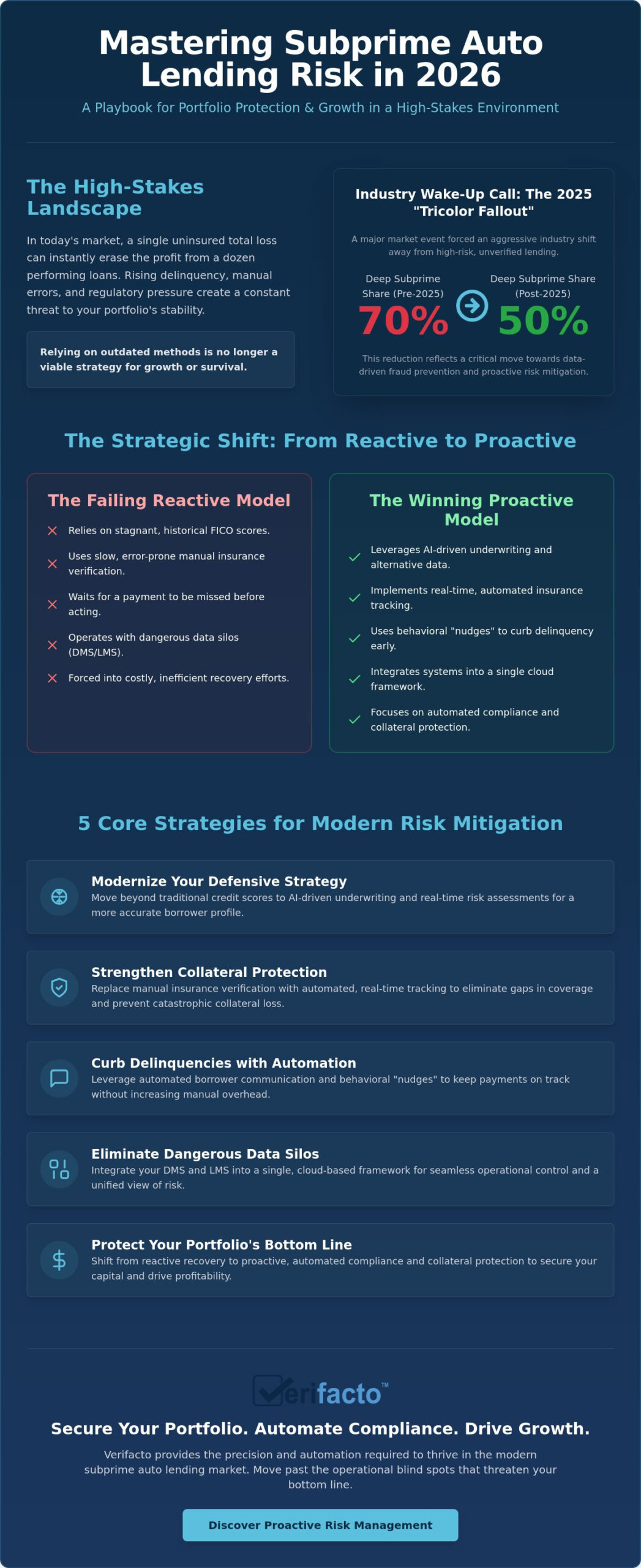
The 2025 “Tricolor fallout” served as a massive wake-up call for the industry. This event led to unprecedented lender scrutiny and an aggressive shift toward fraud prevention. Industry data from federalreserve.gov indicates that the deep subprime share reduced from 70% to 50% in 2025. This shift wasn’t accidental; it was a survival response. Lenders who survived realized that relying on stagnant credit scores was a recipe for disaster. They moved toward alternative data points and behavioral monitoring to catch red flags before they turned into charge-offs.
Manual risk tracking has become a liability for independent dealerships looking to scale. When you’re managing a growing portfolio, human error in insurance verification or payment tracking isn’t just an inconvenience; it’s a financial leak. You can’t afford to wait for a person to check a box. You need systems that act instantly. Relying on spreadsheets and manual follow-ups in a high-stakes environment is a gamble that most modern lenders aren’t willing to take.
Current Trends and Regulatory Pressures
The CFPB has significantly increased its oversight of subprime practices in 2026. They’re focused on transparency and fair treatment, which means your data must be impeccable. Deep subprime segments are evolving as economic shifts change borrower profiles. Bank funding sources now demand granular, real-time data transparency. If you can’t prove your portfolio is protected with modern risk management in subprime auto lending, you’ll find your access to capital shrinking. Compliance isn’t a burden; it’s a prerequisite for growth.
The Shift from Reactive to Proactive Mitigation
Waiting for a missed payment is a failing strategy. By the time the payment is late, the risk has already materialized. Real-time monitoring has become the industry standard for proactive lenders. This approach allows you to identify insurance lapses or behavioral shifts the moment they happen. The ROI of risk mitigation software is undeniable in this high-interest environment. It’s the difference between a stable, profitable portfolio and one plagued by uninsured total losses and costly recoveries. You need to stay ahead of the curve to stay in the game.
Core Risk Mitigation Strategies: Beyond the Credit Score
FICO scores are a snapshot of the past, but in 2026, you need a movie, not a photo. Relying solely on legacy credit data is like driving looking only at the rearview mirror. Modern risk management in subprime auto lending requires a shift toward real-time behavioral analysis and AI-driven underwriting. By establishing robust standards that incorporate alternative data, you can identify high-performing borrowers that traditional models might reject. This is essential because, as highlighted by Georgetown Law on Subprime Lending Risks, economic pressures like inflation and shifting interest rates can rapidly change a borrower’s financial stability regardless of their historical score.
Implementing tiered interest rates based on real-time risk assessments allows you to price each loan accurately for its specific danger level. You shouldn’t treat every deep subprime borrower the same. Automated workflows for verifying employment and residency remove the friction and potential for human error inherent in manual checks. These systems ensure that the foundation of the loan is solid before the car ever leaves the lot. It’s about building a scalable framework that balances aggressive growth with the long-term health of your portfolio through automated limits and triggers.
Alternative Data in Subprime Underwriting
Static scores don’t tell the full story. Using payment history for utilities and rent provides a much clearer picture of a borrower’s commitment to their monthly obligations. Cash flow analysis is now a more reliable predictor of auto loan performance than a FICO score from six months ago. Modern auto loan management software integrates these alternative data streams directly into your underwriting engine. This allows you to spot “thin file” borrowers who are actually low-risk, high-opportunity clients.
Portfolio Diversification and Risk Layering
Avoid the trap of risk concentration. If your portfolio is too heavily weighted in one geographic area or a single employment sector, a local economic downturn could be catastrophic. Successful lenders use risk layering to create a multi-point safety net. This involves combining automated reminders, real-time insurance tracking, and GPS tools to monitor collateral health. When behavioral patterns shift—like a missed check-in or a change in driving habits—your system should trigger immediate manual intervention. Implementing these automated risk tracking solutions ensures you maintain control even as your portfolio expands.
The Critical Role of Real-Time Insurance Tracking & CPI
A GPS device can tell you exactly where a vehicle is located, but it won’t write you a check if that vehicle is wrapped around a telephone pole. In the high-stakes world of subprime lending, your collateral is only as secure as the insurance policy protecting it. Uninsured collateral represents one of the most significant leaks in any portfolio’s profitability. If a car is totaled while “naked”—without active comprehensive and collision coverage—your recovery options vanish instantly. This makes real-time insurance monitoring a non-negotiable pillar of risk management in subprime auto lending.
Traditional manual verification is a reactive process that leaves you exposed for weeks at a time. The financial impact of a single uninsured total loss can wipe out the interest gains from dozens of performing loans. You need a system that closes the gap between a policy lapse and your awareness of it. By the time a paper notice arrives in the mail, your collateral has likely been at risk for ten days or more. Modern lenders can’t afford that window of vulnerability.
Why Manual Insurance Verification Fails
Manual tracking is plagued by the “Friday Afternoon Lapse.” This occurs when a borrower provides proof of insurance to drive off the lot, only to cancel the policy minutes later to save on premiums. Your staff doesn’t have the bandwidth to call every insurance agent daily. This administrative burden creates a massive operational bottleneck. Automated tracking identifies these lapses within 24 hours, giving you the power to act before a disaster happens. It replaces the guesswork of manual spreadsheets with the certainty of digital oversight.
Integrating CPI into Your Risk Strategy
Collateral Protection Insurance (CPI) serves as the ultimate safety net when a borrower fails to maintain their own coverage. Understanding what is collateral protection insurance is vital for any lender looking to stabilize their portfolio. When a lapse is detected, a force-placed insurance workflow begins. This isn’t just about protection; it’s about maintaining compliance through proper notice requirements and managing the refunding of unearned premiums if the borrower provides proof of their own insurance later.
Managing the cost of CPI is a strategic choice. You can choose to pass premiums to the borrower or absorb the risk as a cost of doing business. Regardless of the model, having an automated CPI solution ensures that your risk management in subprime auto lending remains proactive rather than defensive. It protects your capital and keeps your portfolio healthy even when borrowers fall short of their obligations. You gain peace of mind knowing that every asset in your fleet is covered, regardless of the borrower’s actions.
Automating Borrower Communication to Curb Delinquency
Effective risk management in subprime auto lending extends beyond collateral tracking; it begins with managing the human element of the loan. Delinquency often starts with a simple oversight rather than a deliberate refusal to pay. By automating borrower communication, you create a consistent, multi-channel engagement strategy that keeps your loan at the top of their priority list. This proactive approach reduces the manual workload on your collections team while building a more reliable payment culture within your portfolio. Engaging borrowers early and often is the most cost-effective way to prevent a loan from sliding into default.
The “Nudge” Theory is the foundation of this strategy. Small, timely reminders via SMS, email, or automated IVR prevent forgetfulness-based delinquency before it requires a manual phone call. It’s essential to maintain strict compliance with the FDCPA and TCPA during this outreach. Automated systems ensure that every message sent is within legal timeframes and follows approved scripts, removing the risk of costly regulatory violations that manual teams might accidentally trigger. You gain the benefit of constant contact without the legal exposure of unmonitored staff interactions.
The Lifecycle of an Automated Reminder
A well-structured communication plan follows the borrower through the entire payment cycle. Pre-due date notifications, sent three to five days before the deadline, set the expectation for payment and allow the borrower to resolve any banking issues early. If a payment is missed, grace period alerts provide immediate action for day-1 delinquency, often resolving the issue before it reaches the ten-day mark. Finally, urgent insurance lapse notices serve as critical communication for compliance breaches, reminding the borrower of their contractual obligations to protect the collateral.
Improving Collection Efficiency through Technology
Success in improving collection efficiency for auto loans depends on how well you can personalize messages at scale. Generic “payment due” texts are easy to ignore, but messages that include the borrower’s name and specific account details drive much higher response rates. Utilizing two-way SMS allows borrowers to resolve minor issues or confirm payment dates without ever picking up the phone. This reduces friction for the borrower and saves your team hours of unproductive dialer time.
Integrating these communication workflows directly into your LMS ensures that no borrower falls through the cracks. You can’t scale a subprime portfolio if your team is manually chasing every five-day late payment. By deploying automated borrower communication tools, you shift your staff’s focus from routine follow-ups to high-value problem solving. This shift is what separates profitable lenders from those struggling with high overhead and inconsistent cash flow. It’s time to let technology handle the reminders so your team can handle the growth.
Scaling with Integrated LMS and DMS Solutions
Data silos represent a silent threat to your bottom line. When your sales data doesn’t talk to your servicing data, effective risk management in subprime auto lending becomes impossible to scale. You end up with blind spots that lead to missed insurance lapses, delayed payment follow-ups, and fragmented borrower records. A cloud-based integrated payment solution is the first step in removing this operational friction. It ensures that every dollar collected is immediately reflected across your entire operation, providing the transparency needed to manage high-risk portfolios with absolute confidence.
True integration between your Dealership Management System (DMS) and Loan Management System (LMS) is the only way to grow without adding massive manual overhead. Verifacto acts as the central nervous system for risk-aware lenders, connecting every stage of the loan lifecycle from the initial handshake to the final payment. This connectivity ensures that the protection strategies we’ve discussed, such as real-time insurance tracking and automated nudges, are built into the workflow, not added as afterthoughts. You need a system that works as a single source of truth, allowing your team to focus on growth strategy rather than manual data entry.
The Efficiency Gains of a Unified Platform
You can’t afford the errors that come with manual double-entry. Moving data manually from one system to another is where compliance breaches happen and where collateral is lost. A unified platform automates the transition from “Sold” in the DMS to “Serviced” in the LMS, ensuring that insurance tracking and communication start the moment the contract is signed. Real-time reporting allows you to view your total portfolio risk at a glance from any device. This visibility gives you the agility to make data-driven decisions before a negative trend becomes a crisis. It’s about having total control over your assets at every moment.
Future-Proofing Your Lending Operations
The regulatory landscape won’t stand still. Preparing for 2027 shifts requires a flexible software architecture that can adapt to new disclosure or reporting requirements. Built-in payment processing does more than just secure cash flow; it provides a clean, automated audit trail that’s vital for any modern auto finance compliance management framework. Moving away from legacy systems isn’t just a technical upgrade; it’s a strategic necessity to protect your capital. By adopting these integrated tools, you ensure your risk management in subprime auto lending is both cutting-edge and dependable for the long haul.
Take Decisive Action to Secure Your Lending Future
The transition from reactive recovery to proactive automation is no longer optional for lenders who want to remain competitive. By integrating real-time tracking and behavioral nudges, you eliminate the operational blind spots that lead to costly charge-offs. We’ve seen how a unified platform removes data silos, allowing you to scale without the weight of manual errors. Mastering risk management in subprime auto lending is ultimately about reclaiming control over your collateral and your time.
Verifacto stands ready as your strategic partner, providing the sophisticated tools necessary to navigate high-stakes environments safely. Our real-time insurance tracking technology, automated CPI solutions, and cloud-based integrated LMS/DMS work together to build a fortress around your capital. It’s time to leave legacy manual processes behind and embrace a future of modernization and security. Protect your portfolio with Verifacto’s integrated risk management tools today. We’re here to ensure your growth is as stable as it is ambitious.
Frequently Asked Questions
What is the biggest risk in subprime auto lending today?
The most significant threat is the financial impact of uninsured total losses. While delinquency is a major concern, a totaled vehicle without active insurance results in a complete loss of collateral value. Modern risk management in subprime auto lending focuses on closing the gap between a policy lapse and lender awareness. This prevents “naked” collateral from remaining on the road for extended periods.
How does insurance tracking reduce lender risk?
Insurance tracking provides instant notifications the moment a borrower’s policy cancels or expires. It replaces slow, manual paper notices with digital alerts that arrive in real time. This speed allows you to contact the borrower or initiate a CPI workflow before an accident occurs. You maintain constant protection over your assets without waiting for a manual audit of your entire portfolio.
Is Collateral Protection Insurance (CPI) legal in all states?
CPI is generally legal across the United States but is subject to specific state regulations regarding notice requirements and premium charges. You must follow strict guidelines for notifying borrowers before force-placing coverage on their behalf. It’s essential to work with a provider that understands these local compliance nuances. Always consult with legal counsel to ensure your specific program meets state-level mandates.
Can automated communication really reduce my delinquency rate?
Automated communication reduces delinquency by keeping payments top-of-mind through multi-channel “nudges.” Many defaults happen because of simple forgetfulness rather than a lack of funds. By sending SMS or email reminders before the due date, you establish a consistent payment culture. This proactive engagement often resolves potential issues during the grace period, saving your team from thousands of manual collection calls.
What is the difference between an LMS and a DMS for risk management?
A DMS (Dealer Management System) primarily handles inventory, sales contracts, and front-end operations. An LMS (Loan Management System) focuses on the lifecycle of the loan, including payment processing and servicing. For robust risk management in subprime auto lending, these systems must be integrated. This ensures that data flows seamlessly from the initial sale into ongoing borrower servicing without manual entry errors.
How does real-time tracking help with regulatory compliance?
Real-time tracking creates a digital audit trail that proves you’re monitoring collateral consistently across your entire portfolio. This transparency is vital when facing scrutiny from the CFPB or other regulators. It ensures that all borrowers are treated fairly according to automated, pre-set rules. You can demonstrate that notices were sent and insurance was verified according to a standardized, compliant process every time.
Should I use GPS tracking or insurance tracking for my subprime loans?
How long does it take to implement a modern risk management platform?
Most modern risk management platforms can be implemented within a few weeks depending on the complexity of your data migration. Cloud-based solutions allow for faster integration with your existing DMS. A structured onboarding process ensures that your team is trained and your automated workflows are active without long periods of operational downtime. It’s an investment in long-term stability that pays off quickly.