
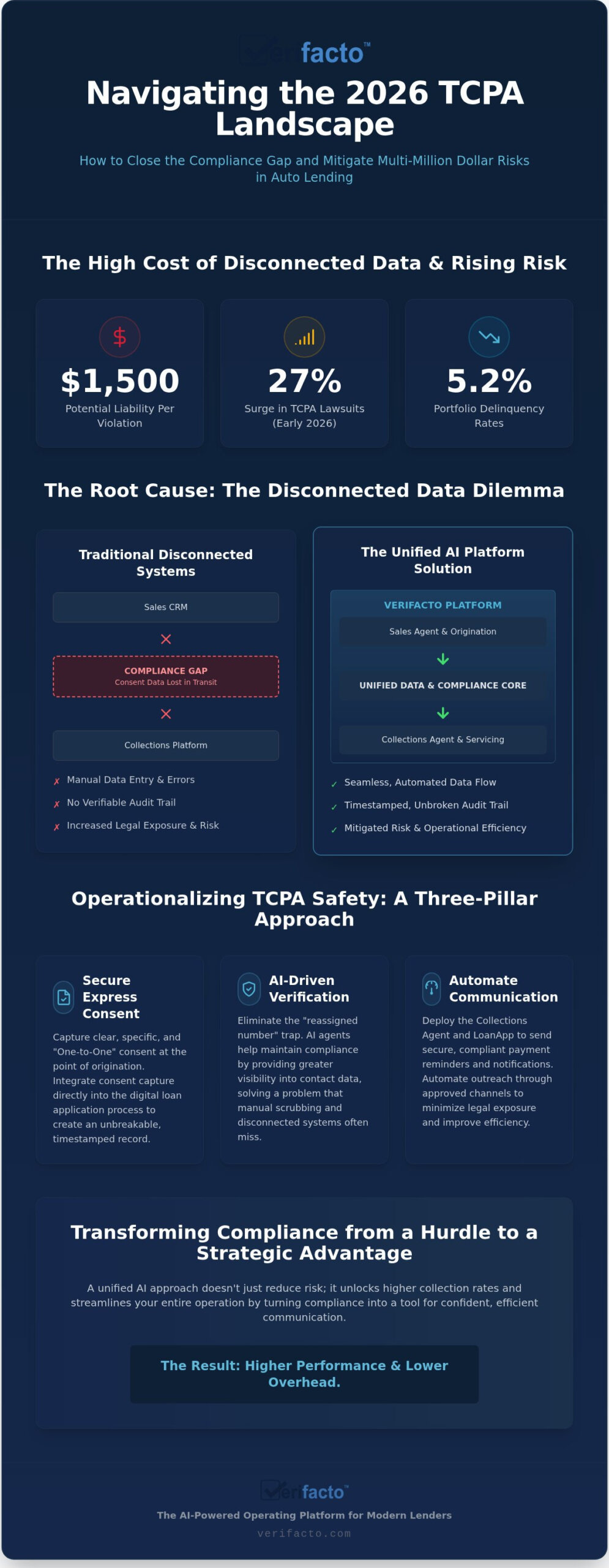
With TCPA lawsuits surging by nearly 27% in early 2026, your manual tracking methods aren’t just inefficient; they’re a multi-million dollar liability waiting to happen. You likely feel the mounting pressure of maintaining TCPA compliance for auto lenders while managing a portfolio where delinquencies have reached 5.2%. It’s a high-stakes environment where a single missed opt-out or an unrecorded consent revocation can lead to devastating legal consequences.
You shouldn’t have to choose between effective collections and legal safety. This guide shows you how to operationalize compliance within a unified AI platform to mitigate risk and boost performance. We’ll look at how embedding AI agents into your workflow can turn disconnected data into a secure, audit-ready system. By the end, you’ll see how to protect your business and streamline your entire loan lifecycle from the first lead to the final payment.
Key Takeaways
- Learn how to close the “compliance gap” by unifying sales and collection data within a single operating platform rather than managing disconnected systems.
- Discover strategies for capturing clear, specific prior express consent at origination to protect your communication across the entire customer lifecycle.
- Understand how AI-driven verification helps maintain TCPA compliance for auto lenders by solving the “reassigned number” trap that manual scrubbing often misses.
- See how to deploy the Collections Agent and LoanApp to automate payment reminders through secure, compliant channels that minimize legal exposure.
- Explore how a unified AI approach transforms compliance from a legal hurdle into a strategy for higher collection rates and reduced operational overhead.
The High Cost of Disconnected Data in 2026 TCPA Compliance
Dealerships often operate as a single business but manage it through three or four disconnected systems. This fragmentation creates a dangerous compliance gap where critical borrower permissions are lost in transit. For the modern lender, TCPA compliance for auto lenders isn’t just about following rules; it’s the systematic management of every borrower communication permission from the first click to the final payment. If your sales team captures consent but your collections team can’t see the timestamped proof, your entire portfolio is at risk.
When sales data and collection data live in separate silos, your legal risk increases exponentially. You might have obtained prior express written consent during the lead phase, but if that data doesn’t flow seamlessly to your servicing team, you’re flying blind. The Telephone Consumer Protection Act of 1991 remains the bedrock of these regulations, but its application has evolved. Today, if your collections department can’t prove consent with a verifiable audit trail, every text message or automated call becomes a potential $1,500 liability. Verifacto is designed to solve this by bringing your operation, data, and AI together in one platform.
This fear of non-compliance often leads to revenue leakage. When your team is hesitant to reach out to past-due borrowers because they aren’t sure about consent status, recovery efforts slow down. Delinquency rates, which hit 5.2% in early 2026, continue to climb while your communication stays paralyzed by data uncertainty. A unified system ensures that your team knows exactly who they can contact and when, turning compliance from a bottleneck into a tool for efficiency.
The FCC’s 2026 ‘One-to-One’ Consent Rule
The regulatory environment shifted significantly in 2026 with the FCC’s “One-to-One” consent requirement. Gone are the days of relying on blanket third-party consent from lead aggregators. Now, lenders must obtain specific authorization for their individual brand at the point of contact. This change forces a complete rethink of lead generation. You must verify consent at the source. Verifacto provides greater visibility into lead origin and consent metadata, ensuring you only communicate with borrowers who have explicitly invited the conversation. This level of transparency is essential for defending against the rising tide of TCPA class-action lawsuits.
Why Your Current DMS or CRM Might Be a Liability
Traditional systems often create vendor lock-in, where your data is trapped in a format that’s difficult to export or audit for compliance. When you’re forced to manually transfer consent status from a standalone CRM to an LMS, you invite manual entry errors. A single typo can turn a compliant account into a legal landmine. By using a unified AI-powered operating platform, you eliminate duplicate data entry. Your data stays under your control, and your compliance trail remains unbroken throughout the entire loan lifecycle. This modernization is the only way to scale safely in the current regulatory climate.
Securing Prior Express Consent Across the Auto Loan Lifecycle
Capturing consent isn’t a one-time event; it’s a continuous thread that must run through your entire operation. To maintain TCPA compliance for auto lenders, you must secure permission at the earliest possible point of contact. This usually happens during origination. If your consent capture is handled by a third-party lead provider or a disconnected CRM, you’re building your portfolio on shaky ground. You need a system that integrates disclosures directly into the initial engagement, ensuring every borrower understands exactly how you’ll communicate with them.
Disclosures must be clear, conspicuous, and highly specific. In the 2026 regulatory environment, generic “consent to contact” language is no longer enough. Your forms should explicitly mention the communication methods you intend to use, including SMS, voice calls, and AI-driven interactions. By using the Verifacto Sales Agent, you can engage leads while documenting these permissions in real time. This creates a digital paper trail that links the borrower’s consent directly to their loan file and vehicle collateral, providing a robust defense if a dispute ever arises.
Capturing Consent at Origination
The most effective way to ensure 100% coverage is to integrate consent forms into your digital loan application process. This moves compliance from a manual checklist to an automated workflow. You should also implement “granular consent.” This means allowing borrowers to opt into specific types of alerts, such as payment reminders or insurance notifications, while perhaps opting out of marketing. Verifacto’s unified platform is designed to store this granular data as a permanent part of the loan file. This ensures that every department, from sales to servicing, respects the borrower’s specific boundaries without needing to cross-reference multiple databases.
Managing Consent Revocation Without Data Silos
The biggest operational hurdle for most lenders is managing consent revocation. When a borrower texts “STOP” or tells a representative they no longer wish to be called, that information often gets trapped in a single department’s notes. This creates “zombie calls,” where one agent continues to reach out because they haven’t seen the update from another. These errors are exactly what trigger expensive litigation under FCC rules on robocalls and automated messaging.
Verifacto solves this by operating as a unified system. When a borrower revokes consent, the platform instantly updates every communication agent, including the Collections Agent and LoanApp. This real-time synchronization eliminates the compliance gaps that lead to lawsuits. You can explore how our AI agents work together to keep your communication workflows secure and synchronized across the entire loan lifecycle.
AI vs. Manual Compliance: Eliminating the Wrong Number Trap
One of the most persistent threats to TCPA compliance for auto lenders is the “reassigned number” problem. Thousands of mobile numbers are recycled every day. If you call a number that once belonged to a consenting borrower but has since been reassigned to someone else, you’re committing an automatic violation. The law doesn’t care if you acted in good faith. Manual database scrubbing, which many still consider the industry standard, is simply too slow and error-prone to protect a high-volume portfolio in 2026. It leaves gaps that lead directly to litigation.
Verifacto changes the dynamic by replacing reactive manual checks with AI-driven real-time verification. Instead of relying on a staff member to remember to scrub a list once a month, our AI-powered operating platform connects to live data sources to verify number ownership before communication occurs. This isn’t a standalone novelty; it’s an embedded tool designed to support human judgment. Your team can focus on recovery while the system handles the heavy lifting of data integrity behind the scenes.
The Risk of Recycled Numbers in Auto Lending
High turnover rates for mobile numbers create a ticking time bomb for lenders. The FCC provides specific “safe harbor” protections, but these only apply if you can prove you consistently and accurately checked the Reassigned Numbers Database (RND). Manual processes struggle to document this audit trail effectively. Verifacto connects your operation directly to the necessary data streams, ensuring every contact is verified against current ownership records. This aligns with the broader privacy protections outlined in the FTC’s Telemarketing Sales Rule guide, which emphasizes that lenders are responsible for the accuracy of their outreach regardless of the technology used.
How AI Analytics Agents Monitor Compliance
Our Analytics Agent goes beyond simple data verification by flagging communication anomalies in real time. If a phone number consistently returns specific network codes or fails to connect, the agent identifies these patterns of non-reachability before your staff makes a call. Real-time dashboards provide managers with total visibility into call volumes and staff compliance levels. This predictive insight allows you to avoid legal pitfalls before they manifest as a lawsuit.
By unifying your data, the Analytics Agent provides a clear view of which accounts are safe to contact and which require manual intervention. This approach ensures that your collectors aren’t wasting time on high-risk numbers. It provides greater visibility into your operational health while keeping your communication workflows within compliant windows. This isn’t just about avoiding fines; it’s about building a more efficient, data-driven collection strategy that respects the boundaries of modern regulation.
Operationalizing TCPA Safety in Your Collection Workflow
Collections is the stage where communication frequency spikes and legal risk reaches its peak. Most dealerships operate one business but are forced to manage it through disconnected systems, leading to a fragmented view of borrower contact history. When your team manually dials numbers to address the 2.00% 30-day delinquency rate seen in early 2026, they often lack the real-time guardrails needed to maintain TCPA compliance for auto lenders. Verifacto brings the operation, data, and AI together in one platform to ensure every touchpoint stays within legal boundaries.
Operationalizing safety means hard-coding compliance into your automation engine. Instead of relying on a collector’s memory, you can deploy the Verifacto Collections Agent to handle routine payment reminders. This agent works alongside LoanApp, our secure mobile application, to deliver in-app messaging. Because LoanApp uses data-driven notifications rather than traditional telephony, it provides a communication channel that is designed to bypass many of the “auto-dialer” triggers that lead to $1,500-per-violation lawsuits.
Verifacto’s Collections Agent: Automation with Oversight
The Collections Agent utilizes your connected business data to personalize outreach without violating contact rules. It’s programmed with “quiet hours” and frequency caps, such as the “7-in-7” rule under Regulation F, ensuring you don’t exceed seven contact attempts within a seven-day period. This automation doesn’t replace your staff; it supports human judgment by handling the repetitive, low-risk reminders. When a borrower requires a high-stakes negotiation, the system flags the account for a “human-in-the-loop” intervention. This balance improves recovery rates while keeping your communication workflow strictly compliant.
Building an Audit Trail for Federal Regulators
If the CFPB or FCC initiates an inquiry, your best defense is a set of audit-ready logs. Verifacto maintains a comprehensive record of every interaction, providing greater visibility into your communication history. Every SMS sent and every call made is logged with specific data points, including:
- Precise timestamps for every message sent and received.
- Verifiable delivery receipts from the carrier level.
- Documented consent status at the exact moment of contact.
- A record of the specific AI agent or staff member who initiated the contact.
This sensitive audit data is protected by SOC II certified cloud infrastructure and bank-level encryption. By unifying your servicing data, you ensure that your compliance trail is never broken by a vendor switch or a system gap. This structured approach turns compliance from a source of professional anxiety into a predictable, manageable part of your daily operations. Book a demonstration to explore how the platform fits your business.
Unifying Compliance and Profitability with Verifacto
Scaling an auto finance portfolio in 2026 requires more than just capital; it requires a data strategy that can withstand federal scrutiny. Dealerships operate one business but are often forced to manage it through disconnected systems. This fragmentation doesn’t just create compliance gaps; it creates revenue leakage. When your sales, analytics, and collections data are siloed, you lose the visibility needed to make informed decisions. Verifacto brings the operation, data, and AI together in one platform to eliminate these risks and drive operational efficiency.
Maintaining TCPA compliance for auto lenders is no longer a legal hurdle to clear but a strategic advantage to leverage. By unifying your communication workflows, you can reduce legal spend and lower operational overhead simultaneously. A unified platform provides greater visibility into the entire loan lifecycle, from the first credit application to the final payment. This transparency allows you to identify risks before they become liabilities, ensuring your business remains audit-ready at all times. For lenders looking to observe how modern financial platforms present secured vehicle financing options to their customers, you can check out V8Loans.
The high-stakes environment of 2026 demands a move toward modernization. Relying on manual consent tracking or fragmented vendor systems is a liability you can’t afford. By embedding AI agents into your daily operations, you ensure that every borrower interaction is backed by connected business data. This approach supports human judgment while automating the high-volume workflows that often lead to data errors and legal exposure.
LoanApp: The Future of Compliant Borrower Engagement
Traditional SMS and voice calls are increasingly prone to regulatory triggers and “wrong number” traps. LoanApp provides a secure, branded alternative for borrower engagement. It functions as a secure channel for document sharing and payment processing, keeping sensitive interactions within a controlled environment. Because it uses data-driven in-app notifications, it offers a safer alternative to traditional SMS, which is often the primary target of class-action lawsuits. You can explore our full range of AI solutions to see how this technology ecosystem supports a more secure communication strategy.
Scaling Your Portfolio Without Increasing Legal Risk
Lenders often fear that growth leads to a proportional increase in legal exposure. With embedded AI agents, you can scale your portfolio without significantly adding to your compliance headcount. The Collections Agent and Sales Agent handle high-volume, routine tasks with hard-coded guardrails, allowing your human staff to focus on high-risk accounts and complex negotiations. This automation is backed by a 99.99% uptime guarantee and SOC II certified infrastructure, providing the reliability required for daily operations.
The transition from fragmented tools to a unified operating platform is the only way to safeguard your 2026 portfolio. Move away from the uncertainty of manual tracking and toward a secure, cloud-based future that prioritizes both protection and performance. Book a demonstration to explore how the platform fits your business and see how Verifacto connects your operation from the first lead to the final payment.
Modernize Your Compliance Strategy for 2026
Managing a growing portfolio requires a shift from reactive manual checks to proactive, data-driven automation. By unifying your sales, analytics, and collections data, you eliminate the disconnected systems that often lead to communication gaps. This integration is the most effective way to maintain TCPA compliance for auto lenders while improving recovery rates. You can now leverage an AI-Driven Operational Assistant to handle routine outreach while your team focuses on high-risk accounts and complex negotiations.
Verifacto provides the security and reliability your daily operations demand. With SOC II Certified infrastructure and bank-level encryption, your sensitive audit data remains protected. Our 99.99% uptime guarantee ensures that your communication guardrails are always active, preventing the “zombie calls” and reassigned number errors that lead to litigation. It’s time to move toward a secure, cloud-based future where compliance and profitability work in tandem.
See how Verifacto connects your operation from the first lead to the final payment. Building a resilient, audit-ready workflow is within your reach, and we’re here to help you navigate these operational challenges with confidence.
Frequently Asked Questions
What is the “One-to-One” consent rule for auto lenders in 2026?
The “One-to-One” rule requires auto lenders to obtain specific, individual authorization from a consumer for a single seller rather than relying on blanket consent from lead aggregators. This means a borrower must explicitly agree to receive calls or texts from your specific dealership or finance company. Verifacto is designed to capture this brand-specific metadata at origination, ensuring your records meet the 2026 FCC standards for verifiable, brand-specific consent.
Does using an AI agent for collections count as an “autodialer” under TCPA?
As of February 2024, the FCC classifies AI-generated voices as “artificial or prerecorded” under the TCPA, making them subject to the same consent requirements as traditional autodialers. Verifacto’s Collections Agent operates as an embedded tool that uses connected business data to trigger compliant outreach. It’s designed to support human judgment rather than functioning as a standalone, mass-dialing novelty, helping you maintain TCPA compliance for auto lenders.
How does Verifacto help manage reassigned or recycled phone numbers?
Verifacto manages the risk of recycled numbers by connecting your operation to real-time data sources that verify number ownership before any communication occurs. Unlike manual scrubbing, which is often prone to human error and delay, our Analytics Agent identifies patterns of non-reachability and flags anomalies. This proactive approach helps you avoid the “wrong number” trap that triggers automatic violations when a mobile number changes hands.
Can I use Verifacto to track consent for both BHPH and traditional auto financing?
You can use Verifacto to track consent and communication permissions for both Buy Here Pay Here (BHPH) and traditional auto financing portfolios. Because the platform unifies the entire loan lifecycle, it eliminates the data silos that often exist between a dealership’s CRM and its loan servicing software. This ensures that consent captured during the sales process remains visible and verifiable throughout the collection phase.
What happens if a borrower revokes consent through a text message?
If a borrower revokes consent through a text message, such as by typing “STOP,” new rules that took effect in April 2025 require you to honor that request within 10 business days. Verifacto is designed to update your entire system instantly when a revocation occurs. This prevents “zombie calls” by ensuring that the Collections Agent and all staff members see the updated status in real time across the unified platform.
Is Verifacto SOC II compliant for storing sensitive borrower communication data?
Yes, Verifacto utilizes SOC II certified cloud infrastructure to store and protect sensitive borrower communication data. This certification, combined with bank-level encryption, provides a secure environment for maintaining your audit-ready logs. By keeping this data in a centralized, protected system, you ensure that your compliance history is always accessible for federal inquiries while remaining safe from unauthorized access or vendor lock-in.
How does LoanApp improve TCPA compliance for auto finance companies?
LoanApp improves compliance by providing a secure, in-app messaging channel that doesn’t rely on traditional telephony triggers. Since notifications occur within the app environment rather than through a cellular network’s SMS protocol, it provides a safer alternative for routine payment reminders. This helps auto finance companies reduce their reliance on high-risk communication methods while maintaining a direct, documented connection with the borrower.
What is the penalty for a willful TCPA violation in 2026?
In 2026, the penalty for a willful or knowing TCPA violation is $1,500 per call or text message. For non-willful violations, the fine is $500 per instance. These costs can escalate quickly into multi-million dollar class-action lawsuits if a lender’s automated system repeats the same error across a large portion of their portfolio. Verifacto’s hard-coded guardrails are designed to help mitigate these financial risks through better data oversight.