
In a 2026 economy where U.S. household debt has reached $18.8 trillion and delinquency rates sit at 4.8%, a single broken cell in an Excel sheet isn’t just a minor typo; it’s a significant financial liability. You likely rely on these manual grids because they feel familiar and appear cost-effective on the surface. However, the limitations of using spreadsheets for loan management become painfully clear when your staff spends hours on repetitive data entry only to discover an insurance lapse after the vehicle is gone. Managing a dynamic auto portfolio with static tools creates a dangerous lag in visibility.
Formula errors in payoff quotes and disconnected data silos lead to direct revenue leakage that most lenders don’t catch until it’s too late. This article explores why relying on manual processes puts your collateral at risk and how a connected AI platform secures your portfolio. You’ll learn how to eliminate calculation errors and gain real-time insights into your operations. We’ll examine the transition from fragmented systems to a unified workflow that connects your data and allows embedded AI to handle the routine monitoring that spreadsheets simply cannot manage.
Key Takeaways
- Static spreadsheets fail to mirror the dynamic nature of auto loans, leading to version control conflicts that compromise your data integrity.
- Recognize how the limitations of using spreadsheets for loan management, such as broken formulas and manual entry errors, create significant revenue leakage.
- Close the dangerous “lapse window” in collateral protection by replacing manual insurance verification with automated, real-time tracking.
- Unify disconnected systems into a single operating platform to eliminate duplicate data entry and streamline the entire customer lifecycle.
- Leverage embedded AI agents to automate routine operational tasks, freeing your staff to focus on complex problem-solving and growth.
The Hidden Cost of Static Data in a Fast-Moving Portfolio
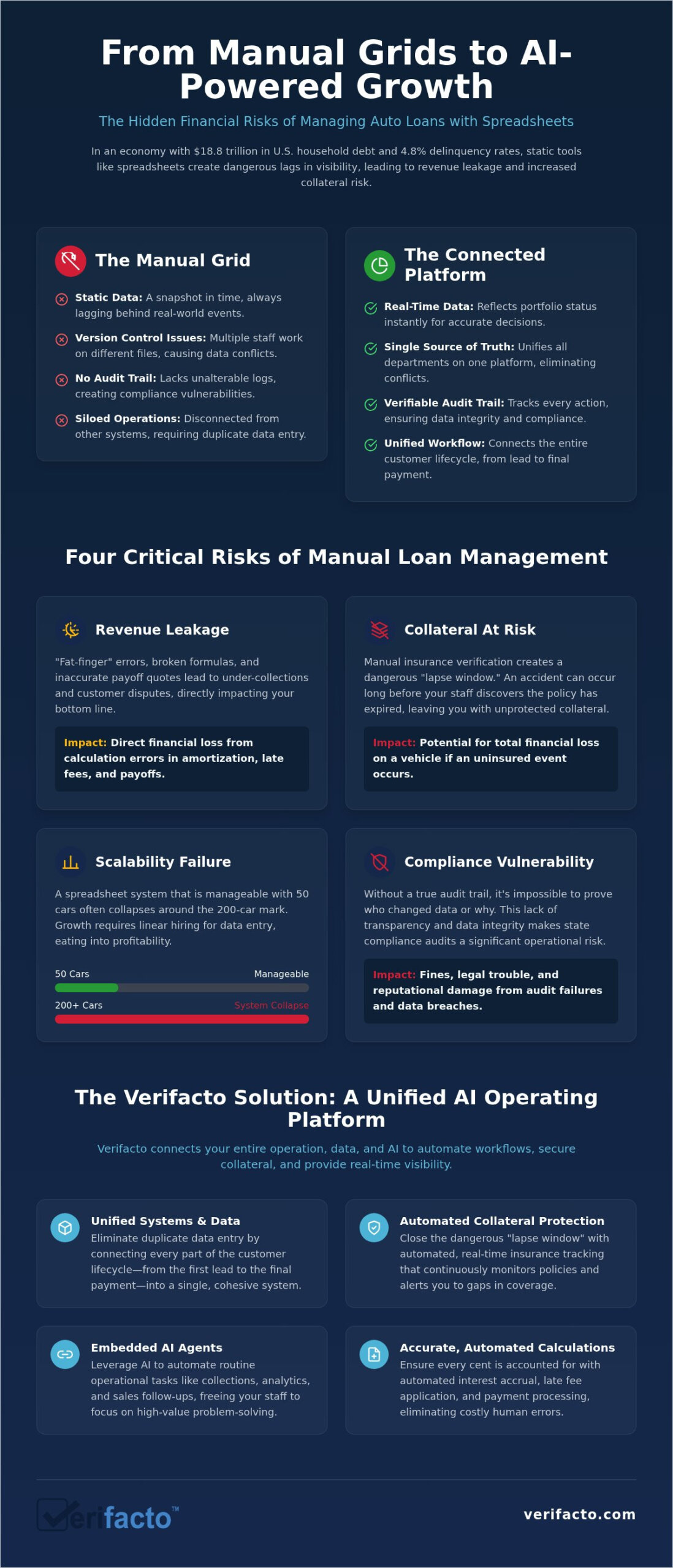
Dealerships often treat their portfolio as a fixed set of numbers, but the reality of auto finance is constant motion. A Spreadsheet is a snapshot in time; it captures the state of a loan only at the moment the data was typed. However, an auto loan portfolio is dynamic, shifting every time a borrower makes a partial payment, changes their insurance provider, or moves to a new address. With U.S. household debt at $18.8 trillion and delinquency rates sitting at 4.8% in 2026, looking at stale data is a liability. One of the primary limitations of using spreadsheets for loan management is this inherent lack of agility.
Static data risk is the delay between a real-world event and its manual entry.
When your team relies on manual updates, you’re always looking at the past. This creates a “Version Control” nightmare where multiple staff members might work on different versions of the same master sheet simultaneously. By the time the collections manager identifies a late payment on version B, the sales manager may have already promised a payoff quote based on version A. These discrepancies lead to friction with customers and direct financial loss for the dealership.
The Scalability Wall for Independent Dealers
Managing a 50-car portfolio in Excel might feel manageable, but that system typically collapses once you hit the 200-car mark. Manual data entry scales linearly with staff costs; to manage more loans, you simply have to hire more people to type. This eats directly into dealership profitability. These limitations of using spreadsheets for loan management become even more pronounced as your business grows. You also face “Key Person Dependency,” where your entire operational logic lives in the head of one employee who built the complex formulas. While cloud-based sheets allow for basic collaboration, they lack the relational database power found in specialized auto loan management software.
Data Integrity and Audit Vulnerabilities
Spreadsheets offer almost no protection against accidental or intentional data alteration. There is no true audit trail to show who changed the interest rate on a specific loan or why a payment date was moved. This lack of transparency makes preparing for state compliance audits a fragmented, stressful process. Verifacto provides greater visibility by replacing these vulnerable files with a centralized operating platform. Our AI-powered system maintains unalterable logs, ensuring every action is tracked and verifiable. This level of control is essential for protecting your collateral in a high-stakes environment where accuracy isn’t just a goal, but a requirement for survival.
Error-Prone Calculations and the Risk of ‘Fat-Finger’ Financials
A single keystroke can dismantle years of portfolio growth. One accidental deletion in a hidden cell can cascade through an entire amortization schedule, rendering your financial projections useless. These technical vulnerabilities highlight the significant limitations of using spreadsheets for loan management. When a staff member provides an incorrect payoff quote due to a broken formula, you face a lose-lose scenario. You either under-collect on the loan or enter a legal dispute with a customer who has already signed the title.
The “fat-finger” reality is a constant threat in high-volume operations. Manually typing 17-character VINs, Social Security Numbers, and payment amounts into a grid is a high-risk activity that inevitably leads to data corruption. These errors don’t just stay in the spreadsheet. They flow into your insurance claims and credit reporting, creating a massive cleanup job for your compliance team. Embedded payment processing reduces this risk by eliminating the need for manual reconciliation entirely.
Amortization and Interest Accrual Errors
Managing the nuances of simple interest versus pre-computed interest in a manual grid is a logistical nightmare. Spreadsheets struggle to accurately apply late fee logic and grace period rules, especially when a borrower makes multiple partial payments within a single cycle. This complexity often leads to inaccurate balances that frustrate both lenders and borrowers. Using integrated payment solutions for dealers automates these calculations in real-time. This ensures that every cent of interest is calculated correctly based on the actual date the payment was received, not just when someone found time to update the sheet.
Reconciliation Gaps Between Bank and Sheet
Every morning, many dealers waste hours matching bank deposits to spreadsheet rows. This manual reconciliation process is fertile ground for revenue leakage and is another example of the limitations of using spreadsheets for loan management. Unapplied payments or forgotten credits often slip through the cracks, leading to incorrect delinquency reports and unnecessary collection calls. Automation serves as a safeguard, ensuring every dollar is accounted for from the first lead to the final payment. By connecting your bank data directly to your operating platform, you eliminate the need for manual tallying. You can explore how Verifacto unifies your payment data to secure your cash flow and reduce administrative overhead.
The Insurance Gap: Why Manual Tracking Fails Collateral Protection
Protecting the physical asset is just as vital as managing the financial data. While spreadsheets can track a payment date, they’re incapable of monitoring the real-time status of an insurance policy. Lenders relying on manual grids often find themselves stuck in a reactive loop. Staff members spend hours calling agents, checking carrier portals, and updating cells, only to realize the information is outdated by the time they hit save. This lag is one of the most dangerous limitations of using spreadsheets for loan management. It leaves your portfolio exposed to the “Lapse Window,” the critical time between a policy cancellation and a lender discovering it.
If a vehicle is totaled during this window, the lender often faces a total loss. Spreadsheets can’t provide the real-time alerts needed to identify high-risk segments of your portfolio before a disaster occurs. Verifacto acts as a guardian for your collateral by automating the insurance monitoring process. By connecting directly to insurance data, the platform mitigates financial risk and ensures your team only intervenes when a genuine lapse is detected. This shifts your operation from manual busywork to proactive risk management.
Collateral Risk and the Need for CPI
Managing collateral protection insurance (CPI) through manual notifications is a recipe for operational failure. When you rely on a spreadsheet to decide when to force-place coverage, you’re often too late or, worse, you place it on a vehicle that is actually insured. These errors lead to unnecessary costs and damaged borrower relationships. Real-time visibility into active coverage allows you to secure your assets precisely when needed. Our platform provides the data-driven confidence to manage CPI programs without the guesswork inherent in manual tracking.
Automating Borrower Insurance Communication
Communication is the first line of defense against insurance lapses. A static spreadsheet can’t trigger an automated SMS or email reminder when a policy is 48 hours away from expiring. This forces collections staff to spend their day on the phone instead of focusing on high-priority accounts. The LoanApp changes this dynamic by allowing borrowers to upload their insurance documents directly from their mobile devices. These documents are verified and updated in the system automatically. This connected workflow reduces the administrative burden on your team and ensures that insurance compliance is a seamless part of the customer lifecycle.
Siloed Operations and the Collaboration Bottleneck
Dealerships operate one business but are often forced to manage it through disconnected systems. Sales teams live in a CRM, while finance managers rely on a spreadsheet to track payments. This separation creates a massive collaboration bottleneck that slows down your entire operation. One of the most frustrating limitations of using spreadsheets for loan management is the constant need for duplicate data entry. Typing a customer’s address and VIN into three different places isn’t just a waste of time; it’s an invitation for data entry errors that haunt you later in the loan lifecycle. To solve this, businesses can explore monthly subscription fees for SaaS software from platforms like Key Negocios that unify their sales and data management.
The struggle with manual data entry is common in many asset-heavy industries; for example, property managers who deal with complex leasing workflows often utilize soaverify.com to automate their processes and eliminate the risks associated with static spreadsheets.
Communication breakdowns are the natural result of these silos. A sales manager might promise a borrower a specific payment grace period during the closing process, but if that detail isn’t manually updated in the finance sheet, the collections team won’t know. The collections staff then makes a call that feels abrasive to the customer, damaging the relationship. A unified, cloud-based platform eliminates this friction. It allows every authorized user to access the same system anytime, anywhere, ensuring that a promise made at the sales desk is visible to the collections agent in real-time.
Sales vs. Collections Friction
Friction between departments often stems from a lack of shared data. Sales teams may originate loans for high-risk borrowers because they lack visibility into historical portfolio performance or specific dealer risk rules. This disconnect leaves the collections team to deal with the inevitable fallout. An AI Sales Agent can help ensure leads are handled according to consistent dealer rules from the start. By bridging the gap between the front-end sale and the back-end loan lifecycle, you ensure that every deal fits your business’s long-term financial health.
The Reporting Lag
If your team spends days “cleaning” data just to create a single month-end report, you’re managing by looking in the rearview mirror. Static grids can’t provide a real-time “heat map” of your portfolio’s performance. You can’t see which zip codes or vehicle types are trending toward delinquency until the month is already over. Using an Analytics Agent allows you to generate predictive insights without manual data manipulation. This moves your operation away from the reporting lag and toward a proactive strategy. Book a demonstration to explore how the platform fits your business.
Transitioning from Manual Grids to AI-Driven Loan Lifecycle Management
Moving from manual grids to a connected platform shifts your focus from mere tracking to active management. In a spreadsheet, you’re constantly chasing data that is already hours or days old. In an AI-powered operating platform, the data works for you in real-time. Consider this streamlined workflow: a lead enters the system and is qualified by the Sales Agent based on your specific dealer rules. The customer completes their profile via the LoanApp, and once the loan is originated, the system automatically verifies insurance coverage without a single staff member picking up a phone. This end-to-end connectivity addresses the fundamental limitations of using spreadsheets for loan management by removing the manual friction between stages.
Transparency is a core pillar of modern operations. Many legacy systems trap your data, making it difficult to switch providers or run independent analytics. Verifacto reduces vendor lock-in by providing easy data export and full transparency. You maintain control over your business data at all times. This ensures that while you benefit from embedded AI, you aren’t tethered to a system that restricts your ability to analyze your own portfolio performance or move your data when necessary.
AI agents are designed to support human judgment, not replace it. These tools automate the repetitive, high-volume tasks that lead to burnout and error in manual environments. By handling the heavy lifting of data verification and task reminders, the platform allows your team to focus on high-value decisions that require a human touch, such as complex borrower negotiations or strategic expansion. This synergy between human expertise and machine efficiency is what defines a modern lending operation.
The Role of Embedded AI Agents
Embedded AI agents serve as your tireless operational backbone. The Operational Assistant can help automate task reminders and even initiate repossession workflows based on your predefined criteria. Beyond simple alerts, AI is designed to identify borrower behavior patterns, such as determining which individuals are most likely to respond to a text message versus a direct phone call. This level of personalization is impossible to achieve within the limitations of using spreadsheets for loan management. Check out how Verifacto AI connects your entire operation to see these agents in action.
Security and Reliability Standards
As a lender, you handle sensitive financial information that requires the highest level of protection. Bank-level encryption and SOC II compliance are non-negotiable standards for any modern platform. These protocols ensure that your data and your customers’ identities remain secure against evolving cyber threats. Combined with a 99.99% uptime guarantee, this infrastructure provides the stability needed to run a professional operation without fear of system failure or data loss. Book a demonstration to explore how the platform fits your business.
Secure Your Portfolio with a Connected Platform
Dealerships operate one business but are often forced to manage it through disconnected systems. We’ve explored how the limitations of using spreadsheets for loan management create invisible risks, from broken formulas to dangerous insurance lapse windows. Relying on manual entry in 2026 isn’t just inefficient; it’s a direct threat to your collateral. By transitioning to an AI-powered operating platform, you replace fragmented grids with a unified lifecycle that protects your revenue and your assets.
Verifacto provides the stability and control modern lenders require. Our platform is SOC II compliant and offers a 99.99% uptime guarantee, ensuring your data is secure and accessible. With embedded Sales and Analytics Agents, your team moves from reactive data cleaning to proactive, strategic decision-making. It’s time to close the gap between your sales desk and your final payment. You have the tools to turn operational friction into a competitive advantage.
See how Verifacto connects your operation from the first lead to the final payment
Frequently Asked Questions
Is it really risky to use Excel for a small loan portfolio?
Risk remains constant regardless of your portfolio size. Even with only 20 active loans, a single broken formula in an amortization schedule can lead to an incorrect payoff quote. Small lenders often lack the dedicated audit staff that larger institutions employ, making “fat-finger” errors harder to catch before they result in financial loss. Relying on manual grids means you’re always one keystroke away from a significant operational setback.
How does loan management software reduce manual data entry errors?
Modern platforms reduce errors by unifying disconnected systems. Instead of re-typing customer information from a CRM into a spreadsheet, data flows automatically from the first lead through to the final payment. This connectivity removes the need for staff to touch the same data point multiple times. By automating the transfer of VINs, SSNs, and payment amounts, you eliminate the primary source of data corruption in your office.
Can spreadsheets handle insurance tracking for auto loans?
Spreadsheets are fundamentally incapable of effective insurance tracking because they are static snapshots. They cannot connect to carrier databases or trigger real-time alerts when a policy cancels. This is one of the major limitations of using spreadsheets for loan management in collateral protection. Without automated monitoring, you’re forced to rely on reactive manual checks that often discover lapses only after a vehicle has been totaled.
What is the difference between an LMS and a spreadsheet?
A spreadsheet is a general-purpose grid, while an LMS is a relational database built for lending logic. Verifacto goes beyond a standard LMS by acting as a connected operating platform. It unifies the entire customer lifecycle with embedded AI agents that automate workflows. Unlike a spreadsheet, which just stores data, a platform actively manages tasks like payment processing, borrower communication, and real-time risk assessment.
How do I move my existing loan data from Excel to Verifacto?
Transitioning your data is a straightforward process designed to minimize downtime. You can export your current portfolio from Excel and import it directly into the platform. Verifacto prioritizes dealer control and reduced vendor lock-in, so you always have the ability to access and export your data for external analytics. This ensures your historical data remains accurate and useful as you scale your operations.
Will switching from spreadsheets to a platform improve my collection efficiency?
A connected platform provides greater visibility into borrower behavior, which is essential for efficient collections. Automated SMS reminders sent through the LoanApp and AI-driven task prioritization help your staff focus on high-risk accounts. Instead of wasting hours on manual data entry or routine follow-up calls, your team can use real-time data to intervene exactly when a borrower starts trending toward delinquency.
Is my data more secure in the cloud than in a local spreadsheet?
Data stored in the cloud is significantly more secure than a local file. Verifacto utilizes bank-level encryption and maintains SOC II compliance, standards that local spreadsheets cannot meet. Local files often lack audit trails, are rarely encrypted, and are vulnerable to hardware failure or accidental deletion. A cloud-based platform with a 99.99% uptime guarantee ensures your portfolio data is protected and always available.
Can AI help me manage my loan portfolio more effectively?
AI supports human judgment by automating the routine monitoring that humans often miss. It can identify which borrowers are most likely to lapse on insurance or suggest the most effective communication channel for a specific customer. By overcoming the static limitations of using spreadsheets for loan management, AI agents handle the repetitive “heavy lifting,” allowing you to make more informed, strategic decisions for your dealership’s growth.