
Dealerships run one business, yet often manage it through disconnected systems. Verifacto brings operations, data, and AI together in one platform. Auto finance software solutions connect lending and dealership workflows so teams can manage applications, loan information, payments, and borrower communication in a coordinated way.
That coordination matters because software works best when it fits the way a dealership and its lending partners operate. Connected workflows can make the digital finance journey smoother and give teams clearer visibility into customer, vehicle, and loan information.
This guide explains what automotive finance software does, how dealer collaboration and integrations fit into the process, and what to consider when evaluating platforms. It also covers how DMS, LMS, dealership CRM, and BHPH software relate, helping you identify where connected systems can address operational gaps.
Key Takeaways
- Map the handoffs between dealers and lenders to see where application information can stall or need re-entry.
- Assess finance software by how it organizes customer, vehicle, and loan information across connected workflows.
- Design digital finance journeys that give customers flexibility while keeping clear steps for dealership teams.
- Evaluate integrations by the information they exchange and how reliably that data supports daily decisions.
- Compare vendors by operational fit, visibility, and the specific finance or insurance workflows they support.
Loan origination collaboration between dealers and lenders
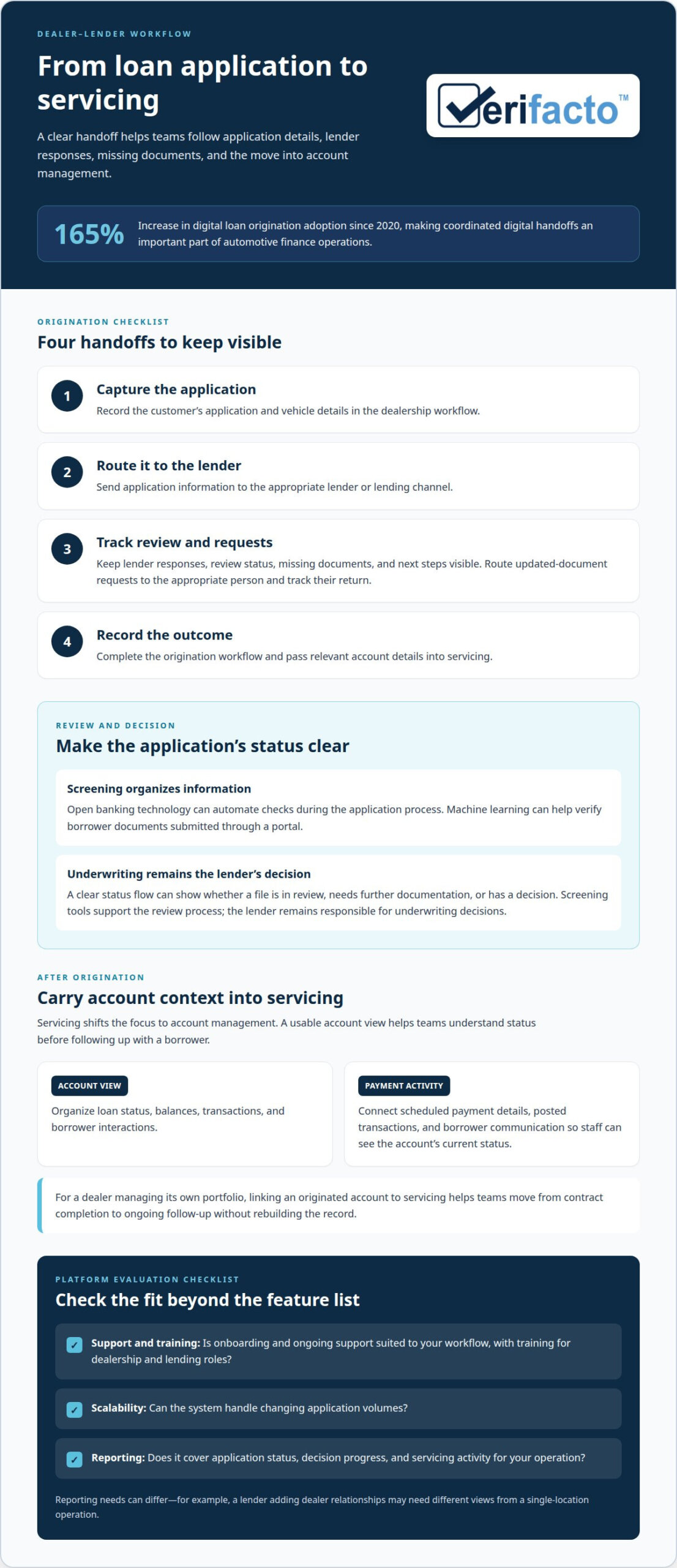
Loan origination connects a dealership’s vehicle sale with a lender’s application, screening, underwriting, and funding workflow. Digital loan origination adoption has increased by 165% since 2020, making coordinated digital handoffs an important part of automotive finance operations.
Collaboration begins when a dealer captures an application and shares the relevant details with one or more lenders. A shared workflow can help teams track submitted information, lender responses, missing documents, and next steps without repeatedly entering the same data. For example, a sales manager can see whether an application is awaiting a credit decision or additional borrower information.
Credit-risk screening organizes the information lenders use to assess an application. Open banking technology can automate checks during the application process, while machine learning can help verify borrower documents submitted through a portal. These tools support the review process, but the lender remains responsible for underwriting decisions.
Underwriting follows screening by evaluating the application against the lender’s criteria. A clear status flow can show whether a file is in review, needs further documentation, or has a decision. When a lender requests an updated document, the dealer can route that request to the appropriate person and track its return, reducing uncertainty around the handoff.
- Capture: Record the customer’s application and vehicle details in the dealership workflow.
- Route: Send application information to the appropriate lender or lending channel.
- Track: Monitor review status, documentation requests, and lender decisions.
- Complete: Record the outcome and pass relevant account details into servicing.
After origination, servicing shifts the focus to account management. Lenders need a usable view of loan status, balances, transactions, and borrower interactions. For a dealer managing its own portfolio, linking an originated account to servicing helps teams move from contract completion to ongoing follow-up without rebuilding the record.
Payment collection also relies on clear account information. A servicing workflow can connect scheduled payment details, posted transactions, and borrower communication, helping staff understand an account’s current status before responding. Built-in payment processing can support this work, while keeping collection activity visible for staff review.
When comparing software, assess customer support, training, scalability, and reporting together. Look for onboarding and ongoing support suited to your workflow, training for dealership and lending roles, capacity to handle changing application volumes, and reports covering application status, decision progress, and servicing activity. A lender adding dealer relationships may need different reporting views from a single-location operation.
What is Automotive finance software?
Automotive finance software organizes workflows across applications, credit decisions, vehicle transactions, and loan contracts. Its value depends on how effectively it connects dealer and lender information.
KYC, Credit Bureau, and Dealer System Integrations
KYC checks help verify an applicant’s identity, while credit bureau connections bring credit information into the lending workflow. Integration with a dealer management system can transfer vehicle and transaction details, reducing duplicate entry across dealership and lender records.
Auto finance software can also use APIs to connect with electronic document tools and third-party verification providers. Compare what information moves between systems, how errors or missing fields appear, and whether teams can trace an application through each handoff.
Useful features for dealerships and lenders include application handling, credit review, contract records, account servicing, payment workflows, and reporting. Evaluate how each feature connects with the dealer’s existing DMS and the lender’s servicing process.
Credit Underwriting and Risk Management
Underwriting workflows organize application details for review, including credit information and supporting documents. A clear record of decision status, missing information, and review activity helps staff see what remains before a lender makes a decision.
Businesses assessing U.S. legal workflows commonly consider TILA, ECOA, FCRA, and GLBA. TILA requires accurate written disclosure of APR, monthly payments, and other loan details. Software should support the documentation and review processes a business uses to meet its obligations.
Risk management also relies on consistent records. For example, a lender can connect application details and underwriting notes to the resulting account record, making the path from initial review to servicing easier to follow.
Vehicle Transactions and Lifecycle Management
Transaction management links a vehicle record to its purchase and financing details. A dealer workflow might connect the selected vehicle, application, contract documents, and transaction status, giving dealership and lending teams a shared reference point.
Vehicle lifecycle and fleet management involve tracking relevant vehicle information over time. Assess whether a system can organize vehicle records, titles, related assets, and transaction history alongside loan or lease information.
Security reviews should consider who can access applicant and vehicle records, how information moves between systems, and how access and retention are managed. These questions help surface privacy and cybersecurity risks across the software workflow.
Auto Finance Contract Management
Contract management organizes finance documents and links them to the relevant customer, vehicle, and account. Useful workflows track document status, store customer records, and make contract information available to authorized teams during servicing.
Implementation time depends on integration scope, data cleanup, workflow configuration, testing, and staff training. Plan these steps around the systems involved, such as a dealer DMS, credit services, and electronic document tools, then train the teams using each workflow.
A strong platform makes contract records useful beyond signing. Connecting contract details to account management helps teams refer to the original transaction when reviewing balances, payments, or customer questions.
Flexible digital retailing and finance journeys
Digital retailing lets customers handle parts of a vehicle purchase online, in-store, or across both channels. According to Cox Automotive, 64% of vehicle shoppers want to move toward an online purchase process the next time they buy a vehicle. For dealers and lenders, that preference makes a connected digital journey a practical consideration, not simply a website feature.
A flexible platform lets customers move between steps without losing progress. A shopper might review vehicle details online, start a finance application on a mobile device, then complete the transaction with dealership staff. Auto lending software can keep application and transaction information organized as customers switch channels. Map each handoff, including what information is captured and who acts next.
Digital retail solutions can also let customers shape a finance package. Borrowers may, for example, select an upfront payment, repayment timeline, and ancillary products, services, or accessories. The platform should present these choices clearly and carry selected details into the relevant transaction steps. That helps align what customers review online with what staff see during an in-person conversation.
Mobile access matters when a customer starts an application away from the dealership or returns to it later. A clear mobile journey shows the next step, such as continuing an application or providing requested information. Dealership teams with access to the same current transaction context can respond without asking customers to repeat earlier steps. The experience should also work for customers who prefer staff assistance.
- Map the journey: Identify online, mobile, and in-store steps, then define each handoff.
- Preserve context: Keep customer selections and application progress connected across channels.
- Support choice: Present upfront payment, repayment pace, and optional package decisions clearly.
- Plan integration: Determine how digital retail connects with dealership and finance workflows.
Integration determines whether the digital journey continues smoothly after an online choice. If vehicle details, application information, or selected terms must be entered again, staff have to reconcile records before proceeding. When comparing auto finance software solutions, examine the full customer path, from vehicle browsing through application, transaction review, and handoff. A walkthrough using a sample journey can expose friction before rollout.
Flexibility does not require every customer to follow the same channel or sequence. A digital process should support both online-first shoppers and buyers who prefer dealer guidance, while giving staff a clear view of the current step. This balance can help dealerships serve different preferences without separating digital retail from everyday finance operations.
APIs and third-party integrations
An API lets two software systems exchange selected information. In auto lending, it can connect an application platform with identity, residence, or income verification providers. A lender can use a third-party provider like SOAWebServices to automate application checks instead of routing each step through separate manual entry.
Integrations shape the borrower’s journey from application through account servicing. An origination workflow can collect applicant details, send them to a verification provider, and return results for review. The lending team sees the information in its working system, while the provider remains responsible for its own service. Clear handoffs help teams identify incomplete data and determine the next action.
Document connections matter too. Modern auto finance software solutions can use APIs to integrate with eSignature and electronic document tools for processing and storing customer documents. For example, a completed contract can move into a document workflow linked to the relevant customer record. Assess how documents are identified, stored, retrieved, and connected to transactions.
- Identity and verification: Identify which applicant fields go to a KYC or identity provider and how results return.
- Credit workflows: Map how application data reaches credit services and how returned information becomes available for review.
- Dealer records: Trace vehicle, customer, and transaction details between the dealer’s DMS and finance systems.
- Documents: Follow a contract from preparation through eSignature and electronic storage.
Each connection needs clear data ownership. If a borrower’s address changes, teams should know which system is authoritative and how the update reaches related records. Test an integration with a sample application that includes a missing field, a corrected value, and a completed document. This reveals how errors appear and who can resolve them.
Integration quality also shapes operational visibility. If a verification result sits outside the lending workflow, staff may need to switch systems to understand an application’s status. Connecting the result to the relevant record helps teams follow borrower progress and maintain a consistent customer experience. Define which status updates each role needs, such as submitted, returned, or awaiting review.
Before implementation, document the purpose of each connection, the data it exchanges, and the team responsible for acting on any returned result. Auto lenders leveraging robust auto finance software solutions can automate identity, residence, and income verifications using third-party providers, with checks handled seamlessly through connected workflows.
Auto finance software vendor directory
A useful vendor comparison starts with the operating model, not a popularity ranking. Dealers need tools connecting vehicle sales with lender handoffs; lenders focus on origination, underwriting, and servicing; buy-here-pay-here businesses need workflows for their own customer accounts and payments.
Dealers should assess whether a management system keeps vehicle, customer, and finance information connected throughout the sales process. A dealership CRM may organize customer interactions, while a DMS supports dealership operations. The key question is whether staff can follow a deal from customer interest through financing without repeatedly entering or reconciling the same details.
Lenders should assess software across the full auto loan lifecycle. Look for application intake, credit review, contract records, account management, payment processing, and borrower communication. A lender servicing a portfolio needs useful account and transaction visibility after origination, not just tools for processing new applications.
Buy-here-pay-here businesses have different needs because the dealership also manages ongoing borrower accounts. Assess BHPH software for how it connects customer records, vehicle details, payment activity, and collections workflows. Teams should be able to understand an account’s current status and act on relevant information without switching between disconnected records.
Across automotive finance, integration and data access shape how smoothly daily work runs. A system may need to exchange information with a DMS, LMS, credit services, payment tools, or document workflows. For businesses coordinating standardized electronic data interchange between diverse enterprise systems, solutions like 123 EDI help streamline these data flows. Evaluate each handoff: what data moves, where staff see it, and how exceptions or incomplete information are handled.
- Workflow fit: Match the software’s core workflows to your role as dealer, lender, or BHPH operator.
- Information visibility: Review how customer, vehicle, loan, balance, and transaction details appear to relevant teams.
- Integration needs: Map connections to existing systems and identify manual steps that remain.
- Reporting usefulness: Assess whether reports help teams track applications, accounts, payments, and operational activity.
- Control and flexibility: Understand how your business accesses its data and adapts workflows as operations change.
Compare vendors using the same workflow, such as moving a customer from application to account servicing. This makes gaps in handoffs, reporting, and operational efficiency easier to spot than a feature checklist alone. It also helps distinguish a specialized origination tool from a broader management system.
To connect your vendor evaluation with dealership and lending workflows, discuss your finance operation and the systems it needs to connect.
Automotive finance CRM software helps organizations manage driver, vehicle, and financial data, giving customer-facing teams secure visibility into driver information. When comparing CRM capabilities with broader dealership or lending workflows, consider which teams need access to each type of information and how it supports customer interactions. Use a representative workflow to check whether relevant details are available to the people handling customer, vehicle, and financing steps. This helps clarify a CRM’s role alongside other systems and keeps the comparison focused on practical workflow fit.
Verifacto: CPI Solutions
Verifacto is an AI-powered operating platform that connects dealership operations with the loan lifecycle. Its CPI Solutions and Insurance Tracking support insurance workflows alongside Verifacto DMS and Verifacto LMS.
Automated Borrower Communication helps teams manage follow-up as part of that broader operation. Consider Verifacto when insurance tracking, loan records, and dealership workflows need to work together with clearer operational visibility.
Contact Verifacto to discuss how its platform fits your operation.
Make Your Next Finance Workflow Decision Count
Before changing systems, decide which operational handoff needs attention first. You might prioritize insurance visibility, connecting dealership records with loan accounts, or managing borrower follow-up more easily. That priority gives your team a practical basis for assessing how auto finance software solutions fit your business.
Verifacto offers Verifacto DMS, Verifacto LMS, and Insurance Tracking as part of its connected platform. Together, these products help teams manage dealership and loan workflows with relevant account information accessible across the operation. The best starting point depends on where disconnected processes create the most friction for staff and customers.
Use that workflow as the focus for a conversation: identify the people involved, the information they need, and the step that should become easier to manage. Contact Verifacto about your auto finance operation and explore a practical next step for your business.
Frequently Asked Questions
What are the best auto finance software solutions in the United States?
The right fit depends on whether your business primarily manages dealership operations, lender portfolios, or both. Compare how each platform handles daily work, reporting, payment activity, and data ownership. For businesses seeking connected dealer and loan management, Verifacto offers Verifacto DMS and Verifacto LMS alongside Insurance Tracking. Start by identifying the operational handoff that takes the most staff attention, then assess platforms against it.
Which auto finance software integrates with dealer management systems, CRM, accounting, and credit bureaus?
Integration coverage varies by platform, so assess each connection separately rather than assuming one product supports every system. Verifacto supports accounting integration with QuickBooks and other accounting tools. For CRM, DMS, and credit bureau workflows, map the information your team needs to exchange, then evaluate how each system handles that flow. This helps distinguish direct integration from a process that still relies on manual transfer.
What are the leading loan origination and servicing software options for auto lenders?
Effective options combine loan origination tools with practical account servicing after contracts are established. Verifacto LMS supports loan lifecycle management, collection management, payment processing, and borrower communication. Lenders can test a scenario such as updating an account after a borrower payment, then see how staff locate the record and review relevant activity. This shows whether the software supports ongoing servicing responsibilities.
How does auto finance software automate credit applications, underwriting, approvals, and funding?
Auto finance software can route application information, organize documents, and support review workflows while lender staff retain control over credit decisions. For example, a system may capture an application, flag missing information for follow-up, and make submitted documents available to underwriting. Approval and funding remain subject to the lender’s process and decisions. Assess how the platform records status changes and communicates the next required action to the right team.