
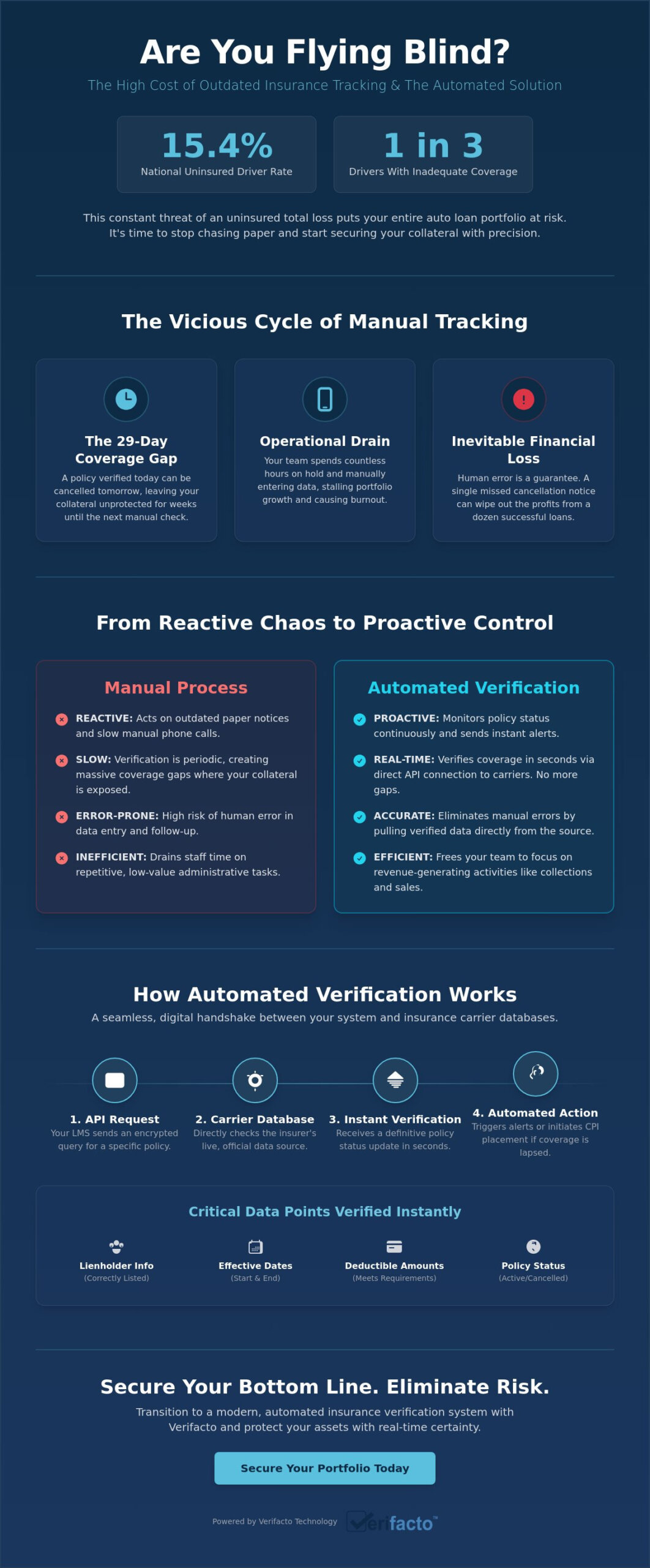
One in three drivers on the road is currently flying blind without enough insurance coverage to protect your assets. With the national uninsured rate hitting 15.4 percent, the risk of an uninsured total loss hitting your portfolio is a constant threat to your bottom line. You’ve likely felt the frustration of endless manual phone calls to agents and the sting of policies that lapse just days after a borrower leaves the lot. Implementing automated vehicle insurance verification is the only way to stop chasing paper and start securing your collateral with precision.
This guide explores how real-time tracking transforms your risk management from a manual chore into a high-speed defensive system. You’ll discover how to eliminate tracking errors, receive instant alerts when coverage changes, and protect your investments without the administrative headache. We’ll break down the shift toward modern API automation and show you how to transition lapsed accounts to CPI solutions seamlessly. By the end, you’ll have a clear roadmap to ensure your portfolio remains stable, compliant, and fully protected against the unpredictable realities of the road.
Key Takeaways
- Pinpoint the hidden labor costs of manual tracking and learn how to reclaim your team’s productivity for high-value tasks.
- Understand the mechanics of API-driven tracking and how direct connections to carrier databases eliminate the need for borrower-provided documents.
- Master the implementation of automated vehicle insurance verification to detect policy cancellations in real-time before they turn into financial losses.
- Examine the advantages of a “closed-loop” risk strategy that links verification directly to collateral protection insurance (CPI) placement.
- Discover how integrating insurance data into your DMS or LMS creates a single source of truth for your entire automotive portfolio.
The High Cost of Manual Insurance Tracking in Auto Finance
Manual insurance tracking is a slow-motion disaster for your balance sheet. While most lenders believe a monthly check is enough, the reality is that a policy can be cancelled 24 hours after you verify it, leaving your collateral unprotected for 29 days. This “coverage gap” isn’t just a theoretical risk; it’s a mathematical certainty in high-volume portfolios. Relying on paper notices and manual phone calls creates a lag that exposes your assets to total losses with zero chance of recovery. When you lack real-time data, you’re essentially flying blind for most of the month.
Your team likely spends hours every week on hold with insurance carriers. This labor drain is expensive and inefficient. Even when your staff reaches an agent, the data they receive is only as good as the moment the call ends. Human error is inevitable when people are tasked with managing thousands of expiring policies. A single missed cancellation notice can wipe out the profit from a dozen successful loans. To mitigate this, many states have moved toward systems like the Insurance Information and Enforcement System (IIES) to help track compliance, but lenders need more direct control. Transitioning to automated vehicle insurance verification replaces this guesswork with real-time certainty.
The Financial Vulnerability of BHPH and Subprime Lenders
High-risk portfolios demand a higher frequency of verification. In the Buy Here Pay Here (BHPH) and subprime space, there is a direct correlation between payment delinquency and insurance lapses. When a borrower struggles to make a car payment, the insurance premium is often the first expense they cut. A single unrecovered total loss doesn’t just hurt; it can erase months of portfolio growth. Without automated vehicle insurance verification, you’re gambling that every borrower will prioritize their policy as much as you do. You need a system that alerts you the moment a policy status changes, not weeks after the fact.
Operational Friction and Team Burnout
Manual tracking is a repetitive task that often leads to high employee turnover. When your best people spend their day entering data into auto loan management software instead of managing accounts, your growth stalls. This operational bottleneck prevents you from scaling your portfolio effectively. By automating the verification process, you empower your staff to move from being “trackers” to becoming “closers” and “collectors.” This shift improves morale and ensures your team focuses on revenue-generating activities rather than administrative busywork. Modernizing your workflow doesn’t just protect your cars; it protects your culture and your bottom line.
How Automated Vehicle Insurance Verification Works
Modern collateral protection relies on speed and accuracy, moving far beyond the era of paper documents and manual callbacks. At its core, automated vehicle insurance verification is a digital handshake between your lending platform and the insurance carrier’s database. Instead of waiting for a physical notice to arrive in the mail, the system sends an encrypted query through an API to confirm the current status of a policy. This process happens in seconds, providing a definitive answer on whether your collateral is protected.
By leveraging direct Application Programming Interface (API) connections, modern platforms bypass the need for human intervention. These systems often align with AAMVA insurance verification standards, which provide the framework for secure, real-time data exchange between private insurers and administrative bodies. When a lender initiates a check, the system verifies several critical data points simultaneously:
- Policy Status: Confirms if the policy is active, cancelled, or pending.
- Effective Dates: Validates the start and end dates of the current coverage term.
- Deductible Amounts: Ensures the borrower’s deductibles meet your loan requirements.
- Lienholder Information: Confirms your institution is correctly listed as the loss payee.
This isn’t just data for the sake of data. It’s a “closed-loop” system where verification triggers automated next steps. If a lapse is detected, the system doesn’t just flag it; it can immediately launch a borrower communication sequence or alert your team to initiate a CPI placement. Lenders who want to stop reacting to losses and start preventing them often find that modernizing their insurance tracking is the most effective way to secure their portfolio.
Real-Time Data vs. Stale Databases
A physical insurance card is a snapshot of the past. It proves coverage existed at the moment it was printed, but it tells you nothing about the policy’s status today. Nightly batch updates are an improvement, but they still leave a window of vulnerability. Instant API-based verification ensures your dealer management systems are receiving the most current data available. This real-time visibility eliminates the “coverage gap” that manual tracking creates, ensuring you never find out about a cancellation after an accident has already occurred.
The Role of AI and Machine Learning in Verification
AI and machine learning add a layer of predictive intelligence to the verification process. These tools identify patterns in policy cancellations, helping you predict which borrowers are most likely to let their coverage lapse based on historical data. Machine learning also streamlines automated document processing, reading endorsements and physical policy updates with high accuracy. This reduces “false positives” in lapse alerts, ensuring your team only spends time on accounts that truly require intervention.
Manual vs. Automated vs. CPI: Choosing the Right Strategy
Lenders often struggle to balance the cost of tracking against the cost of an uninsured loss. In-house manual tracking appears cheap on a balance sheet because it doesn’t require a monthly software subscription. However, the hidden labor costs and the massive financial exposure of a missed cancellation make it the most expensive option in the long run. Outsourced services offer a middle ground, but they often operate on a delay, leaving you vulnerable during the critical 48-hour window after a policy lapse. You need a strategy that closes the gap between detection and action.
The gold standard for modern portfolios is a system that utilizes automated vehicle insurance verification. This technology doesn’t just track; it integrates. By connecting directly to carrier data, it removes the friction of third-party delays and manual data entry errors. Many states are currently adopting model legislation for online verification to streamline their own enforcement. Lenders who follow suit gain the same level of precision, ensuring that their collateral is never a question mark on the ledger.
When to Move Beyond Manual Tracking
There is a tipping point in every lending operation, typically around the “100 Loan Threshold,” where manual tracking starts to crumble. When you manage fewer than 100 loans, a dedicated employee might keep up with phone calls and mail. Once you cross that line, the volume of expiration dates and mid-cycle cancellations becomes too dense for human oversight. You should assess your current uninsured loss rate. If a single unrecovered loss costs you more than a year of automation, the investment justifies itself immediately. Don’t wait for a catastrophic hit to your portfolio to acknowledge that your “free” manual method is actually a liability.
Integrating CPI with Your Verification Workflow
Automation is the diagnostic tool, but collateral protection insurance (CPI) is the cure. When automated vehicle insurance verification detects a lapse, it should act as a trigger for a seamless transition to lender-placed coverage. This closed-loop approach ensures there is never a moment where the asset is unprotected. Maintaining strict auto finance compliance management is essential during this process. A unified system ensures that all borrower notifications are sent on time and that the placement of CPI follows all state and federal regulations, protecting you from both physical loss and legal liability.
Implementing Automated Verification: A Lender’s Checklist
Transitioning from a manual process to a modern digital workflow requires more than just a software subscription. It demands a strategic shift in how your team handles risk. To successfully launch automated vehicle insurance verification, you must first understand the current state of your portfolio. Start by auditing your existing accounts to identify where coverage gaps already exist. This baseline allows you to measure the immediate impact of automation as you begin to close those windows of exposure.
Once you’ve assessed your risk, follow this implementation roadmap to ensure 100 percent collateral coverage:
- Select an Integrated Platform: Choose a DMS or LMS that features native insurance tracking. Stand-alone tools often create data silos that require double entry, defeating the purpose of automation.
- Define Communication Triggers: Establish specific rules for when a borrower receives a text or email. For example, an alert should trigger the moment a policy status changes to “pending cancellation.”
- Configure CPI Placement: Set clear “point of no return” dates. If a borrower doesn’t provide updated coverage within a set window, the system should automatically prepare the account for CPI placement.
- Refocus Your Team: Train your staff to stop chasing routine renewals and start managing “exceptions.” Automation handles 95 percent of the work, leaving your team to focus on the high-risk accounts that require a personal touch.
Lenders who want to see these results in action can schedule a demo of Verifacto’s integrated solutions to see how a unified system simplifies the entire verification lifecycle.
Selecting the Right Technology Partner
The biggest mistake lenders make is choosing “stand-alone” tracking tools. These systems don’t talk to your ledger, which means your team still spends time jumping between windows to update account statuses. A cloud-based platform ensures that your data is accessible to multi-location teams in real-time. Before committing, verify the tool’s carrier connectivity. It must be able to query the specific regional and national carriers your borrowers actually use, or you’ll be left with data gaps that lead to unrecovered losses.
Setting Up Automated Borrower Communication
Effective communication is about timing and friction. Your text and email templates should be professional, assertive, and helpful. Instead of just telling a borrower their insurance is lapsed, provide a link to a secure portal where they can upload their new policy information instantly. Send the first alert immediately upon detection of a lapse, followed by a final warning 48 hours before CPI placement. This proactive approach encourages renewals and reduces the number of accounts that ever require force-placed insurance.
Verifacto: The Future of Automated Insurance Management
Verifacto DMS and LMS platforms transform your operational chaos into a streamlined, high-performance environment. Instead of toggling between disparate systems, you gain a unified “single pane of glass” that monitors every facet of your portfolio in one place. This visibility is critical when managing automated vehicle insurance verification across hundreds or thousands of active loans. By centralizing your data, you identify potential lapses before they evolve into unrecovered total losses. You no longer have to guess which vehicles are unprotected; the system tells you exactly where your risk lies the moment a change occurs.
Our technology integrates insurance tracking directly into your daily workflow. When a policy status changes, the system responds instantly. This proactive stance allows you to deploy collection efficiency strategies that keep borrowers accountable and collateral protected. You aren’t just watching your assets; you’re actively securing them through a closed-loop system that links verification, communication, and CPI placement. This eliminates the friction of manual tracking and ensures your team stays focused on closing deals and collecting payments rather than chasing paper notices.
The Verifacto Advantage: Integrated Security
True portfolio security comes from having your payment processing, loan management, and insurance tracking in one ecosystem. This integration eliminates the data silos that lead to missed alerts and costly charge-offs. Verifacto offers a no-nonsense professional platform designed for the high-stakes reality of auto finance. You receive proactive risk alerts that allow you to take action while there’s still time to protect the asset. It’s about maintaining mastery over complex operational hurdles and ensuring that your risk management strategy is as modern as the technology you use to run your business.
Ready to Secure Your Portfolio?
Moving away from outdated manual systems is simpler than you think. Verifacto’s cloud-based platform is built for rapid transition, allowing you to modernize your operations without disrupting your daily business. Lenders who switch to automated vehicle insurance verification workflows consistently report a significant reduction in uninsured losses and a dramatic decrease in administrative overhead. You can finally stop the cycle of chasing paper and start growing your business with confidence. Take control of your risk management today. Schedule a demo with Verifacto today to see how real-time verification secures your future and stabilizes your portfolio.
Take Command of Your Collateral Security
Manual tracking is a liability you can’t afford in a high-stakes market. By adopting automated vehicle insurance verification, you move from a reactive posture to a position of total control. You’ve learned that integrating these tools into your existing workflow doesn’t just save time; it fundamentally protects your capital from the unpredictable nature of borrower behavior. Relying on real-time data ensures that you never discover a lapse after an accident has already occurred.
You don’t have to navigate these operational hurdles alone. Verifacto offers a sophisticated, cloud-based LMS/DMS integration that brings your insurance tracking and CPI solutions into one powerful dashboard. Our automated borrower communication tools ensure your team stays focused on growth while your collateral remains secure. Secure your collateral with Verifacto’s automated insurance tracking and build a more resilient lending operation today. You have the roadmap; now it’s time to take the first step toward a more secure and profitable future.
Frequently Asked Questions
How does automated insurance verification differ from manual tracking?
Automated systems use direct API connections to carrier databases, whereas manual tracking relies on physical mail and phone calls. This technology removes the lag time that creates “coverage gaps,” allowing you to see policy changes the moment they happen. While manual methods are reactive, automated vehicle insurance verification is proactive, catching lapses before they lead to financial losses. It replaces guesswork with real-time certainty.
Will automated verification integrate with my existing DMS?
Yes, modern solutions are designed to sync directly with your workflow. Verifacto DMS and LMS platforms feature built-in insurance tracking to provide a unified source of truth for your portfolio. This integration eliminates the need for double data entry and ensures that your loan ledger always reflects the most current insurance status. It turns your software into an active risk management tool rather than a passive database.
How often does the system check for insurance lapses?
The system performs checks in real-time through direct API queries rather than waiting for nightly batch updates. This constant monitoring ensures that you receive an alert as soon as a policy status changes to “pending cancellation” or “lapsed.” By maintaining this continuous loop of verification, you eliminate the 30-day window of vulnerability common in traditional manual tracking processes and keep your collateral secure 24/7.
What happens if a borrower’s insurance policy is canceled?
The system immediately triggers an automated alert to your team and can launch a communication sequence to the borrower. Using Automated Borrower Communication tools, the platform sends text or email notifications to prompt an immediate renewal. If the borrower fails to provide proof of coverage within your specified timeframe, the system streamlines the transition to a CPI solution to keep the collateral protected without manual intervention.
Is automated insurance verification compliant with lending regulations?
Yes, these systems are built to align with modern financial and state-level regulations. By using standardized data exchange protocols, automated vehicle insurance verification ensures that your tracking and notification processes are consistent and fully documented. This digital paper trail is essential for maintaining compliance during audits and when placing force-placed insurance, protecting your institution from both physical loss and legal risks.
Can I use automated verification to place CPI (Collateral Protection Insurance)?
Absolutely. The verification process acts as the primary trigger for your CPI Solutions. When the system confirms a lapse that isn’t resolved through borrower communication, it provides the verified data needed to place coverage immediately. This seamless integration ensures that there is no gap in protection, maintaining the value of your collateral throughout the entire life of the loan regardless of borrower actions.
How much time can my team save by automating insurance checks?
Automation typically eliminates up to 95 percent of the manual tasks associated with insurance tracking. Your team no longer needs to spend hours on hold with carriers or manually entering policy dates into a spreadsheet. By shifting the focus from routine tracking to managing exceptions, your staff can dedicate more time to high-value activities like collections and portfolio growth, significantly improving your operational efficiency.
Does the system track all major insurance carriers in the US?
Yes, modern verification platforms connect to thousands of insurance providers across the country, including all major national and most regional carriers. This broad connectivity ensures that regardless of who your borrower chooses for coverage, you have a direct line to verify their policy status. It provides comprehensive coverage for your entire portfolio, leaving no asset unmonitored or unprotected by a lack of carrier data.