
An insurance lapse can turn a routine account update into a coverage and payment issue for an auto finance operation. Dealership teams need clear visibility into policy status and borrower communication across active loans. Mortgage loans covered by Regulation X have specific notice timelines: a servicer must send an initial notice at least 45 days before assessing a force-placed insurance charge, according to the Consumer Financial Protection Bureau. If the servicer receives no insurance information, it must send a reminder at least 30 days after the initial notice and at least 15 days before charging.
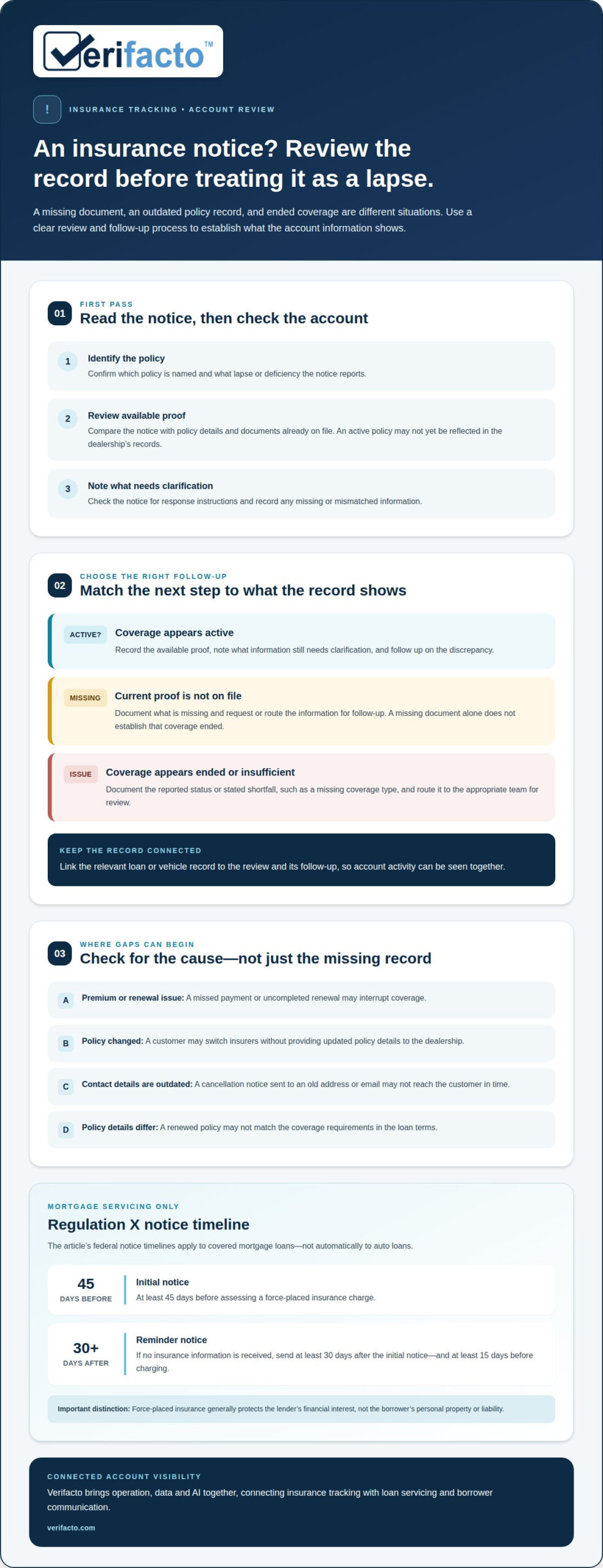
Force-placed insurance is coverage a lender or servicer obtains when required insurance lapses, isn’t renewed, or is considered insufficient. It generally protects the lender’s financial interest, not the borrower’s personal property or liability. For auto finance teams, tracking insurance information and related communications can help keep account records visible; mortgage notice requirements do not automatically apply to auto loans.
Dealerships operate one business but are often forced to manage it through disconnected systems. Verifacto brings the operation, data and AI together in one platform, helping teams connect insurance tracking with loan servicing and borrower communication. This article explains force-placed insurance, why coverage lapses, how lender and borrower responsibilities differ, and what mortgage notices must say and when they must arrive. The mortgage timelines described here apply to mortgage servicing, not automatically to auto loans.
Key Takeaways
- Review how missed payments, renewal issues, or outdated policy records can create a coverage gap and affect a loan account.
- Track coverage requirements, insurance status, and follow-up responsibilities across dealership operations.
- Use an insurance notice to identify the issue, determine what information is needed, and document follow-up.
- Connect coverage tracking with customer communication and loan account records to support account review.
- Explore how Verifacto Insurance Tracking, alongside its broader DMS and LMS platform, can support clearer visibility into insurance status.
When Insurance Records Show a Gap, Dealerships Face an Operational Risk
An insurance lapse or missing document can leave a dealership unsure whether a vehicle’s required coverage is current. When a notice or record shows a possible gap, staff can review the policy details, document the discrepancy, and route unresolved issues to the appropriate team member. If the policy appears active, record the available proof and follow up to clarify what information is still needed.
Dealership and Lender Responsibilities
Dealership staff can monitor insurance records and compare them with the information on file, while lenders or servicers may also track whether their records show coverage. A policy can be active but still appear insufficient if updated proof has not been received or recorded. Prompt communication helps clarify whether coverage ended or the records need correction.
For example, a customer might renew a policy while the dealership’s file still shows an earlier expiration date. Staff can review the available documents, note the discrepancy, and route the record for follow-up. If the policy appears to have lapsed, document the status and direct the issue to the appropriate team for review. A lender or servicer may obtain force-placed coverage if required insurance remains absent.
Flood insurance has a separate federal framework. The 12 CFR 22 reference concerns flood-related mortgage processes, including lender notices during an NFIP lapse; it should not be assumed to set requirements for auto loans. Dealership staff can distinguish a flood-related reference from other insurance records and route questions about unresolved coverage issues to the appropriate contact.
Steps After an Insurance Notice
An insurance notice identifies a reported problem and gives dealership staff a reason to review the record. Acting promptly can help clarify the issue and reduce the chance that a discrepancy remains unresolved. Start by identifying the policy named in the notice, the stated lapse or deficiency, and any response instructions.
Review the available information to determine whether the policy ended, was not renewed, or remains active with different details. If coverage appears active, record the proof on file and note any information that needs clarification. If the policy appears to have ended, document the reported status and route the issue to the appropriate team. Keep the relevant loan or vehicle record connected to the follow-up.
For instance, if a notice says a renewal has not been recorded, staff can review the file for current proof and document what is missing. If the notice identifies insufficient coverage, record the stated shortfall, such as a missing coverage type, and route it for review. Clear records and a direct follow-up help the dealership determine whether its information needs updating or the insurance issue remains unresolved.
How Insurance Tracking Gaps Affect Dealership Operations
An insurance tracking gap can start with a missed premium, an uncompleted renewal, or a policy change. For example, an insurer may cancel a customer’s auto policy after a payment fails, while the dealership’s loan file still shows active coverage. A customer may also switch insurers but not provide updated policy details. The new policy exists, but the dealership’s records still show a gap.
Payment problems can also affect the dealership’s workflow. A changed bank account or expired card can interrupt an automatic premium payment. If the insurer sends a cancellation notice to an old address or email, the customer may not learn about the issue before coverage ends. Keeping contact details current and tracking policy status can help dealership teams follow up on potential gaps.
A renewal does not always resolve an insurance tracking issue. A new policy could differ from the requirements in the loan terms, or its limits may not meet those terms. For example, a customer might renew coverage while a required protection is excluded. The insurer’s renewal document may show an active policy, but the dealership may still need to review the available details against its records.
Documentation gaps can create the same operational problem without an actual lapse. A customer may change insurers without sending updated policy details to the dealership. The dealership’s records then show the former policy ending, while the replacement policy is missing from the loan file. A notice may follow because the team cannot match current evidence to the account, even when the customer believes coverage is in place.
When a dealership identifies a gap or an issue with recorded coverage, the team needs a clear workflow to review the account, request information, and document follow-up. The customer may be responsible for addressing a premium or policy issue under the loan terms. Keeping insurance tracking connected to the loan file helps teams see the status and related activity without treating a missing document as proof that coverage has ended.
These situations call for different responses. A missed payment may require the customer to resolve the premium issue with the insurer; a missing document may require the team to request current proof. If the recorded policy differs from the loan terms, the team needs to review the coverage details rather than simply resend the same paperwork. Verifacto’s connected auto finance software can help dealership teams link insurance tracking, customer communication, and loan records, providing greater visibility into follow-up and account status.
What Happens After a Borrower Receives an Insurance Notice?
Force-placed insurance is coverage a mortgage servicer obtains when required insurance lapses or appears insufficient. If a borrower doesn’t respond, the servicer may proceed after required notices; to dispute an error, send current policy evidence and ask the servicer to review its records and charge.
Notice and Time to Restore Coverage
Regulation X sets notice intervals before mortgage servicers charge for force-placed coverage. According to the Consumer Financial Protection Bureau, the initial notice must arrive at least 45 days before a related charge. If no insurance information is received, a reminder must follow at least 30 days after the initial notice and at least 15 days before charging.
A renewal notice also matters: according to the Consumer Financial Protection Bureau, a servicer must send it at least 45 days before assessing a renewal or replacement charge. For updating a notice with new insurance information, a reasonable time means no more than five days, excluding legal holidays, Saturdays, and Sundays. Send proof promptly so the servicer can assess whether coverage is continuous.
Borrowers should identify the policy or hazard named in the notice, then contact the insurer if the policy status is unclear. Submit documents showing the insurer, policy details, and effective dates. If compliant coverage is already active, the Consumer Financial Protection Bureau says the servicer must cancel force-placed insurance within 15 days after receiving evidence. These mortgage timelines should not be assumed to govern auto loans.
Consequences of Not Responding
When required mortgage coverage remains unverified, the servicer may obtain lender-placed insurance and assess a related charge after required notice periods. The policy generally protects the lender’s financial interest in the collateral, rather than providing the borrower’s full homeowners protection. A charge can therefore affect the mortgage account without replacing personal property or liability coverage.
Flood insurance has a distinct rule: according to the National Credit Union Administration, a credit union must force-place required flood insurance if the borrower hasn’t obtained coverage within 45 days after notification. The Flood Disaster Protection Act of 1973 also excludes certain hazard insurance from the Regulation X force-placed insurance definition. This distinction matters when a notice concerns flood coverage.
An incorrect notice may reflect a missing renewal document, a policy number mismatch, or a delay in information reaching the servicer. Send the insurer’s current declarations page or other proof, identify the disputed period, and ask the servicer to review its records and any related charge. Automated administration can help organize expiration dates, notices, and received documents, while staff review mismatches before a coverage decision or charge proceeds.
A Practical Workflow for Tracking Insurance
An insurance record can become outdated while a vehicle loan remains active. A dealership workflow should make coverage status, received documents, and borrower communication visible together. This helps staff distinguish an apparent documentation gap from a reported lapse before deciding what needs attention.
Consider a borrower whose policy renewal date has passed, but the dealership has not received updated proof. The account should be flagged for review, not automatically treated as proof that coverage ended. Staff can compare the loan record with the insurance information on file, note the missing renewal document, and contact the borrower with a clear request for current policy evidence.
A practical sequence can keep that review organized:
- Identify the account. Match the insurance record to the correct borrower and loan before sending a message.
- Record the issue. Note whether the file shows an expired policy, missing renewal evidence, or a possible coverage mismatch.
- Communicate clearly. Tell the borrower what information appears to be missing and how to provide updated proof.
- Review what arrives. Record the received documents and update the account status based on staff review.
- Escalate unresolved gaps. Route accounts that still appear to lack required coverage for the dealership’s next review.
For example, a borrower might reply that the policy renewed with a different insurer. The dealership can associate the new document with the account, record its effective dates, and review whether it addresses the original flag. If the response instead shows that the policy was canceled, staff can document that status and follow the appropriate account process. The workflow should distinguish an actual insurance issue from a record that simply needs updating.
Communication should be specific and factual. A message can identify the loan account, explain that current insurance evidence is needed, and state how the borrower can submit it. Avoid implying that a mortgage notice timeline applies to an auto loan. Mortgage servicing rules and auto finance processes are not interchangeable, so dealership teams should follow the terms and procedures applicable to their accounts.
Insurance Tracking and Automated Borrower Communication can support a more consistent process by connecting coverage records with borrower follow-up. The value is operational visibility: staff can see which accounts need review, which messages have been sent, and where documents are awaiting review. Human judgment remains important, especially when records conflict or the submitted policy raises questions.
To explore how Verifacto can support insurance tracking workflows, contact the team about your dealership’s process.
Verifacto: Insurance Tracking
Verifacto connects Insurance Tracking with loan records to help dealerships manage coverage follow-up in context. When insurance information is missing or appears outdated, teams need to see the account, record the issue, and coordinate borrower communication without treating an incomplete file as proof that coverage has ended.
Verifacto LMS and Verifacto DMS provide operational context for this process. Insurance status can be considered alongside the borrower and loan account, helping staff identify which record needs attention. Insurance Tracking supports visibility into coverage information, while Automated Borrower Communication supports consistent follow-up with borrowers. Staff remain responsible for reviewing the information and deciding how to handle discrepancies.
Consider a dealership that has not received a borrower’s updated policy after renewal. Staff can use the account context to identify the missing information, communicate what documentation is needed, and review the evidence received. If the borrower provides an updated policy, the dealership can associate it with the account and update its records. If questions remain, the team can route the account for further review instead of treating an incomplete record as a confirmed lapse.
A connected workflow can help teams keep key account actions visible:
- Review the account: Locate the relevant loan and available insurance information.
- Document the issue: Record whether the concern is missing evidence or a reported coverage problem.
- Contact the borrower: Communicate the information needed to clarify the account.
- Review the response: Associate received documentation with the relevant account for staff review.
- Track follow-up: Keep unresolved questions visible for the next appropriate action.
This structure can reduce fragmented work across loan records and separate communication processes. It also provides greater visibility into follow-up, received documents, and accounts still needing review. That visibility supports more organized operations, but it does not replace staff judgment or determine whether a borrower’s policy satisfies contractual requirements.
Dealerships operate one business but are often forced to manage it through disconnected systems. Verifacto brings operations, data, and AI together in one platform, connecting the customer and loan lifecycle. For teams evaluating their insurance workflow, the practical question is whether coverage information and borrower follow-up can be managed with clearer account context and less manual coordination.
If your dealership is assessing how to organize insurance tracking and borrower communication, contact Verifacto to discuss your workflow.
Build a More Visible Insurance Workflow
For auto finance teams, a borrower notification for insurance lapse can prompt a broader review of how account information moves through the operation. A useful next step is to define who reviews uncertain records, how follow-up is assigned, and where unresolved questions remain visible. Clear ownership can help teams address gaps consistently while keeping decisions grounded in human review.
As your dealership evaluates its process, consider where handoffs create delays and what information managers need to oversee open accounts. A workflow that makes responsibilities and outstanding actions easier to see can support more deliberate operational decisions. The right approach should fit how your team manages its customer and loan lifecycle, rather than add another disconnected task.
A focused conversation can help you explore possible next steps for your dealership’s workflow. Discuss your dealership’s needs with Verifacto and consider how a more connected operation could support your team. Your next improvement can start with a clear view of the process you want to strengthen.
Frequently Asked Questions
What is a borrower notification for an insurance lapse?
It is a lender or servicer communication that flags a possible gap in the insurance record and tells the borrower what response is needed. It differs from an insurer’s notice of intent to cancel, which warns that the insurer may end the policy. For example, a lender’s notice may arrive because renewal evidence is missing, even while the borrower believes the policy remains active.
When must a lender notify a borrower that homeowners insurance has lapsed?
A lender or servicer must notify the borrower after determining that required coverage is absent or insufficient, following the timeline that applies to the loan and coverage type. A courtesy reminder sent before a policy expires does not replace the required notice after an actual lapse or deficiency is identified. This distinction matters if the borrower receives a pre-expiration message but coverage later ends.
What federal or state laws govern insurance lapse notices to mortgage borrowers?
Federal mortgage-servicing requirements include Regulation X, which implements the Real Estate Settlement Procedures Act. Flood insurance also has a distinct federal framework under the Flood Disaster Protection Act and related rules. State requirements may also affect insurance and charges. The applicable framework depends on whether the notice concerns hazard coverage, flood coverage, or another policy issue tied to the mortgage.
What information must an insurance lapse notice include?
A notice should make the reported issue and the borrower’s response options understandable. It should identify the property or coverage concern, explain how to submit evidence of an existing policy, and describe potential force-placement and the related charge. If the notice arrives by mail, force-placement notices must use mail no lower than first-class. Keep the notice with the policy documents and any proof submitted in response.
Can a mortgage lender buy force-placed insurance after a policy lapse, and what does it cost?
A lender may obtain force-placed insurance when required coverage is missing, subject to applicable requirements and the loan terms. The premium depends on the property and coverage involved, so there is no single amount that applies to every borrower. Under § 1024.37(c)(1)(i) through (iii), charges may be assessed retroactively to the first day of an uninsured period when the specified conditions are met.