
When a contract is complete but your team still has to search separate systems for funding status, servicing details, or the next customer interaction, the handoff is not giving managers a clear view of the account. Disconnected records can lead to repeated data entry and manual follow-up. Choosing auto loan portfolio management software means looking beyond contract steps to how information supports the rest of the loan lifecycle.
Dealerships operate one business but are often forced to manage it through disconnected systems. A digital contracting workflow can help move a transaction forward, but its value depends on whether your team can connect that activity with applications, approvals, funding, and servicing. Evaluate the handoffs, visibility, and workflow ownership rather than relying on broad software promises.
This article explains where digital contracting fits, how to compare standalone tools with connected-system approaches, and how to map a practical workflow while keeping people involved in decisions. It also covers how Verifacto’s AI-powered operating platform connects DMS and LMS workflows with CRM, origination, payments, collections, insurance tracking, and reporting to provide greater visibility across dealership and lending operations.
Key Takeaways
- Map contract-stage handoffs to see where information becomes difficult to track across the loan lifecycle.
- Distinguish digital records, workflow automation, electronic signatures, and loan servicing before comparing solutions.
- Compare standalone tools and connected platforms by workflow scope, data handoffs, status visibility, reporting, and data control.
- Evaluate auto loan portfolio management software as part of a lifecycle review, not just as a way to manage contract steps.
- Define workflow owners, exception paths, and visibility needs before choosing an approach, while keeping people involved in decisions.
Why Digital Contracting Matters to Auto Loan Portfolio Management
A contract may be marked complete in one workflow while the loan record still shows an earlier status in another. Staff then have to check multiple systems to confirm whether a file is ready for funding or has moved into servicing. Digital contracting is the technology-supported handling of contract-stage information and the handoffs around it. Its value depends not only on how documents are handled, but also on whether teams can see what happens next.
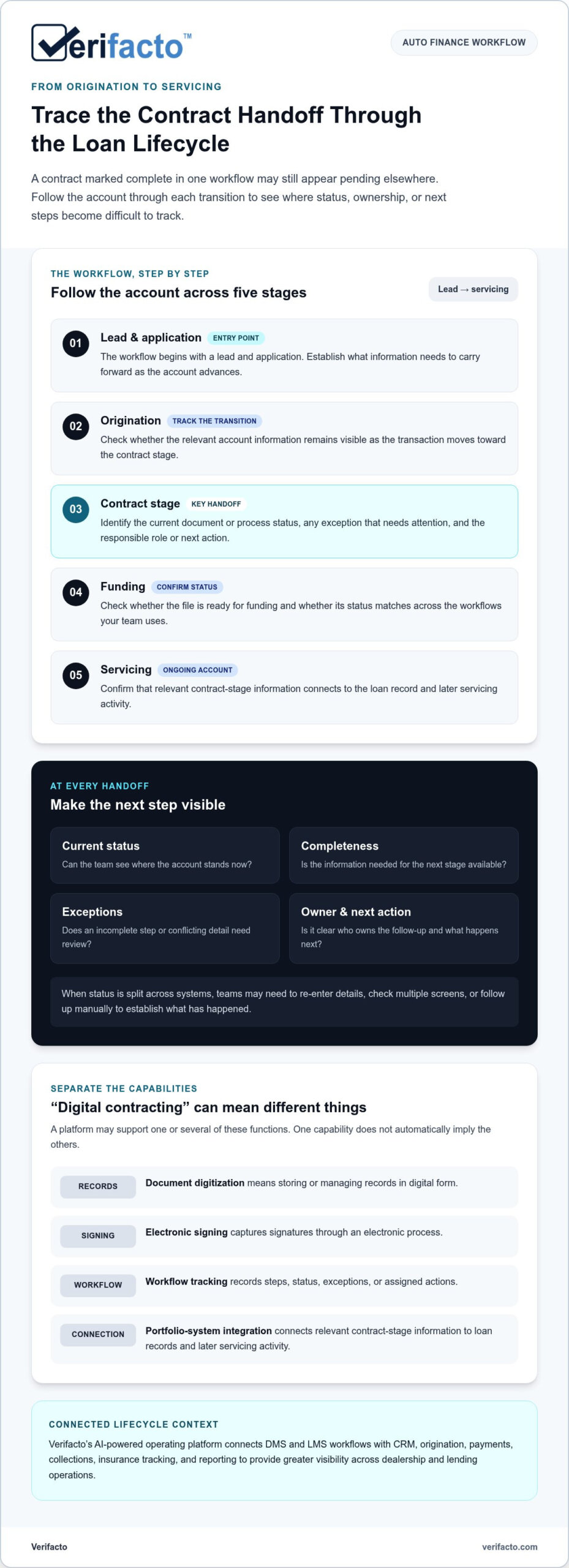
Four functions are easy to confuse. Document digitization means storing or managing records in digital form. Electronic signing captures signatures through an electronic process. Workflow tracking records steps, status, exceptions, or assigned actions. Portfolio-system integration connects relevant contract-stage information to loan records and later servicing activity. A platform may support one or several of these functions, so a digital document does not automatically mean end-to-end integration or contract execution.
Car finance can involve direct or indirect lending, and the parties and handoffs may vary by transaction. A Car finance overview provides useful background on these arrangements. For portfolio operations, focus on how the dealership or lender tracks a specific account as it moves from origination into funding and servicing.
Where contract activity sits in the auto finance lifecycle
A typical workflow starts with a lead and application, continues through origination and the contract stage, then moves to funding and servicing. At each transition, the team needs to know whether information is complete, whether an exception needs attention, and who owns the next action. If those details arrive late or live only in a separate tool, the loan record may not reflect the current operational state.
Contract execution capabilities vary by software platform. Some tools focus on document handling or signatures; others also track workflow status or connect information to broader loan records. Assess the scope directly: a digital document alone does not show whether funding has progressed or servicing has begun.
The cost of disconnected contract workflows
When systems do not share clear status information, teams may re-enter details, check multiple screens, or follow up manually to establish what has happened. These steps add process friction and can slow coordination, especially when a contract exception changes the expected next action. The issue to solve is the design of the handoff, not the effort of the people managing it.
Contract-stage visibility matters after origination because it helps teams connect the signed-file process to funding, servicing, and the loan’s ongoing portfolio record. When evaluating auto loan portfolio management software, assess how status and ownership carry forward, not just whether documents can be handled digitally.
What Digital Contracting for Auto Finance Should Cover
Evaluate the workflow in parts instead of treating “digital contracting” as a single capability. Digital records make contract-stage information available electronically. Electronic signatures capture signing activity. Workflow automation routes tasks or records status. Integrated loan servicing connects relevant information with the account after origination. These functions can work together, but one does not automatically imply the others. In particular, a digital record does not by itself mean that a platform generates contracts, supports electronic signatures, or passes information into servicing.
Connected contract workflow data is the information people need to understand a contract’s status, who owns the next step, and how the account moves into funding and servicing. Use that definition to keep the evaluation focused on operational visibility rather than a software label.
Contract-stage data and workflow visibility
Start by identifying the minimum information teams need to act on a contract-stage file. This may include the parties associated with the transaction, the current document or process status, an exception that needs attention, and the responsible role or next action. The goal is not to collect every possible detail. It is to make the status useful to the people handling the next handoff.
Ask how status stays consistent as an account moves from origination toward servicing. If a file is marked complete in one workflow but still appears pending elsewhere, teams may need to reconcile the records before proceeding. Trace a sample account through those stages and note where information is updated, where it can be viewed, and what happens when something is incomplete.
Controls, records, and human review
Assess access controls, change history, and exception handling as workflow and governance criteria. Can the dealership define which roles need access to particular information? Can staff understand what changed and what still needs review? These questions clarify how a tool supports oversight, but they do not by themselves establish a legal or regulatory outcome. An auto finance compliance management checklist can help organize related control considerations for internal review.
People still need a clear review path. If parties or transaction details conflict, or a required step appears incomplete, the process should make the exception visible and identify who can resolve it. Automation may route or flag work, but staff judgment remains important when information is uncertain. Include these review steps when comparing auto loan portfolio management software.
Verifacto’s AI-powered operating platform connects DMS and LMS workflows with origination, borrower communications, payments, collections, and reporting. This connected context can help teams follow account activity beyond the contract stage. Review how the platform’s operational workflows fit alongside your contract-stage process, and explore Verifacto’s AI agents.
Standalone Contracting Tools vs. Connected Auto Finance Platforms
A focused contract tool and a broader auto finance platform address different operational needs. The useful question is not “specialized or integrated” in the abstract. It is whether the workflow gives your team the contract-stage information it needs, where that information goes next, and how much work it takes to keep records aligned.
Decision rule: assess how contract-stage information reaches servicing and portfolio oversight before choosing the system approach. A standalone tool may handle a defined task, while a connected platform can provide context across more of the loan lifecycle. Capabilities and integration depth differ by product, so compare the workflow you need rather than assuming every tool in either category works the same way.
| Evaluation area | Standalone contracting tool | Connected auto finance platform |
|---|---|---|
| Workflow scope | Typically centers on a specific contract-stage task or set of tasks. | May connect contract-stage context with broader dealership and lending workflows. |
| Data handoffs | Information may need to move between the tool and other systems; the method varies. | Can provide broader lifecycle context when relevant operational data is connected. |
| Status visibility | May show activity within the contracting workflow. | May help teams view account activity across origination and servicing workflows. |
| Reporting | Often focuses on activity within its defined scope. | Can support a wider operational view, depending on available data and reporting. |
| Operational ownership | Teams manage the contract workflow alongside their other systems. | Teams may work across connected functions, with ownership still defined by the dealership. |
When a standalone contracting tool may fit
A focused tool may suit a team that wants to address a specific contract-stage process without changing its broader operating model. Evaluate how it fits existing origination and loan-management steps: what information transfers, when it transfers, and who handles exceptions. Include the ongoing work of switching interfaces, checking status in multiple places, and reconciling records. Those handoffs are part of the operational cost, even when they do not appear as a separate software fee.
When a connected platform deserves consideration
A broader platform deserves consideration when leadership wants contract-stage context alongside other lending and dealership activity. Compare visibility across dealership CRM, origination, payments, collections, insurance tracking, and reporting, then identify which teams need access to that view. Verifacto’s integrated DMS and LMS connect operational areas across the lifecycle. A review of integrated DMS and LMS benefits can help frame the broader system decision.
For dealerships assessing auto loan portfolio management software, include data control, reporting needs, and human review at key steps. Verifacto brings operational data and AI together to support visibility across connected workflows. Explore how Verifacto’s AI platform fits into a broader operating approach.
How to Map a Digital Contracting Workflow Before Choosing Software
Start with the process your team follows today, not a software feature list. A workflow map helps leadership see where information begins, who owns each handoff, and what teams need to know before an account moves into servicing. It also gives you a practical way to assess auto loan portfolio management software without assuming that a new platform will automatically fix unclear steps.
Map the current contract-to-servicing handoff
Trace one representative account from origination through contract status and the initial servicing handoff. At each step, record the starting event, responsible role, system used, status update, and expected next action. Include pauses and exceptions, not just the ideal path.
For example, in a hypothetical workflow, an approved loan moves to a contract-stage review, then to a funding check and servicing setup. This is a general process illustration, not a claim about a specific platform’s functions. Note where information is entered twice, where a team waits for an update, or where it is unclear who should act next. These are process observations, not judgments about staff performance.
Pay special attention to how approved loan information becomes available to the people handling servicing and payments. If one system shows a completed step while another still shows it as pending, record the discrepancy and how the team resolves it. The map should show the handoff itself, not just the systems involved.
Define requirements and test a realistic scenario
Turn the map into requirements before evaluating software. Separate must-haves from preferences, and describe them in operational terms:
- Visibility: Which status, outstanding action, and responsible role should staff be able to see?
- Reporting: What information helps managers identify pending work or recurring handoff gaps?
- Integration: Which origination and loan-management processes need to share information, and how should teams handle a failed or delayed handoff?
- Exceptions: What should happen when information is incomplete, inconsistent, or needs human review?
Then test the requirements with a realistic scenario. Follow a hypothetical account from origination through contract status to the first servicing action. Ask the team to identify the current status, find an exception, locate the person responsible for resolving it, and confirm what information the next workflow needs. Record unanswered questions and extra steps. This makes the evaluation practical without promising a particular efficiency or financial result.
For broader servicing criteria, use an auto loan management software guide alongside your workflow map. Verifacto’s AI-powered operating platform connects DMS and LMS workflows with origination, payments, collections, insurance tracking, and reporting, providing greater lifecycle context. Compare these connected capabilities with the handoffs and reporting needs in your workflow map.
How Verifacto Connects Contracting Context to the Lending Lifecycle
Contract-stage activity is more useful when viewed alongside the wider loan record. Verifacto is a cloud-hosted, AI-powered operating platform that connects dealership and lending operations through an integrated DMS and LMS. It brings operational context together across the lending lifecycle, helping teams relate contract-stage handoffs to the account activity that follows.
For dealership leaders, the practical focus is how information around origination and contract-stage handoffs relates to servicing and other connected workflows. Map where contract information enters your current process, who handles each transition, and how the resulting account activity is tracked. This makes it easier to assess how the operating platform fits with the contract workflow your business uses.
Use connected operational data with controlled AI support
The platform connects operational areas including CRM, inventory, origination, payments, collections, borrower communications, insurance tracking, CPI, reporting, and analytics. This can help teams view loan activity in context rather than treating a contract-stage update as an isolated event. For example, the operational question can move from “Has this step moved?” to “What does the account need next across the lending workflow?”
AI agents support workflows using connected operational data. The Sales Agent can support lead engagement and sales workflows. Analytics and Personal Assistant agents can support analysis and day-to-day operations. Collections agents can support collections workflows, while execution agents can support operational tasks. These agents assist with work and insight, not replace human judgment. Staff remain responsible for reviewing exceptions and making decisions that require their experience. Learn more about AI across the platform.
Evaluate fit around the whole operation
Assess the contract handoff alongside the workflows around it. Can the team follow the account from dealership CRM and origination into LMS servicing? Can it relate payment activity, collections, insurance tracking, and reporting to the same operational picture? These questions help reveal where connected context could reduce fragmentation and where a process still needs a clearly owned handoff.
For a dealership or BHPH operation evaluating auto loan portfolio management software, platform fit should reflect the full operating model, not just a single contract-stage task. Consider how the DMS and LMS support the dealership’s workflows, who can access relevant data, what managers need to see, and where staff review remains essential. A connected platform can provide greater visibility and support dealer control over operational data without assuming every system or process must be consolidated.
Verifacto brings operational data and AI together across dealership and lending workflows. A platform demonstration can show how its connected DMS and LMS fit your operation and how contract-stage processes relate to the broader lending lifecycle.
Make the Next Workflow Decision with Confidence
Use your workflow map as a working management tool, not a one-time software checklist. As processes change, revisit who owns each handoff, what information teams need, and where human review should remain part of the process. That discipline can help your dealership keep contract-stage activity connected to portfolio oversight without assuming every task belongs in one system.
When assessing auto loan portfolio management software, look for a fit with how your operation handles customer and loan activity today, as well as the visibility leaders need to guide future decisions. A platform demonstration gives your team a chance to walk through its actual workflow, identify unanswered questions, and assess how connected operational data may support the operation. Verifacto brings DMS and LMS capabilities together in a cloud-hosted operating platform, with AI agents designed to support sales, analytics, collections, and operational workflows while people retain judgment.
Book a demonstration to explore how Verifacto connects your operation from the first lead to the final payment. A clear view of your workflow is a practical starting point for stronger operational control.
Frequently Asked Questions
What is digital contracting in auto finance?
Digital contracting in auto finance is the use of digital tools to handle contract-related information and work during a vehicle financing transaction. For example, a team might use a digital process to coordinate a correction to a customer or vehicle detail before the transaction proceeds. The useful measure is whether the process helps staff work from accurate, current transaction information, not simply whether a paper form has been converted to a file.
Does auto finance software always include electronic signatures?
No. Software designed for dealership or loan operations may not include electronic signing. If signing is part of your workflow, clarify how the process handles corrections, replacement documents, and cases involving more than one signer. Also consider how the dealership records that the applicable signing step is complete. These details help distinguish a tool that supports related operations from one that includes the specific signing function your process requires.
Can a digital contracting tool integrate with a loan management system?
Yes, if the two systems support a workable connection, but integration can vary in scope. Before selecting an approach, identify the account identifier each system uses and decide which system is authoritative for key loan details. Then consider how staff would detect duplicate accounts or mismatched information. This helps clarify whether a connection supports the dealership’s operating model or adds another place to reconcile records.
How does digital contracting affect auto loan portfolio management?
It can give managers a way to examine whether contract-related processing is affecting portfolio operations. For example, if accounts regularly wait at a particular stage before servicing begins, leaders can investigate whether the cause is a process bottleneck, incomplete information, or another operational factor. That context may inform workflow planning, but it does not establish a borrower’s ability to pay or predict an individual account’s performance.
What should lenders compare when evaluating digital contracting software?
Alongside workflow fit, compare how each option supports data portability and day-to-day administration. Consider whether the dealership can retrieve its records in a usable form, assign system access according to internal roles, and manage process changes without creating unclear ownership. Ask the evaluation team to document these requirements and the responses from each demonstration. A written comparison helps decision-makers weigh ongoing operational fit, not just the initial feature presentation.
Can AI manage auto finance contracts without human review?
AI may assist with selected repetitive tasks, but it should not be treated as the sole authority for contract-related decisions. A sound operating approach defines which actions can be automated, which conditions require escalation, and who reviews uncertain cases. Teams can also examine a sample of completed work to understand where automation is reliable and where judgment is needed. This keeps automation bounded by dealership policy and accountable human oversight.