
In 2026, the biggest threat to your lending operation isn’t a federal mandate. It is the volatile, high-stakes patchwork of state-level regulations that can overturn a repossession or trigger a massive fine without warning. Staying ahead of state compliance for auto finance companies has evolved from a legal checkbox into a complex data integrity challenge. With the California CARS Act taking effect on October 1 and Connecticut’s new junk fee requirements already active, the margin for error has disappeared.
You probably feel the constant pressure of manually tracking shifting usury limits and inconsistent insurance verification. It’s a heavy burden that often leads to collateral risk and professional anxiety. This guide promises to help you master these complexities and build a bulletproof, audit-ready compliance framework. We’ll break down the most critical 2026 regulatory changes and show you how to implement an automated workflow that keeps your documentation clear and your repossessions legally sound.
Key Takeaways
- Understand why state authorities are becoming the primary enforcement agents in 2026 and how this shift impacts your daily operations.
- Identify the core pillars of state compliance for auto finance companies, including how to navigate varying usury laws and interest rate caps across different jurisdictions.
- Learn the specific “Notice of Placement” requirements for Collateral Protection Insurance (CPI) to ensure your insurance tracking remains legally defensible.
- Discover how to eliminate siloed data between your DMS and LMS to create a streamlined, audit-ready workflow that reduces the risk of overturned repossessions.
- Explore how modernizing your technology stack with integrated solutions like Verifacto LMS and DMS provides the real-time oversight needed for proactive risk mitigation.
The 2026 Regulatory Landscape: Federal Oversight vs. State Authority
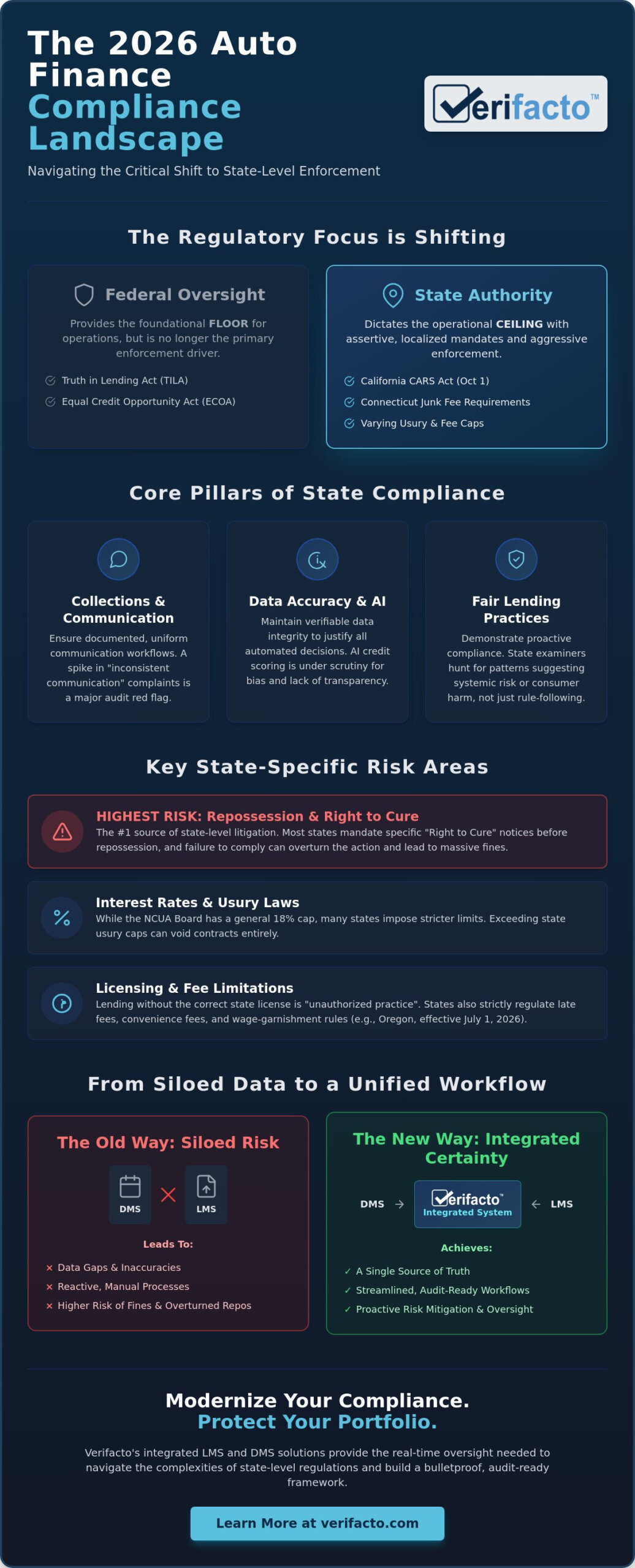
Auto finance lenders currently operate in a high-pressure, dual-layered environment. While federal interest rates have stabilized after recent cuts, the regulatory temperature is rising at the state level. Federal statutes like the Truth in Lending Act (TILA) and the Equal Credit Opportunity Act (ECOA) provide the foundational floor for your operations, but state compliance for auto finance companies often dictates the ceiling. You cannot rely on a “one size fits all” federal standard when state regulators are increasingly assertive. They are filling the enforcement gaps with localized mandates that require more precise oversight.
In 2026, the regulatory spotlight is fixed on three specific pillars: collections, data accuracy, and fair lending. It’s no longer enough to simply follow the rules; you must demonstrate compliance through verifiable data. State examiners are hunting for patterns that suggest systemic risk or consumer harm. If your collection practices or interest rate caps don’t align with state-specific statutes, you risk heavy fines and overturned repossessions. Success requires a shift from reactive legal reviews to proactive, data-driven management.
The Role of the CFPB and State AGs
State Attorneys General are now the front line of enforcement. They frequently collaborate with federal agencies to enforce consumer protection laws, sharing resources to target non-compliant lenders. Regulators pay closer attention to consumer complaint portals than ever before. A sudden spike in complaints regarding “inconsistent communication” is a major red flag for 2026 auditors. It signals a lack of control over your borrower interactions and often triggers a full-scale state audit. You must ensure your communication workflows are documented and uniform across every jurisdiction.
Emerging Trends in Data Accuracy and AI
Artificial Intelligence is transforming underwriting, but it also creates new liabilities. Regulators are scrutinizing AI-driven credit scoring and automated decisioning for potential bias and lack of transparency. You need to ensure total data integrity across your LMS to provide reporting that explains every adverse action. Regulatory data integrity is the 2026 gold standard, defined as the verifiable accuracy of digital records that ensures every automated decision aligns perfectly with current state statutes. Modernizing your stack is the only way to maintain this level of precision without slowing down your business.
Key State Compliance Pillars for Auto Lenders
Managing state compliance for auto finance companies requires a granular understanding of how local statutes override general business practices. You’re dealing with a moving target. Every state maintains its own set of rules regarding interest rates, licensing, and consumer notifications. While the NCUA Board’s 18% general interest rate cap remains in effect through March 10, 2026, individual states often impose even stricter limits. Exceeding these caps by even a fraction of a percent can lead to usury claims that void your contracts and trigger costly litigation.
Licensing requirements vary significantly across the country. A “Buy Here Pay Here” (BHPH) dealer often faces different regulatory hurdles than an independent finance company. Failing to secure the correct license before lending across state lines is considered “unauthorized practice.” This is why robust auto finance compliance management is essential for lenders with multi-state portfolios. You must ensure your licensing is current in every jurisdiction where you have an active lien.
Licensing and Fee Limitations
Beyond the base license, you must monitor fee limitations with precision. Many states strictly regulate “convenience fees” for credit card payments or set hard caps on “late fees.” The CFPB supervision rules highlight how federal oversight often follows state-level fee disputes. Your documentation must include state-specific disclosure forms that clearly outline these costs. Effective July 1, 2026, states like Oregon have also increased wage-garnishment protections. This change directly impacts how you calculate deficiency balances and recovery potential. You don’t want to be caught using outdated disclosure forms during a state audit.
Repossession and Right to Cure
Repossession is the highest-risk area for state-level litigation. Most states require a “Right to Cure” notice, giving borrowers a specific window to bring the account current before recovery efforts begin. Timelines for post-repossession notices and deficiency balance calculations vary wildly by state. If you rely on manual tracking, you’re inviting “wrongful repossession” lawsuits. Errors in these notices are the primary reason repossessions are overturned in court. You need a system that triggers these notices based on specific state timelines rather than a generic internal calendar. You can mitigate these risks by streamlining your portfolio management with automated compliance triggers.
Navigating State-Specific Rules for Insurance Tracking and CPI
Protecting your collateral is a fundamental right, but the execution is heavily regulated at the state level. You need to understand what is collateral protection insurance (CPI) through the lens of local insurance departments. Each state has unique “Notice of Placement” requirements. These mandates dictate exactly how and when you must notify a borrower before adding a premium to their account. Missing a single notice or using outdated phrasing can render the entire premium uncollectible during a state exam. You need a system that adapts to these localized rules without requiring manual legal research for every account.
A primary concern for state compliance for auto finance companies involves “force-placed” insurance on borrowers who already have coverage. Regulators view “double coverage” as a predatory practice that unfairly inflates borrower debt. To avoid penalties, you must demonstrate a rigorous process that verifies existing policies before any CPI placement. This is a core component of an audit-ready operational workflow. Real-time tracking is the only way to prove you acted in good faith and only when a genuine lapse occurred. It eliminates the “he-said, she-said” disputes that often lead to consumer complaints.
Automated Insurance Verification
Manual insurance verification is a massive compliance liability in 2026. Spreadsheets and manual phone calls to agents can’t keep pace with the high-speed nature of modern state audits. Insurance Tracking provides continuous, real-time monitoring of your entire portfolio. This technology alerts you to lapses instantly, allowing for proactive borrower communication. It reduces the friction of “force-placing” insurance by ensuring you only act when the collateral is truly at risk. This precision protects your reputation and keeps your operations lean.
CPI Disclosure and Premium Handling
State rules on premium handling are often complex and non-negotiable. Some jurisdictions allow you to capitalize the CPI premium into the loan balance, while others require separate billing structures. Refund requirements for unearned premiums are equally strict. If a borrower provides retroactive proof of insurance, you must refund the unearned portion of the premium within a specific timeframe. Maintaining a clear, digital audit trail of every insurance-related communication and transaction is essential. It provides the transparency regulators demand and ensures you’re never caught off guard during a routine inspection.
Building an Audit-Ready Operational Workflow
In 2026, being “audit-ready” isn’t a status you achieve once a year. It’s a continuous state of operational readiness where every transaction, communication, and disclosure is logged in a tamper-proof digital trail. State examiners no longer accept disorganized paper files or delayed reports. They demand immediate access to real-time data. Achieving state compliance for auto finance companies depends on your ability to prove that your workflows match the legal requirements of each jurisdiction. If you can’t pull a specific disclosure record within seconds, you’re already at risk of a failed audit.
The biggest obstacle to this level of precision is siloed data. When your Dealership Management System (DMS) and Loan Management System (LMS) don’t communicate, manual entry errors become inevitable. These small mistakes, like a mismatched payment date or a missing insurance update, are exactly what regulators look for to justify deeper investigations. Utilizing robust auto loan management software centralizes your compliance data. It creates a unified environment where every action taken on a loan is automatically documented and mapped to the appropriate state statute.
The Power of Integrated LMS and DMS
True integration is the backbone of state compliance for auto finance companies because it eliminates the “red flag” errors caused by duplicate data entry. When your payment processing is built directly into your LMS, collection activities are logged as they happen. This provides a single source of truth that state auditors can verify with confidence. You don’t have to worry about inconsistencies between systems because there is only one record of the truth. This level of synchronization protects your portfolio and streamlines your internal reviews.
Automating Borrower Notifications
Automated borrower communication tools take the guesswork out of compliance messaging. You can set up specific triggers for late payment notices or insurance expirations based on state-mandated timelines. Using pre-approved, compliant templates for text and email ensures your staff never sends a message that violates local consumer protection rules. Multi-channel communication also reduces “failure-to-contact” claims, proving you made every reasonable effort to reach the borrower before taking adverse action. This proactive approach keeps your portfolio stable and your documentation bulletproof.
Ready to eliminate the risk of siloed data? Modernize your workflow with Verifacto LMS today.
Modernizing Compliance with Verifacto LMS and DMS
Achieving state compliance for auto finance companies in 2026 requires more than just a legal team. It requires a technology partner that understands the practical realities of high-stakes lending. Verifacto provides a comprehensive ecosystem where compliance isn’t a separate task; it’s a built-in feature of your daily operations. By integrating Verifacto LMS and Verifacto DMS, you gain total control over the entire loan lifecycle. This unified approach eliminates the dangerous data gaps discussed earlier that often lead to regulatory scrutiny or overturned repossessions. You can stop juggling multiple platforms and start managing your portfolio from a single, authoritative source of truth.
The unique advantage of the Verifacto platform is the seamless integration of Insurance Tracking and CPI Solutions. Most lenders struggle with the friction between identifying insurance lapses and placing coverage. Verifacto removes this hurdle by automating the verification process and ensuring every Notice of Placement meets specific state requirements. This no-nonsense approach to efficiency extends to Automated Borrower Communication and built-in Payment Processing. You can manage your portfolio with confidence, knowing that every interaction is logged and every payment is processed within a compliant, audit-ready framework. This level of modernization doesn’t just protect you from fines; it stabilizes your entire business model.
Risk Mitigation Through Real-Time Tracking
Verifacto protects your portfolio by monitoring collateral 24/7, providing the real-time oversight needed to prevent losses before they occur. When an insurance policy lapses, the system manages the transition to CPI placement without the need for manual intervention or guesswork. This ensures continuous coverage while maintaining full compliance with state-specific disclosure rules. Verifacto acts as a reliable guardian for lender portfolios, providing the security you need to scale your operations safely across state lines. You don’t have to worry about “double coverage” penalties because the system verifies active policies instantly before any action is taken.
Streamlining Operations and Profitability
Automating compliance-heavy tasks significantly reduces your operational overhead and frees your staff for higher-value activities. Instead of your team manually tracking usury caps or complex repossession timelines, the software handles the heavy lifting with precision. This shift allows you to focus on improving collection efficiency for auto loans through integrated multi-channel communication tools. You’ll see fewer administrative errors and more consistent cash flow as a result of this streamlined workflow. It’s time to stop fearing state audits and start using them as proof of your operational excellence. Schedule a Verifacto demo to audit your compliance workflow today and see how modernization protects your bottom line.
Take Control of Your 2026 Compliance Roadmap
The regulatory shift toward assertive state-level enforcement is no longer a prediction; it’s your current reality. To thrive, you must move beyond manual tracking and embrace a data-driven framework that eliminates siloed information. Mastering state compliance for auto finance companies requires a proactive approach that prioritizes real-time visibility and automated precision. By centralizing your operations, you protect your collateral and ensure every borrower interaction remains legally defensible.
Verifacto provides the tools you need to navigate this complex landscape with total confidence. Our platform offers real-time insurance tracking, seamless cloud-based LMS and DMS integration, and automated borrower communication tools designed for the modern lender. You don’t have to face state audits with anxiety when you have a single source of truth for your entire portfolio. It’s time to transform your compliance burden into a competitive advantage.
Secure Your Portfolio with Verifacto’s Integrated Compliance Solutions and build a more resilient, profitable future today.
Frequently Asked Questions
What are the most common state compliance violations for auto lenders?
The most frequent violations include improper fee disclosures, exceeding state-specific usury caps, and failing to provide timely “Right to Cure” notices. Auditors often find that lenders use outdated templates that don’t reflect recent legislative changes. These errors can lead to significant fines and the potential for repossessions to be overturned in court. Maintaining an updated document library is essential to avoiding these systemic risks.
How does state-level usury law affect auto loan pricing in 2026?
State-level usury laws set the maximum allowable interest rate you can charge, effectively acting as a price ceiling for your loan products. While federal caps like the NCUA’s 18% general rate exist, individual states often impose lower limits based on the vehicle’s age or the total loan amount. In 2026, staying under these varying caps is critical to avoiding usury claims that could void your contracts and trigger costly litigation.
Is force-placed insurance (CPI) legal in all 50 states?
Collateral Protection Insurance (CPI) is legal across all 50 states, but the specific “Notice of Placement” requirements vary significantly by jurisdiction. You must follow strict timelines and use specific language when notifying borrowers of a force-placed policy to remain compliant. Failure to follow these state-specific notice rules often results in mandatory premium refunds and regulatory penalties during an audit.
How often should an auto finance company conduct a compliance audit?
You should conduct internal compliance audits at least quarterly to catch operational drifts before they become systemic issues. External audits by third-party professionals are typically recommended on an annual basis. Frequent internal reviews help ensure that state compliance for auto finance companies remains a core part of your daily workflow rather than a last-minute scramble before a state examiner arrives at your office.
What is the difference between federal and state repossession laws?
Federal laws primarily focus on broad consumer protections against unfair or deceptive acts, while state laws provide the specific procedural requirements for collateral recovery. State statutes dictate the exact number of days required for “Right to Cure” notices and the specific methods for calculating deficiency balances after a sale. You must prioritize state-specific timelines to ensure your repossessions are legally sound and defensible in local courts.
Can automated software really handle different state compliance rules?
Modern automated software is specifically designed to manage the complexities of different state compliance rules through localized triggers and templates. Systems like Verifacto LMS use geographic data to apply the correct interest rate caps and notice timelines automatically for each account. This automation removes the risk of human error and ensures your documentation is always tailored to the borrower’s specific jurisdiction without manual research.
What documentation do state auditors look for in an auto loan portfolio?
State auditors look for a clear, chronological digital trail that includes signed loan contracts, proof of insurance verification, and all borrower communication logs. They specifically examine fee disclosures to ensure they match state-mandated caps for late fees or convenience charges. Having this data centralized in an integrated system makes the audit process faster and significantly reduces your risk of a negative finding or regulatory fine.
How does integrated payment processing help with state compliance?
Integrated payment processing ensures that every transaction is logged in real-time within your LMS, providing an accurate record of payment dates and fee applications. This helps with state compliance for auto finance companies by automatically applying the correct state-specific caps to late fees or convenience charges as they occur. It eliminates the data silos that often lead to inconsistent reporting and regulatory red flags during a state examination.