
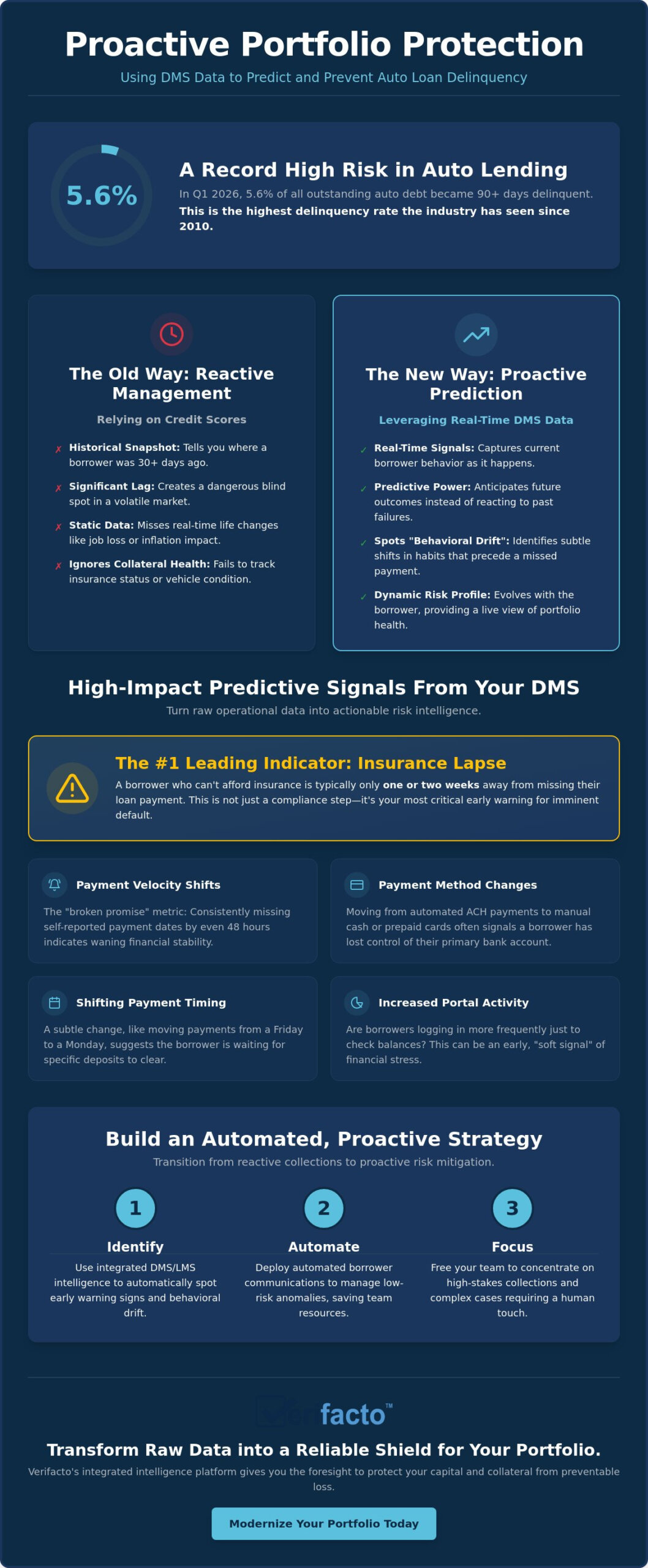
Did you know that 5.6% of all outstanding auto debt reached at least 90 days delinquent in the first quarter of 2026? This is the highest rate the industry has seen since 2010, and it signals a critical need for a shift in how you manage risk. Relying on credit scores often means you’re looking at the past rather than the future. By using DMS data to predict loan delinquency, you can identify at-risk borrowers through real-time behavioral signals before they ever miss a payment.
You likely feel the strain of high charge-off rates and the inefficiency of manual collection calls that don’t move the needle. We understand that protecting your portfolio requires more than just hope; it requires precision and control. This guide teaches you how to leverage your Dealer Management System data to automate early-stage collections and safeguard your collateral. We’ll walk through the transition from reactive to proactive management, showing you how integrated intelligence turns raw data into a reliable shield for your daily operations.
Key Takeaways
- Shift your focus from lagging credit scores to real-time behavioral signals that reveal a borrower’s current financial health.
- Identify why insurance lapses are the most critical leading indicator of an imminent default in your portfolio.
- Learn the specific methodology of using DMS data to predict loan delinquency by analyzing shifts in payment timing and borrower engagement.
- Deploy automated borrower communication to manage low-risk anomalies, freeing your team to focus on high-stakes collections.
- Discover how an integrated DMS/LMS platform streamlines risk mitigation by feeding real-time insurance tracking directly into your workflow.
Beyond Credit Scores: Why DMS Data is the New Standard for Risk Prediction
Traditional risk assessment relies on historical snapshots. Credit scores tell you where a borrower was 30 days ago, not where they’re heading tomorrow. In a volatile market, this lag creates a blind spot that costs lenders millions in charge-offs. Predictive DMS data eliminates this delay by capturing real-time behavioral and collateral signals directly from your operational workflow. By applying predictive analytics to your portfolio, you can anticipate future outcomes rather than reacting to past failures. Using DMS data to predict loan delinquency allows you to spot “behavioral drift,” the gradual shift in a borrower’s habits that precedes a missed payment.
The Limitations of Static Origination Data
Real-Time Data: The Pulse of Your Portfolio
Modern lenders need a dynamic risk profile that evolves as the borrower does. Daily updates from your DMS provide a transparent view of the loan’s health. Watch for “soft signals” that indicate stress before a payment fails. Is the borrower logging into their portal more frequently to check balances? Have they changed their primary payment method from a bank account to a prepaid card? These are early warnings of financial strain. Even a shift in payment timing, like moving from a Friday to a Monday, suggests a borrower is waiting for specific deposits to clear.
DMS data prediction is the process of using current operational metrics to forecast future payment defaults. When you integrate this intelligence with robust auto loan management software, you transform from a reactive collector into a proactive risk manager. Using DMS data to predict loan delinquency gives you the foresight to intervene when it matters most, protecting both your capital and your collateral from preventable loss.
Identifying the High-Impact Predictive Variables in Your DMS
Identifying risk before it manifests as a missed payment requires a deep dive into operational data that traditional credit bureaus simply don’t see. While the industry monitors auto loan delinquency data to understand national trends, your own Dealer Management System (DMS) holds the specific behavioral keys to your portfolio’s health. By using DMS data to predict loan delinquency, you move from broad market assumptions to precise, borrower-specific insights. You’re no longer guessing based on a score from three years ago; you’re acting on what’s happening in your office today.
Collateral Health: The Insurance Signal
The most powerful leading indicator of an imminent default is a lapse in insurance coverage. Borrowers under financial stress often prioritize their car payment over their insurance premium because they need the vehicle to get to work. However, this is a major red flag for lenders. A borrower who can’t afford insurance is typically only one or two weeks away from missing their loan payment. When your system triggers collateral protection insurance (CPI), it shouldn’t just be viewed as a compliance step. It’s a high-priority risk signal. Real-time insurance tracking acts as an early warning system, allowing you to engage the borrower before the financial gap becomes unbridgeable.
Payment Velocity and Method Shifts
Clean data from integrated payment processing reveals subtle shifts in “payment velocity” that signal trouble. Watch for the “broken promise” metric. If a borrower consistently self-reports a payment date but misses it by even 48 hours, their stability is wavering. Another critical variable is the shift in payment methods. Moving from automated ACH payments to manual cash or money order transactions often indicates that a borrower is managing a volatile bank balance. Using DMS data to predict loan delinquency means flagging these patterns early. If your built-in processing shows a trend of “insufficient funds” (NSF) notifications, you have concrete evidence of liquidity issues well before the account reaches a 30-day delinquency status.
Communication engagement provides the final layer of prediction. High-risk borrowers often stop opening SMS reminders or clicking email links as they begin to avoid the reality of their debt. If engagement rates drop while insurance lapses occur, you’ve identified a borrower with a high “intent to default.” Analyzing these variables in tandem allows you to deploy resources where they’ll actually prevent a charge-off, rather than chasing accounts that are already lost.
Analyzing Behavioral Signals vs. Collateral Risk
Identifying a borrower’s financial capacity is only half the battle. While traditional models focus on the “Ability to Pay,” modern risk management prioritizes the “Intent to Pay.” A borrower might have the funds available but could be reprioritizing their obligations due to life changes or decreasing interest in the asset. This is where alternative data for credit risk provides a necessary layer of context that static scores miss. By using DMS data to predict loan delinquency, you can distinguish between a temporary liquidity crunch and a total loss of borrower commitment.
The most dangerous scenario for any lender is the combination of collateral neglect and communication silence. When your system flags an insurance lapse alongside a complete lack of response to automated reminders, the probability of repossession spikes. We view this as a risk multiplier. An insurance lapse alone is a financial hurdle; an insurance lapse paired with “ghosting” is a clear signal of imminent default. Maintaining high standards for auto finance compliance management ensures your data remains clean and actionable, allowing you to weight these variables accurately before the situation escalates.
The “Ghosting” Metric: Communication Engagement
We track the “velocity of response” as a primary behavioral indicator. If a borrower typically clicks a payment link within two hours of receipt but suddenly stops opening messages entirely, their risk profile has shifted. This drop in engagement often precedes a missed payment by several days. Monitoring app login frequency is equally telling. A borrower who checks their balance daily is engaged and likely intends to pay. When those logins stop, it suggests they’ve stopped managing the debt. Using DMS data to predict loan delinquency means identifying these subtle behavioral withdrawals before the account ever hits your collections queue.
Collateral Risk: Physical vs. Financial
Collateral risk isn’t just about the loan balance; it’s about the physical asset. Frequent address changes recorded in your DMS can signal a “skip” in progress, especially if the borrower hasn’t updated their insurance or registration. Similarly, significant jumps in vehicle mileage may indicate the car is being used for high-wear activities like commercial delivery, which decreases the collateral’s recovery value. Real-time data keeps you informed of these physical risks. By syncing behavioral signals with collateral status, you create a 360-degree view of the loan that protects your portfolio from both financial default and asset depreciation.
Building an Automated Response Strategy Based on Predictive Insights
Identifying risk is only valuable if it leads to decisive action. Many lenders struggle with “analysis paralysis,” where they have the data but lack the operational structure to use it effectively. By using DMS data to predict loan delinquency, you can categorize your portfolio into distinct risk tiers. This allows you to allocate your most expensive resource, human collectors, to the accounts that truly need them while automation handles the rest. This structured approach is essential to improve collection efficiency across your entire operation.
We recommend a three-tier response model based on the severity of the signals detected:
- Tier 1 (Low Risk): Soft signals such as a change in payment method or a decrease in app login frequency. These require a “nudge” via automated SMS.
- Tier 2 (Moderate Risk): A combination of soft signals or a single hard signal like a first-time insurance lapse. These trigger a multi-channel sequence of emails and text reminders.
- Tier 3 (High Risk): Hard signals such as an insurance lapse exceeding three days paired with non-responsiveness. These require immediate manual intervention or CPI placement to protect the asset.
Step 1: Setting Your Predictive Triggers
Success depends on defining the specific DMS events that trigger an alert. If your thresholds are too sensitive, your team will suffer from alert fatigue. If they’re too loose, you’ll miss the window for early intervention. Refine your variables based on historical performance. For example, write a clear rule where a 3-day insurance lapse combined with a missed login triggers an immediate SMS reminder. This level of precision ensures that using DMS data to predict loan delinquency remains a functional part of your daily workflow rather than a distraction.
Step 2: Leveraging Automated Communication
Automated borrower communication allows you to maintain a high frequency of touchpoints without increasing your headcount. Your system should send personalized messages that address the specific signal detected. A borrower who has an insurance lapse should receive a different message than one who simply changed their payment date. This targeted approach feels less like a collection call and more like proactive assistance. Maintaining this dialogue keeps the borrower engaged and prevents the “ghosting” behavior that often leads to total default.
Ready to turn your data into a proactive defense? Explore how Automated Borrower Communication can streamline your response strategy today.
Modernizing Your Portfolio with Verifacto’s Integrated Intelligence
The transition from reactive collections to proactive risk mitigation requires more than just a change in strategy; it requires the right infrastructure. Many lenders still struggle with fragmented systems where the Dealer Management System (DMS) doesn’t talk to the Loan Management System (LMS). This gap creates a dangerous data lag. While competitors might suggest exporting data to spreadsheets for manual analysis, that approach defeats the purpose of real-time prediction. Using DMS data to predict loan delinquency effectively requires a single, unified source of truth that captures every borrower interaction as it happens.
Verifacto serves as the guardian of your portfolio by consolidating these disparate data points into a high-performance engine. By integrating Verifacto DMS and Verifacto LMS into a single cloud-based environment, you ensure that every insurance update and every processed payment immediately informs your risk models. This integrated intelligence allows you to move with speed and precision, identifying threats to your capital before they become losses.
The Power of All-in-One Cloud Architecture
Siloed data is the enemy of accuracy. When your sales and collections teams operate in different systems, critical signals get lost in the shuffle. Verifacto’s cloud architecture eliminates these silos, ensuring that behavioral shifts recorded in the DMS are instantly visible to the collections team. This real-time syncing means you never make decisions based on “yesterday’s” data. Whether it’s a change in contact information or a new insurance policy, the update is universal. This specialized platform provides the security and scalability you need to manage a growing portfolio without losing control over individual account health.
Securing the Future of Your Dealership
The ultimate goal of using DMS data to predict loan delinquency is to protect your bottom line. By leveraging Verifacto’s built-in payment processing and real-time insurance tracking, you can significantly reduce charge-offs and improve overall recovery rates. You don’t need to hire a massive team of collectors to handle a rising delinquency market. Instead, you can scale your operations through automation, allowing your staff to focus on the high-risk accounts that require a human touch. This modernization transforms your dealership from a traditional lender into a tech-forward operation capable of navigating any economic environment.
Don’t wait for the next missed payment to take action. See how Verifacto’s integrated DMS/LMS can predict and prevent delinquency today.
Secure Your Portfolio with Predictive Intelligence
The auto lending landscape in 2026 demands a shift from reactive collections to proactive risk management. You now understand that using DMS data to predict loan delinquency provides a far more accurate forecast of borrower behavior than traditional credit scores alone. By monitoring real-time insurance status and behavioral engagement, you can identify high-risk accounts before the first payment is even missed. This strategy doesn’t just save time; it preserves your capital and protects your collateral in an increasingly volatile market.
Verifacto provides the integrated platform necessary to execute this strategy with precision. Our cloud-based LMS/DMS architecture is founded on over a decade of industry expertise, ensuring you have a reliable partner for your daily operations. With real-time insurance tracking integrated directly into your workflow and automated borrower communication tools designed for high-risk portfolios, you gain complete mastery over your risk profile.
Don’t let lagging indicators dictate your success. Streamline your portfolio and reduce delinquency with Verifacto. We’re ready to help you modernize your operations and achieve the stability your business deserves.
Frequently Asked Questions
What is the most accurate predictor of auto loan delinquency?
The most accurate predictor is the intersection of insurance compliance and borrower communication engagement. While credit scores provide a historical snapshot, real-time behavioral data from your DMS reveals current financial stress. Lenders who monitor these internal signals can often identify at-risk accounts up to two weeks before a payment is actually missed.
How does DMS data differ from traditional credit bureau data?
DMS data provides real-time, internal behavioral insights, whereas traditional credit bureau data offers a lagging, external view of a borrower’s past history. Credit scores are static snapshots that don’t reflect sudden changes in liquidity or collateral status. By using DMS data to predict loan delinquency, you gain a dynamic risk profile based on actual interactions occurring within your dealership today.
Can insurance lapses really predict future payment defaults?
Yes, insurance lapses are among the strongest leading indicators of a future payment default. Borrowers facing financial hardship often stop paying their insurance premiums to keep cash available for car payments or other necessities. When a policy cancels, it signals that the borrower’s financial stability has already fractured, making a missed loan payment highly probable within the next billing cycle. Much like how real estate professionals visit Landvoice to find data on pre-foreclosures, auto lenders use these signals to identify financial distress before it’s too late.
How often should a lender analyze DMS data for risk signals?
You should analyze your DMS data for risk signals daily to ensure you don’t miss narrow windows for intervention. Since borrower behavior can shift rapidly, weekly or monthly reviews often come too late to prevent a charge-off. Automated systems can monitor these metrics in the background, alerting your team only when a specific risk threshold is crossed.
Does predictive modeling require a dedicated data scientist?
No, modern predictive modeling doesn’t require a dedicated data scientist if you use an integrated platform like Verifacto. Our system handles the complex data aggregation and risk tiering for you, presenting actionable insights through a user-friendly interface. This allows your existing team to focus on executing collections strategies rather than interpreting raw data sets.
What is the first step in using DMS data to reduce charge-offs?
The first step is integrating your DMS and LMS into a single cloud-based architecture to eliminate data silos. Without a unified system, your collections team won’t have immediate access to the behavioral triggers captured during the sales or servicing process. Establishing this “single source of truth” is the foundation for using DMS data to predict loan delinquency effectively across your entire portfolio.
How does integrated payment processing improve delinquency prediction?
Integrated payment processing improves prediction by providing clean, immediate data on “insufficient funds” (NSF) notifications and payment method shifts. When your payment system is built into your LMS, you can automatically track if a borrower moves from ACH to cash or money orders. These subtle changes in payment velocity are critical indicators of bank account volatility and imminent risk.
Is automated borrower communication compliant for collections?
Automated borrower communication is fully compliant when it’s managed through a platform designed specifically for auto-finance regulations. These systems maintain audit trails and adhere to contact frequency limits required by law. Using automation ensures that your reminders remain professional and consistent, reducing the risk of manual errors that could lead to compliance violations during the collections process.