
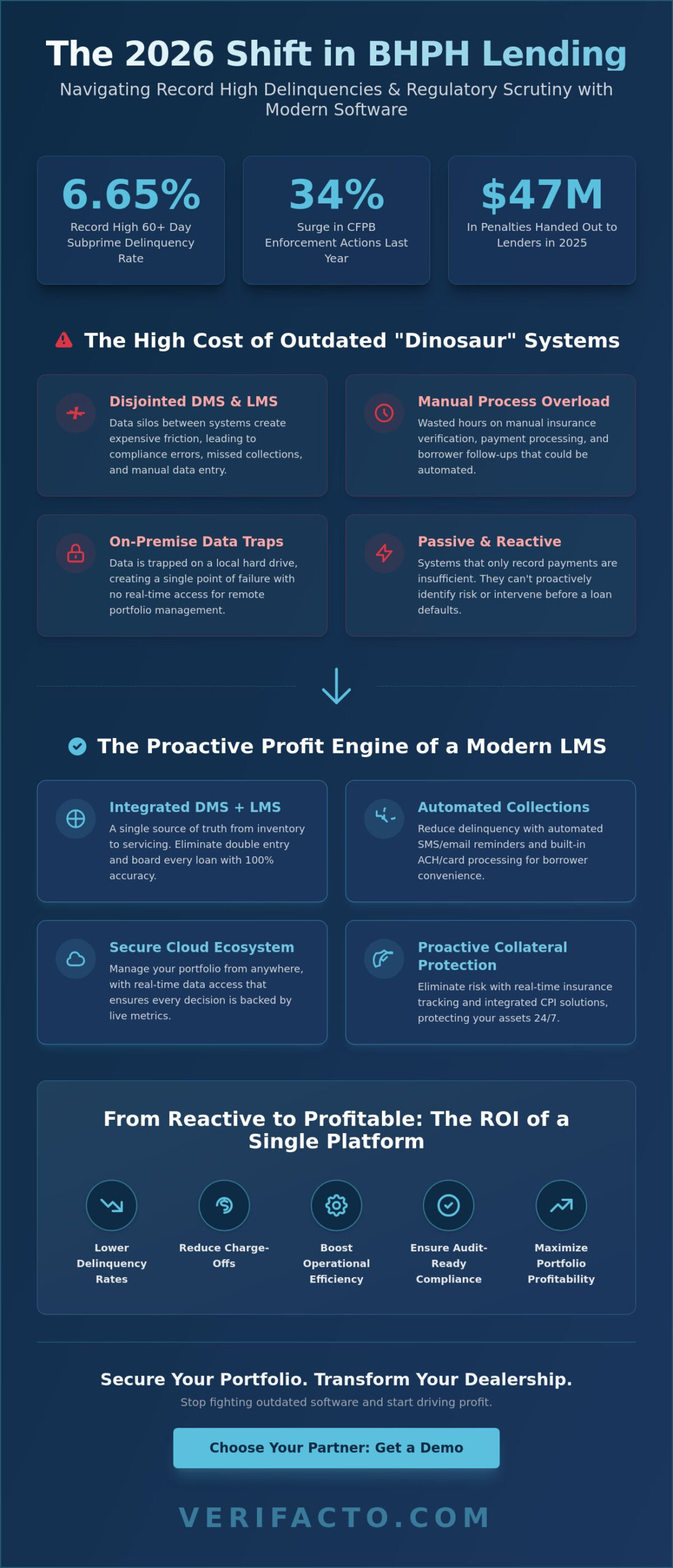
With subprime auto loan delinquency rates hitting an all-time high of 6.65% at the end of 2025, the margin for error in your portfolio has never been thinner. Managing disjointed systems while tracking manual insurance updates isn’t just a headache; it’s a direct threat to your bottom line. You need a way to stabilize your operations before delinquency turns into a permanent loss. Every day spent fighting manual processes is a day your collateral remains at risk.
We understand that the current regulatory environment, including the 34% surge in CFPB enforcement actions last year, makes compliance feel like a moving target. This 2026 buyer’s guide shows you how the right BHPH loan management software transforms your dealership from a reactive environment into a proactive, profit-generating machine. You’ll learn how to choose a system that protects your collateral, automates collections, and secures your portfolio against market volatility. Our goal is to provide you with the mastery needed to navigate these high-stakes operational challenges.
We’ll examine the essential features for modern lenders, from integrated CPI solutions to automated borrower communication, giving you a clear roadmap to a more secure and profitable future.
Key Takeaways
- Transition from legacy on-premise systems to integrated cloud ecosystems to maintain compliance and operational control in the 2026 market.
- Unify your inventory and servicing workflows by selecting BHPH loan management software that offers a seamless connection between DMS and LMS functions.
- Protect your assets by implementing real-time insurance tracking and CPI solutions that eliminate the risks associated with manual verification.
- Lower your delinquency rates and recovery costs through automated borrower communication and built-in payment processing that supports ACH and card transactions.
- Maximize your portfolio’s profitability by moving to a single-platform approach that combines loan servicing, collateral protection, and advanced reporting.
The Evolution of BHPH Loan Management Software in 2026
The industry has reached a critical tipping point. For decades, Buy Here, Pay Here (BHPH) dealers relied on local servers and basic ledgers to track their accounts. That era is officially over. In 2026, modern BHPH loan management software has evolved from a simple record-keeping tool into a sophisticated, integrated ecosystem. It isn’t just about tracking dollars anymore; it’s about survival in a high-stakes environment where the 60+ day delinquency rate for subprime auto loans hit a record 6.65% at the end of 2025.
Legacy on-premise systems have become a significant liability for independent dealers. These “dinosaur” platforms lack the agility to handle the 34% surge in CFPB enforcement actions seen over the last year. If your data is trapped on a local hard drive, you’re operating with a blindfold on. Cloud-based platforms have replaced these outdated models, offering the real-time data access required to navigate a landscape where $47 million in penalties were handed out in 2025 alone. Modern lenders need the ability to manage their portfolios remotely, ensuring that every decision is backed by live performance metrics rather than yesterday’s news.
From Passive Tracking to Proactive Risk Mitigation
Simply recording a payment when it arrives is the bare minimum for any lender. High-performance teams have shifted toward active portfolio monitoring. Modern systems alert you the moment a risk profile changes, allowing you to intervene before a loan goes into default. “Set it and forget it” automation is now the standard for lean dealer teams who can’t afford to waste hours on manual follow-ups. In this context, an LMS is a tool that bridges the gap between lending and asset recovery. This proactive stance ensures your capital stays protected even as market volatility increases.
The Death of Disjointed Systems
Relying on separate DMS and LMS platforms creates expensive friction. These data silos lead to missed collection opportunities and frequent compliance errors that draw regulatory heat. When your inventory management doesn’t communicate instantly with your loan servicing, you’re forced to deal with manual data entry and mismatched records. True integration means establishing a single source of truth for every VIN and borrower in your system. This streamlined approach eliminates the hidden costs of disjointed software and ensures that your dealership remains audit-ready and operationally efficient at all times.
Essential Features of a High-Performance BHPH LMS
High-performance BHPH loan management software isn’t just a digital filing cabinet. It’s the engine that drives your dealership’s profitability. To scale effectively, you need a system that eliminates friction between your sales floor and your servicing desk. Understanding the benefits of integrated DMS and LMS is the first step toward a leaner operation. When these systems talk to each other, you eliminate double data entry and ensure that every loan is boarded with 100% accuracy from day one. This creates a seamless transition that protects your data integrity and improves the borrower’s experience.
Beyond integration, your system must handle the heavy lifting of payment logistics. Modern borrowers expect flexibility. If you’re still relying on cash or money orders, you’re building unnecessary barriers to payment. A robust LMS includes built-in processing for ACH, credit, and debit transactions. This keeps your staff focused on managing exceptions rather than processing routine paperwork. By providing multiple ways to pay, you make it easier for customers to stay current, which directly impacts your portfolio performance.
Automated Payment Solutions and Collection Workflows
Cash flow stability is the heartbeat of any BHPH operation. Recurring ACH payments are the most effective way to secure that heartbeat. By automating the payment lifecycle, you reduce the manual touchpoints that often lead to human error or missed follow-ups. Automated SMS and email reminders are equally vital. These tools keep your dealership top-of-mind for the borrower without requiring a single phone call from your staff. In many cases, these proactive nudges can significantly lower 30-day delinquency rates by resolving minor payment hurdles before they escalate into major defaults. You can explore Verifacto’s integrated platform to see how these automated workflows simplify daily tasks.
Comprehensive Reporting and Compliance Tools
In an era of heightened regulatory oversight, your software must act as your first line of defense. The CFPB continues to emphasize consumer protection in auto lending, making it essential to have built-in compliance guardrails. Your LMS should automatically track FDCPA requirements and state-level lending caps to prevent accidental violations. Real-time dashboards are no longer a luxury; they’re a necessity for monitoring Related Finance Company (RFC) performance. You should be able to audit your portfolio by risk tier with just a few clicks, identifying trends before they impact your overall health. This level of transparency allows you to make data-driven decisions that safeguard your capital.
The Missing Link: Collateral Protection and Insurance Tracking
Most lenders focus on payment tracking as their primary defense against loss. While important, this approach ignores the physical asset that secures the debt. Insurance lapses are the silent killers of BHPH profitability. If a vehicle is damaged or stolen while uninsured, your chances of recovering the loan balance drop to near zero. You can’t afford to wait for a repossession agent to find a wrecked car to discover the policy expired months ago. Protecting the collateral is just as vital as collecting the monthly payment.
The shift from manual verification to real-time insurance tracking is what separates modern lenders from those stuck in the past. Staff members shouldn’t spend their afternoons chasing down insurance binders or calling agents to confirm coverage. By integrating these status updates directly into your BHPH loan management software, you gain a live view of your portfolio’s risk level. This integration ensures that insurance data is never siloed, allowing your collections team to prioritize accounts based on both payment status and asset protection. It’s about having total visibility over every VIN in your fleet.
Real-Time Insurance Verification Workflows
Automated systems now communicate directly with insurance carriers to detect policy cancellations or lapses the moment they happen. This technology eliminates the “gap time” that traditionally left lenders exposed for weeks at a time. Real-time tracking prevents total losses on repossessions by ensuring you always know the status of your collateral before you send out a tow truck. This immediate feedback loop allows your team to act decisively, contacting the borrower to rectify the lapse before a disaster occurs. You no longer have to guess if your assets are covered; you have the data to prove it.
Automated CPI Placement as a Revenue Driver
When a borrower refuses or fails to provide adequate coverage, Collateral Protection Insurance (CPI) acts as your ultimate safety net. Modern software automates the mechanics of force-placing this coverage, which protects the principal balance of the loan against physical damage. This process must be handled with precision to stay compliant with state-level lending laws and consumer protection standards. By automating the notices and the premium additions, you protect your capital while maintaining professional, transparent communication with your borrowers. This systematic approach transforms a major risk factor into a controlled, manageable part of your daily operations that safeguards your bottom line.
Evaluating ROI: How the Right Software Reduces Charge-Offs
ROI in the BHPH world isn’t just a metric for your accountant. It’s the difference between a thriving dealership and one struggling to keep its head above water in a high-delinquency market. When you transition to high-performance BHPH loan management software, you’re trading expensive, error-prone manual labor for scalable automation. Think about the hours your staff spends on manual insurance verification or chasing down late payments. These tasks drain your resources without adding strategic value. By automating loan servicing, you reallocate that human capital toward growth and high-level risk management.
The financial impact of 24/7 collateral monitoring is substantial. You aren’t just tracking payments; you’re securing the asset’s value in real time. Implementing integrated payment solutions for dealers reduces the friction that often leads to missed payments. Every reduction in payment friction is a direct win for your bottom line. Automation ensures that your collection efforts remain consistent, regardless of your staff’s workload or office hours. This consistency builds a culture of accountability with your borrowers, which is essential for maintaining a healthy portfolio.
Shortening the Collection Cycle
Speed is your greatest ally in collections. Automated workflows accelerate the time from a missed payment to a resolution. There’s a clear correlation between payment friction and default rates. If it’s hard for a borrower to pay, they eventually won’t. Modern software uses data to identify high-risk accounts before they actually go into default. By flagging subtle changes in borrower behavior or insurance status, you can intervene early. This proactive approach keeps accounts performing and prevents the costly spiral into charge-offs that erodes your capital.
Protecting Asset Value Through Better Management
When a loan fails, the speed of recovery determines your loss severity. Better tracking leads to faster repossessions, which preserves the vehicle’s condition and results in higher resale values at auction or on your own lot. You also reduce the legal and administrative costs associated with prolonged delinquency and disjointed record-keeping. Beyond the raw numbers, there’s a significant “Peace of Mind” factor. Relying on technological reliability reduces dealer stress and allows you to focus on strategic scaling rather than daily fires. It’s about building a business that is both profitable and sustainable.
Choosing Your Partner: Migration and Scaling with Verifacto
Selecting the right partner for your BHPH loan management software is a decision that defines your dealership’s trajectory. You aren’t just buying a tool; you’re choosing the infrastructure that will support your growth in an increasingly complex market. A cloud-based partner must offer more than just accessibility. They need to provide a secure, scalable environment that evolves alongside federal regulations and shifting borrower behaviors. In the 2026 lending landscape, your software partner should act as a strategic advisor that understands the “no-nonsense” requirements of your daily operations.
The Verifacto approach replaces disjointed workflows with a unified ecosystem. By integrating Verifacto DMS, LMS, and Insurance Tracking into a single platform, we eliminate the friction that slows down your team. This consolidated model ensures that data flows seamlessly from the initial sale to the final payment. You don’t have to worry about mismatched records or missed collection opportunities. Instead, you gain a high-definition view of your entire portfolio, allowing you to make assertive decisions that maximize profitability and minimize risk.
We understand that the anxiety of change often keeps dealers trapped in outdated systems. That’s why we’ve perfected a step-by-step migration process designed to protect your data integrity. Our team handles the heavy lifting of transitioning your existing records into the Verifacto environment without disrupting your active business. We provide comprehensive training to ensure your staff masters these modern tools quickly. You won’t be left to figure things out on your own; we’re with you from the initial data mapping to the moment you process your first automated payment.
The Verifacto Advantage: A Reliable Guardian for Your Portfolio
Verifacto stands apart by masterfully handling the complex operational hurdles that keep other lenders awake at night. Our platform functions as a reliable guardian, providing the tools necessary to navigate high-stakes environments safely. While others offer basic tracking, our core differentiator is real-time insurance monitoring and integrated CPI solutions. When combined with our automated borrower communication and built-in payment processing, you get a system that does more than record history; it proactively protects your future.
Next Steps for Your Dealership
It’s time to audit your current software for gaps in risk management. If you’re still relying on manual insurance checks or dealing with disjointed data, your capital is at unnecessary risk. We invite you to see our LMS and insurance tracking in action through a live demonstration. Witness how automation can transform your collections department and provide the stability your business deserves. Don’t let legacy technology hold back your portfolio’s potential.
Schedule a consultation with Verifacto to secure your portfolio today.
Secure Your Dealership’s Future with Modern Automation
The 2026 market doesn’t reward hesitation. With delinquency rates at historic highs, your choice of BHPH loan management software is the most critical operational decision you’ll make this year. Moving beyond simple payment tracking to a proactive model of asset protection is no longer optional. It’s the only way to safeguard your capital against uninsured losses and rising default rates. By unifying your inventory and loan servicing on a single cloud platform, you eliminate the data silos that lead to costly recovery errors.
Verifacto provides the mastery you need to navigate these challenges with confidence. Our integrated DMS and LMS work in tandem with real-time insurance tracking and automated borrower communication workflows to keep your portfolio performing at its peak. You don’t have to manage these high-stakes risks alone. Transitioning to a smarter system gives your team the freedom to focus on growth while our technology handles the heavy lifting of compliance and collateral security. It’s time to take control of your dealership’s profitability and build a more resilient business.
Secure Your Portfolio with Verifacto’s Integrated LMS
Frequently Asked Questions
What is BHPH loan management software?
It’s a specialized platform designed to automate the entire lifecycle of a “Buy Here, Pay Here” loan, from initial boarding and payment processing to collections and collateral protection. Unlike generic accounting tools, this software is built specifically to handle the high-risk nature of subprime auto lending. It provides a centralized hub where you can monitor borrower behavior and asset health simultaneously to ensure your capital stays protected.
How does automated insurance tracking reduce lender risk?
Automated insurance tracking eliminates the dangerous delay between a policy cancellation and lender notification. By connecting directly to carrier data, the system flags lapses in real time, allowing you to intervene before a total loss occurs. This proactive approach ensures your collateral remains protected, which is vital since insurance lapses are a leading cause of unrecoverable charge-offs in the current lending market.
Can I integrate my existing DMS with a new loan management system?
Yes, integration is possible, though a unified platform often provides superior results. While many dealers attempt to bridge disjointed systems, using a natively integrated DMS and LMS ensures data integrity and eliminates double data entry. If you’re currently using a third-party DMS, you should check for API compatibility to ensure your inventory data flows seamlessly into your loan servicing workflows without manual friction.
What are the compliance requirements for BHPH software in 2026?
Modern software must adhere to strict federal and state regulations, including the Truth in Lending Act (TILA), the Fair Credit Reporting Act (FCRA), and the Equal Credit Opportunity Act (ECOA). In 2026, the CFPB also emphasizes digital disclosure requirements under Regulation Z. Your system should automate these disclosures and maintain detailed audit trails to protect your dealership during regulatory examinations or potential enforcement actions.
How does Collateral Protection Insurance (CPI) work within an LMS?
CPI functions as an automated safety net that triggers when a borrower’s primary insurance coverage fails. When the LMS detects a lapse, it automatically generates the required notices and places force-placed coverage to protect the loan’s principal balance. This integration ensures that the premium is correctly added to the borrower’s ledger, maintaining compliance while safeguarding your physical asset from uninsured damage or theft during the loan term.
Is cloud-based BHPH software secure for sensitive borrower data?
Cloud-based BHPH loan management software is significantly more secure than legacy on-premise servers. Modern cloud providers utilize enterprise-level encryption, multi-factor authentication, and redundant backups to protect sensitive financial information. These systems are designed to meet rigorous data privacy standards, ensuring that your borrower’s personal data remains safe from local hardware failures or physical security breaches at your dealership location.
How long does it take to migrate data to Verifacto?
Data migration timelines vary based on the complexity of your current records, but our team works to ensure a swift transition. We follow a structured mapping process to move your borrower history and vehicle data without disrupting your daily operations. Our goal is to minimize downtime, providing a streamlined path from your legacy system to a more efficient, automated environment where your team can start scaling immediately.
Does BHPH software include payment processing for ACH and credit cards?
High-performance BHPH loan management software includes built-in payment processing to support ACH, credit, and debit transactions. This feature allows you to set up recurring payments that stabilize your cash flow and reduce the staff time spent on manual collections. By offering multiple digital payment options, you lower the friction for your borrowers, which directly leads to improved on-time payment rates and a healthier overall portfolio.