
How much margin is your dealership losing to the “manual tax” every time a borrower makes a payment? If your staff is still toggling between a standalone payment terminal and your accounting software, you’re likely facing reconciliation errors and compliance anxiety that slow down your entire operation. By 2026, the standard for high-volume dealers has shifted toward integrated payment solutions for dealers that bridge the gap between the transaction and the ledger. You already know that every minute spent on data entry is a minute lost on growth, and high transaction fees shouldn’t be the price of doing business.
This guide explores how a unified payment ecosystem eliminates the friction of manual updates while keeping you ahead of strict FTC transparency rules and PCI DSS 4.0 standards. We’ll show you how to achieve real-time payment updates within your DMS, trigger automated borrower notifications instantly, and slash your administrative overhead. You’ll discover the strategic path to accelerating your cash flow and securing your sensitive data through modern tokenization and built-in processing. We’re moving beyond fragmented tools to a system that protects your margins and your peace of mind.
Key Takeaways
- Identify how fragmented systems create “reconciliation fatigue” and high-stakes risks like wrongful repossessions caused by manual data entry errors.
- Learn the critical technical difference between simple API connections and true integrated payment solutions for dealers that are built into the core DMS.
- Discover how to accelerate cash flow by linking real-time payment processing with automated borrower communication and collection workflows.
- Access a 2026 buyer’s checklist to evaluate essential security standards, including PCI DSS Level 1 certification and point-to-point encryption.
- Understand how a unified ecosystem streamlines the borrower journey by keeping loan balances and insurance tracking updated in real-time.
Beyond the Swipe: Why Fragmented Payments Cost Dealers Thousands
Many dealers treat payment processing as a simple utility, much like electricity or water. They assume that as long as the card swipes and the money eventually hits the bank, the system is working. This perspective ignores the massive administrative drain hidden beneath the surface. When you rely on fragmented systems, your staff acts as a manual bridge between your terminal and your ledger. This “manual tax” eats into your margins every single day.
In 2026, the complexity of the auto industry means you can’t afford to treat payments as a separate silo from your dealership management system. Fragmented tools create a disconnect between what the customer pays and what your records show. This friction doesn’t just annoy your office manager; it increases delinquency rates. When borrowers find it difficult to pay or see inaccurate balances, their trust in your dealership erodes, often leading to missed payments.
The High Price of Manual Reconciliation
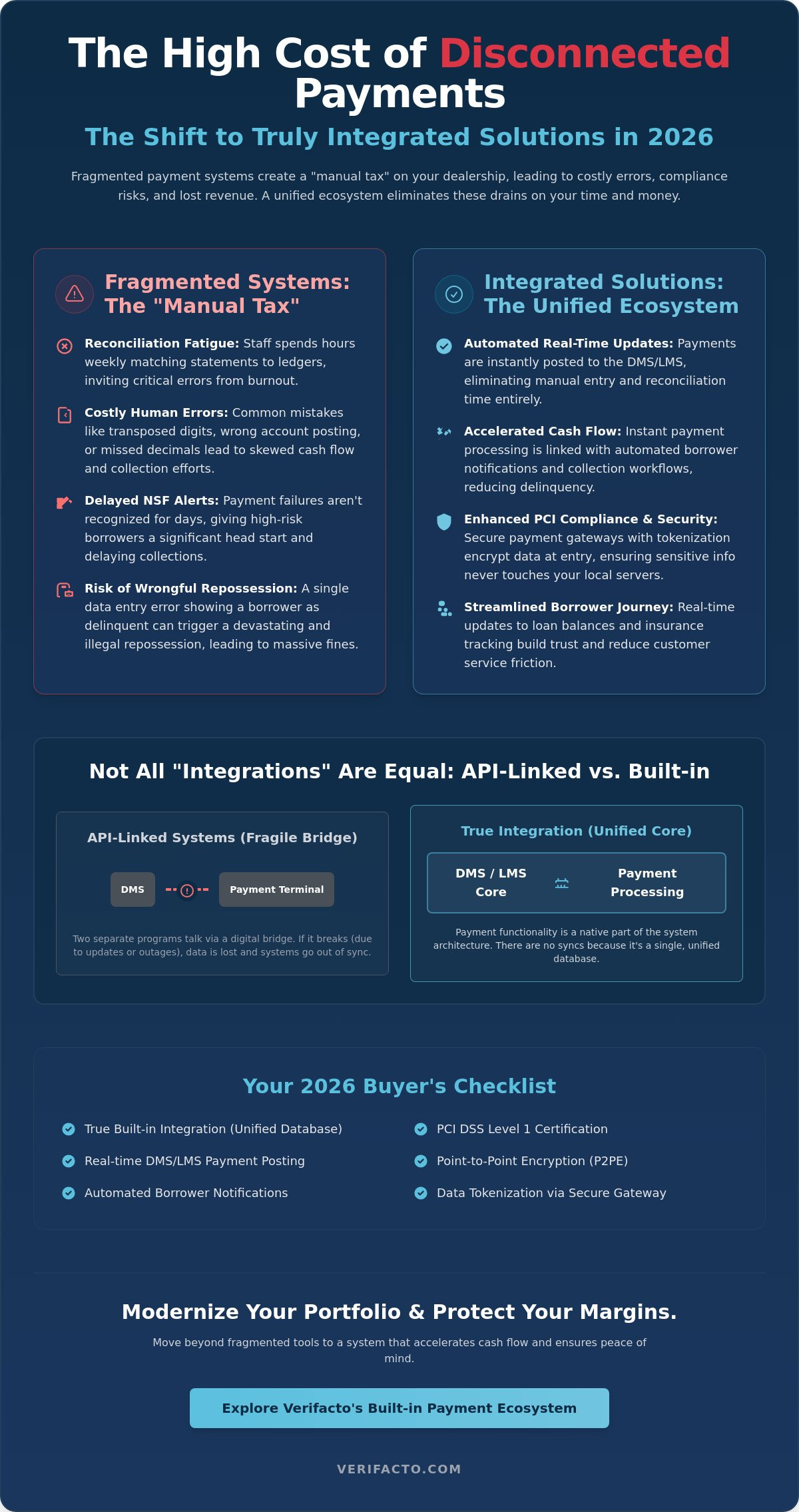
Think about the time your team spends at the end of the month matching bank statements with ledger entries. For many independent dealers, this process consumes several hours every week. It’s a tedious task that invites “reconciliation fatigue,” where staff members are more likely to make critical errors as they rush to finish. The top three human errors in manual posting include transposing digits, applying payments to the wrong customer account, and missing decimal points. A simple error, like entering $100 instead of $1,000, can skew your cash flow projections and lead to costly collection efforts.
Manual systems also create a dangerous lag in recognizing Non-Sufficient Funds (NSF) alerts. If a payment fails, a siloed system won’t notify you until the bank notifies your staff, who then must manually update the records. By the time you realize the payment bounced, several days may have passed, giving a high-risk borrower a significant head start. Relying on integrated payment solutions for dealers eliminates this gap by providing immediate feedback on transaction status.
Compliance and Security Risks in Disconnected Systems
The “swipe and type” method significantly increases your exposure to PCI compliance violations. Every time an employee handles sensitive card data or writes down a payment authorization on paper, your risk profile grows. Storing paper-based authorizations in a digital-first world is a liability you don’t need. Modern integrated payment solutions for dealers solve this by using a secure payment gateway that encrypts data at the point of entry, ensuring sensitive info never touches your local servers.
Real-time data synchronization is no longer a luxury; it’s a requirement for a modern DMS for independent dealers. One transposed digit in a payment entry isn’t just a typo; it can trigger a wrongful repossession. If your system shows a borrower is delinquent because a payment wasn’t posted correctly, taking the car back could lead to devastating legal consequences and massive fines. Transitioning to a unified ecosystem ensures that every dollar is accounted for the moment it’s processed, protecting both your customers and your license.
Defining True Integration: API-Linked vs. Built-in Payment Processing
The term “seamless” is often tossed around in software demos, but for a dealer, the technical reality behind that word determines your daily workload. Many vendors market their products as integrated payment solutions for dealers, yet they actually rely on fragile external connections. These are typically API-linked systems, where two separate programs attempt to “talk” to each other through a digital bridge. If that bridge collapses because of a software update or a server outage, your payment data stays on one side while your ledger remains empty on the other.
True integration is different. It means the payment processing functionality is a native part of your Loan Management System (LMS) and Dealer Management System (DMS) architecture. In this environment, there’s no “syncing” process because there are no separate databases to sync. A unified database prevents the common data collisions that happen when the sales department sees a “paid” status while the finance department is still looking at an unposted transaction. This architectural choice eliminates the API trap, where staff must still perform manual oversight and periodic reconciliations to ensure the “connection” actually worked.
The Architecture of a Seamless Transaction
In a built-in system, the data flow is direct and instantaneous. When a borrower makes a payment, the data travels from the payment gateway directly to the loan balance without stopping at an intermediate third-party app. Built-in Integration is a system where the payment processor and ledger share a single source of truth, ensuring that a transaction and its record are created simultaneously. This setup utilizes advanced tokenization to protect data. Tokenization replaces sensitive card info with a unique identifier, allowing the system to process recurring payments without the dealer ever needing to “touch” or store sensitive borrower data, which significantly simplifies PCI DSS 4.0 compliance.
Why Built-in Systems Outperform API Plugins
Reliability is the primary differentiator. When you rely on an external API plugin, you’re at the mercy of multiple service providers. If the plugin provider has a glitch, your ability to post payments to your DMS breaks. A built-in system removes these points of failure. Speed is another factor. Comparing a “double-entry” workflow, where you enter data into a terminal and then a DMS, to a “single-click” integrated workflow reveals a massive gap in efficiency. You save minutes on every transaction, which adds up to hours of saved labor every month.
Managing your business through integrated payment solutions for dealers also simplifies your vendor relationships. Instead of juggling three separate contracts and three different support lines for your DMS, your payment processor, and your gateway, you handle everything through one partner. Consolidating your tech stack into a single, high-performance platform allows you to focus on growth rather than troubleshooting software handshakes. You can see how this unified approach stabilizes your operations by exploring the Verifacto DMS ecosystem.
The Operational Impact of Unified DMS and Payment Systems
While many systems focus on the initial retail swipe in the service bay, true integrated payment solutions for dealers must secure the long-term health of your loan portfolio. In the Buy Here Pay Here and subprime sectors, a payment isn’t just a transaction; it’s a critical data point for risk management. When your payment processing is built directly into your LMS, you gain the ability to automate the entire collection lifecycle. This integration ensures that when a payment is successful, the borrower’s account reflects the new balance instantly, and your liquidity remains high through same-day settlement.
Accelerated cash flow is the most immediate result of a unified system. With the expectation for faster settlement becoming the 2026 standard, real-time payouts allow you to move capital back into inventory without waiting days for batch processing. This speed is vital for maintaining a competitive edge in a high-stakes market. You’re not just collecting money; you’re optimizing the velocity of your capital.
Boosting Collection Efficiency for Auto Loans
Effective collections rely on meeting borrowers where they are. Integrated systems enable “Pay-by-Text” functionality that actually works because the payment link is tied directly to the live loan balance in your Verifacto LMS. When you combine this with Automated Borrower Communication, you can send automated payment reminders for car loans that significantly reduce 30-day delinquency rates. These systems link payment success directly to your insurance tracking. If a borrower makes a payment but has an expired policy, the system flags the account immediately. This allows you to deploy CPI Solutions faster, protecting your collateral without the need for manual cross-referencing. For a deeper look at how automation transforms recovery rates, explore the complete guide to improving collection efficiency for auto loans in today’s high-delinquency environment.
Real-Time Financial Transparency
A unified ecosystem eliminates the “end-of-month scramble” by providing auto-generated financial statements that are always current. You no longer have to wait for a manual reconciliation of your bank accounts to see your true portfolio performance. This real-time visibility allows you to identify high-risk borrowers before they default, using payment patterns to trigger proactive outreach. For multi-location dealership groups, this transparency is even more valuable. You can compare the collection efficiency of different lots from a single dashboard. By automating the audit trail for every dollar, you reduce your administrative burden and ensure your records are always ready for review.
How to Evaluate Integrated Payment Solutions: A 2026 Buyer’s Checklist
Selecting the right technology for your dealership isn’t just about comparing feature lists; it’s about verifying the underlying architecture that will support your business for the next decade. As regulatory scrutiny from the FTC increases regarding price transparency, your choice of integrated payment solutions for dealers must do more than just process cards. It needs to act as a defensive shield for your dealership while maximizing operational speed. Use the following criteria to separate modern unified systems from legacy plugins.
- True Real-Time Updates: Verify if the system updates the loan balance the exact second a card is authorized. If the provider mentions “nightly batches” or “scheduled syncs,” they aren’t offering true integration.
- Security Standards: Demand PCI DSS Level 1 certification. With PCI DSS 4.0 now the minimum standard, ensure the provider uses Point-to-Point Encryption (P2PE) so sensitive data never enters your local environment.
- Omni-channel Capability: Your borrowers expect flexibility. The system must handle text-to-pay, branded online portals, and in-person swipes through a single, unified interface.
- Pricing Transparency: Avoid vendors that hide “integration fees” or “monthly maintenance” surcharges. Look for a flat, predictable structure that doesn’t penalize you for using the software’s core features.
- The Single Support Model: Ask what happens when a payment fails. You want a single point of contact for both the software and the processing, rather than being bounced between two different companies.
Must-Have Features for Modern Dealerships
In 2026, convenience is a primary driver of collection success. Your system should offer recurring payment scheduling (Auto-pay) as a standard feature for long-term loan servicing. This reduces the cognitive load on your staff and ensures consistent cash flow. Additionally, ensure the payment portals are mobile-responsive and match your brand identity. Since integrated ACH processing for auto finance carries significantly lower fees than credit card transactions, your platform should prioritize ACH as a primary payment method. This is especially relevant as evolving regulatory landscapes increasingly encourage or require dealers to offer a free payment alternative when collecting electronic fees.
Questions to Ask Your Current DMS Provider
Before you commit to a new contract, dig into the technical reality of their “integration.” Ask if the payment solution shares the same database as your loan management system. If it doesn’t, you’ll eventually face data collisions. Inquire about the specific number of manual steps required to reconcile a daily deposit. If it’s more than zero, the system isn’t fully automated. Finally, ask about the process for handling a payment dispute or chargeback. A built-in system should allow you to manage the entire dispute process directly from the customer’s account screen. You can see how a truly unified system operates by reviewing the Verifacto payment processing features.
Modernizing Your Portfolio with Verifacto’s Built-in Payment Ecosystem
Verifacto isn’t just another software provider. It’s a partner that understands the high-stakes environment of independent dealerships and subprime lending. Unlike competitors who bolt on third-party gateways, we provide integrated payment solutions for dealers as a core feature of our platform. This cloud-based architecture ensures that payments are never an afterthought. They are the heartbeat of your operational efficiency, designed to provide stability and control over your entire portfolio.
Streamlining the borrower journey requires more than just a working credit card terminal. It requires a system that manages the relationship from the first down payment to the final title release. By linking the Verifacto LMS directly to our built-in payment processing, you ensure every interaction is documented and every balance is accurate. This professional experience builds trust with your borrowers, which is a key factor in reducing delinquency and encouraging on-time payoffs. When your tech stack is unified, the transition from one stage of the loan to the next is seamless.
Protecting your collateral is where the Verifacto ecosystem truly shines. Our built-in processing doesn’t just move money; it communicates directly with our insurance tracking and CPI solutions. If a payment is made but the borrower’s insurance has lapsed, the system alerts you instantly. This level of protection is only possible when your payments, loan management, and insurance tracking live in the same database. Growth-oriented dealers choose Verifacto because it provides the security needed to scale their operations without adding expensive administrative headcount.
A Unified Solution for Lenders and Dealers
Verifacto’s LMS/DMS integration eliminates the need for clunky third-party payment plugins that often break or require manual syncs. We provide the tools so you can focus on selling cars and managing your portfolio, not playing accountant. Our team has mastered the complexities of loan servicing, meaning you get a platform that handles the heavy lifting of data security and regulatory compliance automatically. Transitioning to our cloud-based infrastructure is straightforward, allowing you to move away from legacy hardware and toward a more agile, secure environment that you can access from any location.
Next Steps: Securing Your Dealership’s Future
The long-term ROI of switching to a unified platform is clear. You’ll see a reduction in manual labor costs and a significant decrease in the risks associated with data entry errors. You can see this technology in action by requesting a personalized demo tailored to your specific inventory and borrower profile. Our experts will show you exactly how integrated payment solutions for dealers can transform your daily operations from a series of hurdles into a streamlined path toward growth. Stop managing fragmented silos and start leading a modernized dealership. Streamline your dealership with Verifacto’s integrated solutions today.
Secure Your Dealership’s Growth in 2026 and Beyond
The transition from fragmented tools to a unified ecosystem isn’t just a technical upgrade; it’s a strategic necessity. You’ve seen how manual data entry creates reconciliation fatigue and introduces unnecessary risks to your portfolio. By adopting integrated payment solutions for dealers, you eliminate these bottlenecks and protect your margins from hidden administrative costs. A system that shares a single source of truth ensures that your loan balances, insurance status, and borrower communications are always in sync.
Verifacto provides the sophisticated tools you need to navigate high-stakes environments safely. Our cloud-based LMS and DMS integration, combined with real-time insurance tracking and automated borrower communication strategies that improve collection efficiency on auto loans, gives you total control over your operations. You don’t have to settle for disjointed plugins that slow you down. It’s time to modernize your workflow and focus on the high-level decisions that drive your business forward.
Request a Verifacto Demo to see Integrated Payments in Action and discover how a truly unified platform can transform your dealership today. We’re here to help you build a more efficient, secure, and profitable future.
Frequently Asked Questions
What are integrated payment solutions for dealers?
Integrated payment solutions are systems where processing technology is built directly into the core Dealer Management System (DMS) or Loan Management System (LMS). This setup allows transaction data to flow instantly between the point of sale and the customer ledger without manual intervention. It creates a unified environment that handles everything from the initial down payment to long-term loan servicing within a single database.
How does payment integration reduce manual data entry?
Integration removes the need for staff to re-type transaction details from a standalone terminal into your accounting software. When a borrower pays, the system automatically recognizes the transaction, posts it to the correct account, and updates the remaining balance in real-time. This automation eliminates common human errors like transposed digits and saves your office team hours of labor during daily reconciliation.
Is it safer to use a built-in payment processor or a separate gateway?
Built-in payment processors are generally safer because they utilize point-to-point encryption and tokenization, ensuring sensitive card data never touches your local servers. Using integrated payment solutions for dealers reduces your PCI compliance scope by keeping data within a secure, managed environment. Separate gateways often create more “touchpoints” for data, which increases the surface area for potential security breaches or compliance violations.
Can integrated payments help with BHPH compliance?
Yes, integrated systems simplify compliance by creating an automated, immutable audit trail for every transaction. They help you stay ahead of strict transparency rules by ensuring that all fees and payments are clearly documented and accurately reflected in the borrower’s record. By automating the application of payments to principal and interest, you reduce the risk of accounting errors that could lead to regulatory fines.
What is the difference between ACH and credit card processing for auto loans?
ACH transfers move money directly from a borrower’s bank account and typically incur much lower flat fees compared to credit card merchant rates. Credit card transactions offer immediate authorization but come with higher percentage-based fees that eat into your margins. A modern system allows you to prioritize ACH to lower overhead while still offering card options for borrower convenience. To understand the full mechanics and 2026 regulatory requirements, review our complete guide to ACH processing for auto finance.
How long does it take to implement an integrated payment system?
The implementation timeline depends on your current data structure, but cloud-based systems are designed for rapid deployment. Because the processing is built into the LMS and DMS, you don’t have to wait for complex third-party API configurations. Most dealers can transition their payment workflows within a few business days once their account is verified and their existing portfolio data is migrated.
Will integrated payments work with my existing insurance tracking?
Integrated payments work best when they are part of a unified ecosystem that includes insurance tracking. In the Verifacto platform, a payment triggers a check against the borrower’s insurance status in real-time. If you currently use a separate insurance tool, switching to a built-in solution allows you to automate CPI placement the moment a payment is processed and a lapse is detected.
Can I offer “Text-to-Pay” with a built-in DMS payment solution?
Absolutely, “Text-to-Pay” is a core feature of advanced integrated payment solutions for dealers. The system sends a secure, personalized link to the borrower via SMS, which connects directly to their live account balance. Once they pay through their mobile device, the DMS updates their record instantly and triggers an automated confirmation message, which improves collection rates without manual staff outreach.