
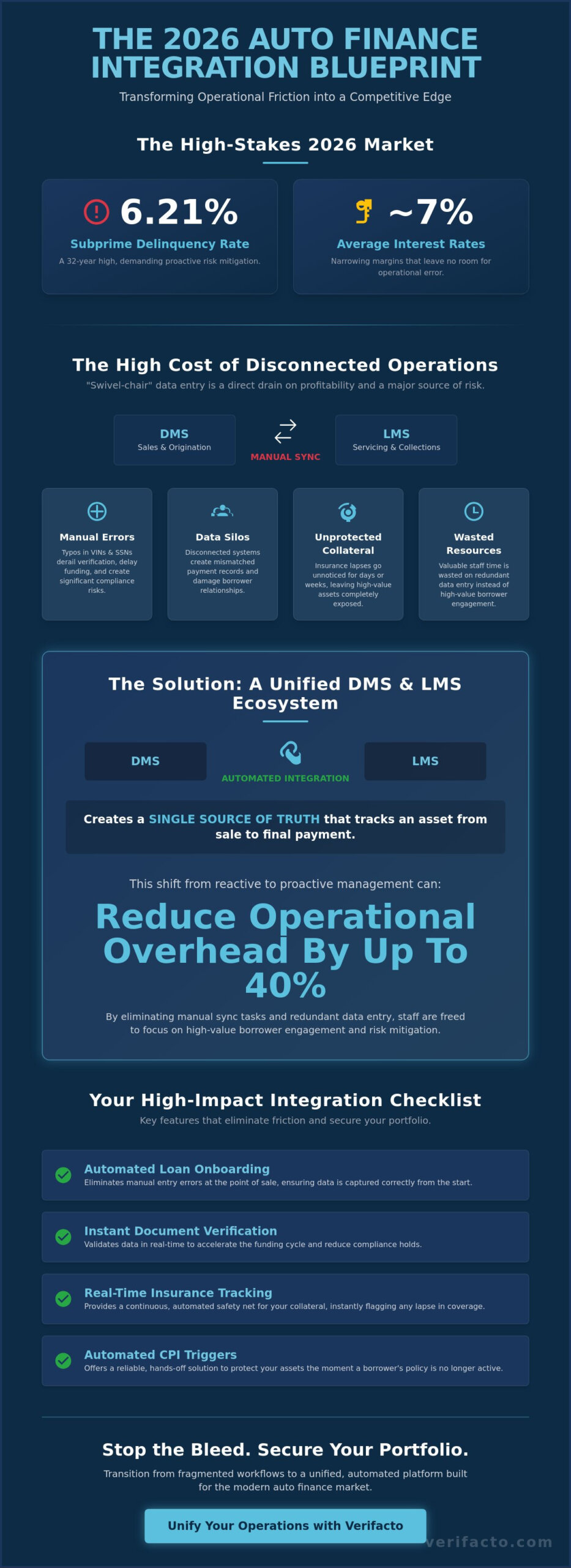
Did you know that subprime delinquency rates hit a 32-year high of 6.21% in February 2026? It’s a sobering reality for lenders who are already battling average interest rates near 7%. You likely feel the pressure of manual insurance verification and the frustration of payment data that never seems to sync between your systems. If your team is stuck in a cycle of manual data entry and reactive collections, you aren’t just losing time; you’re leaving your collateral unprotected. Achieving true efficiency requires streamlining auto finance operations with DMS integration to stop the bleed before it starts.
We understand that the margin for operational error has vanished in this high-stakes environment. This guide will show you how to transform your workflow by bridging the gap between your sales and servicing departments. You’ll discover how a unified DMS and LMS ecosystem creates a single source of truth that automates risk mitigation and improves collection efficiency. We’ve compiled the 2026 integration checklist to help you eliminate operational friction and secure your bottom line against market volatility.
Key Takeaways
- Identify the hidden costs of “swivel-chair” data entry and learn how manual workflows create unnecessary risk in the 2026 subprime market.
- Discover the strategic advantage of streamlining auto finance operations with DMS and LMS integration to establish a single source of truth for every loan.
- Implement a high-impact checklist focused on automated loan onboarding and instant document verification to eliminate operational friction.
- Understand how real-time insurance tracking and automated CPI triggers provide a reliable, hands-off safety net for your collateral.
- Assess your current software stack for integration gaps and transition to secure cloud infrastructure to maintain a competitive edge.
Identifying Operational Friction in Modern Auto Finance
Operational friction isn’t just a minor technical nuisance; it’s a direct drain on your dealership’s profitability. In a market where subprime delinquency rates hit 6.21% in February 2026, every second your team spends moving data from one screen to another is a second you aren’t spending on risk mitigation. The high-rate environment, with average interest rates hovering near 7%, has effectively erased the margin for operational error. If your back-office processes are slow, your capital is at risk.
Most dealerships rely on a Dealership Management System (DMS) to handle the front-end sales process, but a disconnect often exists between that system and the tools used for loan servicing. This gap is at the heart of streamlining auto finance operations with DMS. When these systems don’t talk to each other, your staff is forced into “swivel-chair” data entry. This manual re-entry of borrower information and payment terms invites human error, slows down the funding cycle, and creates a lag in your ability to respond to missed payments or insurance lapses.
The High Price of Data Silos
Siloed data is a silent killer for your portfolio. When your loan management and sales platforms operate in isolation, you lose the single source of truth required for accurate reporting. Mismatched payment records are a common result, leading to awkward and unnecessary collection calls that damage borrower relationships. Even more critical is the risk to your collateral. A lapse in insurance coverage might go unnoticed for days or weeks because the notification didn’t trigger an immediate alert in your servicing tool. In 2026, you can’t afford to leave a vehicle unprotected because of a slow data sync. Fragmented data also hinders your borrower communication, which directly lowers recovery rates during the early stages of delinquency.
Manual Entry: The Compliance Time Bomb
Manual workflows act as a liability, particularly in the high-stakes subprime market. Common errors during loan onboarding, such as typos in VINs or social security numbers, can derail your document verification process and delay funding for days. These mistakes aren’t just administrative headaches; they are significant auto finance compliance management risks. Federal regulators in 2026 are increasingly focused on data accuracy and fair lending practices. Automated integration is essential for streamlining auto finance operations with DMS because it ensures that data is captured correctly at the point of sale and flows seamlessly into your compliance and servicing workflows without human intervention. This shift from manual to automated processes is the only way to maintain the speed and accuracy required by today’s regulatory environment.
The Core Benefits of Integrated DMS and LMS Platforms
Integration isn’t just a technical upgrade; it’s a fundamental shift in how you manage risk and capital. An integrated DMS/LMS ecosystem merges your front-end sales process with back-end loan servicing into a cohesive unit. By streamlining auto finance operations with DMS and LMS connectivity, you establish a single source of truth that tracks an asset from the moment it leaves the lot until the final payment is cleared. This unified approach prevents the “data drift” that occurs when sales and servicing teams work from disconnected systems, ensuring everyone is looking at the same facts.
Real-Time Data Synchronization
Immediate data flow is the lifeblood of a modern dealership. Using modern technology for auto finance companies, updates occur in milliseconds rather than days. When a payment is processed or an insurance policy changes, the information is instantly reflected across your entire platform. This live synchronization allows portfolio managers to act on real-time insights, shifting from a reactive stance to a proactive one. Industry benchmarks suggest that removing manual sync tasks and redundant data entry can reduce operational overhead by up to 40%, freeing your staff to focus on high-value borrower engagement rather than administrative cleanup.
Unified Borrower Profiles for Better Servicing
Servicing excellence requires a complete, 360-degree picture of the borrower. A unified profile consolidates communication logs, payment histories, and real-time insurance tracking into one accessible view. This level of transparency enables your collections team to have more effective, personalized conversations. They don’t have to hunt for documents or verify insurance status while on the phone; the answers are already there. The Unified Profile is the cornerstone of 2026 lending, providing the reliable data foundation necessary for every borrower interaction.
Cloud connectivity takes this a step further by providing 24/7 operational visibility from any location. This ensures your dealership stays aligned with federal consumer financial laws by maintaining accurate, auditable records that are always up to date. Managing these moving parts doesn’t have to be a struggle when you leverage a unified software stack designed specifically for the rigors of the auto finance industry.
Operational Efficiency Checklist: Features That Streamline Workflow
Efficiency in 2026 isn’t about working harder; it’s about deploying tools that work autonomously. While the previous sections established the need for a unified data environment, this checklist focuses on the specific features that drive that transformation. Achieving a high-performing portfolio requires more than just a digital filing cabinet. You need active systems that monitor, alert, and execute routine tasks without human intervention. Streamlining auto finance operations with DMS requires a focus on these four pillars of automation.
- Automated Loan Onboarding: Instant document verification and data extraction to eliminate manual entry errors.
- Real-Time Insurance Tracking: Continuous monitoring of policy status with automated alerts for lapses.
- Built-in Payment Processing: Native ACH and credit card handling to remove third-party reconciliation delays.
- Automated Borrower Communication: Programmatic reminders for upcoming payments, late notices, and insurance requests.
Automated Insurance Tracking and CPI Triggers
Manual insurance checks are a relic of a slower era. Real-time monitoring protects your collateral by verifying coverage status every single day. When a policy lapses, the system should instantly trigger a sequence of borrower notifications. If the borrower fails to provide proof of insurance within the required grace period, automated Collateral Protection Insurance (CPI) placement ensures your asset remains protected. This trigger mechanism removes the guesswork. It eliminates the window of vulnerability that often leads to total losses when an uninsured vehicle is involved in an accident. You gain security without adding to your team’s daily workload.
Built-in Payment Processing and ACH
Disconnected payment systems create a reconciliation nightmare. By utilizing integrated payment solutions for dealers, you remove the friction of third-party portals. Automated ACH recurring payments are the gold standard for reducing delinquency. They ensure funds are pulled on the due date without requiring borrower action. This seamless approach reduces charge-offs and provides multiple payment channels, such as text-to-pay or mobile portals, meeting the borrower where they are. Streamlining auto finance operations with DMS means your payment data is always current, providing an accurate look at your cash flow at any moment.
Automated borrower notifications round out this efficiency model. Instead of your staff spending hours on the phone, the system handles the heavy lifting of reminders and default notices. These automated touchpoints keep the borrower informed and encourage on-time behavior, which is critical for maintaining a healthy subprime portfolio in today’s economy. When you automate the routine, your team can focus on the exceptions that truly require a human touch.
Modernizing Your Lending Operations for 2026
Modernizing your operations is no longer a luxury; it’s a strategic necessity. As we move through 2026, the competitive gap between lenders using legacy systems and those using integrated platforms continues to widen. Streamlining auto finance operations with DMS requires a rigorous audit of your current technology stack. You must identify where data flow stops and manual intervention begins. These “integration gaps” are exactly where your profits leak and where human error takes root.
Success in this transition depends on more than just software. It requires training your staff to stop thinking like data entry clerks and start acting like portfolio analysts. When your team leverages automated communication tools effectively, they shift from reactive fire-fighting to proactive account management. This cultural shift, supported by the right technology, is what allows a dealership to thrive despite the economic pressures of a high-rate environment. Selecting the right auto loan management software is a foundational decision that shapes every aspect of this transformation.
Transitioning to Cloud-Based Infrastructure
On-premise servers are quickly becoming a liability for growth-minded lenders. They lack the agility required for national operations and often fall behind on critical security patches. Implementing a cloud based loan management system provides the flexibility your team needs to access data from anywhere while ensuring your infrastructure is hardened against modern cyber threats. Cloud platforms also offer a significant compliance advantage. As federal and state regulations evolve, updates are pushed automatically. This ensures your dealership always operates within the latest legal frameworks without requiring manual software overhauls or expensive downtime.
Scaling Without Increasing Headcount
Profitability is often hindered by the outdated belief that a larger portfolio requires a larger team. Automation flips this script. By offloading routine tasks to your integrated system, a lean team can effectively manage thousands of loans with precision. This shift reduces the administrative burden on your collection agents, allowing them to focus their human expertise on high-value auto loan default management tasks. When your software handles the routine reminders and insurance tracking, your staff can spend their time on the complex negotiations that prevent repossessions and preserve your capital.
Measuring your ROI is the final step in this modernization journey. You’ll see the impact in two primary areas: a sharp decrease in operational costs per loan and a measurable improvement in your recovery rates. By reducing the time spent on manual verification and data entry, you lower your overhead. Simultaneously, the speed of automated notifications ensures you reach delinquent borrowers faster, which is the most effective way to prevent a default before it happens.
Ready to see the difference a unified platform makes for your bottom line? Schedule a demo with Verifacto today and close your integration gaps for good.
Verifacto: The Unified Solution for Auto Finance Professionals
The previous sections established the “why” and “how” of operational modernization. Now, it’s time to focus on the “who.” Verifacto provides the specialized technology required to turn these strategic goals into daily realities. Unlike generic dealership software that treats finance as an afterthought, our platform is built from the ground up for the high-stakes world of auto lending. By streamlining auto finance operations with DMS and LMS tools that share a single heartbeat, we help you eliminate the gaps where risk and inefficiency hide.
Our solution isn’t just a collection of features; it’s a unified engine designed to protect your capital. With built-in Payment Processing tailored for the specific cycles of auto finance, you no longer have to reconcile disparate systems at the end of the month. Every payment, every insurance update, and every borrower interaction is logged in real time. This ensures that your portfolio data is always accurate and ready for audit.
Why True Integration Outperforms Third-Party Plugins
Many lenders attempt to bridge their operational gaps using a patchwork of third-party plugins and fragile APIs. This approach often leads to system instability and data lag, which can be catastrophic when you need to act on a delinquency immediately. Verifacto offers a single-platform code base that houses both your Verifacto DMS and Verifacto LMS. This “no-nonsense” architecture provides a level of stability that plugins simply cannot match. You don’t have to worry about a software update in one tool breaking the connection to another.
Verifacto serves as the reliable guardian of your portfolio, standing watch over your assets so you don’t have to. This mastery over complex operational data allows you to scale your business with total confidence in your underlying technology.
Transforming Collections with Automated Communication
One of the most immediate impacts of streamlining auto finance operations with DMS is the reduction in 30-day delinquency rates. Verifacto’s Automated Borrower Communication handles the heavy lifting of sending text and email reminders before a payment is even due. When a borrower does fall behind, the system moves with surgical precision. It manages the transition from a simple payment reminder to a formal insurance request or CPI placement through our Insurance Tracking (CIMS™) system.
This automated safety net ensures that no account is ever ignored. If a borrower’s insurance lapses, our CPI Solutions trigger automatically, keeping your collateral protected without requiring a single phone call from your staff. This level of automation doesn’t just save time; it saves your business from the total losses that occur when uninsured vehicles are lost to accidents or repossession. It’s time to stop fighting your software and start using a platform designed for your success.
Ready to see how a truly unified platform can transform your bottom line? Schedule a demo with Verifacto today and take the first step toward a more secure, efficient future.
Mastering the 2026 Lending Landscape
The 2026 auto finance market leaves no room for manual inefficiency or disconnected data silos. By prioritizing the deep integration of your sales and servicing tools, you move from a reactive position to one of absolute control. You’ve seen how streamlining auto finance operations with DMS eliminates the risks of manual data entry and creates a single source of truth for every asset. Automation isn’t just a convenience; it’s the reliable guardian of your capital.
Verifacto provides the specific tools you need to navigate this high-stakes environment safely. Our integrated LMS & DMS cloud platform ensures your data stays in sync while real-time CIMS™ insurance tracking protects your collateral from the moment of funding. When you combine this with built-in automated borrower communication, you create a seamless workflow that reduces delinquency and boosts your bottom line. You don’t have to face operational friction alone.
Streamline your operations with the Verifacto integrated platform today. We’re ready to help you build a more secure and profitable future for your dealership.
Frequently Asked Questions
How does an integrated DMS/LMS reduce manual data entry?
An integrated system eliminates the need for “swivel-chair” entry by syncing the deal jacket directly with the loan servicing ledger. Once a deal is finalized in the DMS, the borrower’s profile and contract terms populate the LMS automatically. This ensures data integrity and removes the risk of human error during loan onboarding. You save hours of administrative labor while ensuring your records remain consistent across every department.
Can I track borrower insurance in real-time with a DMS?
Yes, when you use a platform like Verifacto that features live insurance tracking. The system continuously monitors policy status and alerts your team the moment a lapse is detected. This real-time visibility is a core component of streamlining auto finance operations with DMS, as it allows you to protect your collateral without the need for manual follow-up or constant phone calls to agents.
What are the benefits of integrated payment processing for auto lenders?
Integrated payment processing removes the friction of third-party reconciliation by posting payments directly to the borrower’s ledger in real time. It supports automated ACH and recurring credit card payments, which significantly reduces the administrative burden on your staff. This native connectivity provides a clear view of your cash flow and helps lower delinquency rates through consistent, automated collection cycles.
How does automated borrower communication improve collection efficiency?
It improves efficiency by handling routine touchpoints like payment reminders and late notices without staff intervention. By using automated text and email sequences, you can reach borrowers through their preferred channels at the most effective times. This allows your collection agents to focus exclusively on high-risk accounts that require complex negotiation rather than spending their day on simple reminders.
Is a cloud-based DMS secure for sensitive financial data?
Modern cloud-based systems are often more secure than on-premise servers because they utilize enterprise-grade encryption and continuous security monitoring. These platforms are designed to comply with rigorous financial data standards, providing automatic updates that address new cyber threats immediately. You gain the flexibility of remote access for your team without compromising the safety or privacy of your borrower’s sensitive information.
What is the role of CPI in streamlining auto finance operations?
Collateral Protection Insurance (CPI) acts as an automated safety net that triggers when a borrower’s primary insurance coverage lapses. By integrating CPI solutions with your DMS and LMS, you automate the placement process and the subsequent borrower notification cycle. This reduces the financial risk to your portfolio while streamlining auto finance operations with DMS by removing the manual work of tracking and placing coverage.
How long does it take to transition to an integrated DMS LMS platform?
The transition timeline depends on your portfolio size, but most lenders are fully operational within a few weeks. A structured implementation plan includes secure data migration from your legacy systems and comprehensive staff training on the new automated workflows. A supportive partner manages the technical heavy lifting to ensure your daily operations continue smoothly without any significant disruption to your business.
Can a DMS help with auto finance compliance management?
Yes, an integrated system automates the record-keeping and data accuracy required for federal and state regulatory compliance. It ensures that all borrower communications, payment histories, and insurance records are stored in a single, auditable source of truth. This transparency simplifies the examination process and helps you maintain strict adherence to fair lending and consumer protection laws through automated documentation and reporting.