
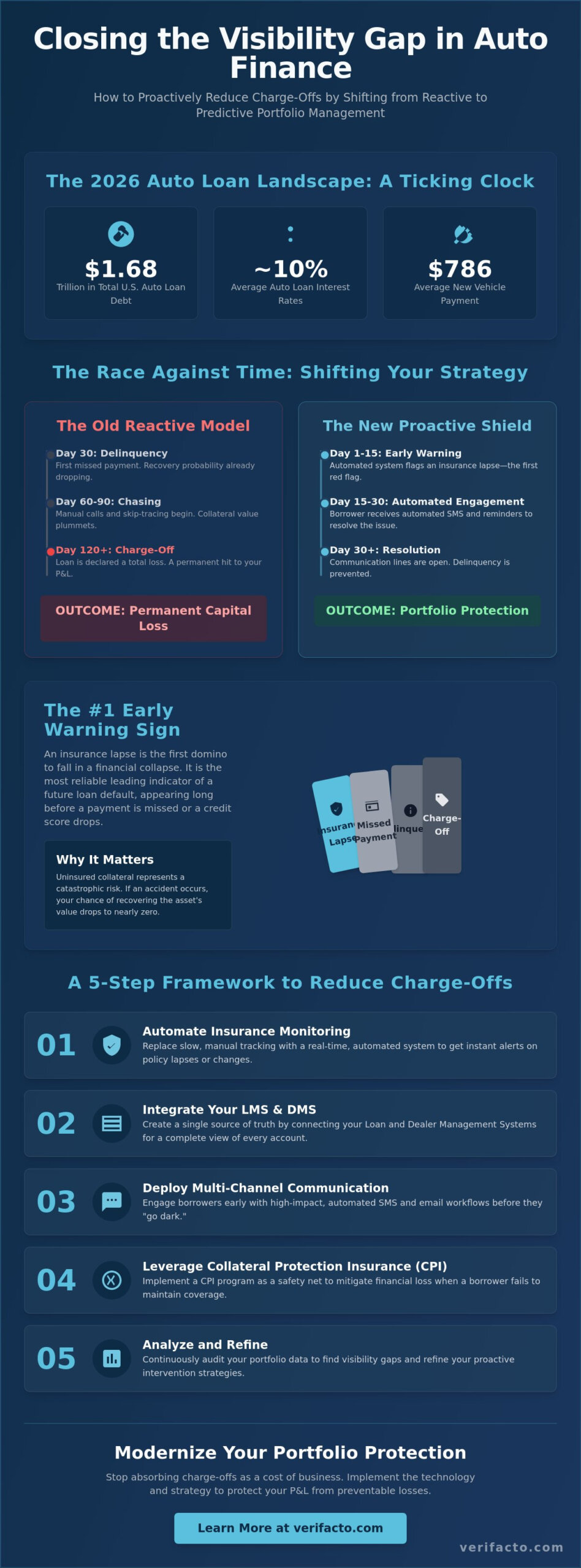
What if your charge-off ratio isn’t a reflection of your collections team’s effort, but rather a symptom of a visibility gap you haven’t closed yet? With total U.S. auto loan debt hitting a record $1.68 trillion in May 2026 and average interest rates near 10%, the stakes for portfolio protection are at an all-time high. Most lenders treat a write-off as an inevitable cost of doing business, but learning how to reduce charge-offs in auto finance starts with a fundamental shift in perspective. It’s about identifying the “dark” borrower long before the first missed payment becomes a permanent loss on your balance sheet.
You’ve likely felt the frustration of manual insurance tracking and the high costs of skip-tracing. It’s a slow, error-prone process that often leaves you reacting to crises rather than preventing them. This guide promises to change that by providing the technological and operational strategies needed to identify early warning signs and secure your collateral. We’ll walk through how automated workflows and real-time data can turn your loan management system into a proactive shield for your P&L.
Key Takeaways
- Identify why insurance lapses serve as the most reliable early warning signal for potential loan defaults.
- Discover how to reduce charge-offs in auto finance by replacing manual tracking with automated, real-time collateral monitoring.
- Learn to deploy multi-channel communication workflows that re-engage delinquent borrowers through high-impact SMS and automated reminders.
- Execute a 5-step operational audit to find and close visibility gaps within your current loan portfolio.
- Explore how an integrated LMS and DMS platform creates a single source of truth to protect your P&L from preventable losses.
The True Cost of Auto Loan Charge-Offs in 2026
A Charge-off is more than just an accounting entry where a debt is written off as uncollectible. For auto lenders in 2026, it represents a total breakdown in the borrower-lender relationship and a permanent loss of capital. While consumers often view this as a credit reporting event, you see it as a direct hit to your bottom line. Understanding how to reduce charge-offs in auto finance requires looking past the balance sheet to account for the actual cash flow interruption. With the average new vehicle payment reaching $786 and used payments at $536, a single default creates a significant hole in your monthly revenue projections.
Collateral depreciation is a relentless enemy in this process. Every day a vehicle remains in the hands of a delinquent borrower, its potential recovery value drops. This is compounded by the “silent killer” of administrative overhead. Your team likely spends dozens of hours on manual tracking, repeated phone calls, and documentation for accounts that are already past the point of no return. This staff time is a sunk cost that you can never recover, making the true price of a charge-off much higher than the principal balance alone.
Why 120 Days is Too Late to Act
Traditional banking models often suggest waiting 120 to 180 days before declaring a total loss. In the modern market, that timeline is a recipe for disaster. The probability of recovery drops significantly after the first 30 days of delinquency. If you want to know how to reduce charge-offs in auto finance, you must shift from a reactive mindset to a 15-day proactive monitoring strategy. Catching a lapse in insurance or a missed check-in within the first two weeks prevents the borrower from “going dark” and keeps the lines of communication open before the situation escalates.
Hidden Costs: Repossession and Legal Overhead
The math of repossession rarely favors the lender. Once you factor in skip-tracing fees, towing costs, and auction commissions, your net recovery is often a fraction of the vehicle’s book value. Beyond the physical recovery, you face growing legal overhead. Regulatory scrutiny in 2026 has increased regarding collection practices, meaning every aggressive move carries a potential compliance risk. Investing in automated communication and real-time visibility is almost always more cost-effective than chasing a vehicle across state lines and dealing with the legal fallout of a failed recovery. Adopting proven auto finance collections best practices can help you build a recovery strategy that minimizes these costs before they compound into permanent losses.
Identifying Early Warning Signs: The Insurance Connection
Lenders often rely on credit scores to predict risk, but by the time a score drops, the damage is already done. A more immediate signal of financial distress is the status of the borrower’s insurance policy. There is a direct, measurable correlation between insurance lapses and subsequent payment defaults. When a borrower stops paying their premium, it’s often the first domino to fall in a total financial collapse. This makes insurance status a vital leading indicator for anyone looking at how to reduce charge-offs in auto finance. If you wait for the missed payment to trigger an alert, you’re already behind the curve.
Uninsured collateral represents a catastrophic risk to your portfolio. If a vehicle is totaled without coverage, your chance of recovery drops to near zero. Relying on manual tracking or outdated spreadsheets is a recipe for failure in a high-volume environment. Manual calls to agents are slow, and the information is often outdated the moment your staff hangs up the phone. Modernizing this process with automated insurance tracking ensures you aren’t left holding an empty bag when an accident occurs.
Real-Time Insurance Monitoring
Automation allows you to verify coverage without the friction of manual outreach. By integrating insurance data directly into your Loan Management System (LMS), you gain instant visibility into policy changes. High-risk borrowers often reveal themselves through frequent policy cancellations or “insurance hopping.” Identifying these patterns early allows your team to intervene before the first payment is even missed. This proactive stance is the most effective way to maintain control over your assets. Recent Federal Reserve analysis of delinquency rates highlights the continued volatility in consumer credit, reinforcing the need for real-time data over historical reports.
Leveraging CPI to Mitigate Financial Loss
Collateral Protection Insurance (CPI) serves as a critical safety net when a borrower fails to maintain required coverage. When a lapse is detected, force-placing insurance protects the underlying asset’s value and ensures your interest remains covered. It’s essential to communicate this clearly to the borrower to encourage them to reinstate their own policy. CPI prevents a total charge-off during a total loss event by providing the necessary funds to cover the remaining loan balance. This strategy remains a cornerstone for lenders determining how to reduce charge-offs in auto finance while managing high-risk portfolios.
Proactive Borrower Engagement Strategies
Many lenders lose contact with borrowers simply because they wait too long to reach out. When a borrower misses a payment, they often feel a sense of anxiety that leads them to stop answering calls. You can break this cycle by shifting your tone from a confrontational collector to a helpful advisor. Establishing a partner relationship early in the loan lifecycle is a key component of how to reduce charge-offs in auto finance. It’s about being proactive rather than reactive, showing the borrower that you’re there to help them keep their vehicle, not just to take it away.
Forgetfulness is often the root cause of the first missed payment. Multi-channel notifications ensure the loan stays top-of-mind. Reaching out on day one of a missed grace period demonstrates that you’re paying attention without being aggressive. It allows you to offer solutions before the debt becomes unmanageable. Traditional phone calls are increasingly ignored by modern consumers. SMS has a much higher engagement rate because it’s less intrusive and allows borrowers to respond at their convenience. A simple text with a direct payment link can resolve a delinquency in seconds, preventing a minor delay from turning into a major loss. For a complete operational breakdown of how to build these workflows compliantly, see our guide to text messaging for loan collections in 2026.
Omnichannel Communication Framework
To maximize results, you need a system that utilizes SMS, email, and push notifications in a coordinated effort. This omnichannel approach ensures your message reaches the borrower where they’re most likely to see it. Reducing friction is essential; every communication should include an automated payment link. This allows the borrower to take action the moment they have the intent to pay. By improving collection efficiency auto loans through these digital channels, you significantly lower the chance of an account sliding into the charge-off category.
Compliance in Automated Outreach
Speed and automation must never come at the expense of legal safety. Navigating TCPA and FDCPA regulations is mandatory to avoid costly litigation. Every automated message should be logged, timestamped, and auditable within your Dealer Management System (DMS). This creates a transparent record of all interactions, protecting you during audits. Implementing a robust auto finance compliance management strategy ensures that your outreach remains both effective and legally sound. This balance is critical for any lender looking at how to reduce charge-offs in auto finance while scaling their operations.
A 5-Step Operational Framework to Reduce Charge-Offs
Lenders often struggle with high loss ratios because their internal processes are reactive rather than systemic. To truly master how to reduce charge-offs in auto finance, you need a repeatable framework that removes human error and provides total portfolio visibility. This five-step approach moves your operations from a state of constant firefighting to a streamlined, data-driven machine. By standardizing these steps, you create a predictable environment where risk is managed before it impacts your bottom line.
- Step 1: Audit your current portfolio for insurance gaps to identify immediate collateral risks.
- Step 2: Implement a centralized LMS and DMS with real-time data syncing to eliminate information silos.
- Step 3: Standardize your “Early Delinquency” communication scripts to ensure professional, compliant, and effective outreach.
- Step 4: Automate payment processing to eliminate manual entry errors and reduce friction for the borrower.
- Step 5: Review performance metrics monthly to refine your risk model and adjust underwriting criteria based on real-world outcomes.
Step 1 & 2: Building the Foundation
Siloed data is one of the most common reasons for preventable losses. When your sales data in the DMS isn’t communicating perfectly with your collections data in the LMS, critical warning signs fall through the cracks. You can’t afford to wait for a weekly report to find out a borrower’s insurance has lapsed. Cloud-based access is no longer a luxury; it’s a necessity for real-time portfolio management. An integrated DMS and LMS platform provides a single source of truth that allows your team to act on delinquency the moment it occurs. This immediate visibility is the only way to stay ahead of a rapidly depreciating asset.
Step 4 & 5: Closing the Loop
Built-in payment processing is a game changer for reducing the “Non-Sufficient Funds” (NSF) rate. When payments are integrated directly into your management system, you can offer flexible scheduling and immediate re-attempts, which keeps the loan performing. However, automation is only half the battle. You must track Key Performance Indicators (KPIs) like the insurance lapse rate and first-payment default rate to predict future charge-off trends. This creates a vital feedback loop between your collections department and your underwriting team. If a specific borrower profile or lead source consistently leads to losses, your data should tell you immediately. Ready to see how these steps look in practice? Explore the Verifacto LMS and DMS suite to start modernizing your operations today.
Modernizing Your Portfolio with Verifacto
Executing a strategy is only as effective as the tools you use to manage it. Understanding how to reduce charge-offs in auto finance is a strategic win, but implementing the right technology is what makes those gains permanent. Verifacto provides an integrated LMS and DMS suite that serves as a single source of truth for the entire loan lifecycle. By consolidating your data into one cloud-based environment, you eliminate the delays and errors that typically lead to account deterioration. It’s time to stop reacting to losses and start preventing them through superior visibility.
Real-time insurance tracking is the core of this protective layer. Rather than guessing the status of your collateral, you gain instant knowledge of policy changes, cancellations, or lapses. When a gap is detected, Verifacto’s scalable CPI solutions and automated borrower communication tools trigger immediately. This allows you to boost recovery rates and maintain asset protection without adding a single person to your headcount. These automated workflows ensure that your team spends their time on high-value tasks, while the system handles the repetitive monitoring required to keep your portfolio secure.
Why True Integration Wins
Fragmented legacy systems are a primary driver of operational friction. When your collections team is working from a different data set than your sales team, critical information gets lost in the shuffle. Verifacto’s all-in-one approach replaces these disjointed tools with a streamlined platform designed for the 2026 market. This “Guardian” approach protects your portfolio by using technology to watch over every account simultaneously. It creates a sense of security for the lender, knowing that no lapse in insurance or missed payment will go unnoticed. This level of mastery over your operations is essential for anyone serious about how to reduce charge-offs in auto finance.
Get Started with a Risk Audit
The first step toward modernization is identifying the “leaks” in your current collection process. A comprehensive risk audit reveals where your manual workflows are failing and where your collateral is most vulnerable. Transitioning to a cloud-based loan management environment is seamless, allowing you to migrate your data and begin seeing real-time insights almost immediately. This shift doesn’t just improve your charge-off ratio; it transforms your entire business model into one that is faster, leaner, and more resilient. Protect your portfolio and reduce charge-offs with Verifacto today.
Take Control of Your Portfolio’s Future
The lending landscape of 2026 demands a shift from reactive collections to proactive asset protection. You’ve seen how real-time insurance monitoring and cloud-integrated data provide the visibility needed to act before a delinquency becomes a permanent loss. By bridging the gap between your DMS and LMS, you remove the operational blind spots that often result in unrecoverable debt. Mastery over how to reduce charge-offs in auto finance isn’t about working harder; it’s about deploying smarter technology that acts as a 24/7 guardian for your collateral.
Verifacto is ready to partner with you to implement these high-impact strategies. Our platform offers real-time insurance monitoring across your entire portfolio, seamless cloud-based integration, and automated borrower communication tools that drive results without increasing your overhead. You can stop chasing lost causes and start growing a more stable, profitable business. Request a Demo of Verifacto’s Integrated LMS & Insurance Tracking to see these tools in action. Let’s build a more secure future for your lending operations together.
Frequently Asked Questions
What is the industry average for auto loan charge-off rates?
As of April 2026, the net charge-off rate for auto loans at U.S. banks stands at 1.13%. Other major lenders, such as Capital One, reported a charge-off rate of 1.64% for the first quarter of 2026. These benchmarks serve as a critical health check for your own portfolio, helping you determine if your current risk mitigation strategies are keeping pace with the broader market.
How does insurance tracking directly reduce the number of charge-offs?
Insurance tracking serves as a leading indicator of financial distress, allowing you to identify “dark” borrowers before they miss a payment. When a policy lapses, it often signals that the borrower is prioritizing other expenses. By intervening at the moment of the lapse, you can re-engage the borrower and secure the collateral, which is a fundamental step in how to reduce charge-offs in auto finance.
Can automated SMS reminders really improve collection rates?
Automated SMS reminders significantly boost collection rates by meeting borrowers on the devices they use most frequently. Text messages have much higher engagement and open rates than traditional phone calls or physical mail. By including a direct payment link in the text, you remove the friction that often prevents a borrower from resolving a minor delinquency before it escalates into a total loss. Learn how to build a fully compliant and effective text messaging for loan collections program to maximize these results.
What is the difference between a repossession and a charge-off?
Repossession is the physical recovery of the vehicle after a borrower defaults, while a charge-off is the accounting process of writing the debt off as uncollectible. A charge-off typically happens after an account is 120 to 180 days past due. Your goal is to use tools like real-time tracking to trigger a repossession or a workout plan long before the debt must be charged off.
How do I implement Collateral Protection Insurance (CPI) without upsetting borrowers?
Successful CPI implementation relies on transparent, proactive communication that positions the lender as a protective partner. You should notify the borrower the moment an insurance lapse is detected and explain that CPI is a necessary step to maintain the loan agreement. Clear messaging helps the borrower understand that reinstating their own coverage is the best way to manage their monthly costs while keeping the asset protected.
Is it possible to automate insurance verification for an entire portfolio at once?
Yes, modern technology allows you to automate insurance verification across your entire portfolio through real-time data syncing. This replaces the slow, manual process of calling agents or checking individual websites. Automating this visibility is a cornerstone of how to reduce charge-offs in auto finance, as it provides instant alerts for every uninsured vehicle in your system without requiring additional staff time.
How does an integrated LMS/DMS improve my dealership’s cash flow?
An integrated LMS and DMS improves cash flow by creating a seamless transition from the point of sale to the collection phase. When data flows freely between systems, you eliminate manual entry errors and identify payment issues much faster. This real-time visibility allows you to process payments more efficiently and re-engage delinquent borrowers sooner, keeping more of your capital in a performing state.
What are the compliance risks of using automated borrower communication?
The main compliance risks involve the TCPA and FDCPA, which regulate how and when you can contact borrowers. To stay protected, you must ensure that every automated message is logged and auditable within your system. Maintaining clear opt-in and opt-out records is essential. Using a platform that automatically tracks these interactions helps you scale your outreach while remaining fully compliant with federal and state regulations. For a deeper look at how leading lenders are modernizing their recovery strategies, explore this comprehensive guide to auto finance collections best practices for 2026.