
What if the biggest threat to your portfolio isn’t the economy, but the manual data entry your team performs for every single payment? In an environment where the 90-day auto loan delinquency rate has reached 5.60%, you can’t afford the “fragmentation penalty” caused by disconnected systems. You likely recognize that friction in the payment process is the primary driver of late accounts, yet many lenders are still forced to toggle between screens just to verify insurance coverage or update a ledger. It’s a drain on resources that stunts your growth and creates unnecessary financial risk.
This guide demonstrates how an LMS with built in payment processing eliminates these operational silos, reduces revenue leakage, and modernizes your entire lending lifecycle. You’ll learn how a unified operating platform provides real-time visibility into every account, from the first lead to the final payment. We will explore how automated recurring payments and embedded AI agents can sync your data instantly, giving you total control over your information while reducing vendor lock-in. By the end of this article, you’ll understand how to transform your servicing department from a cost center into a streamlined engine for recovery and retention.
Key Takeaways
- Identify the financial impact of the “fragmentation penalty” and how manual data re-entry between systems leads to revenue leakage.
- Discover why choosing an lms with built in payment processing provides more reliable ledger updates than traditional third-party middleware integrations.
- Learn to utilize the LoanApp and embedded AI agents to automate borrower engagement and streamline the collections workflow.
- Understand how a unified operating platform reduces vendor lock-in by maintaining data sovereignty and providing easy access for analytics.
- Evaluate essential 2026 security standards, such as SOC II compliance and high uptime guarantees, to protect your business continuity.
The Fragmentation Penalty: Why Disconnected Payment Systems Stall Auto Lending
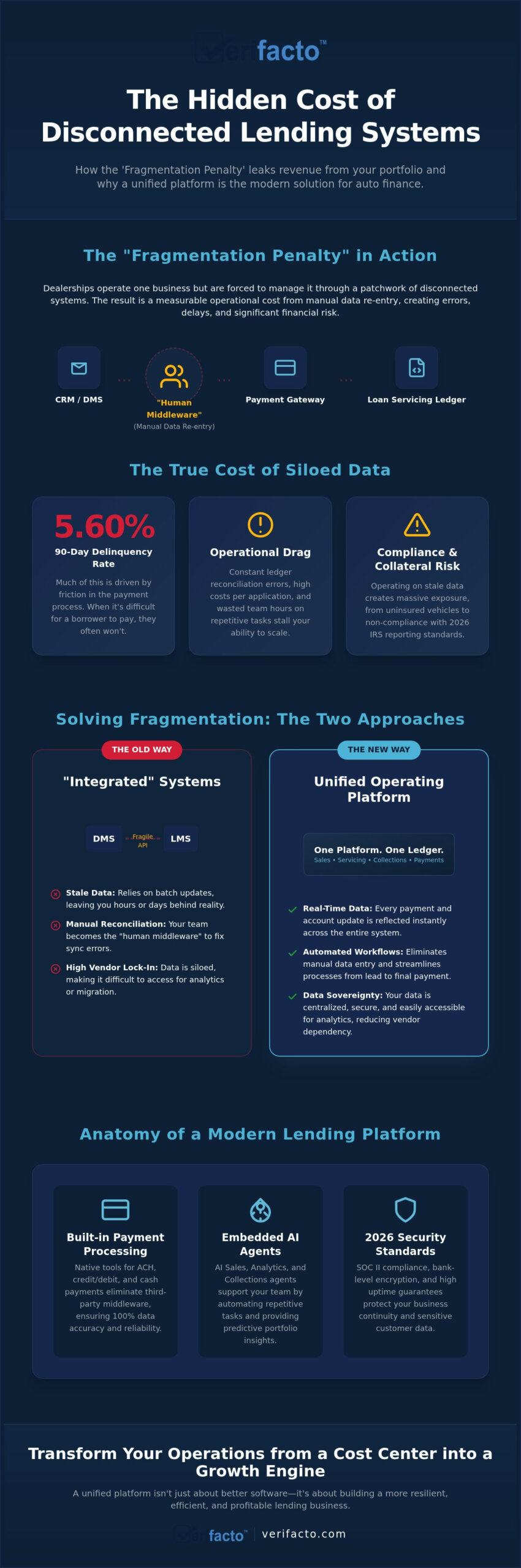
Dealerships operate one business but are often forced to manage it through disconnected systems. This creates a “fragmentation penalty,” which is the measurable operational cost of manual data re-entry between your DMS and third-party payment gateways. When your loan servicing software doesn’t talk to your payment processor, your team becomes the “human middleware” responsible for syncing ledgers. This isn’t just an administrative burden; it’s a financial drain that limits your ability to scale. While a traditional Learning Management System provides a base for administrative tracking, a modern auto finance platform must handle complex financial flows natively.
Legacy “integrated” systems often fail because they rely on fragile API connections that don’t update in real-time. If a payment is processed at 2:00 PM but doesn’t reflect in your LMS until the next morning, you’re operating on stale data. This lag creates significant compliance risks, especially with the 2026 IRS “One Big Beautiful Bill Act” requiring precise borrower interest statements. Choosing an lms with built in payment processing is no longer a luxury. It’s the 2026 standard for any lender who wants to treat payments as a core data stream rather than a third-party add-on.
Recognizing Symptoms of Disconnected Operations
The most obvious sign of fragmentation is the frequent reconciliation error. If your bank statements and your LMS ledger rarely match without manual adjustments, your system is failing you. High costs per application are another symptom, often driven by the time spent manually setting up recurring payments or verifying bank details across multiple screens. For auto lenders, operational efficiency is the absolute elimination of duplicate data entry. When your team stops typing the same customer name into three different platforms, they can focus on higher-value tasks like portfolio analysis and risk mitigation.
The True Cost of Manual Payment Workflows
Manual workflows carry a heavy price tag in the form of time and delinquency. Every minute spent on manual payment reminders or processing cash receipts is a minute lost to growth. Statistics from early 2026 show the 90-day auto loan delinquency rate reached 5.60%, and much of this is driven by friction in the payment process. If it’s difficult for a borrower to pay, they often won’t.
Siloed data also creates massive collateral exposure. When your insurance tracking isn’t synced with payment status, you might continue accepting payments on a vehicle that no longer has active coverage. A unified operating platform designed with embedded AI tools ensures that payment data and insurance status live in the same ecosystem. This provides greater visibility and allows you to catch lapses before they turn into total losses. Transitioning to a native system ensures that every dollar collected is immediately reflected across your entire operation, securing your portfolio and your peace of mind.
The Anatomy of a Modern LMS with Built-in Payment Processing
A modern operating platform isn’t a collection of disparate tools. It’s a unified environment where data flows freely between sales, servicing, and collections. An lms with built in payment processing serves as the central hub of this ecosystem. By housing native tools for ACH, credit/debit cards, and cash payments, the platform eliminates the need for third-party middleware that often breaks or delays data synchronization. This architecture ensures that every transaction is captured securely with bank-level encryption and SOC II compliance, providing the stability required for high-stakes lending.
Embedded AI: Supporting Human Judgment in Lending
The AI Sales Agent is a critical component of this anatomy. It manages lead engagement from the initial contact through the first payment, ensuring no opportunity falls through the cracks. This isn’t about replacing your staff; it’s about providing them with an embedded tool that automates repetitive follow-ups and data entry. While the Sales Agent handles the front end, the Analytics Agent provides real-time dashboards that offer a predictive look at portfolio performance. This allows managers to make informed decisions based on connected business data rather than gut feelings. You can book a demonstration to see how these agents support your team in real-time.
Native Payment Channels and Workflow Automation
Native payment channels are the lifeblood of operational efficiency. Unlike integrated systems that rely on external gateways, an lms with built in payment processing handles transaction logic within the platform itself. This reduces transaction costs and removes the friction often associated with borrower payments. When a payment is scheduled, the system triggers recurring automation that updates the ledger instantly without human intervention.
These AI features work behind the scenes to sync data across the entire loan lifecycle. Whether it’s a one-time card payment or a recurring ACH pull, the platform ensures the financial record is always accurate and accessible. This level of automation reduces the fragmentation penalty by ensuring your data isn’t trapped in a third-party silo. By unifying these channels, dealerships can provide a seamless borrower experience while maintaining total control over their financial data and reporting accuracy.
Built-in vs. Integrated: Solving the ‘Fragmentation Penalty’
Many auto finance professionals use the terms “integrated” and “built-in” interchangeably, but the technical reality behind them determines your operational speed. An integrated system typically relies on third-party middleware to bridge the gap between your loan records and a payment gateway. In contrast, an lms with built in payment processing houses the transaction logic directly within the core platform. This native approach ensures that every ACH or card swipe is immediately tied to the borrower’s ledger, providing real-time visibility that is essential for proactive risk mitigation.
This unity is particularly critical when managing the handoff between sales and servicing. To see how these functions intersect within a larger framework, our guide on What is DMS? explains why a fragmented tech stack often leads to lost data during the transition from a funded deal to active servicing. By choosing a unified operating platform, you ensure that the DMS and LMS functions share a single data stream, eliminating the friction of manual imports and exports.
Eliminating Middleware and Data Latency
The primary risk of relying on third-party integrations is data lag. It’s common for external payment processors to take 24 to 48 hours to sync transaction results with your LMS. During this window, your collections team might unknowingly call a borrower who has already paid, or worse, miss a failed payment notification until the account is already several days past due. An lms with built in payment processing enables immediate triggers. When a payment fails, the system can instantly launch automated borrower communication, allowing you to resolve the issue before it impacts your delinquency rates. This provides a “single source of truth” that simplifies compliance audits and ensures you’re always operating on accurate, up-to-the-second information.
Data Control and Seamless Accounting Sync
Modern BHPH dealers require more than just a place to store records; they need a system that simplifies their entire back-office workflow. Direct QuickBooks integration is a non-negotiable requirement for reducing administrative overhead. Verifacto is designed to automate accounting reconciliation by pushing payment data directly to your general ledger, removing hours of manual work each week.
Beyond accounting, data sovereignty is a major concern for growing lenders. Native platforms reduce “vendor lock-in” by ensuring you retain full control over your information. You should be able to easily access and export your analytics data for deep-dive reporting without jumping through technical hoops. This transparency allows you to use your connected business data to identify trends, refine your underwriting, and protect your financial performance without being tethered to a restrictive, siloed system.
Post-Funding Excellence: Automating Risk and Collections
While many platforms focus solely on the origination stage, true profitability is determined after the vehicle leaves the lot. If your servicing team is forced to manually monitor payments across disconnected gateways, you’re inviting delinquency. An lms with built in payment processing provides the infrastructure needed to automate the entire post-funding lifecycle. This prevents the “servicing gap” where payments are missed simply because the transition from the DMS was delayed or the payment setup was too cumbersome for the borrower.
A unified 5-step workflow ensures business continuity and protects your bottom line:
- Origination Sync: Instant data transition from the sales floor to the servicing ledger.
- Borrower Onboarding: Automated welcome notifications and account setup through a native mobile interface.
- Servicing & Collection: Recurring payment scheduling via ACH or card during the first 24 hours post-funding.
- Continuous Monitoring: Real-time insurance verification to protect the collateral.
- Automated Recovery: Immediate CPI placement if a lapse in coverage is detected.
The LoanApp: Modernizing the Borrower Experience
The LoanApp serves as the primary interface for engagement, effectively turning every borrower’s smartphone into a self-service payment terminal. By offering mobile app payments, text-to-pay, and online portals, you reduce the friction that leads to late accounts. Digital communication via the LoanApp often yields higher recovery rates than traditional phone-based collections because it allows borrowers to resolve issues on their own schedule. This automation frees your staff to handle complex exceptions rather than chasing routine monthly payments.
Real-Time Risk Mitigation: Insurance and CPI
Manual insurance verification is a silent profit killer that leaves your portfolio exposed to unnecessary risk. An lms with built in payment processing that also tracks insurance in real-time provides greater visibility into the health of your collateral. When the system detects an insurance lapse, it can automatically trigger a sequence to protect the asset.
This includes the automated placement of Collateral Protection Insurance (CPI), ensuring your portfolio remains aligned with state regulations and your security interest is preserved. By connecting payment data with insurance status, you eliminate the blind spots that lead to unrecoverable losses. See how Verifacto connects your operation from the first lead to the final payment.
Transitioning to a Unified Operating Platform in 2026
Sticking with legacy tools often feels like the path of least resistance, but the hidden costs of disconnected systems grow every year. Traditional setups that rely on on-premise hardware or isolated databases trap your information, forcing your team to work around the software rather than with it. Transitioning to a unified cloud-hosted platform is the only way to eliminate these bottlenecks. By moving to an lms with built in payment processing, you replace fragile middleware with a single, secure environment where sales, servicing, and collections operate in sync.
Modernization isn’t just about new features; it’s about business continuity. A platform that offers a 99.99% uptime guarantee ensures your payment channels are always open, preventing the technical outages that can disrupt your cash flow. Verifacto acts as the partner that connects your entire operation, data, and AI in one interface, providing the stability you need to manage complex portfolios with confidence. This transition moves your dealership from a reactive posture to a proactive, data-driven strategy.
Security, Reliability, and Long-Term Profitability
Protecting sensitive borrower data is a non-negotiable requirement in 2026. Bank-level encryption and SOC II compliance provide a layer of security that legacy systems simply cannot match. When your data lives in a cloud-hosted architecture, you gain the ability to access your operation anytime and anywhere, without the maintenance burden of local servers.
This reliability directly impacts your bottom line. Improving Collection Efficiency starts with a platform choice that prioritizes uptime and data integrity. When your staff can trust that the ledger is accurate and the system is secure, they can focus on high-impact tasks like risk mitigation and borrower relationship management. Security and reliability are the foundations of long-term profitability in auto finance.
Taking the First Step Toward Modernization
The roadmap for migrating from legacy systems like Frazer or DealerCenter to a modern platform doesn’t have to be a source of anxiety. The process begins with a clear evaluation of your current fragmentation penalty. Identify where your team is losing time to manual data re-entry and where revenue leakage is occurring due to delayed payment notifications. Once these gaps are identified, you can map your existing data for a clean migration into a native lms with built in payment processing.
Transitioning to a modern Loan Management System is a strategic investment in your future scalability. Use your connected business data to drive embedded AI agents that support human judgment, ensuring your workflows are both automated and precise. Unifying your business data is the only way to scale in the 2026 lending market. Book a demonstration to explore how the platform fits your business and see how a unified interface can transform your daily operations.
Secure Your Portfolio with a Unified Operating Platform
Dealerships operate one business but are often forced to manage it through disconnected systems. We’ve explored how moving to an lms with built in payment processing resolves the fragmentation penalty by creating a single source of truth for every transaction. By integrating native payment channels with real-time insurance tracking and embedded AI agents, you can help reduce revenue leakage and protect your collateral more effectively. This shift isn’t just about efficiency; it’s about maintaining control over your data while providing a modern, frictionless experience for your borrowers through the LoanApp.
Success in the 2026 lending market requires a platform that is both cutting-edge and dependable. Verifacto provides the security of SOC II compliance and a 99.99% uptime guarantee to ensure your business remains operational around the clock. Don’t let siloed data and manual re-entry stall your growth. See how Verifacto connects your operation from the first lead to the final payment and book a demonstration to explore how the platform fits your business.
Frequently Asked Questions
How does built-in payment processing differ from using a third-party gateway?
Built-in payment processing eliminates the “human middleware” and data lag common with third-party gateways. Third-party solutions often require manual reconciliation or fragile API integrations that can take 24 to 48 hours to sync. A native system ensures the ledger updates the moment a transaction is authorized, providing a single source of truth for your financial data and reducing the operational cost of manual entry—to explore digital transaction simulation systems for testing these environments, learn more.
Can an LMS with integrated payments help reduce my portfolio’s delinquency rate?
An lms with built in payment processing is designed to help reduce delinquency by removing friction from the borrower’s payment journey. By offering automated recurring payments and instant failed-payment triggers, you can resolve issues before they impact your 90-day delinquency rates. Frictionless payment options like text-to-pay ensure borrowers can fulfill their obligations easily, which directly supports a healthier and more predictable portfolio performance.
What security standards should I look for in a payment-ready loan management system?
You should prioritize bank-level encryption and SOC II compliance as your primary security benchmarks. These standards ensure that sensitive borrower data and payment information are handled with the highest level of protection available. Verifacto maintains these rigorous standards to safeguard your business from data breaches and regulatory penalties. Always verify that your platform provider undergoes regular audits to maintain their compliance status in the high-stakes lending environment.
Does Verifacto support multiple payment methods like ACH, credit cards, and cash?
Verifacto supports a full range of payment channels, including ACH, credit/debit cards, and cash. This multi-channel approach ensures that you can accommodate the specific needs of every borrower in your BHPH or subprime portfolio. By unifying these methods into one interface, you eliminate the need to manage separate vendor accounts for different payment types, which significantly reduces your administrative overhead and vendor lock-in.
How does the LoanApp help with borrower communication and payment collection?
The LoanApp acts as a mobile-first interface that empowers borrowers to manage their accounts and make payments on their own schedule. It delivers automated reminders and real-time notifications directly to the borrower’s smartphone, which is often more effective than traditional phone-based collection efforts. This digital engagement provides a self-service portal for payments and insurance updates, helping recovery rates without requiring a manual call from your staff.
Is it possible to sync built-in payment data directly with QuickBooks?
Direct QuickBooks integration is a core feature of the Verifacto operating platform. This connection allows you to sync payment data, fees, and interest directly with your general ledger in real-time. By automating the reconciliation process, you can save hours of manual accounting work each week and ensure your financial reporting is always accurate. This visibility is essential for maintaining total control over your dealership’s cash flow and long-term profitability.
How does real-time insurance tracking work within a unified LMS platform?
Real-time insurance tracking is embedded into the platform to monitor coverage status alongside your loan payments. When a policy lapse is detected, the system immediately alerts your team and can trigger the automated placement of Collateral Protection Insurance (CPI). This unified approach ensures that your security interest is always protected, preventing the collateral loss that often occurs when insurance verification is handled as a separate, manual process through disconnected systems.
Will switching to a unified platform cause downtime for my dealership operations?
Transitioning to a unified operating platform is designed to be a seamless process that minimizes disruption to your daily operations. The migration roadmap focuses on a clean data transfer from legacy systems like Frazer or DealerCenter. With a 99.99% uptime guarantee, the platform ensures your business remains online and accessible throughout the transition. Specialized support teams guide you through each step to ensure your data remains secure and your team is fully prepared.