
What good is a BHPH DMS if your team still has to piece together customer, deal, payment, and portfolio information across separate systems? Disconnected tools and manual handoffs can make it harder to see which follow-up is due, track servicing activity, or confirm a borrower’s status. Choosing bhph dms software means checking whether dealership operations connect to the lending work that continues after the sale.
That concern is valid: a platform may support dealership tasks without meeting a lender’s servicing needs. The right choice depends on your actual BHPH lifecycle, not just a feature list. Identify which capabilities are built in, which depend on other systems, and how information moves between them.
This guide will help you evaluate DMS and LMS workflows, payments, borrower communication, insurance and CPI tracking, reporting, and risk visibility. It will also show how Verifacto’s AI-powered operating platform brings dealership operations, loan servicing, payments, and AI together, with AI supporting human judgment. Use these criteria to assess operational fit, maintain control, and make a more informed decision about the platform your dealership needs.
Key Takeaways
- Assess bhph dms software against your full dealership and lending lifecycle, not just its feature list.
- Map how customer, inventory, deal, payment, and servicing records connect, and identify where other systems or manual handoffs remain.
- Compare platforms on lifecycle coverage, reporting, security, support, and scalability, then ask vendors to demonstrate a real BHPH workflow.
- Use an illustrative workflow to test how information moves from lead engagement and deal activity into loan servicing and borrower communication.
- Evaluate how Verifacto’s AI-powered platform connects DMS, LMS, payments, insurance tracking, borrower communication, and reporting to support operational visibility.
Why BHPH DMS Software Must Connect Dealership and Lending Operations
A dealership may manage sales in one system, loan servicing in another, and payments somewhere else. Each tool can handle its own task, but the complete customer and loan picture may be difficult to see when information has to move between them. In a buy-here-pay-here model, that separation matters because the dealership sells the vehicle and manages the related financing relationship.
Buy Here Pay Here describes a model in which the dealership provides financing directly to vehicle buyers. BHPH DMS software adapts dealership management technology to this operating context, where deal activity connects to ongoing loan servicing. A DMS supports dealership workflows; an LMS supports loan lifecycle management. The labels alone don’t show how closely those workflows connect.
Where disconnected BHPH systems create operational blind spots
Customer and lead details might sit in a dealership CRM, vehicle and deal records in a DMS, payment activity in a payment tool, and insurance information in another system. If those records don’t connect clearly, staff and managers may have to check multiple places to confirm a customer’s status.
For example, a deal record may show a vehicle sale while a separate servicing record contains current loan or payment activity. Duplicate entry and manual handoffs make it harder to confirm whether information is current, which follow-up is pending, or how a change affects the account. The issue is the workflow design, not the effort of the people using it.
What connected BHPH DMS software is intended to bring together
The core evaluation question is whether dealership and lending workflows can share useful information across the customer lifecycle, from lead and inventory activity to deal records, payments, borrower communication, and insurance or CPI tracking. Connected visibility can help a dealership understand how these activities relate and identify where a process still depends on a separate tool or manual step.
Unified access doesn’t automatically mean every third-party application is natively integrated. Ask which capabilities are part of the platform, which connect to outside systems, and where staff must still enter or reconcile data separately. That distinction helps you judge operational fit instead of relying on the breadth of a vendor’s feature list.
Which BHPH DMS Software Capabilities Matter Across the Lifecycle?
Evaluate capabilities by the work they support and the information they share. A long feature list can still leave gaps if staff must check a separate system for a customer record, deal, payment, or insurance status. Use this map to focus on lifecycle coverage, then confirm what each vendor actually provides and how it works in your processes.
Core DMS and LMS functions BHPH operators should assess
- Customer and lead management: Check whether the dealership CRM keeps customer details and lead activity connected to later deal and servicing records.
- Inventory and deals: Assess how inventory information and deal activity are managed, and whether relevant details carry forward into the loan record.
- Origination and servicing: Clarify which steps the platform supports from loan setup through ongoing account management. A DMS manages dealership workflows; an LMS supports loan lifecycle management.
- Payments and borrower communication: Determine whether payment processing and borrower messaging are built in, integrated, or handled externally. Ask how payment activity appears in servicing and collection workflows.
- Insurance, accounting, and reporting: Check how insurance and CPI tracking fit the workflow, what accounting connections are available, and whether reports help you review dealership and loan activity.
These distinctions matter. “Available” can mean included functionality, a connection to another system, or a separate tool the dealership must manage. Ask vendors to identify which applies to each capability. For example, Verifacto’s platform materials describe integration with QuickBooks and other accounting solutions; confirm the fit and scope for your accounting workflow. Its platform also describes compliance automation for state rules and audit-ready logs. Ask how those tools support your processes and what review remains with your team. Industry resources from the National Independent Automobile Dealers Association (NIADA) can also help keep your evaluation grounded in independent dealership operations.
How AI agents can support dealership and finance workflows
AI is most useful to assess in the context of connected work, not as a standalone feature. An AI Sales Agent can support lead engagement, follow-up, and appointment scheduling. AI Analytics can provide dashboards, custom reporting, and performance insights, while an Operational Assistant can support reminders and workflow tasks. Ask for a demonstration using your processes. Clarify what the system does, what information it uses, and where staff review or act on its output.
AI should assist staff judgment, not replace oversight or make every lending decision independently. The dealership remains responsible for its processes and decisions. Explore how AI-powered dealership workflows fit alongside DMS, LMS, payments, communication, and reporting. That gives you a clearer basis for comparing bhph dms software by connected capability, not feature names alone.
How to Compare BHPH DMS Software Beyond the Feature List
A vendor’s feature list can show what a platform claims to do, but not whether your dealership’s workflows and records actually connect. Compare bhph dms software against real operating needs. Ask providers to demonstrate how information moves from lead to payment, including what happens when a process doesn’t follow the standard path.
| Evaluation area | What to verify |
|---|---|
| Lifecycle coverage | Can the platform support your customer, inventory, deal, loan, payment, and servicing workflows? |
| Connected records | Can you follow relevant information across DMS, LMS, CRM, and any outside tools? |
| Reporting | Which operational and portfolio views are available, and which records inform them? |
| Support and scalability | What assistance is included, and can the system accommodate your planned operating needs? |
| Security and control | What documented security information, user permissions, and data access options can the provider explain? |
Questions to ask during a BHPH software demonstration
Ask the vendor to walk through a realistic workflow using a lead, customer record, deal, loan, and payment. At each step, ask where the information is stored, what carries forward, and whether staff must enter it again. Request a demonstration of exceptions too, such as a changed customer detail or an activity that needs review. This reveals where the system supports the workflow and where a person or separate tool must complete the handoff.
Confirm which integrations are currently available, what setup they require, and any limitations or third-party dependencies. Discuss data migration responsibilities and what happens to records if you change providers. These details can shape implementation planning and day-to-day control just as much as the listed functions.
How to assess control, security, and vendor dependence
Clarify who can access records, how permissions are managed, what export options are available, and which party handles each setup or support responsibility. Review the vendor’s documented security information alongside your own requirements. The FTC’s Safeguards Rule guidance is a primary reference for dealerships; software selection alone shouldn’t be treated as legal or compliance advice.
One system may not fit every workflow. Test the important paths, document exceptions, and decide which outside tools you still need. Connected workflows may help reduce duplicate systems, but preserve the dealership’s ability to access its data and understand dependencies. For payment evaluation, use a guide to integrated payment solutions for dealers as a companion resource. When assessing Verifacto, ask for a demonstration of the workflows that matter most to your team.
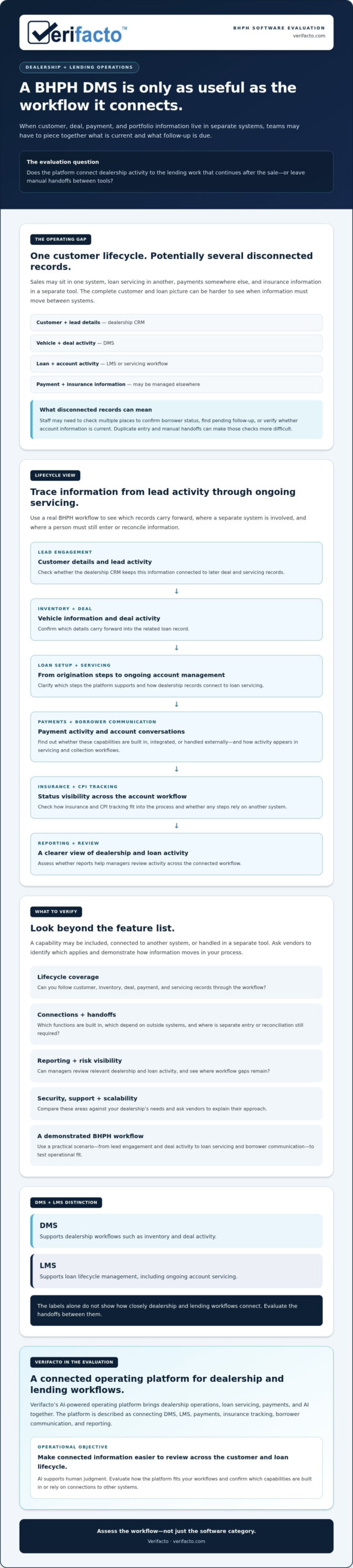
What a Connected BHPH Workflow Looks Like in Practice
Illustrative scenario: A prospective buyer submits an inquiry about a vehicle. The path below shows how a connected BHPH operation might carry relevant information from initial contact into deal activity and loan servicing. Actual workflows depend on the dealership’s processes and the systems in use.
From first inquiry to a documented deal
A lead record captures the inquiry and follow-up context in the dealership CRM. An AI Sales Agent may support lead engagement and follow-up, while staff review the interaction and decide what action makes sense. If the customer visits, the team can refer to the existing record rather than starting with disconnected notes, depending on how the platform is configured.
As the customer considers a vehicle, inventory and sales activity can be associated with the customer and deal records. Information relevant to origination may then carry into dealership and loan workflows. Staff still review deal details and make decisions that require their judgment. The point is to make the relationship between records easier to follow, not to assume every system automatically shares every data point.
During a demonstration of bhph dms software, trace one lead through these steps. Ask what information carries forward, what requires staff entry, and where a review or approval point occurs.
From scheduled payments to portfolio visibility
Once a loan is being serviced, payment processing and borrower communication become part of the ongoing customer relationship. A connected workflow can help staff view payment activity alongside relevant loan information. For example, Verifacto materials list ACH, credit and debit cards, cash, and recurring payments among supported payment methods. Confirm which options and workflows apply to your operation.
Insurance tracking and CPI workflows can add another view of account status, while servicing records and reporting can help managers review operational activity across the portfolio. If a payment needs follow-up or an insurance record needs attention, staff should be able to see where the issue stands and decide on the next step. Automated borrower communication and AI-supported workflows can assist the process, but they don’t replace staff oversight or judgment. For more on building collection efficiency strategies for auto loans, evaluate how follow-up fits your servicing process.
Where human review remains essential
At each transition, ask who checks the information and handles exceptions: lead follow-up, deal documentation, loan setup, payment questions, or insurance status. AI can support teams with connected operational information, but dealership staff remain responsible for reviewing context and deciding how to respond.
Use this scenario to test the connections, handoffs, and review points in your own workflow. A platform demonstration can help you explore how Verifacto’s DMS, LMS, payments, borrower communication, insurance tracking, and AI agents may fit your BHPH operation.
How Verifacto Fits a BHPH DMS Software Evaluation
Verifacto is an AI-powered operating platform designed to connect dealership and loan lifecycle workflows, rather than function only as a DMS or LMS. For a BHPH operation, evaluate how dealership records relate to loan servicing, payments, borrower communication, insurance tracking, and reporting. The fit depends on how those capabilities align with your processes and which connections your operation needs.
Where Verifacto’s connected platform may fit
Verifacto’s platform brings together DMS and LMS capabilities with CRM, inventory, payment processing, automated borrower communication, insurance and CPI tracking, and reporting. Its materials also state that it integrates with QuickBooks and other accounting solutions. Supported payment methods include ACH, credit and debit cards, cash, and recurring payments. Confirm the details that apply to your workflow directly with the provider.
AI Sales, Analytics, and Operational Assistant capabilities are described as support for sales engagement, operational insights, and day-to-day tasks. They can help staff work with connected data while leaving review and decisions in human hands. Explore Verifacto’s AI platform capabilities as part of your evaluation, and ask how they map to your team’s actual processes.
A practical next step before selecting BHPH software
Bring a short list of priority workflows to a platform discussion. Include the tools you use today, the records you need to connect, any integrations you depend on, and the reports managers use to monitor dealership and loan activity. This keeps the evaluation specific. Instead of asking only whether a feature exists, ask how it handles your process from customer activity through servicing.
Also ask how data access and implementation are handled, what security documentation is available for review, and how workflow exceptions are managed. These answers can help you understand the platform’s boundaries, outside dependencies, and fit for your operation before making a decision.
Use those criteria to compare Verifacto with your needs, not to assume every capability works the same way in every setup. A connected platform can provide greater visibility across dealership and loan activity, but it doesn’t guarantee a particular financial result. A demonstration can help you explore how Verifacto may fit your BHPH workflows.
Choose a Platform That Connects the Full BHPH Operation
The right bhph dms software should support more than dealership tasks in isolation. Evaluate how customer and deal information connects to loan servicing, payments, borrower communication, insurance tracking, and reporting. Then test that flow with your real workflows, including exceptions and the points where staff review information or make decisions.
Verifacto is a cloud-hosted, AI-powered platform designed to connect dealership and loan lifecycle capabilities. Its materials state that the platform integrates with QuickBooks and other accounting solutions, and supports ACH, credit and debit cards, cash, and recurring payments. Confirm how these capabilities fit your processes, which connections apply to your setup, and how you can access your data.
A connected platform can provide greater visibility into operational activity and help reduce fragmented workflows, while embedded AI can support staff without replacing human judgment. The best choice is the one that aligns with your dealership’s needs and keeps the operation understandable and manageable.
See how Verifacto connects your operation from the first lead to the final payment, and explore a practical path toward greater visibility and control.
Frequently Asked Questions
What is BHPH DMS software?
BHPH DMS software is dealership management technology adapted to buy-here-pay-here operations, where a dealer sells vehicles and manages related financing. A DMS organizes dealership activity, such as customer, inventory, and deal records. An LMS supports the loan lifecycle, including servicing and payment-related workflows. In a BHPH operation, how these systems connect matters because information from a sale may remain relevant throughout the borrower relationship.
What features should BHPH DMS software include?
Assess features by workflow. Customer and lead management should organize CRM records and follow-up; inventory and deal tools should connect vehicle and transaction information. Origination and servicing capabilities should support the loan lifecycle. Check whether payment processing and borrower communication fit servicing workflows, and whether insurance tracking, including CPI, and reporting help staff review account and portfolio activity. Confirm which capabilities are built in, connected to other tools, or handled separately.
Can a BHPH DMS integrate with loan management software?
Yes, some platforms connect DMS and LMS workflows, but specific data flows vary by provider and setup. Ask whether customer, deal, and vehicle details carry into loan records, and how payment or servicing activity becomes visible to dealership users. Confirm whether each connection is native, uses an integration, or requires separate entry. A vendor demonstration using your workflow can reveal handoffs, limitations, and staff review points.
How do I compare BHPH DMS software providers?
Compare providers by testing workflows, not just checking feature names. Ask each vendor to demonstrate a lead moving through customer records, a deal, loan servicing, and payment activity. Verify current integrations, third-party dependencies, data access and export options, implementation responsibilities, and reporting coverage. Document your requirements and exceptions, then review how each platform handles them. This makes it easier to assess operational fit, control, and visibility across your BHPH lifecycle.
Does BHPH DMS software process borrower payments?
Payment capabilities vary by platform, so confirm available methods and how transactions connect to servicing records. Ask whether recurring payments are supported, how payment activity is recorded, and what staff can see when an item needs attention. Verifacto’s materials list ACH, credit and debit cards, cash, and recurring payments as supported methods. Confirm how those options fit your dealership’s configuration and borrower payment workflows.
Can AI replace staff in a BHPH dealership?
No. AI can support defined tasks and provide information, but it shouldn’t replace staff judgment or oversight. For example, an AI Sales Agent may assist with lead engagement and follow-up, while analytics capabilities can help users review operational information. An Operational Assistant may support tasks such as reminders and workflow guidance. Dealership staff remain responsible for evaluating context, handling exceptions, and making decisions that require human review.