
What good is a daily payment report if it doesn’t reconcile with the loan system and the general ledger? For many buy here, pay here dealerships, the challenge isn’t a lack of activity data. It’s connecting contracts, payments, and accounting records consistently. BHPH accounting best practices start with a repeatable process that makes those connections clear and exceptions easier to investigate.
When payment and contract activity is hard to reconcile, an unclear chart of accounts can obscure how parts of the business are performing. Delayed reports can also make cash and portfolio decisions less certain. Producing more reports won’t solve those problems on its own. Dealerships need defined account structures, regular reconciliations, and financial reviews that connect operational activity to the books.
This guide explains how to build that workflow, from creating a dealership-relevant chart of accounts to establishing routine reviews and maintaining human oversight of accounting decisions. It also covers how connected systems can reduce manual handoffs. Verifacto brings DMS, LMS, payment processing, reporting, and analytics together, with accounting connections such as QuickBooks subject to supported configuration. Its Analytics Agent can support reporting tasks, while accounting judgment stays with your team.
Key Takeaways
- Use BHPH accounting best practices to create repeatable processes for recording, checking, and reviewing dealership financial activity.
- Build a chart of accounts around your dealership’s operations and reporting needs, using core account categories as a starting point.
- Reconcile source records systematically: identify exceptions, investigate them, document findings, and review resolutions.
- Use a written close checklist with clear owners and review evidence to make reporting routines more consistent.
- Connected DMS, LMS, payment, and accounting workflows can improve visibility, while accounting professionals retain control of financial judgments.
Why BHPH Accounting Best Practices Start with Reliable Records
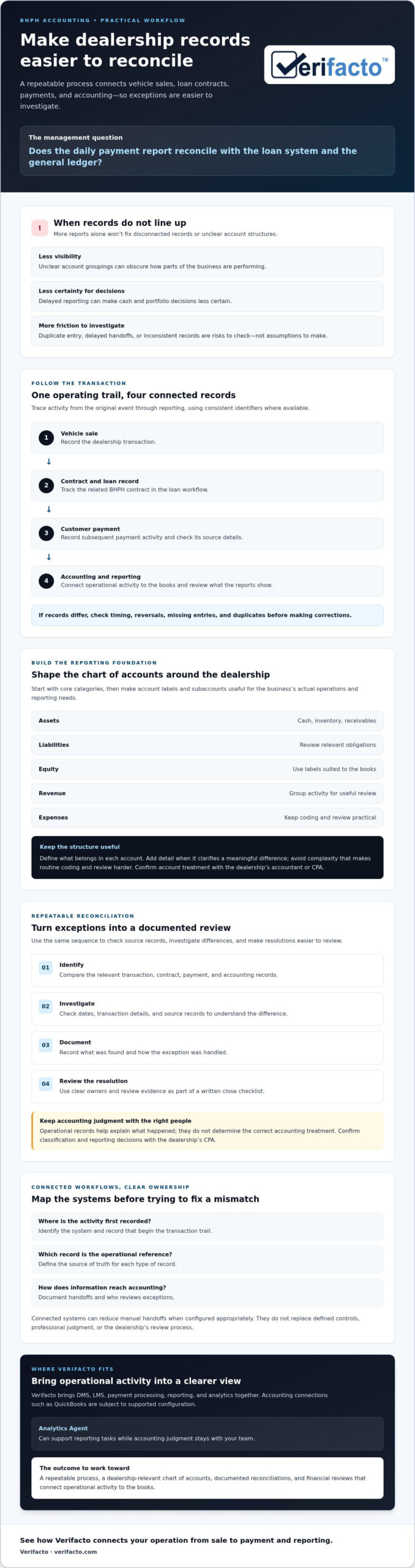
A vehicle sale is recorded, a contract is created, and a customer makes a payment. If those events appear differently across dealership, loan, payment, and accounting records, it can be difficult to tell whether the books reflect the operation. BHPH accounting best practices begin with repeatable processes for recording, checking, and reviewing financial activity. That way, staff can identify questions, trace them to relevant records, and investigate them before they cloud reporting.
Buy here, pay here dealerships manage vehicle inventory and lending activity within the same operating business. The Buy Here Pay Here (BHPH) model helps explain why a vehicle transaction can continue as a loan-account workflow after the sale. Incomplete or delayed records can make cash activity and portfolio information less visible, which may limit management’s confidence in day-to-day decisions. Tracking what happened is essential, but it doesn’t determine the correct accounting treatment. Confirm that treatment with the dealership’s CPA.
What makes BHPH accounting different from a basic sales ledger?
A basic sales ledger may capture the sale, but a BHPH workflow also needs to track the related contract and later payment activity. For example, the dealership records a vehicle transaction, the loan system tracks the contract, and subsequent payments are recorded and included in reporting. A dependable process lets staff trace those records using consistent identifiers and investigate differences by checking dates, transaction details, and source records. The CPA can advise how transactions should be classified and reported.
How disconnected systems create avoidable accounting friction
When dealership and lending workflows sit in separate systems, duplicate entry, delayed handoffs, or inconsistent records are risks to check, not inevitable outcomes. Document each system’s role: where a transaction is first recorded, which record is the operational reference, how information reaches accounting, and who reviews exceptions. This map gives staff a practical starting point when a discrepancy appears and helps them investigate without assuming every difference is an error.
A dealer management system guide can help clarify how a DMS organizes dealership information. To map your own process, follow a transaction from sale to contract to payment and reporting. If records don’t match, check whether timing differences, reversals, missing entries, or duplicates explain the mismatch before making corrections. Document what you find and confirm accounting decisions with the CPA.
Connected dealership and lending tools can reduce manual handoffs when configured appropriately, but technology doesn’t replace defined controls or professional judgment. Agree on the source of truth for each record and set a consistent review process. Managers can then use a clearer view of activity to decide which questions need attention.
Build a BHPH Chart of Accounts That Supports Clear Reporting
A chart of accounts should help dealership leaders answer practical questions, not just sort transactions into generic categories. Start with the broad framework of assets, liabilities, equity, revenue, and expenses. Then shape account labels and subaccounts around the dealership’s real workflows and reporting needs. A copied template may use familiar terms but still leave important activity hard to distinguish.
For example, a dealership may want reports that make cash, vehicle inventory, receivables, liabilities, revenue, and expenses easier to review. Whether to create separate subaccounts for particular activities depends on how the business operates and what its accountant recommends. Aim for enough detail to clarify meaningful differences without making routine coding and review unnecessarily complex.
Which account categories should a BHPH dealer review?
Review the labels and groupings for cash, inventory, receivables, liabilities, revenue, and expenses with the dealership’s accountant. Start with the management questions the reports need to answer. For instance, should a report distinguish activity by department or business process? Account names should reflect actual operations, and definitions should explain what belongs in each account. Don’t assume another dealership’s account numbers or contract-specific treatment will work as a universal template.
Clear definitions also support consistent reporting and review. The Federal Register’s Supervisory Highlights on Auto-Finance describes findings from examinations of auto-finance companies. It isn’t a chart-of-accounts template, but it underscores why dealerships should keep records and reporting processes clear enough for appropriate professional review.
How to keep the chart useful as operations change
Revisit the chart when the dealership adds a product, changes a process, or expands a business line. First, identify the reporting question the current structure can’t answer. Then ask the accountant whether a new account or subaccount is appropriate, who can approve the change, and how its definition will be shared with the people who use it. Record the decision so future reviews follow the same logic.
BHPH accounting best practices depend on a chart that stays useful as the operation evolves. A lending lifecycle system can organize contract and payment activity, but the dealership and its accountant should decide how that activity is represented in the books. For background on how these systems support lending workflows, see this auto loan management software guide.
Verifacto’s Analytics Agent provides dashboards, reporting, and performance insights that can help teams review connected operational information. Explore Verifacto’s AI capabilities as one way to support reporting workflows, while keeping account definitions and accounting judgments under professional oversight.
Reconcile BHPH Payments, Contracts, and Accounting Records
A payment may appear in a processor record before it shows up in another system, or a contract record may not match the accounting detail being reviewed. Treat differences as exceptions to investigate, not proof of an error. A consistent reconciliation process helps the dealership establish what happened, who followed up, and whether an item needs further review.
A repeatable payment reconciliation workflow
Set an agreed comparison period and identify the source records to compare, such as payment activity, loan or contract records, and accounting records. The timing and frequency of reconciliation should fit transaction volume and the controls approved with the dealership’s accountant.
Then follow a clear sequence:
- Compare: Review records for the same period and use consistent identifiers, such as a transaction reference or account identifier, where available.
- Flag: List items that don’t match or need explanation, including possible timing differences, reversals, missing records, or duplicate entries.
- Investigate: Trace each exception to its source. Check dates, transaction details, and relevant system records before deciding what the difference means.
- Document and review: Record the finding, follow-up owner, and resolution. Escalate unresolved items for appropriate review.
This process creates a trackable path from discrepancy to resolution. It doesn’t prescribe how a transaction should be allocated or recorded. Confirm accounting treatment and any adjustments with the dealership’s accountant.
Keep payment processing and accounting handoffs visible
Map how ACH, card, cash, and recurring payment information enters the dealership’s workflows. For each payment type, identify where the transaction is first recorded, how the information is passed to other records, and who checks exceptions. This makes handoffs easier to review without assuming every system updates at the same time.
Before adopting or changing an integration, ask how it handles timing differences, reversals, exceptions, and record ownership. Confirm which system provides the relevant source record and how staff can trace an item across the workflow. Verifacto’s platform connects dealership and lending workflows, including payment processing and accounting integration. Depending on the supported configuration, connected processes can help reduce manual handoffs, while reconciliation and accounting decisions remain subject to dealership controls and professional oversight.
For additional context on payment workflow considerations, review the integrated payment solutions guide. Applied consistently, BHPH accounting best practices can make payment activity easier to trace and exceptions easier to manage.
Use a Consistent Close and Reporting Routine to Spot Exceptions
A report is most useful when managers know what was reviewed, who checked it, and what happened to open questions. Build a written close checklist with assigned owners, evidence of review, and timing approved with the dealership’s accountant. The cadence should fit the operation and its accounting controls rather than follow an arbitrary schedule.
Use the routine to compare relevant cash activity, receivables, inventory-related balances, and financial statements. Treat these checks as prompts to investigate, not instructions for accounting treatment. The accountant should confirm report definitions and guide how findings are interpreted.
What should managers review in recurring financial reports?
Choose reports based on management questions: What does cash activity show? Are receivables changing as expected? Which expenses or operating trends need attention? Compare consistent periods and record material variances for follow-up. A variance is a signal to investigate, not proof of its cause or an accounting conclusion.
| Routine check | Question it helps answer | Review role |
|---|---|---|
| Cash activity | Do recorded inflows and outflows align with the information being reviewed? | Assigned accounting reviewer |
| Relevant receivables | Are balances or activity showing a change that needs explanation? | Accounting reviewer, with lending operations input as needed |
| Inventory-related balances | Are the balances consistent with available dealership records? | Accounting reviewer, with inventory operations input as needed |
| Financial statements | Are material period-to-period changes identified and reviewed? | Manager and accountant, according to the close process |
Use the same definitions and comparison periods from one review to the next. If an amount changes, trace it to supporting operational detail where possible instead of relying on an unexplained summary figure. Confirm accounting interpretations with the dealership’s accountant.
Make accounting exceptions actionable without overrelying on dashboards
Give each exception an owner, a next step, and a documented status, such as under review or resolved. A dashboard can surface a change, but it can’t establish the reason or determine the correct accounting treatment on its own. Before relying on a custom report, verify that its fields and calculations fit the question being reviewed. For portfolio context, see this guide to improving collection efficiency.
Verifacto’s Analytics Agent provides dashboards, reporting, and performance insights that can support review of operational information. Explore Verifacto’s AI capabilities to see how connected data may support reporting workflows, with accounting judgment remaining under professional oversight.
Connect BHPH Accounting Workflows Without Losing Human Control
A dealership operates one business but may manage dealership and lending activity across disconnected systems. Each handoff can make it harder to trace a sale, contract, payment, or report back to its source. Connected workflows can improve visibility and reduce manual steps, but they work best when the dealership defines how information moves and who reviews it.
Verifacto is a cloud-based, AI-powered operating platform that connects workflows across its DMS, LMS, payment processing, collections, accounting integration, and reporting capabilities. For dealerships evaluating BHPH software or auto finance software, this connected approach can also bring dealership CRM activity into view alongside lending workflows. The goal isn’t to replace accounting controls. It’s to give the team a clearer view of relevant operational activity while people remain responsible for review and accounting decisions.
Where connected platform workflows may support accounting discipline
Accounting integration with QuickBooks and other accounting tools is available, but confirm the applicable setup and workflow before relying on specific data synchronization. Before configuration, map which system records each activity, what information passes between systems, and how exceptions reach the appropriate reviewer.
For example, a connected view of payment and lending activity may help staff trace an item for accounting review. It doesn’t determine how that item should be classified, recorded, or reported. The dealership and its accounting professionals should confirm data mapping, review the configured workflow, and approve accounting treatment.
That distinction matters. Technology can streamline handoffs, but reliable BHPH accounting best practices still depend on clear ownership, appropriate review, and professional judgment. Treat integrations as part of the control process, not a substitute for it.
Use embedded AI as workflow support, not accounting authority
Verifacto’s Analytics Agent provides dashboards, reporting, and performance insights. These can help users review operational information and identify items that may warrant attention, provided they confirm the fields and calculations relevant to the dealership’s workflow. The Operational Assistant may support tasks and workflows, but it shouldn’t be treated as an autonomous accounting decision-maker.
AI is most useful here as controlled support. It can help surface information or assist with workflow tasks, while authorized people investigate exceptions and determine the next step. Learn more about Verifacto AI capabilities and the platform’s available agents.
With clear configuration and human oversight, connected systems can provide greater visibility across dealership and lending workflows. Contact Verifacto to discuss connected dealership operations and explore how the platform may fit your accounting workflow.
Build a More Reliable BHPH Accounting Workflow
Strong BHPH accounting best practices depend on more than accurate entries. A dealership needs records that can be traced across vehicle sales, contracts, payments, and reporting, supported by a chart of accounts designed for its operations. Regular reconciliations and a consistent close routine help surface exceptions, while clear owners and documented reviews keep follow-up on track.
Connected systems can help reduce manual handoffs and provide greater visibility into dealership and lending activity. Verifacto’s cloud-based platform connects DMS, LMS, payment processing, collections, and reporting workflows. Accounting integration with QuickBooks and other tools is available, with the supported setup and workflow to be confirmed. Technology can support visibility and routine tasks, but accounting treatment and financial decisions remain with dealership leadership and accounting professionals.
Start by strengthening the records and review process you already have, then assess where connected workflows may fit. See how Verifacto connects your operation from the first lead to the final payment. With clear controls and the right visibility, your team can make day-to-day decisions with greater confidence.
Frequently Asked Questions
What accounting practices should a BHPH dealership follow?
Use repeatable processes to record, check, and review sales, contracts, payments, and related financial activity. Maintain a chart of accounts suited to the dealership, reconcile operational and accounting records, and use a written close routine with assigned reviewers. Document exceptions, their owners, and how they were resolved. These BHPH accounting best practices can improve record clarity and management visibility, but a dealership’s CPA should confirm accounting treatment and reporting decisions.
How should a BHPH dealership set up its chart of accounts?
Start with the broad categories of assets, liabilities, equity, revenue, and expenses, then tailor account labels and subaccounts to the dealership’s actual operations and reporting questions. Categories for cash, inventory, receivables, and expenses may be useful to review with an accountant. Don’t copy another dealer’s account structure without checking whether it fits your workflows. Have your accountant approve account definitions and changes before putting them into use.
How often should a BHPH dealership reconcile its accounts?
Set reconciliation frequency based on transaction volume, the records being compared, and controls approved with the dealership’s accountant. A written schedule should identify the comparison period, responsible reviewer, and process for following up on open exceptions. Reconciliation may surface timing differences or other items that need investigation, but a difference isn’t automatically an error. Ask the accountant to help establish an appropriate cadence and escalation process for unresolved items.
How can a BHPH dealer track payments accurately?
Keep a traceable record of each payment using consistent transaction and account identifiers across relevant payment, loan, and accounting records. Compare records for an agreed period, flag unmatched items, investigate their source, and document the outcome and reviewer. Include applicable payment channels in the process and clarify where each record originates. Confirm payment posting and accounting treatment with the dealership’s established policy and accountant rather than assuming a system match determines either.
What reports should BHPH dealership managers review?
Choose reports that answer management questions about cash activity, receivables, expenses, inventory-related balances, financial statements, and operating trends. Compare consistent periods and investigate material changes instead of assuming what caused them. Document follow-up, including who owns an exception and its status. Before drawing accounting conclusions, confirm report definitions and interpretation with the dealership’s accountant. Dashboards can help organize information, but managers should verify the data and calculations behind them.
Can dealership software integrate with QuickBooks for BHPH accounting?
Some dealership software offers accounting integration with QuickBooks and other accounting tools, but confirm the supported setup and workflow before relying on a specific data flow. Ask which records can be shared, how timing differences and exceptions are handled, and which system remains the source of each record. Integration can help reduce manual handoffs when configured appropriately, but the dealership and its accountant should review mappings and accounting treatment.
Can AI handle BHPH accounting without staff review?
No. AI can support reporting or workflow tasks, but it shouldn’t replace staff review or professional accounting judgment. For example, an analytics tool may help surface information for review, while an authorized person investigates an exception and consults the accountant on its treatment. Keep human oversight in place, verify relevant fields and calculations, and assign clear responsibility for decisions. AI should assist a controlled process, not independently determine how transactions are recorded.
See how Verifacto connects your operation from the first lead to the final payment.