
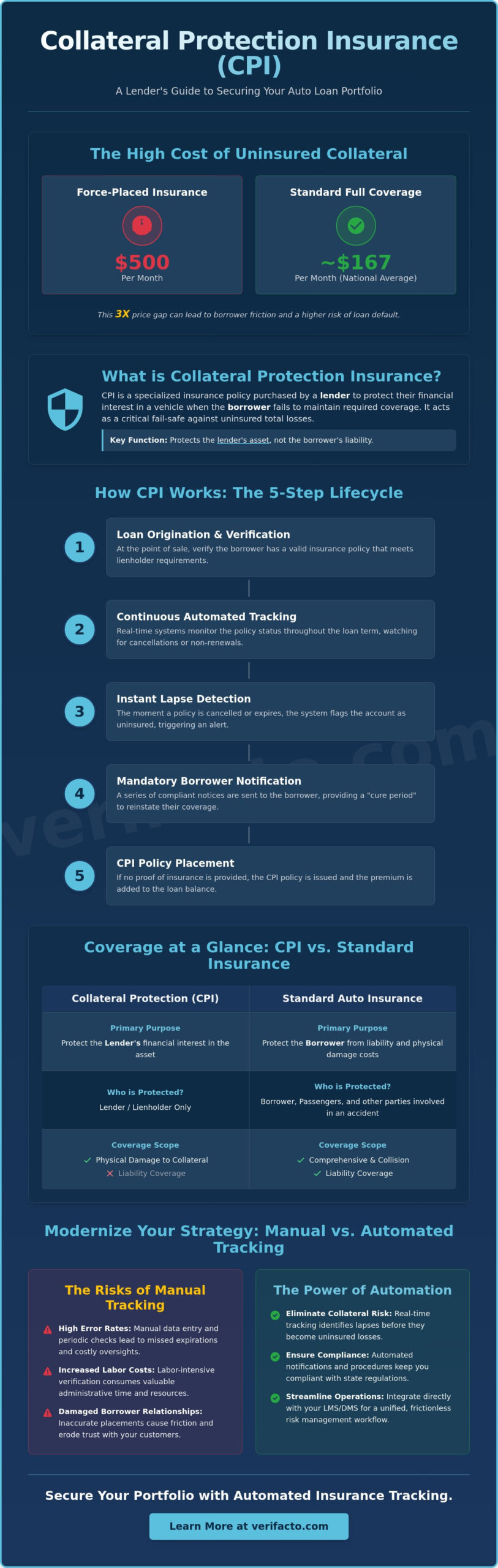
Did you know that force-placed insurance can cost a borrower up to $500 per month, nearly triple the national average for a standard full-coverage policy? This staggering price gap often leads to borrower friction and increased default risk, leaving many lenders asking exactly what is collateral protection insurance and how it can be managed more effectively. You already know that uninsured total losses are a primary driver of portfolio charge-offs. It’s frustrating when manual tracking leads to errors, missed expirations, and unexpected losses that eat into your margins.
This 2026 guide is designed to help you secure your auto loan portfolio while transitioning to a more sophisticated, data-driven risk management strategy. You’ll discover how automated tracking eliminates collateral risk and keeps your institution compliant with evolving regulations in states like Georgia and Texas. We will break down the operational mechanics of CPI, show you how to reduce labor-intensive verification, and explain why modern automation is the only way to protect your assets without damaging the borrower relationship.
Key Takeaways
- Define what is collateral protection insurance and its role in shielding your portfolio from the financial impact of uninsured vehicle damage.
- Master the 5-step lifecycle of insurance placement to ensure consistent protection from the moment of loan origination through the life of the contract.
- Compare the specific coverage limitations of CPI against standard policies to better manage your liability exposure and collateral security.
- Eliminate the administrative burden and error rates of manual verification by implementing automated tracking that identifies lapses before they become losses.
- Streamline your operations by integrating insurance tracking directly into your Verifacto LMS or DMS for a unified, frictionless risk management approach.
What is Collateral Protection Insurance (CPI)? Definition and Core Purpose
Lenders face a constant battle against depreciation and operational risk. When a borrower drives off the lot, that vehicle represents a significant portion of your capital. If that borrower lets their insurance lapse, your investment is exposed to total loss without any path to recovery. Understanding what is collateral protection insurance starts with recognizing it as a specialized policy that you, the lender, purchase to cover a vehicle when the borrower fails to maintain their own coverage. Unlike standard auto insurance that protects the driver’s liability, CPI focuses exclusively on the physical asset. In the volatile 2026 market, where vehicle values fluctuate and subprime defaults are under intense scrutiny, this coverage has become a non-negotiable tool for portfolio stability. With rising repair costs and parts shortages, the financial impact of an uninsured accident is higher than it’s ever been.
CPI vs. Standard Force-Placed Insurance
You’ll often hear the terms CPI and force-placed insurance used interchangeably. While they describe the same outcome, the distinction lies in the application. Force-placed is the action taken based on the loan agreement, while Collateral Protection Insurance is the specific financial product used to mitigate risk. Modern CPI programs differ significantly from the legacy models of the past. They’re designed to be surgical, using real-time data to minimize the “noise” or borrower friction that typically accompanies insurance placement. Instead of blanket placements that cause customer service nightmares, modern systems ensure that coverage is only triggered when a verified lapse occurs. This precision helps you maintain a professional relationship with your borrowers while keeping your assets secure.
Why Lenders Require Physical Damage Coverage
The retail installment contract gives you the legal right to ensure the collateral is protected. When a borrower signs that document, they agree to maintain continuous physical damage coverage. If they don’t, it constitutes a breach of contract. From a business perspective, the stakes are high. An uninsured total loss on a vehicle with a $20,000 balance creates an immediate charge-off that hits your bottom line directly. CPI acts as a fail-safe, ensuring that even if the borrower ignores their obligations, your financial interest remains secure. A breach of contract isn’t just a legal technicality; it’s a red flag for future payment default. When a borrower stops paying for insurance, they’re often weeks away from stopping their car payments. Implementing a robust insurance tracking system allows you to identify these risks early and take action before the collateral disappears or is destroyed.
How Collateral Protection Insurance Works: The 5-Step Cycle
Successful risk management isn’t a one-time event; it’s a continuous operational loop. To fully grasp what is collateral protection insurance, you must view it through the lens of a five-step lifecycle that begins the moment a loan is funded. This cycle ensures that your capital remains shielded even when borrower behavior shifts. It moves from initial verification to active tracking, lapse detection, mandatory notification, and finally, policy placement. Each stage is designed to provide the borrower with every opportunity to maintain their own coverage while ensuring the lender isn’t left holding the bag for an uninsured total loss.
- Step 1: Loan Origination and Verification. At the point of sale, you verify that the borrower has a valid policy that meets your lienholder requirements.
- Step 2: Continuous Tracking. Your system monitors the policy status throughout the loan term, looking for cancellations or non-renewals.
- Step 3: Lapse Detection. The moment a policy fails to renew or is cancelled for non-payment, the system flags the account as uninsured.
- Step 4: Mandatory Notification Window. You send a series of compliant notices to the borrower, providing a “cure period” to reinstate their coverage.
- Step 5: Policy Placement. If no proof is provided after the notice period, the CPI policy is issued and the premium is added to the loan balance.
The Critical Role of Real-Time Tracking
The old model of periodic “batch” audits is no longer sufficient in a digital-first economy. Borrowers can cancel a policy minutes after leaving the lot, leaving your asset unprotected for weeks before a manual audit catches it. Utilizing real-time tracking eliminates these dangerous gap periods. By leveraging direct carrier feeds, you receive instant updates on policy changes. This level of accuracy is essential for maintaining compliance in states like Texas, where the effective date of CPI coverage cannot be earlier than the date the collateral actually became uninsured. If you want to tighten your operations, consider how Verifacto’s insurance tracking technology can automate this entire monitoring phase for you.
Managing the Borrower Notification Process
Communication is where most lenders face the highest friction. A surprise “force-placed” charge on a monthly statement is a guaranteed way to trigger a complaint. A structured sequence of digital and physical notices is required to stay compliant and maintain a positive borrower relationship. This sequence usually starts with a friendly reminder and moves toward a formal notice of placement. Automating these communications ensures that every borrower receives the same clear, timely information. This transparency often encourages borrowers to reinstate their own insurance, which is the ideal outcome for both parties, as it keeps their monthly costs lower and your risk at zero.
CPI Coverage vs. Standard Auto Insurance: A Direct Comparison
To effectively manage your portfolio, you must distinguish between the broad protection of a consumer policy and the targeted scope of a lender-placed product. While both aim to mitigate financial loss, their structures serve fundamentally different masters. Standard auto insurance is a comprehensive contract designed to protect the driver from a variety of risks, including legal liability for hurting others. In contrast, understanding what is collateral protection insurance requires a focus on the asset itself. CPI is a specialized tool that ensures the vehicle remains a viable piece of collateral, regardless of the borrower’s personal insurance status. It’s a safety net for your capital, not a comprehensive lifestyle policy for the driver.
One of the most significant differences lies in how the cost is determined. Standard insurance premiums fluctuate based on the driver’s age, location, and credit score. CPI premiums are typically calculated based on the outstanding loan balance, aligning the cost directly with the lender’s financial exposure. This ensures that the protection is proportional to the risk remaining on your books.
| Feature | Standard Full Coverage | Collateral Protection Insurance |
|---|---|---|
| Liability (Bodily Injury/Property Damage) | Yes | No |
| Physical Damage (Collision/Comprehensive) | Yes | Yes |
| Medical Payments/Uninsured Motorist | Yes | No |
| Pricing Basis | Driver Risk Profile | Outstanding Loan Balance |
| Primary Beneficiary | Driver and Lienholder | Lender (Lienholder) |
What CPI Typically Covers
A robust CPI policy mirrors the physical damage portions of a standard policy. It provides protection against collision and comprehensive perils, including theft, fire, vandalism, and weather-related damage. This ensures that if a vehicle is recovered in a damaged state or totaled, the lender can recover the value of the collateral. Dual Interest defines the protection of both the lender’s lien and the borrower’s equity in the vehicle, ensuring that a loss doesn’t leave either party with an insurmountable financial gap.
What CPI Does NOT Cover
It’s vital to communicate to your team and your borrowers that CPI is not a substitute for a standard consumer policy. It does not provide bodily injury or property damage liability coverage. This means it won’t pay for the other person’s medical bills or car repairs if your borrower causes an accident. Most importantly, CPI doesn’t meet state-mandated financial responsibility laws for drivers. A borrower driving with only CPI is still technically driving uninsured in the eyes of the law and can face fines or license suspension. Clear documentation helps prevent the friction that occurs when a borrower mistakenly believes they’re fully covered.
Overcoming the Challenges of Manual Insurance Tracking
Manual insurance tracking is an administrative bottleneck that scales poorly and invites unnecessary risk. Many lenders start with spreadsheets and a dedicated staff member, but as a portfolio grows, this approach becomes a liability. The sheer volume of policies to verify, combined with the constant flux of cancellations and renewals, makes human error inevitable. When your team is bogged down in paperwork, they aren’t focusing on collections or growth. The reality of what is collateral protection insurance in a modern context is that it requires a digital backbone to be effective. Without it, you’re essentially gambling on the hope that your staff catches every lapse before a total loss occurs.
One of the most damaging aspects of manual tracking is the “false positive.” This happens when your staff misses an insurance update and sends a placement notice to a borrower who is actually compliant. This creates immediate friction, generates angry phone calls, and erodes the trust you’ve built with your customers. Modern risk management focuses on “noise reduction,” ensuring that you only communicate with borrowers when a verified lapse exists. This precision protects your reputation while securing your assets.
The Hidden Costs of Human Error in Risk Management
The financial impact of a single missed insurance lapse can be devastating. If a vehicle is totaled while uninsured, you’re looking at a potential $20,000 charge-off that hits your bottom line directly. Beyond the loss of the asset, you must account for the hundreds of hours staff spend calling agents and manually updating records. This labor-intensive process is a drain on resources that could be better spent on high-value tasks. During economic downturns, untracked portfolios become a primary source of capital erosion. Viewing mitigating risk in auto lending as a strategic priority for 2026 means moving away from reactive manual checks toward proactive, automated systems that provide 24/7 visibility into your collateral’s status.
Automating Borrower Communication to Reduce Friction
Automation does more than just track data; it transforms how you interact with your borrowers. By using multi-channel notifications, including SMS and email, you can reach borrowers where they are most active. This significantly improves response rates compared to traditional mail alone. Modern portals allow borrowers to simply take a photo of their insurance card and upload it via a mobile device, clearing the lapse in seconds without human intervention on your side. This streamlined workflow ensures you remain compliant with state and federal regulations while providing a frictionless experience. If you’re ready to stop the manual grind, explore Verifacto’s automated insurance tracking solutions to see how we can modernize your workflow.
Modernizing Your Portfolio: Integrating CPI into Your LMS/DMS
Integrating insurance tracking into your existing Loan Management System (LMS) or Dealer Management System (DMS) represents the ultimate efficiency gain for modern finance companies. Traditionally, loan servicing and insurance placement functioned in isolated silos, leading to data delays and missed opportunities for risk mitigation. Breaking down these silos ensures that your insurance status is always synced with your loan data. When you view what is collateral protection insurance as an integrated feature rather than an external add-on, you eliminate the friction that typically slows down portfolio management. This unified approach is essential for scalability, and choosing the right auto loan management software is the foundation that allows your institution to grow its loan volume without being throttled by manual oversight or the need for a massive administrative staff.
Why Real-Time Data is Your Best Defense
Real-time data is your best defense against unexpected charge-offs. Implementing automated insurance verification provides an immediate, high-definition view of your entire portfolio’s health. This transparency is particularly valuable for lenders looking to sell loan pools on the secondary market or pursue securitization. Investors prioritize portfolios with verified, continuous coverage. It significantly lowers the risk profile of the underlying assets and increases the value of your paper. Verifacto provides real-time tracking as a core feature of its LMS/DMS ecosystem, ensuring that your data is always current and your assets are always protected. This level of visibility transforms risk management from a guessing game into a strategic advantage.
Streamlining Compliance with Automated Workflows
Compliance is often the most stressful part of insurance management. Automated workflows maintain a perfect, timestamped audit trail that regulators require during examinations. This documentation proves that you followed the mandatory notification windows and provided the borrower with every chance to comply. Additionally, having built-in payment processing for CPI premiums streamlines the financial side of the equation. It allows you to add premiums to the loan balance and collect payments through a single interface, reducing administrative complexity for your accounting team. Protection should be a seamless part of your business model, not a constant struggle against manual errors. Secure your portfolio today by exploring Verifacto’s integrated CPI solutions.
Secure Your Capital with Data-Driven Protection
Understanding what is collateral protection insurance is only the first step toward building a resilient lending operation. You’ve seen how manual tracking creates administrative bottlenecks and leaves your portfolio vulnerable to uninsured total losses. By shifting to an automated framework, you eliminate the friction of false positives and ensure that every vehicle in your portfolio remains shielded by active coverage. This isn’t just about insurance; it’s about maintaining absolute control over your capital in an increasingly volatile market. Modernizing your approach means you don’t have to choose between asset security and borrower satisfaction.
You can transform your risk management from a labor-intensive chore into a streamlined competitive advantage. Verifacto offers real-time tracking for 100% of your portfolio, backed by automated borrower communication tools that keep your customers informed without taxing your staff. Our solutions integrate seamlessly with the Verifacto LMS and DMS ecosystems, providing a unified platform for modern finance companies. Protect your portfolio with Verifacto’s integrated CPI and tracking solutions today. Take the guesswork out of asset protection and focus on growing your business with total confidence.
Frequently Asked Questions
Is Collateral Protection Insurance legal in all states?
Yes, purchasing CPI is legal across the United States, though state-specific regulations vary significantly. For instance, Georgia lawmakers proposed House Bill 1554 to introduce stricter regulations on rates and commissions, while Texas law requires creditors to cancel coverage immediately upon proof of private insurance. Lenders must stay informed about these evolving standards to maintain compliance while protecting their financial interests in the collateral.
How much does CPI insurance typically cost the borrower?
Borrowers usually pay between $150 and $500 per month for this coverage depending on the lender and the state. When you consider that the national average for a standard full-coverage policy is approximately $2,356 per year, CPI is a much costlier alternative for the borrower. These high premiums reflect the increased risk associated with portfolios where borrowers have already demonstrated a failure to maintain their own insurance requirements.
Can a borrower cancel CPI once it has been placed?
A borrower can cancel the policy at any time by providing valid proof of their own qualifying insurance. Once you receive the new policy details and verify the lienholder information, the CPI policy is terminated. In jurisdictions like Texas, the law is very clear: creditors cannot charge the borrower for CPI once they’ve provided proof of alternative coverage that meets the loan’s requirements.
Does CPI fulfill the state requirements for auto insurance?
CPI does not fulfill state-mandated financial responsibility laws for drivers. It protects the vehicle’s physical value but ignores liability, medical expenses, and bodily injury coverage. Borrowers who rely solely on CPI are still driving uninsured in the eyes of the law. It’s critical to explain what is collateral protection insurance to your customers so they understand they still need a standard policy to drive legally.
What happens to the CPI premium if the borrower provides proof of their own insurance?
If a borrower provides proof of insurance, the lender must cancel the CPI policy and issue a refund for the unearned premium. This refund is typically credited back to the borrower’s outstanding loan balance. Modern automated tracking systems make this process seamless, ensuring that the coverage period for CPI never overlaps with the borrower’s private policy, which helps maintain compliance and reduces borrower friction.
How does CPI benefit the borrower if it’s more expensive than standard insurance?
The primary benefit to the borrower is the protection of their vehicle equity and the prevention of loan default. While the premiums are higher than standard insurance, CPI ensures that a total loss doesn’t leave the borrower with a massive debt and no vehicle. It acts as a safety net that keeps the loan agreement active even when the borrower faces challenges in securing traditional private market coverage.
What is the difference between CPI and GAP insurance?
CPI and GAP insurance serve two different risk mitigation purposes. CPI covers the actual physical damage or theft of the vehicle, similar to collision and comprehensive coverage. GAP insurance, however, covers the difference between the vehicle’s actual cash value and the remaining loan balance in the event of a total loss. Lenders often use both tools to ensure the entire financial exposure is covered if the collateral is destroyed.
Can CPI be added to a loan after the contract is signed?
Lenders can add CPI to a loan at any point during the term if the borrower fails to maintain the required coverage. This right is established in the original retail installment contract signed at the time of purchase. When a lapse is detected, the lender can exercise this contractual right to place what is collateral protection insurance on the asset to ensure the capital remains protected until the borrower reinstates their own policy.