
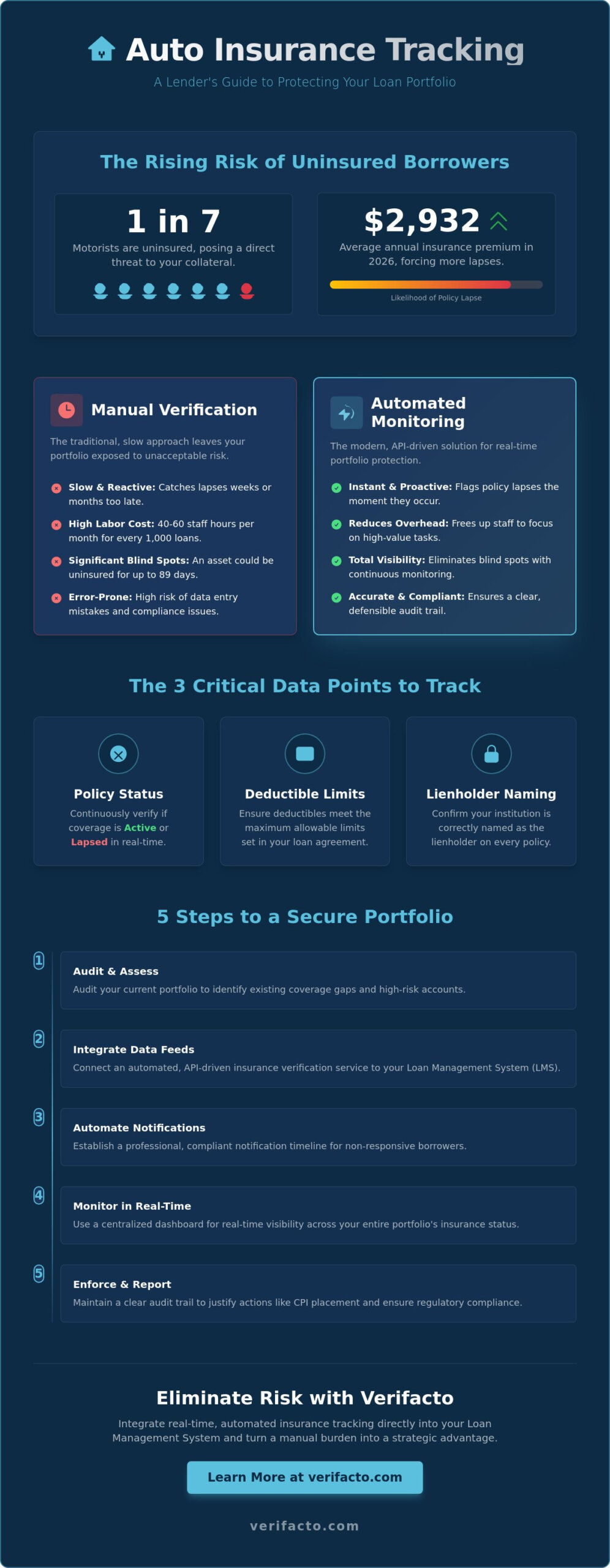
Did you know that 1 in 7 motorists on the road today are driving without insurance? With the national average cost for full coverage reaching $2,932 annually in 2026, more borrowers are choosing to let their policies lapse. Learning how to track auto insurance on a loan portfolio effectively is no longer optional; it’s a critical defensive strategy for your capital. You’ve likely felt the sting of manual verification being too slow to catch a cancellation before an accident occurs.
We agree that losing collateral value due to administrative delays is unacceptable. This guide promises to help you master the frameworks and technologies required to monitor borrower insurance coverage and eliminate risk across your entire auto loan portfolio. You’ll discover how real-time data integrations and automated borrower communication transform a manual burden into a streamlined, high-impact operation. We’ll dive into the 2026 regulatory shifts and the specific tools you need to maintain total control over your assets.
Key Takeaways
- Protect your capital by avoiding the “total loss trap” through continuous, real-time monitoring of borrower policy status.
- Discover how to track auto insurance on a loan portfolio using modern API-driven data feeds that outperform slow, manual verification methods.
- Master the “Big Three” essential data points, including policy status, deductible limits, and lienholder naming, to ensure every asset remains fully protected.
- Implement a five-step framework to audit your current portfolio for coverage gaps and establish a professional notification timeline for non-compliant borrowers.
- Eliminate operational silos by integrating insurance tracking directly into your Loan Management System for real-time visibility across your entire portfolio.
Understanding the Financial Risk of Uninsured Auto Portfolios
Auto insurance tracking is the systematic, ongoing verification of a borrower’s insurance status throughout the life of a loan. It isn’t a one-time event at origination. Instead, it’s a proactive defense against the “total loss trap.” This occurs when a vehicle is destroyed or stolen after a borrower has allowed their policy to lapse. Without active coverage, the lender is left with a worthless asset and a borrower who likely lacks the funds to pay off the remaining balance. With 15.4% of U.S. drivers operating without insurance in 2023, the statistical probability of encountering this trap is higher than most lenders realize. Understanding how to track auto insurance on a loan portfolio is the only way to shield your capital from these preventable losses.
The financial stakes have shifted significantly in 2026. The national average cost for full coverage insurance has climbed to $2,932 annually. As premiums rise, insurance is often the first expense a struggling borrower abandons. This makes a policy lapse a primary indicator of potential loan default. By the time a payment is missed, the collateral might have already been unprotected for weeks. Inflation has also driven up the replacement cost of vehicles, meaning every uninsured loss hits your balance sheet harder than it did a few years ago.
The Direct Impact on Portfolio Yield
Uninsured losses aren’t just an inconvenience; they’re a direct erosion of your bottom line. Every vehicle that is totaled without coverage represents a 100% loss of the remaining principal. Traditional manual verification methods are too slow to stop this. By the time a staff member calls an agent, the policy might have been canceled for thirty days. Moving toward automated tracking is essential for mitigating risk in auto lending. Automation provides the speed required to catch lapses before an accident happens, preserving your yield and reducing the administrative overhead of manual follow-ups.
Regulatory Compliance and Collateral Requirements
Most loan agreements contain explicit clauses requiring borrowers to maintain continuous full coverage insurance. Lenders must enforce these terms to protect their interests and comply with internal risk policies. Maintaining a clear audit trail of insurance verification is vital for legal protection. This documentation supports the placement of Collateral Protection Insurance (CPI) when a borrower fails to provide proof of their own policy. Without a robust system to track auto insurance on a loan portfolio, justifying these actions becomes difficult during regulatory audits or legal disputes. A centralized tracking framework ensures you’re always prepared to prove compliance with both state and federal requirements.
Manual vs. Automated Insurance Tracking: Choosing Your Methodology
Deciding between manual and automated methods is a strategic choice that determines your portfolio’s resilience. Many lenders still rely on the traditional “call-and-verify” approach, where staff members spend hours on the phone with agents or scouring mail for policy updates. While this might feel like maintaining control, it’s a reactive strategy that leaves your assets vulnerable. In contrast, modern API-driven data feeds represent the 2026 industry standard for real-time monitoring. This technology doesn’t wait for a paper notice to arrive; it connects directly to carrier databases to flag a lapse the moment it happens. Understanding how to track auto insurance on a loan portfolio through automation is the difference between catching a risk and discovering a loss too late.
The High Cost of Manual Verification
Manual tracking is notoriously difficult to scale. If you’re managing 1,000 active loans, a single staff member might spend 40 to 60 hours every month just trying to verify coverage. This process is riddled with “blind spots.” If you only check a policy every 90 days, a borrower could be uninsured for 89 of those days without your knowledge. Peak renewal seasons aggravate this problem, as the sheer volume of paperwork leads to data entry errors in your DMS. These mistakes don’t just create administrative headaches; they can lead to legal complications if you accidentally trigger force-placed coverage. To stay compliant, lenders must strictly follow CFPB regulations on force-placed insurance, which require precise timing and accurate documentation that manual systems often fail to provide.
The Advantages of Automated Data Integration
Automated systems eliminate the friction of human intervention by pulling data directly from insurance carriers using ACORD standards. This digital handshake ensures that your records are always a mirror image of the carrier’s latest data. Beyond simple verification, automation plays a vital role in improving collection efficiency for auto loans. When your system automatically flags a cancellation, your team can pivot from administrative data entry to high-value borrower outreach. This proactive stance keeps your collateral protected while reducing the labor costs associated with chasing paper. If you’re looking to modernize your operations, exploring an integrated Insurance Tracking solution is the most effective way to close the gaps in your risk management strategy.
- Real-time updates: Instant notification of policy cancellations or non-renewals.
- Reduced error rates: Eliminates the risk of manual data entry mistakes.
- Scalability: Effortlessly manage thousands of loans without adding headcount.
- Audit readiness: Automatically generates a digital trail for every verification attempt.
Essential Components of a Modern Insurance Tracking Framework
A high-performing framework for risk management does more than just confirm a policy exists; it verifies the integrity of the protection. To maintain a secure position, your system must capture the “Big Three” data points: policy status, deductible limits, and correct lienholder naming. If any of these elements are missing or incorrect, your collateral is at risk. Lenders often ask how to track auto insurance on a loan portfolio without drowning in paperwork. The answer lies in a centralized dashboard within your LMS that provides a single source of truth for every asset. This dashboard should include automatic document imaging to store policy declarations, ensuring you’re always prepared for internal audits or regulatory reviews.
Modern tracking also requires a shift from reactive phone calls to proactive, multi-channel communication. When a policy status changes, your system should instantly trigger a sequence of SMS, email, and mail notifications. This automated approach ensures that the borrower is informed immediately, reducing the duration of any insurance lapse. By integrating these components, you move away from fragmented spreadsheets and toward a streamlined, secure operation that protects your capital around the clock.
Deductible and Coverage Limit Monitoring
Monitoring just the “active” status of a policy is a common mistake that leaves lenders exposed. If a borrower carries a $2,500 deductible on a vehicle with a $5,000 repair bill, your actual protection is significantly diminished. Your tracking framework must verify that deductible maximums and coverage limits meet your specific loan requirements. Additionally, you must confirm that your institution is correctly listed as the Loss Payee. Without this designation, an insurance carrier might send a claim check directly to the borrower, leaving you with a damaged asset and no funds for repair. Maintaining these standards is a core part of staying compliant with CFPB Auto Finance Examination Procedures, which emphasize the need for rigorous collateral oversight.
Automated Borrower Communication Triggers
The 2026 industry standard favors “self-service” portals where borrowers can upload proof of insurance from their mobile devices. This convenience significantly improves compliance rates and reduces the administrative burden on your staff. When you understand how to track auto insurance on a loan portfolio using these digital tools, you can sync insurance status with other operational functions. For instance, integrated payment solutions for dealers can be configured to alert your team if a borrower attempts a payment while their insurance is lapsed. This creates multiple touchpoints for verification, ensuring that no vehicle in your portfolio remains unprotected for long.
- Document Imaging: Automatically store every policy declaration for instant retrieval.
- Lienholder Verification: Ensure your institution is correctly named on every policy.
- Multi-Channel Outreach: Use SMS and email to resolve lapses faster than traditional mail.
- Self-Service Uploads: Empower borrowers to provide proof of insurance instantly through a secure portal.
How to Implement an Insurance Tracking System in 5 Steps
Implementation is the bridge between a risk management theory and a protected balance sheet. Moving from a manual process to a modern framework requires a methodical approach to ensure no data is lost during the transition. When you’re ready to master how to track auto insurance on a loan portfolio, follow this five-step blueprint to build a resilient, automated system.
- Step 1: Audit your current portfolio. Begin by identifying missing or expired insurance data. Focus on high-risk segments where verification dates are older than 90 days.
- Step 2: Define your policy. Establish clear grace periods and notification timelines. Consistency here prevents legal friction and sets clear expectations for your borrowers.
- Step 3: Integrate your LMS. Connect your management system with an automated insurance data provider to replace manual calls with real-time digital feeds.
- Step 4: Automate the notification sequence. Set up triggers for “Notice of Lapse” messages via SMS and email to resolve coverage gaps immediately.
- Step 5: Establish a CPI protocol. Define the exact point when lender-placed insurance is activated to ensure the asset never remains unprotected.
Auditing Your Existing Collateral Data
Success begins with a clean data baseline. Before turning on automation, you must standardize carrier naming conventions in your DMS. Inconsistent entries like “State Farm” versus “St. Farm” can break automated matching algorithms. By identifying high-risk segments with the oldest verification dates, you can prioritize your team’s initial cleanup efforts. This audit ensures that when the automated system goes live, it’s working with accurate, actionable information rather than trying to fix historical errors. Clean data is the foundation of any scalable tracking operation.
Designing the Compliant Notification Sequence
Your notification sequence must balance professional authority with regulatory compliance. Legal requirements usually dictate the timing of a “First Notice” and a “Final Notice” before any lender-placed insurance is added. Use an assertive yet helpful tone in these communications to drive borrower action. Automation also allows for a “Thank You” message once new coverage is verified, which reinforces positive borrower behavior. If you want to streamline this entire process, our Insurance Tracking and CPI Solutions provide the tools to manage these sequences with surgical precision. This proactive communication reduces lapse duration and protects your relationship with the borrower.
Ready to modernize your workflow? Explore our Insurance Tracking solutions to automate these steps today and eliminate collateral risk across your entire portfolio.
Scaling Portfolio Protection with Verifacto’s Integrated LMS
Lenders often struggle with fragmented data that creates dangerous gaps in their risk management strategy. When your insurance information lives in a separate spreadsheet from your loan balances, you’re operating with a blindfold. Silos are the enemy of efficiency. Verifacto eliminates this friction by unifying loan management and insurance tracking into a single, high-impact ecosystem. Learning how to track auto insurance on a loan portfolio becomes a streamlined, one-screen operation rather than a multi-departmental headache. You gain real-time visibility into every vehicle’s status, allowing your team to act with precision the moment a policy changes.
This integration does more than just display data; it drives action. Automated borrower communication is built directly into the workflow, meaning a lapse notification can be sent via SMS or email without a staff member ever picking up a phone. You reduce administrative overhead and mitigate risk through cutting-edge technology rather than by hiring more staff. This proactive approach ensures your collateral remains protected while your team focuses on high-value tasks that actually grow your business.
A Unified Platform for Modern Lending
The primary benefit of our framework is the synergy between our DMS and LMS capabilities. Understanding what is dms technology in 2026 requires looking at how it integrates with servicing tools to protect the lender’s interest. When a lapse is detected, the transition from a notification sequence to a CPI placement is seamless and compliant. For a comprehensive look at how to operationalize this process, the lender placed insurance management reference guide covers the full workflow from detection to force-placement under the latest 2026 CFPB and Fannie Mae mandates. Verifacto’s cloud-based architecture serves as a vigilant digital guardian, providing autonomous, 24/7 monitoring that identifies policy changes the instant carriers update their databases. This ensures that your portfolio is never left vulnerable during weekends or holidays when manual teams are offline.
Transforming Risk Management into a Competitive Advantage
Precision tracking isn’t just a defensive move; it’s a strategic asset that strengthens your market position. Lenders who utilize real-time monitoring see significantly lower charge-offs and report higher investor confidence. When you can prove that your capital is shielded by automated frameworks, you become a more attractive partner for warehouse lenders and investors alike. You’re no longer chasing paper or dealing with the “total loss trap” described earlier in this guide. Instead, you’re running a modernized operation where risk is controlled and growth is the priority. It’s time to stop reacting to losses and start preventing them. Modernize your insurance tracking with Verifacto today and take full control of your portfolio’s security.
- Eliminate Silos: View loan data and insurance status on a single, unified screen.
- Automate Outreach: Trigger SMS and email notifications automatically when a lapse occurs.
- Boost Confidence: Lower your risk profile to attract better investment and scaling opportunities.
- Scale Efficiently: Manage thousands of loans without increasing your administrative headcount.
Secure Your Assets with Automated Risk Management
Protecting your capital in 2026 requires more than just reactive phone calls. You’ve seen how the “total loss trap” can devastate a portfolio when a vehicle is destroyed without active coverage. By mastering how to track auto insurance on a loan portfolio through automation, you eliminate the blind spots that manual verification creates. Moving to a unified ecosystem isn’t just about efficiency; it’s about establishing a reliable digital guardian for every asset you finance.
Verifacto provides the tools you need to modernize your operations and scale without adding headcount. Our platform offers real-time insurance monitoring and an integrated LMS/DMS architecture that keeps your data in sync. With automated multi-channel borrower notifications, you can resolve lapses in record time and maintain continuous protection across your entire portfolio.
Don’t let manual processes leave your collateral exposed. Request a Verifacto demo to automate your insurance tracking and take the first step toward a more secure, results-oriented future. You have the framework; now it’s time to implement the technology that makes it work. Your assets deserve the highest level of protection available.
Frequently Asked Questions
What is auto insurance tracking for lenders?
Auto insurance tracking is the continuous process of verifying that a borrower maintains the required coverage throughout the life of their loan. This practice ensures that the lender’s lienholder status is active and that the vehicle remains protected against physical damage. Effective tracking helps you identify potential risks before they turn into financial losses. It serves as a vital safeguard for your capital by ensuring the collateral’s value is always backed by a valid policy.
How does an automated insurance tracking system work?
Automated systems work by establishing direct digital connections with insurance carrier databases using standardized data protocols like ACORD. Instead of waiting for paper notices, the system receives real-time updates whenever a policy is canceled, changed, or non-renewed. This technology eliminates the delays of manual phone calls and data entry. When you implement a modern system to manage how to track auto insurance on a loan portfolio, you gain instant visibility into every asset’s status.
What happens if a borrower’s auto insurance lapses?
When a lapse is detected, the system immediately initiates a predefined notification sequence to the borrower via SMS, email, or mail. This sequence informs the borrower of their contractual obligation to maintain coverage and provides a deadline for resolution. If the borrower fails to provide proof of insurance within the allowed grace period, the lender may proceed with placing Collateral Protection Insurance (CPI) to ensure the asset does not remain unprotected.
Is it legal for a lender to track a borrower’s private insurance?
Yes, tracking insurance is a standard legal practice supported by the terms of most retail installment contracts and loan agreements. Lenders hold an insurable interest in the collateral because its value secures the loan. By signing the agreement, the borrower consents to maintain coverage and allows the lender to verify that status. However, lenders must strictly follow federal guidelines, such as CFPB regulations, when moving from tracking to placing lender-placed insurance.
What is the difference between insurance tracking and Collateral Protection Insurance (CPI)?
Insurance tracking is the monitoring function, while CPI is the corrective action taken when tracking reveals a lapse. Tracking identifies when a borrower’s private policy is no longer active or no longer meets the required coverage limits. CPI is the actual insurance policy the lender purchases to protect their interest in the vehicle. The cost of this premium is typically passed on to the borrower as part of their loan balance. For a deeper understanding of how to operationalize this transition compliantly, review the complete guide to lender placed insurance management and its 2026 regulatory requirements.
Can I track insurance manually for a small loan portfolio?
While you can technically track insurance manually for a small portfolio, it’s rarely the most cost-effective or secure choice. Manual tracking relies on periodic checks that leave your assets vulnerable during the weeks or months between verifications. Even with a small number of loans, the labor hours required to call agents and update spreadsheets are better spent on growth. Automation provides a level of security and scalability that manual processes simply cannot match.
How often should a lender verify insurance coverage on their portfolio?
Lenders should verify insurance coverage continuously to meet the 2026 industry standard for risk management. Periodic checks, such as monthly or quarterly audits, create significant coverage gaps where a vehicle could be uninsured for extended periods. Real-time monitoring allows you to react the moment a policy is canceled. This proactive approach is the most effective way to understand how to track auto insurance on a loan portfolio while minimizing the risk of uninsured losses.
What are the benefits of integrating insurance tracking with an LMS?
Integrating insurance tracking with a Loan Management System (LMS) creates a unified source of truth for your entire operation. It allows for automated communication triggers that link insurance status directly to borrower accounts and payment processing. This integration eliminates the need for data silos and reduces administrative overhead. You gain a comprehensive view of your portfolio’s health, allowing your team to manage risk and collections from a single, high-impact dashboard. For a deeper look at how insurance tracking in loan management software can streamline these workflows, explore the complete 2026 lender’s guide to automating insurance verification for car loans.