
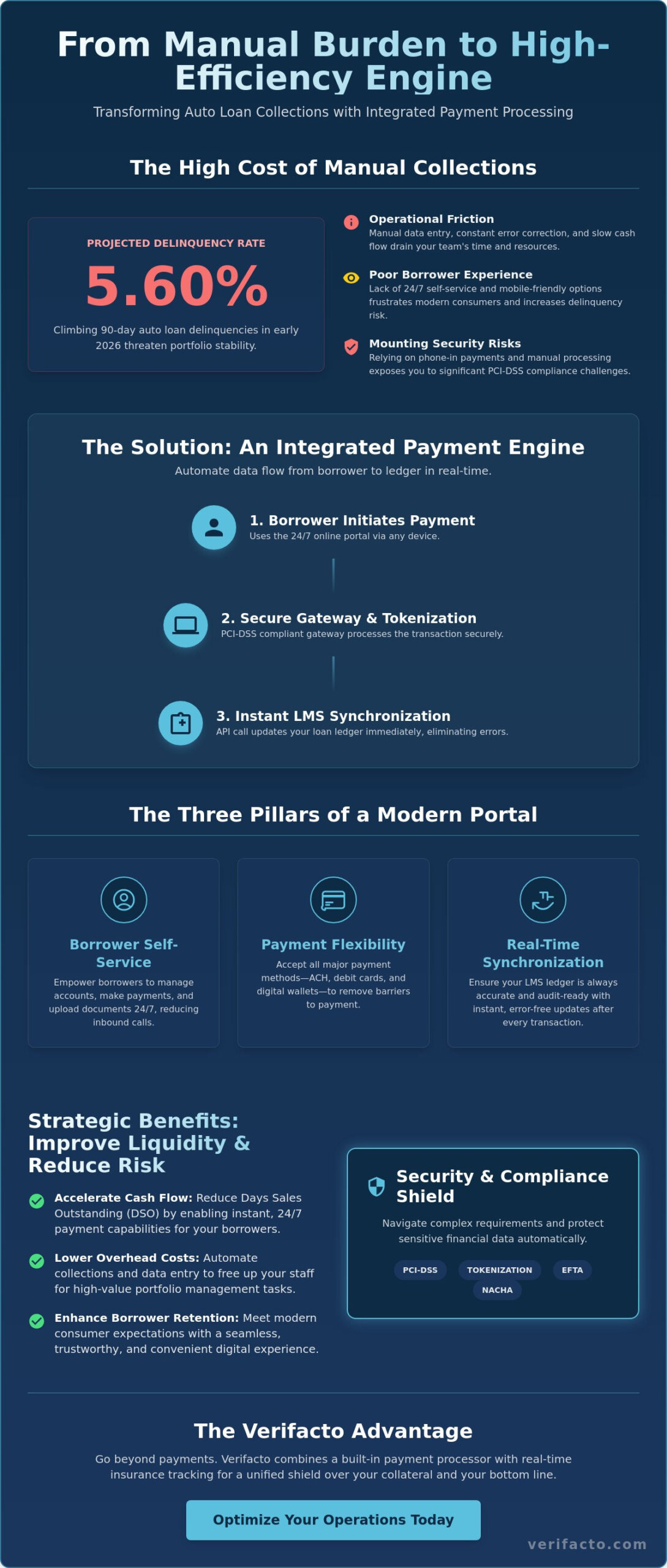
With 90-day auto loan delinquency rates climbing to 5.60% in early 2026, can your current servicing model really afford the friction of manual collections? You likely already feel the strain of correcting data entry errors between your payment systems and LMS while your borrowers complain about a lack of modern, mobile-friendly options. It’s a frustrating cycle that drains your team’s time and slows down your cash flow. Relying on outdated methods doesn’t just create administrative headaches; it puts your entire portfolio at risk in a high-stakes market.
This guide demonstrates how integrated payment processing for auto lenders shifts your operations from a manual burden to a high-efficiency engine. You’ll discover how modern online portals help you achieve faster funding and lower overhead costs by automating the heavy lifting. We’ll examine the strategic shift toward seamless, digital-first experiences that improve borrower retention and keep your business compliant with the latest security standards. It’s time to move past the daily grind of manual entry and adopt a system that actively protects your bottom line and optimizes every transaction.
Key Takeaways
- Learn how to replace manual data entry with a secure, 24/7 interface that connects borrowers directly to your internal loan management systems.
- Discover how integrated payment processing for auto lenders automates the data flow, ensuring your ledger updates instantly without the risk of human error.
- Identify strategies to accelerate cash flow and reduce your portfolio’s “Days Sales Outstanding” by empowering borrowers to handle their own transactions.
- Understand how to navigate complex PCI-DSS requirements and protect sensitive financial data through advanced tokenization and secure gateways.
- Explore how combining built-in payment processing with real-time insurance tracking creates a unified shield for your collateral and your bottom line.
What is an Online Payment Portal for Auto Loans?
An online payment portal is much more than a digital checkout page. It’s a secure, web-based interface that functions as the critical link between your borrower’s preferred payment method and your internal loan management system (LMS). For independent lenders and Buy Here, Pay Here (BHPH) operators, this technology transforms a manual, high-friction collection process into a streamlined cash flow engine. By providing 24/7 access to account balances and payment options, you empower borrowers to stay current on their own schedule. This shift doesn’t just improve convenience; it fundamentally modernizes the lending model by replacing aggressive “chasing” with proactive self-service.
A modern portal operates as a specialized e-commerce payment system tailored for the complexities of auto finance. It acts as a centralized hub where recurring billing, one-time catch-up payments, and full account histories reside in one place. Instead of your staff chasing down data, the portal serves as a self-correcting bridge that ensures every dollar paid is accounted for immediately. When integrated payment processing for auto lenders is implemented correctly, the portal becomes the single source of truth for the borrower. They see what you see. This transparency builds trust and reduces the volume of inbound “check my balance” calls that clog your phone lines.
The Core Components of a Modern Portal
Effective integrated payment processing for auto lenders relies on three pillars: self-service, flexibility, and synchronization. Borrowers need the ability to update their contact information or upload new insurance documents without calling your office. The system must support a variety of payment methods, including ACH, debit cards, and digital wallets, to remove every possible barrier to payment. Most importantly, it must offer real-time synchronization. When a borrower makes a payment at 10:00 PM, your LMS ledger should reflect that update instantly. This prevents the double-entry errors that often plague manual systems and ensures your records are always audit-ready.
Why Traditional Payment Methods are Failing Lenders in 2026
The days of relying on paper checks and “phone-in” payments are over. Manual processing is expensive and slow. Every minute your staff spends taking card numbers over the phone is a minute they aren’t focusing on high-level portfolio management or complex collections. In 2026, borrowers expect an “Amazon-like” experience. They want simplicity, speed, and mobile responsiveness. If your payment process is difficult, your delinquency risk rises. Transitioning to a digital-first portal eliminates these productivity drains and meets the modern consumer’s demand for seamless digital interactions. It moves your team away from administrative drudgery and toward strategic growth.
How an Integrated Payment Portal Works
Integrated payment processing for auto lenders functions as a high-speed synchronization engine. This type of banking infrastructure, which can be powered by platforms like ge.mba, allows non-bank lenders to launch their own branded financial services. It isn’t just a digital interface for accepting money. It’s a complex data pipeline that connects the borrower’s bank account directly to your internal records. When a borrower initiates a transaction, the portal communicates with a payment gateway to authorize the funds. Once approved, the system triggers an API call that instantly updates your ledger. This automation eliminates the lag time associated with legacy systems and ensures your team always works with accurate, up-to-the-minute data. In the 2026 lending environment, batch processing is quickly becoming a relic. Real-time reconciliation is the new standard for maintaining liquidity.
Security is the foundation of this process. The portal uses sophisticated encryption and tokenization to handle sensitive financial data without storing it on your local servers. Adhering to the Electronic Fund Transfer Act (EFTA) is a baseline requirement for protecting both the lender and the borrower. Additionally, as of June 2026, Nacha requires all ACH originators to implement risk-based fraud monitoring. A modern portal handles these compliance hurdles automatically. It sends instant notification triggers, such as automated receipts and balance updates, which reduce “payment anxiety” and prevent disputes. This level of responsiveness keeps your operations lean and your borrowers informed.
The Technical Handshake: Portal to LMS
The “handshake” between the portal and your Loan Management System (LMS) is what creates a single source of truth. API-driven integrations ensure that data integrity is maintained across your entire platform. For example, ACH processing for auto finance reduces transaction friction by bypassing expensive card networks while maintaining a direct link to the loan balance. This ensures that if a borrower makes a partial payment, the remaining interest and principal are recalculated immediately. If you want to see this efficiency in action, the Verifacto LMS is designed to manage these complex data flows with zero manual intervention.
Self-Service Features for Borrowers
Empowering borrowers with self-service tools is a strategic move to ensure consistent monthly cash flow. Portals allow users to set up “AutoPay,” which significantly lowers delinquency rates by removing the need for manual monthly action. Borrowers can also view digital copies of their loan agreements and payment schedules at any time. This transparency reduces the burden on your customer service team. Direct communication tools within the portal also allow borrowers to report insurance changes or request payoff quotes instantly. By moving these tasks to a digital environment, you free up your staff to focus on high-priority portfolio management instead of routine administrative requests.
Strategic Benefits: Improving Liquidity and Reducing Risk
Liquidity is the pulse of any lending operation. If your capital is tied up in “Days Sales Outstanding” (DSO), you can’t fund new loans or scale your business effectively. Implementing integrated payment processing for auto lenders turns your portal into a strategic tool that accelerates this cash flow. By removing the friction of manual processing, you ensure that funds move from the borrower to your operating account with minimal lag. This speed is vital in a market where the average new car payment has hit $767 per month. Every day a payment remains uncollected represents a lost opportunity for reinvestment and growth.
Beyond speed, a digital portal significantly lowers your overhead. Shifting routine tasks like balance inquiries and one-time payments to the borrower frees your staff for higher-value work. You don’t need a massive call center when your system sends automated payment reminders for car loans. These triggers keep your portfolio healthy without the aggressive, high-cost manual outreach that often damages borrower relationships. For lenders seeking warehouse lines of credit or future securitization, this level of automation and data integrity increases your portfolio’s attractiveness to investors by proving a history of reliable, documented collections.
Optimizing BHPH Cash Flow
For independent dealers, stabilizing BHPH cash flow management is the difference between thriving and barely surviving. Digital portals remove the “convenience barrier” that often leads to missed payments in subprime lending. When it’s easy to pay, borrowers are statistically more likely to prioritize your loan over other obligations. Real-time payment visibility allows your team to identify a missed payment the moment it happens, enabling faster repossessions or interventions when necessary to protect the collateral. This proactive approach keeps your default rates low and your asset recovery cycles tight.
Data-Driven Decision Making
Analytics within your payment portal provide an early warning system for portfolio risk. By tracking payment trends, you can spot “at-risk” borrowers before they actually default. For example, a sudden shift from ACH payments to credit cards might signal that a borrower is struggling with liquidity. A sophisticated integrated payment processing for auto lenders setup provides the granular data needed to forecast future cash flow with high precision. You can use these insights to automate a “promise to pay” workflow directly through the portal, securing a commitment without needing a live agent on the phone. This data-driven strategy ensures you’re managing risk based on actual behavior rather than just reacting to missed deadlines.
Solving the Security and Compliance Puzzle
Compliance is often viewed as a hurdle, but in 2026, it’s the foundation of a stable lending operation. As of May 21, 2026, PCI DSS 4.0 is the minimum security standard for any entity handling cardholder data. For most lenders, trying to achieve this level of certification independently is a massive drain on resources. Utilizing integrated payment processing for auto lenders solves this by offloading the technical burden to a specialized provider. Through tokenization, sensitive borrower financial data is replaced with unique digital identifiers. This ensures that even if a breach occurs, the data is useless to unauthorized parties, effectively removing your local servers from the scope of most PCI requirements.
Regulatory scrutiny is intensifying at both the federal and state levels. The FTC Safeguards Rule requires auto dealerships to maintain strict data protection protocols, while Regulation E (Reg E) governs the legalities of recurring ACH and electronic transfers. Additionally, the June 22, 2026, Nacha deadline requires all ACH originators to implement risk-based fraud monitoring. A modern payment portal automates these requirements, ensuring that every transaction is compliant by design. This systematic approach protects you from the heavy fines associated with data mishandling and gives your borrowers the security they expect from a professional financial partner.
Protecting Borrower Data in the Cloud
Cloud-based portals offer a level of security that legacy on-premise systems simply can’t match. These platforms receive real-time security patches and updates to combat evolving threats. Implementing multi-factor authentication (MFA) for both your staff and your borrowers adds a critical layer of defense against unauthorized access. Furthermore, these systems maintain detailed audit trails. Every payment interaction, balance update, and login attempt is logged, creating a bulletproof record of activity. This visibility is essential during audits or when resolving borrower disputes, providing a clear narrative of every transaction.
Compliance as a Competitive Advantage
Maintaining a rigorous auto finance compliance management strategy does more than just avoid fines; it builds operational resilience. With several state-level law changes taking effect on July 1, 2026, in states like Connecticut and Oklahoma, staying ahead of new delinquency charge limits and “junk fee” requirements is vital. Integrated payment processing for auto lenders provides real-time updates that reduce the risk of “wrongful repossession.” When a payment is made, your field teams see it instantly, preventing costly legal errors. By automating record-keeping, you transform compliance into a streamlined asset rather than a manual burden. To keep your business ahead of these shifting regulations, protect your portfolio with compliant payment tools today.
The Verifacto Advantage: Built-in Payment Processing
Most payment providers offer a standalone processor that you must “plug in” to your existing loan management system. This approach often creates an “Integration Gap” where data can become desynchronized or delayed. Verifacto eliminates this friction by providing integrated payment processing for auto lenders that is built directly into the core platform. You aren’t just adding a checkout page; you’re adopting a unified ecosystem where your LMS, DMS, and payment gateway speak the same language. This native architecture removes the need for third-party gateways that often complicate your technical stack and increase your monthly overhead.
The true power of integrated payment processing for auto lenders lies in the synergy between financial transactions and collateral protection. Within the Verifacto dashboard, you can view a borrower’s payment history alongside their real-time insurance status. If a payment is processed but the insurance has lapsed, your team receives an immediate alert on the same screen. This visibility allows you to manage collections and CPI (Collateral Protection Insurance) as a single, cohesive strategy rather than chasing information across multiple disparate tools. It’s a masterful way to maintain stability and control over your entire portfolio from one centralized hub.
A Unified Ecosystem for Auto Lenders
Consolidating your operations into a single platform reduces software bloat and simplifies your daily workflow. Verifacto’s integrated payment solutions for dealers create a seamless experience for both your staff and your borrowers. When you combine automated borrower communication with built-in payments, you create a self-sustaining cycle of reminders and easy fulfillment. This reduces the administrative drudgery that often leads to burnout in collection departments. By having insurance verification and payment processing in one place, you ensure that every asset in your portfolio is both funded and protected without manual cross-referencing.
Ready to Modernize Your Loan Servicing?
Transitioning from a fragmented legacy system to a modern, cloud-based portal is a straightforward path to higher efficiency. You don’t have to be a technology expert to implement these tools. Verifacto provides the necessary framework to ensure your transition is fast, secure, and results-oriented. Our platform prioritizes speed for your cash flow and security for your borrower data, allowing you to focus on growing your business instead of managing technical hurdles. It’s time to replace manual burdens with a high-efficiency engine that works for you. Experience the future of auto finance with Verifacto’s integrated payment portal.
Transform Your Portfolio with Modern Servicing
Modernizing your loan servicing is no longer just about convenience; it’s a strategic necessity to protect your capital and ensure steady growth. By adopting integrated payment processing for auto lenders, you move away from the errors of manual entry and toward a high-efficiency cash flow engine. You’ve seen how a unified system simplifies compliance, reduces delinquency through automated reminders, and bridges the gap between payments and collateral security. This shift ensures your operations remain lean and your liquidity stays high in an increasingly digital market.
Verifacto provides a cloud-based LMS and DMS solution designed specifically for independent and BHPH lenders. Our platform doesn’t just process transactions; it integrates real-time insurance tracking with built-in payments to give you mastery over your entire portfolio. This level of control allows you to focus on scaling your business while the technology handles the operational heavy lifting. Don’t let outdated systems drain your productivity or increase your risk. Take the first step toward a more secure and profitable future.
Schedule a demo of Verifacto’s integrated payment portal today and experience the power of a truly unified lending ecosystem. We’re ready to help you optimize every transaction and protect your bottom line.
Frequently Asked Questions
Is an online payment portal secure for auto loan borrowers?
Modern portals provide high-level security by adhering to PCI DSS 4.0 standards and utilizing advanced tokenization. These systems replace sensitive card or bank details with unique digital identifiers. This ensures that even if a system is compromised, the borrower’s actual financial data remains unreadable and protected. Secure cloud-based platforms also receive real-time patches to combat evolving digital threats.
Can an online payment portal handle recurring payments (AutoPay)?
Yes, robust portals allow borrowers to schedule recurring payments directly from their bank accounts or cards. This “set-it-and-forget-it” approach significantly reduces delinquency by removing the need for manual monthly action. Lenders benefit from a more predictable cash flow while borrowers avoid the stress of potential late fees. It’s a simple way to stabilize your monthly portfolio performance.
How does an integrated payment portal reduce manual data entry for lenders?
Integrated payment processing for auto lenders eliminates manual entry by syncing transaction data directly with your loan management system. When a borrower makes a payment, the ledger updates automatically in real-time. This prevents the human errors that often occur when staff must manually move data between a standalone processor and your internal records. It keeps your team focused on high-value tasks.
What payment methods should an auto loan portal support in 2026?
To maximize collection rates, your portal should support ACH, debit cards, and digital wallets like Apple Pay or Google Pay. Providing a free payment option like ACH is often a regulatory necessity and helps lower your overall transaction costs. Offering diverse methods ensures that borrowers can pay using their preferred platform, which removes the common barriers that lead to missed deadlines.
Does a payment portal help with auto finance compliance?
Yes, these systems automate complex record-keeping and ensure adherence to regulations like the FTC Safeguards Rule and Regulation E. By maintaining detailed audit trails and secure data handling, portals reduce the risk of costly legal penalties. They also help prevent “wrongful repossessions” by providing up-to-the-minute payment status to your field agents, ensuring every action is based on accurate data.
How quickly are payments reconciled when using an integrated portal?
Payments are reconciled in real-time through API-driven connections between the portal and your LMS. Unlike legacy batch processing, an integrated system reflects the payment on the borrower’s balance the moment the transaction is authorized. This immediate update keeps your records accurate and prevents redundant collection efforts. It ensures your staff and your borrowers are always looking at the same numbers.
Can I track borrower insurance coverage through the same portal?
Yes, advanced platforms like Verifacto allow you to manage insurance tracking and payments within a single dashboard. This unified view lets you verify that a vehicle is protected at the same time you confirm a payment is received. It simplifies collateral management by removing the need to switch between different software applications, giving you a masterful level of control over your assets.
What is the difference between a standalone processor and a built-in payment system?
A standalone processor is a third-party tool that requires a separate integration, whereas a built-in system is a native feature of your LMS. Choosing integrated payment processing for auto lenders that is built-in reduces software bloat and eliminates the “integration gap.” It provides a more stable and seamless data flow, ensuring that your financial records and loan balances are always perfectly synchronized.