
A dealership can accept payments at the sales desk and still have disconnected workflows across service, parts, and finance. The challenge is finding integrated payment processing for car dealers that fits each department’s transactions, connects with existing systems, and makes fees and security requirements clear.
Payment costs depend on the fee structure and how customers pay. Operational fit depends on transaction types, reconciliation needs, and system integration. This guide explains how to assess those factors, compare solutions for different automotive businesses, and identify how built-in payment processing can support a more connected operation.
Key Takeaways
- Map payment needs across sales, service, parts, and F&I to identify where workflows need different support.
- Assess how payment tools connect with dealership systems and where disconnected records can create extra manual work.
- Compare processing costs and payment methods while considering security, fraud prevention, and chargeback handling.
- Evaluate providers by how well they support reconciliation, commercial transactions, and your dealership’s day-to-day operations.
- See how built-in payment processing alongside Verifacto DMS and LMS can support a connected workflow from transaction to reconciliation.
Where Dealership Payment Workflows Break Down
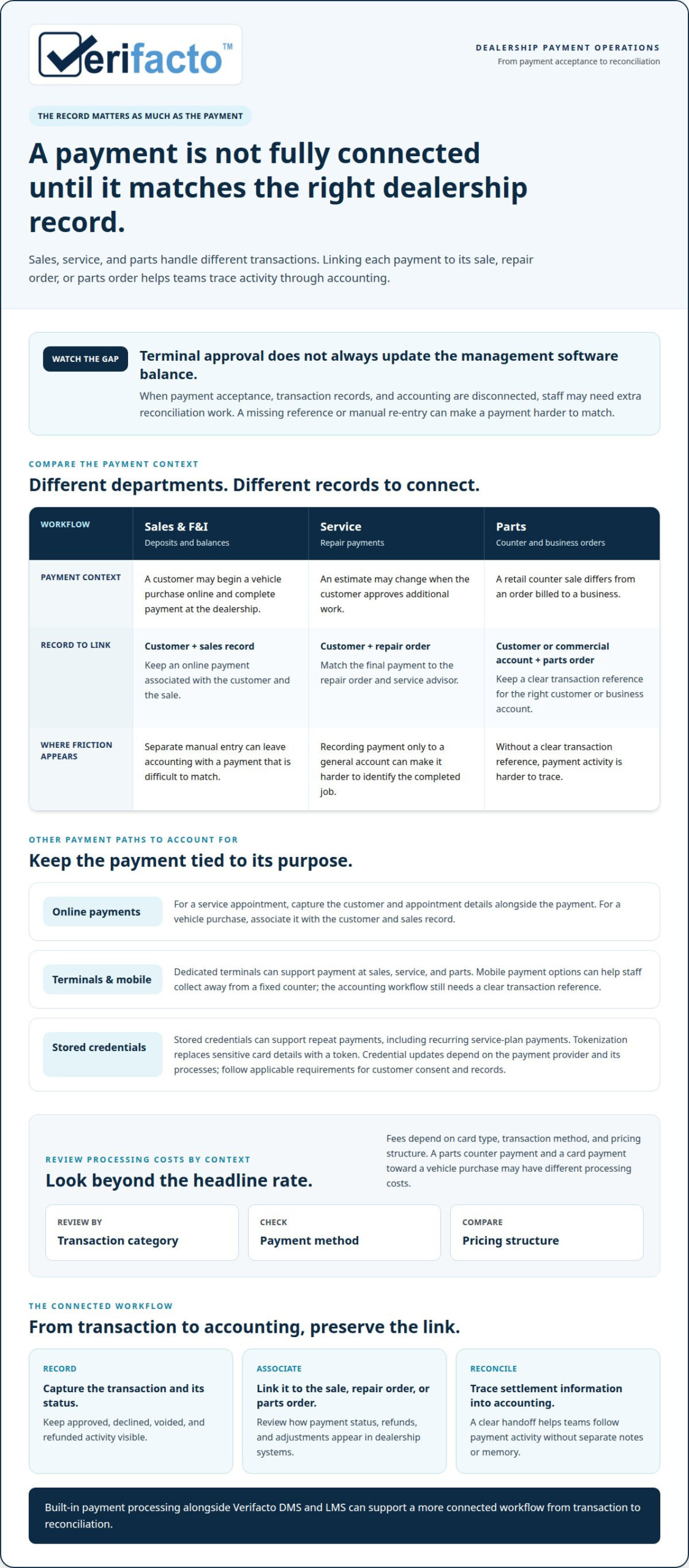
A dealership may take a vehicle deposit at the sales desk, a repair payment in the service lane, and a parts payment at the counter. Each transaction has a different customer, reference record, and payment context. When staff must enter the same details into separate systems, errors can follow the payment from the terminal to accounting.
Vehicle sales and F&I handle deposits, balances, and other transaction-related payments. A customer might begin a vehicle purchase online, then complete payment at the dealership. The workflow should keep that online payment linked to the customer and sale record. A separate manual entry can leave accounting with a payment that is difficult to match.
Service follows a different sequence. An advisor opens a repair order, provides an estimate, and may need to adjust the amount if the customer approves additional work. The final payment should reconcile to the repair order, customer, and service advisor. For example, recording a payment only against a general account can make it harder to identify the completed job it belongs to.
Parts teams also need transaction records tied to the right customer or commercial account. A retail counter sale differs from an order billed to a business. Dedicated payment terminals at sales, service, and parts can support each point of payment, while mobile payment options can help staff collect payment away from a fixed counter. The accounting workflow still needs a clear transaction reference.
Online payments can support service appointments and vehicle purchases, but each payment must connect to the right record. For a service appointment, capture the customer and appointment details alongside the payment. For a vehicle purchase, associate the payment with the customer and sales record. Check applicable requirements and the payment provider’s process for ACH authorization before processing.
Stored credentials can support repeat payments, including recurring service-plan payments. Follow applicable requirements and the payment provider’s process for obtaining customer consent and maintaining customer records. Tokenization replaces sensitive card details with a token. Whether a stored credential can be updated when a customer replaces a card depends on the payment provider and its processes.
These workflows work best when each department follows a clear handoff: record the transaction, associate it with the sale, repair order, or parts order, then reconcile it in accounting. This sequence helps dealership teams trace payment activity without relying on separate notes or memory.
Why Disconnected Systems Make Payment Operations Harder
A payment terminal can approve a card while the dealership’s management software still shows an open balance. The gap between payment acceptance, transaction records, and accounting creates extra reconciliation work.
Dealer Management System Connectivity
A DMS can hold the customer, deal, repair order, or parts ticket that gives a payment its business context. The connection should include enough detail to match a completed transaction to the correct record. For example, a service payment should reference its repair order, not just a general customer account. Review how payment status, refunds, and adjustments appear in the DMS.
Dealership Software Integration
Dealership operations may also rely on CRM, inventory, service, and accounting software. Each system handles different information, so integration needs a clear purpose. A sales record may identify the customer and deal, while accounting tracks the deposit and settlement. Assess which details move between systems, when they update, and which steps still require manual entry.
Credit card processing becomes harder to manage when staff must rekey transaction details. A cashier might enter a payment in the terminal, then record it again against a customer ticket. A missed reference or mistyped amount can disconnect payment acceptance from the sale. At higher transaction volumes, repeated manual steps can add reconciliation pressure across departments.
Map the workflow from authorization to accounting. First, identify the business record linked to each payment type. Next, determine whether the system records approved, declined, voided, and refunded transactions. Then trace how settlement information reaches accounting. This sequence reveals whether software integration supports the full transaction or only the initial card acceptance.
Exceptions matter, too. If a payment is adjusted after a service estimate changes, the final ticket and payment record should agree. If a transaction is refunded, staff need a visible link to its original record. Clear status updates help teams distinguish unresolved payments from completed transactions without relying on separate notes or memory.
Integrated payment processing for car dealers should be assessed against these specific workflows, not just terminal speed. A useful review includes sales deposits, service tickets, parts orders, accounting handoffs, and exception handling. For a dealership planning connected operations, explore how a connected workflow can fit dealership operations.
The Financial and Operational Cost of Payment Friction
A vehicle sale can involve a customer payment, financing, and several accounting entries. Credit card fees depend on factors such as card type, transaction method, and pricing structure. Review statements by transaction category, not just the headline rate. A counter payment for parts and a card payment toward a vehicle purchase may carry different processing costs.
For a high-value vehicle transaction, a percentage-based card fee can make the payment method an important cost decision. A dealership might accept a card for a smaller deposit while arranging the remaining balance through financing, ACH, or a wire transfer. Each method has a different handling and reconciliation process. Make sure the transaction record identifies the amount received and the portion handled through financing.
ACH can suit bank-account payments, commercial accounts, and wholesale purchases. Wire transfers offer another way to move funds for a vehicle transaction. Neither method eliminates operational work: staff still need to associate each payment with the correct deal, customer, and accounting record. A payment processing solution should make the transaction status and reference clear to the departments handling it.
Payment processes can affect both efficiency and exposure to fraud. PCI DSS is a payment card industry data security standard; dealerships can consult their payment processor or a qualified advisor about how it relates to their specific card-handling processes. For card-present sales, point-to-point encryption is one option dealerships may discuss with their payment provider. A terminal or platform alone does not determine how payment data is handled across sales, service, and accounting.
Chargebacks create extra work when transaction details and customer records are difficult to assemble. For example, a disputed service charge may require the repair order, payment record, and supporting customer documentation. Keep these records connected and establish a process for locating them. This helps teams respond with relevant information instead of searching across disconnected systems.
Compare processing costs across departments and payment methods, then consider the time spent correcting mismatches. An integrated payment processing approach can make transaction records easier to follow from acceptance through accounting. For auto dealerships, the practical goal is to reduce avoidable friction while preserving clear records for each vehicle, customer, and payment method.
How to Evaluate Payment Providers for Your Dealership
Choosing and implementing an integrated payment processor starts with mapping sales, service, parts, and accounting workflows. Then assess transaction handling, reconciliation, security, and commercial payment needs. Test the process against real dealership examples before expanding its use.
Begin with the transactions the provider must handle. A retail service payment, vehicle deposit, and commercial account payment each involve different records and handoffs. List the systems involved in each workflow, such as the DMS, payment terminal, and accounting software. Identify where staff enter information manually and where an unmatched payment could create follow-up work.
Next, assess reconciliation. Trace a transaction from acceptance through its dealership record and accounting entry. For example, a completed service payment should be traceable to its repair order. Confirm how the process represents approved, declined, refunded, or adjusted transactions. These details show whether the workflow provides useful visibility or leaves accounting to match records manually.
Review commercial needs separately. A dealership serving business accounts may need to handle payments by bank account, card, or wire transfer. Consider whether each method suits the transaction, customer relationship, and recordkeeping process. Also map who handles exceptions, such as a payment that arrives without a clear customer or invoice reference.
Use a structured evaluation:
- Map workflows: Document the steps for sales, service, parts, and commercial transactions.
- Review connections: Identify which payment details transfer to the DMS and accounting records.
- Assess security: For card-present sales, review whether a PCI-listed point-to-point encryption solution fits the dealership’s security needs through its established processes.
- Test exceptions: Walk through a refund, an adjusted service ticket, and an unmatched payment.
Before rollout, use representative dealership transactions to test the process from payment acceptance to reconciliation. Include staff who handle each workflow, then document gaps, manual steps, and ownership of exceptions. This gives management a practical view of operational fit beyond a provider demonstration.
The right provider should fit the dealership’s transaction mix and operating model, not just process credit cards. For automotive businesses, integrated payment processing is most useful when it supports clear records, commercial needs, and reconciliation without adding avoidable manual work.
How Verifacto Connects Payment Operations With Dealership Operations
Verifacto is an AI-powered operating platform that brings dealership operations, data, and AI together. Dealerships run one business but are often forced to manage it through disconnected systems. Verifacto connects the customer and loan lifecycle, including CRM, inventory, underwriting, DMS, LMS, collections, messaging, insurance tracking, CPI, reporting, analytics, and AI agents.
Verifacto DMS, Verifacto LMS, and Insurance Tracking are part of the wider platform, which also includes customer communication and collections capabilities. Dealership leaders can consider payment operations in the context of dealership and loan management, rather than as an isolated function.
For example, a dealership managing vehicle sales and loan servicing may want a clearer view of customer and account activity. Verifacto’s connected platform brings relevant lifecycle functions together, while AI agents can access operational data to support work such as analysis and collections. Human judgment remains central to operational decisions.
Verifacto may be worth exploring when payment handling is part of a broader systems challenge. A dealership reviewing its DMS or LMS can also consider how its payment workflows and Insurance Tracking fit its operating model. Reviewing these needs together helps management assess whether the platform aligns with its priorities.
Start with the dealership’s current operating needs: identify where payment activity sits, which teams use related information, and where disconnected tools limit visibility. Then assess whether bringing dealership management, loan management, insurance tracking, payment workflows, and AI capabilities into one platform suits the operation. This keeps the decision grounded in business requirements.
Verifacto brings Verifacto DMS, Verifacto LMS, and Insurance Tracking together in an AI-powered operating platform. Dealerships can also assess how their payment workflows fit alongside these capabilities. This approach may suit dealerships seeking greater visibility across dealership and loan lifecycle operations. The fit depends on the workflows and systems the dealership needs to support.
If disconnected tools are making payment operations harder to oversee, contact Verifacto to discuss your dealership’s needs.
A Practical Payment Workflow From Transaction to Reconciliation
A connected payment workflow starts with a clear transaction record and ends with a matched accounting entry. Consider a customer paying an agreed amount toward a vehicle purchase. The steps below show how dealership systems can keep the payment’s business context visible from acceptance to reconciliation.
- Open the transaction record. Sales staff create or locate the customer and deal record before accepting payment. Confirm the amount due and identify whether the payment is a deposit or another part of the transaction. This gives the payment a clear reference from the start.
- Accept and associate the payment. The customer pays through the dealership’s selected payment method. Staff link the resulting transaction record to the correct deal, rather than relying on a handwritten note or a generic account entry. If the payment is declined, record that status without treating it as collected revenue.
- Review exceptions promptly. If the payment amount changes or a transaction is voided, retain the updated status and its link to the original deal. This helps distinguish a completed payment from a reversed or adjusted transaction during later review.
- Match settlement to dealership records. Accounting compares payment activity with the relevant transaction records and settlement information. Unmatched entries should be assigned for follow-up, with their customer and deal references intact. Clear ownership keeps exceptions from disappearing in a shared queue.
- Close the reconciliation cycle. Once records align, accounting marks the transaction as reconciled according to dealership procedures. Management can then review outstanding items and recurring causes, such as missing references or delayed updates between systems.
For a service payment, the same structure applies, with a repair order as the reference. The service advisor records the approved work and payment context. Accounting then matches the payment to that order. If additional work changes the final amount, the record should reflect the adjustment before reconciliation. This keeps the customer transaction and service documentation aligned.
Connected systems can support this sequence by keeping transaction details associated with the relevant dealership record. The exact handoffs depend on the dealership’s software and processes, so map who creates, updates, and reconciles each record. A defined workflow helps identify where manual entry remains and gives teams a consistent way to resolve exceptions.
Use this transaction-to-reconciliation sequence to assess integrated payment processing for car dealers. The goal is traceable payment activity, clear ownership of exceptions, and records accounting can match to the underlying sale or service work.
Set Up a More Connected Payment Operation
Your next step is to define what a better payment workflow needs to support, then align that goal with your dealership’s wider operating model. For some dealerships, the priority is clearer ownership of payment records. For others, it is connecting payment activity with customer and loan operations. A focused evaluation keeps the decision grounded in the work your teams handle every day.
Verifacto connects dealership and loan operations through its DMS, LMS, and Insurance Tracking capabilities. Dealerships can evaluate how these functions support their payment workflows without assuming that payment processing is built into the platform. The right fit depends on how these functions need to work within your operation.
If you’re considering payment processing for car dealers as part of a wider systems decision, start a conversation about the workflows you want to connect. Contact Verifacto about dealership payments and explore a practical next step for your operation.
Frequently Asked Questions
What is integrated payment processing for car dealerships?
Integrated payment processing connects payment acceptance with dealership records and workflows. Instead of treating a payment as a standalone card transaction, the process associates it with a related deal, service invoice, or account. This gives staff and accounting a clearer record to work from. For example, a customer’s service payment can be tracked alongside the service activity it relates to.
Which dealership management systems and automotive software integrate with payment processors?
Compatibility depends on the processor and dealership software in use, so there is no universal list of systems that connect. A useful integration links payment activity with relevant DMS records and accounting workflows. Verifacto’s platform combines built-in payment processing with its DMS and LMS. Dealerships should assess the specific records and workflows they need to connect.
What payment methods can car dealers accept, including credit cards, ACH, financing, and digital wallets?
Available methods depend on the dealership’s payment setup. Confirm which payment methods are supported by the specific payment system before relying on them in dealership workflows. Financing is a separate way to arrange a vehicle purchase, not a card or bank-account payment method. Digital wallet acceptance also depends on the payment system in use, so don’t assume it is available alongside other methods.
What are typical payment processing fees and pricing for car dealerships in the United States?
There is no single processing rate that applies to every dealership. Costs depend on factors such as payment method, transaction characteristics, processing volume, and pricing terms. To assess a proposal, compare the total charges with the transactions the dealership expects to process. Review how fees are presented and whether the terms distinguish card, ACH, and other payment activity.
How do integrated payment systems handle deposits, down payments, service invoices, and refunds?
They can associate each payment with its business purpose, such as a vehicle deal or service invoice. A dealership’s workflow should show whether a payment is a deposit, a down payment, or a settled invoice amount. For a refund, retain the link to the original transaction and its related record. That context helps staff explain adjustments and maintain a coherent transaction history.
How do payment processing integrations reconcile transactions with dealership accounting and DMS records?
Reconciliation compares payment activity with dealership records and accounting entries. A practical closeout can group transactions by payment date, identify refunds or fees separately, and flag items without a matching deal or invoice reference. This helps accounting focus on exceptions instead of reviewing every entry as an isolated payment. Clear transaction references also make later reporting easier to interpret.
What PCI DSS, state, and federal rules apply to payment processing at U.S. car dealerships?
Requirements depend on the payment methods and activities involved. Dealerships should address applicable payment processing requirements through their established compliance processes and consult appropriate resources for guidance. Avoid assuming that one setup covers every obligation.
How should dealerships compare payment processors for security, support, contract terms, and integration capabilities?
Compare providers against real dealership workflows, not just a feature checklist. Review how card data is protected, how transactions connect to DMS and accounting records, and how exceptions are handled. Examine contract terms for fees, duration, termination, and service responsibilities. Assess the support process for payment issues and reconciliation questions. A written evaluation matrix helps decision-makers weigh operational fit alongside security and commercial terms.