
A subprime loan can look profitable on paper yet create pressure if its terms exceed the borrower’s ability to pay or expose the dealership to too much risk. Effective yield management for subprime auto loans means balancing the amount financed, down payment, pricing, and expected performance, rather than simply seeking the highest rate.
That balance matters. A well-structured offer can help a dealership serve customers responsibly, while a poorly structured one can increase repayment challenges and operational strain. The goal is to make disciplined decisions based on the information available about each borrower and deal.
This article explains how dealerships can estimate loan yield, assess pricing and risk factors, and refine offers through thoughtful underwriting. It also covers how connected loan management, borrower communication, payment processing, and insurance tracking tools can improve visibility across the loan lifecycle and help teams manage decisions and follow-up.
Key Takeaways
- Connect borrower, deal, payment, and insurance information to improve visibility into how loan decisions affect portfolio performance.
- Build loan offers around the borrower’s capacity and the deal structure, considering down payment and amount financed alongside pricing.
- Assess yield after accounting for funding or servicing costs and expected losses, not just the interest rate on the contract.
- Use borrower profile, vehicle value, loan terms, and portfolio performance to understand pricing and risk.
- Coordinate borrower messaging, payment processing, and loan management to support consistent follow-up while keeping human judgment central.
Why Disconnected Systems Make Yield Management Harder
A dealership can complete a deal without having a clear view of how the loan may perform. The application may be in one system, vehicle and deal details in another, and payment or insurance updates somewhere else. Managers then have to piece together borrower, contract, and account histories to assess the full picture.
This fragmentation makes yield management for subprime auto loans harder because yield depends on more than the contract rate. The amount financed, payment behavior, servicing activity, and losses all affect returns. When information arrives late or must be entered repeatedly, decision-makers may rely on incomplete or inconsistent records. A deal can look acceptable at origination while important context remains buried in another system.
Consider a borrower whose payment pattern changes after the sale. If account activity and communications are disconnected from the original deal, staff may not spot the change promptly or understand how it affects expected performance. Follow-up can become reactive, and management has less reliable information for reviewing similar offers or identifying portfolio patterns.
That operational strain adds to financial risk. Teams spend time reconciling records instead of reviewing exceptions, while duplicate entry increases the chance of errors. Reports built from separate systems may use different definitions or timing, making comparisons less useful. Leaders may struggle to tell whether results reflect pricing, borrower performance, vehicle mix, or servicing processes.
- Less visibility: Deal, payment, and insurance information may not tell one continuous account story.
- Slower response: Delayed updates can make emerging account issues harder to address early.
- Weaker analysis: Fragmented reporting can obscure which factors are shaping portfolio performance.
The result is less control over daily work and lending decisions. Connected, consistent information gives dealership leaders a stronger basis for evaluating offers, tracking accounts, and adjusting processes as portfolio experience develops.
Ways to Improve Loan Offers
Improve an offer by reviewing the whole deal, not just its APR. Assess the borrower’s capacity, amount financed, vehicle, and expected portfolio performance before setting terms.
APR, Fees, and Loan Terms
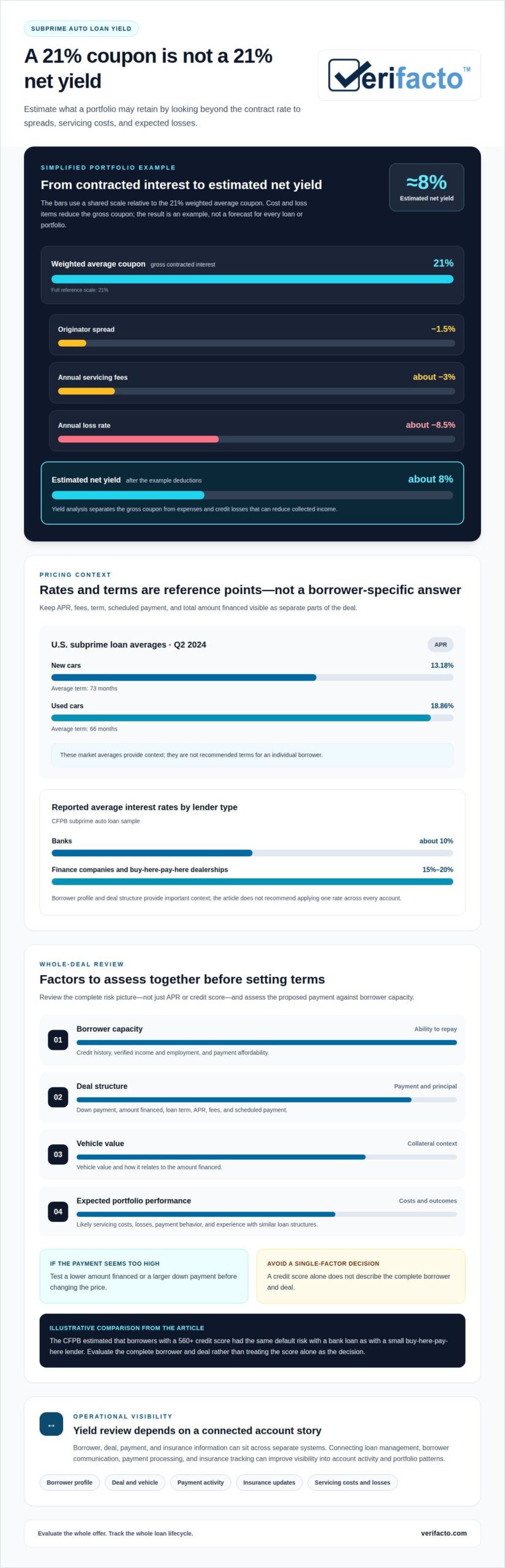
Use current portfolio experience alongside market context, and keep APR, fees, and term visible as separate parts of the offer. In Q2 2024, average APRs for U.S. subprime loans were 13.18% for new cars and 18.86% for used cars; average terms were 73 and 66 months, respectively. These figures are reference points, not recommended terms for an individual borrower.
For each proposed deal, review the scheduled payment and total amount financed alongside the APR. Keep borrower charges distinct from the dealership’s servicing costs, so a cost in one category is not mistaken for a fee in another.
Pricing and Expected Return Factors
Price with the entire risk picture in view. The CFPB’s subprime auto loan sample reported average interest rates of approximately 10 percent at banks, compared with 15 percent to 20 percent at finance companies and buy-here-pay-here dealerships. That difference makes borrower profile and deal structure important context, rather than a reason to apply one rate across every account.
For a practical review, consider credit history, verified income and employment, vehicle value, down payment, amount financed, and loan term. For example, a 580 FICO score and a used vehicle financed with no money down at 100% loan-to-value describe a different risk profile from a deal with a larger down payment.
Approval, Pricing, and Portfolio Yield
Balance approvals with repayment capacity and expected portfolio performance. The CFPB estimated that borrowers with a 560+ credit score had the same default risk with a bank loan as with a small buy-here-pay-here lender. That finding supports evaluating the complete borrower and deal, rather than treating credit score alone as the decision.
If the payment seems too high, test a lower amount financed or larger down payment before changing the price. Then compare the revised offer’s expected return with likely servicing costs and losses. Review outcomes by borrower profile and loan structure, and use those patterns to refine future offers without treating every applicant as equally risky.
How Do Lenders Calculate Yield on Subprime Auto Loans?
A lender starts with the interest income expected from a loan or portfolio, then subtracts costs and credit losses to estimate net yield. A 21% weighted average coupon describes the portfolio’s average contracted interest rate, not the return left after servicing and losses. Yield analysis therefore separates gross coupon from the expenses and performance that reduce collected income.
Consider a simplified portfolio example. Start with a 21% weighted average coupon, then account for a 1.5% originator spread, about 3% in annual servicing fees, and an annual loss rate of about 8.5%. Subtracting those items gives an estimated net yield of about 8%. The result is an example, not a forecast for every loan or portfolio.
- Gross coupon: The weighted average interest rate across the loans.
- Spread: The originator’s share deducted from the coupon.
- Servicing: Ongoing expenses associated with administering accounts.
- Expected losses: Principal and interest income exposed to defaults and recoveries.
For an individual loan, estimate expected interest over its scheduled term, then compare it with servicing expenses and expected credit losses. The payment schedule shows when income is due; actual payment behavior determines how much is collected. Late payments or default can make realized yield differ from the original estimate.
Portfolio calculations also depend on loan mix. A group of contracts with a 21% weighted average coupon can still produce different results as borrower profiles, terms, and account performance change. Track originations by cohort and compare estimated yield with collected payments, servicing costs, and realized losses. That comparison helps reveal whether a pricing assumption or loss estimate needs refinement.
Use a consistent calculation period, such as annual, for every input. Mixing an annual servicing cost with a differently measured loss figure can distort the result. The 8% example illustrates the core discipline: start with coupon income, subtract the relevant spread, servicing costs, and expected losses, then compare the estimate with actual portfolio performance.
Americans owe well over a trillion dollars to auto lenders. Subprime auto lenders are advised to verify prospective borrowers’ current employment and confirm bank balances to assess personal liquidity.
Subprime auto lenders are advised to offer online payments, interactive voice response, and text pay, giving borrowers options to pay by card or bank account. They can also use text messages for payment reminders and account updates, tailoring communication to borrower preferences. Keeping loan paperwork complete and preparing collection and repossession procedures are also important.
Which Factors Affect Subprime Auto Loan Pricing and Expected Returns?
Expected return depends on contracted APR and the cash flows a loan actually produces. Separate borrower profile, vehicle, deal structure, and portfolio performance during each pricing review. For example, two used-car loans for borrowers with a 580 FICO score may carry different risk if one finances more of the vehicle’s value. A single score or rate cannot describe every contract.
Loan term also relates to APR. In a subprime APR regression, six-year auto loans had an APR coefficient 0.84 percentage points below four-year loans, controlling for included factors. Terms of seven years or more had a coefficient 2.46 percentage points below four-year loans. Two-year-or-shorter loans had a coefficient 1.10 percentage points above four-year loans; five-year loans were 1.00 percentage point below.
Those coefficients describe modeled differences, not a universal pricing formula. Credit tier also matters: in Q2 2024, average APRs for U.S. new-car loans were 9.83% for near-prime borrowers and 15.77% for deep subprime borrowers. Use such comparisons to inform portfolio review, not to replace assessment of a specific applicant, vehicle, or contract.
Loan-to-value and down payment shape the amount exposed if repayment falters. A used-car loan issued at 100% loan-to-value with no money down presents a different structure from one with a down payment. Expected losses also vary by loan vintage, borrower profile, and originator, so historical performance should be segmented across those factors.
Review expected returns through a repeatable sequence:
- Assess the borrower: Consider credit profile and the repayment information used in underwriting.
- Examine the structure: Review vehicle value, amount financed, down payment, and term together.
- Compare outcomes: Group portfolio results by vintage, borrower profile, and originator.
These steps help separate pricing effects from changes in loan mix or performance. A lower modeled APR coefficient for a longer term does not, by itself, establish a stronger expected return. Repayment behavior and losses still matter.
How Do Credit Risk, Defaults, and Recoveries Affect Subprime Auto Loan Yields?
Credit risk affects yield when borrowers miss payments, default, or repay less than the outstanding balance. In the CFPB’s sample, approximately 15 percent of subprime auto loans to bank borrowers became at least 60 days delinquent within three years. For finance company and buy-here-pay-here borrowers, the share was 25 percent to 40 percent. Delinquency does not automatically mean a final loss, but it can interrupt expected cash flow and raise servicing demands.
Defaults can reduce principal recovery as well as future interest income. An example estimates an annual loss rate of about 8.5% for subprime auto loans. That loss assumption affects projected portfolio returns, but actual outcomes vary by loan vintage, borrower profile, and originator. Reviewing results by those groups helps show whether a portfolio’s risk estimate fits its experience, rather than hiding different outcomes inside one average.
Vehicle recovery can offset some losses, but it does not erase the full balance. Used cars recovered after repossession are estimated to fetch about 35 cents on the dollar at auction, after repossession and special servicing costs. If a contract has a remaining balance above its net recovery, the difference still weighs on realized yield. The vehicle’s value and the costs of recovery therefore matter alongside the borrower’s payment history.
Use a consistent review sequence for each loan cohort:
- Track payment status: Separate current accounts from those reaching 60 days delinquent.
- Measure realized loss: Compare outstanding balances with recoveries after relevant costs.
- Segment performance: Review results by vintage, borrower profile, and originator.
For example, if one loan vintage has more serious delinquency and weaker auction recovery, its realized yield may fall below the original projection. That pattern can inform future pricing and underwriting assumptions while preserving distinctions between borrower groups. A portfolio average can conceal the shift. Monitoring account performance and recovery proceeds gives lenders a clearer view of how credit risk affects returns over time.
How Do Lenders Balance Approval Rates, Pricing, and Portfolio Yield?
Approval volume alone does not show whether a lending strategy is working. A dealership must consider whether offers fit borrowers’ capacity, whether pricing supports expected returns, and how loans perform after origination. Approving more applications at terms borrowers struggle to sustain can increase delinquency and weaken portfolio results, even as initial contract volume rises.
Start with repayment capacity and deal structure, then assess pricing against the risk. Consider income, employment, existing obligations, down payment, amount financed, and vehicle value together. If the proposed payment seems difficult to sustain, consider whether a lower-priced vehicle or smaller amount financed could make the offer more workable.
Pricing also affects borrower cost and potential returns. A typical borrower at a small buy-here-pay-here lender in CFPB data would save around $900 over the life of a loan if the interest rate fell from 13 percent to 9 percent. This example shows why pricing should be considered alongside payment affordability and expected loan performance, not treated as a stand-alone yield lever.
Use portfolio reviews to refine decision rules instead of relying on a single approval target. Compare outcomes across borrower profiles and deal structures, then identify where repayment performance differs. Changes to the down payment or amount financed can affect both affordability and the balance exposed to loss.
- Protect repayment fit: Review payment burden and deal structure before finalizing terms.
- Assess pricing with costs: Consider expected losses and servicing alongside contract income.
- Learn from results: Compare actual performance across borrower and loan segments.
If one segment shows weaker repayment outcomes, for example, examine its vehicle mix, financed amounts, and underwriting decisions before changing pricing across the board. This helps distinguish an isolated pattern from a wider portfolio issue. Reviewing how loan and account information is connected can also help support more consistent portfolio analysis.
Verifacto: Automated Borrower Communication
Verifacto is an AI-powered operating platform that connects the customer and loan lifecycle beyond a standalone messaging tool. It brings together dealership CRM, inventory, underwriting, DMS, LMS, payments, collections, messaging, insurance tracking, CPI, reporting, and analytics. Embedded AI agents can use connected operational data to support workflows and human judgment.
A practical workflow starts when the dealership records a customer and transaction in Verifacto DMS. As the account moves into servicing, Verifacto LMS supports its ongoing management. Automated Borrower Communication supports messaging, while Insurance Tracking helps teams monitor insurance information associated with the account. Each activity fits into the broader operational workflow.
When an account needs follow-up, staff can review its loan record and communication activity together. That context helps the team understand what has already happened and choose an appropriate next step. The platform supports the workflow, while dealership staff remain responsible for judgment and borrower interactions.
A connected approach can also help managers see where routine work stands across the loan lifecycle. Instead of treating a message, loan record, or insurance status as an isolated task, teams can use related information to support account reviews and operational oversight. Better visibility can help organize follow-up and highlight processes that need attention, without promising a particular collection or financial result.
Verifacto is designed to bring dealership and loan operations together while supporting controlled automation and human decision-making. For dealerships looking to connect borrower communication with their DMS, LMS, and insurance workflow, the platform provides a practical next step to explore.
If you’re considering how this approach fits your operation, contact Verifacto to discuss your needs.
Turn Portfolio Insights Into a Stronger Operating Rhythm
Yield management for subprime auto loans works best as an ongoing discipline. Build a process that gives your team useful operational visibility while preserving control over its data. A connected platform can reduce reliance on disconnected vendors and make workflows easier to manage as business needs change.
Start by identifying friction in your current setup. Do teams move between systems to find operational information? Do separate vendors make it harder to maintain a consistent view of dealership activity? These questions help leaders target efficiency and data control without adding complexity for its own sake.
Verifacto connects dealership and lending operations in one AI-powered platform. It is designed to support clearer oversight and more consistent workflows while keeping human judgment central. Identify which parts of your operation would benefit most from connected data and fewer system handoffs, then explore how those priorities align with your strategy.
Contact Verifacto to discuss your strategy and consider a practical next step for your dealership.
Frequently Asked Questions
What is yield management in subprime auto lending?
Yield management in subprime auto lending aligns loan terms and pricing with expected repayment performance and portfolio goals. For example, a lender can review recently originated loans, compare payment behavior with initial expectations, and adjust underwriting guidelines for similar future applications. Ongoing review helps teams adapt lending decisions as portfolio experience changes instead of relying on a fixed pricing approach.
How does yield management differ for subprime auto loans versus prime auto loans?
Subprime yield management places particular emphasis on verified borrower capacity, deal structure, servicing costs, and expected credit losses, rather than relying on the contract rate alone. The available information does not provide a direct comparison with prime-loan yield management.
How do securitization, funding costs, and dealer participation affect subprime auto loan profitability?
Yield estimates should deduct the originator spread, servicing costs, and expected losses from coupon income. Subprime auto ABS equity tranches are often underwritten for 15-18% returns, but leverage and historical losses can reduce returns to zero; some originators add equity to protect BB- and BBB-rated tranches. Dealer participation is not addressed.