
When accounting, parts, service, and business-office teams rely on disconnected systems, routine decisions can depend on duplicated or outdated information. A cloud based DMS for auto dealers brings core dealership workflows into a shared operating environment, helping teams coordinate daily work as the business evolves.
It’s reasonable to ask whether changing systems will solve more problems than it creates. The value depends on how well a DMS supports your dealership’s actual work, from financial records and parts activity to service operations and digital paperwork.
This article explains how cloud-based DMS tools support dealership workflows, where they can improve visibility, and what to assess when comparing platforms. It also looks at how a DMS can work alongside CRM, LMS, payments, and AI-supported processes, so you can evaluate its role in your broader operations.
Key Takeaways
- Identify where separate systems interrupt the flow of information between accounting, inventory, parts, service, and the business office.
- Assess how disconnected records can affect reporting, payment workflows, and visibility into day-to-day operations.
- Focus your DMS evaluation on the workflows and operating needs specific to your dealership type.
- See how connecting DMS and LMS workflows with customer, loan, payment, and insurance processes can give teams a clearer operating picture.
- Consider how centralized data and controlled AI automation can support efficiency while keeping people involved in decisions.
Why Dealership Operations Become Disconnected
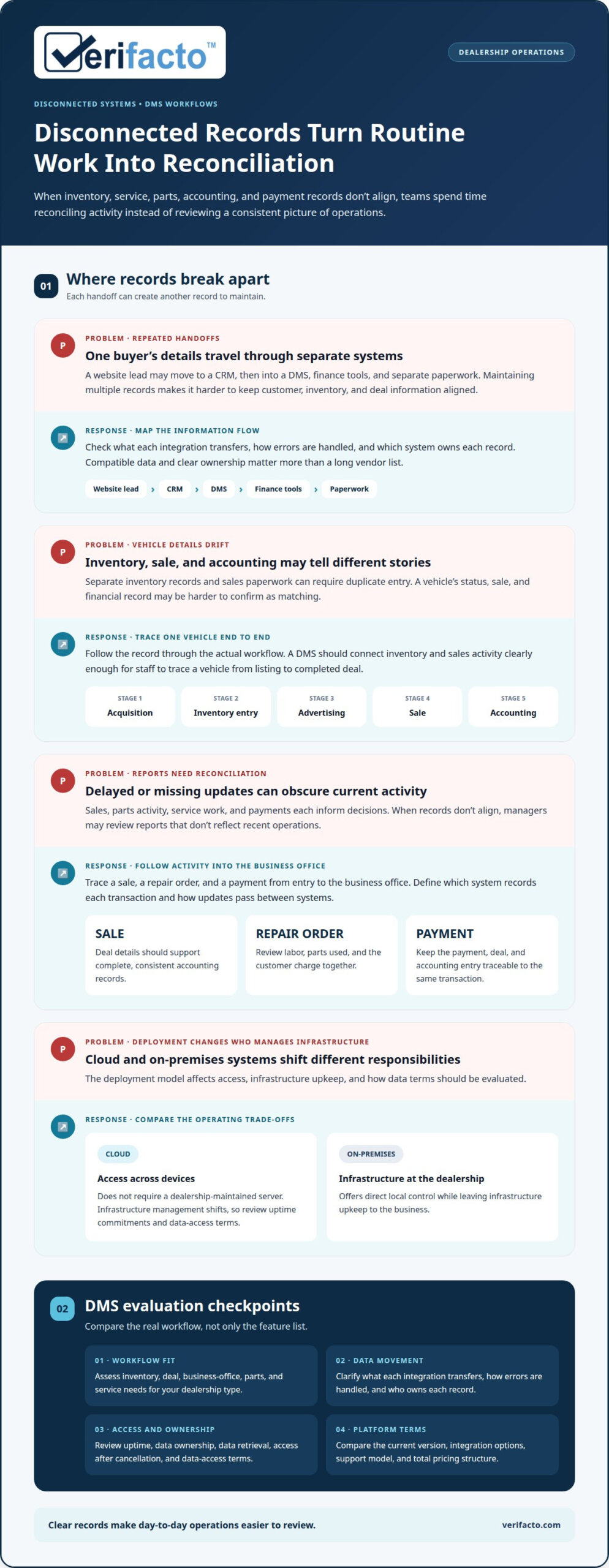
A buyer’s details may move from a website lead to a CRM, then into a DMS, finance tools, and separate paperwork. Each handoff creates another record to maintain, making it harder to keep inventory, customer, and deal information aligned.
Cloud-based dealership operations can connect these workflows, but their practical value depends on how systems exchange information and who controls the data.
Open dealership software integrations
Open integrations connect a dealer management system with tools such as automotive CRM, inventory management, advertising, and finance platforms. For example, a website lead can flow into a CRM, while an inventory update can keep vehicle listings aligned with dealership records.
Ask how each integration transfers data, what information moves, and how errors are handled. Integrated credit applications and pre-approvals can reduce repeated entry when application details pass into the relevant finance workflow. Connections to finance and insurance platforms should clarify how deal documents and related records move between systems.
A smooth process depends on compatible data and clear ownership, not simply a long list of vendors. Open APIs and centralized data management can simplify connections, but each integration still needs defined permissions and a reliable record of changes.
Platform and deployment comparisons
Cloud software can provide access across devices without a dealership-maintained server. On-premises software keeps infrastructure at the dealership, offering direct local control while leaving upkeep to the business. Cloud deployment shifts infrastructure management, so pay close attention to uptime commitments and data-access terms.
For independent dealers, a key consideration is whether the platform supports inventory, deal, and business-office workflows without unnecessary complexity. Franchise dealers may focus on how the DMS fits established processes and connected systems. Either way, compare the current version, integration options, support model, and total pricing structure.
For U.S. customer data, applicable requirements depend on the data and dealership activities. A provider should explain its security controls, access practices, data retention, and how responsibilities align with the dealership’s obligations.
Before choosing cloud DMS software, clarify the terms for uptime, data ownership, and cancellation. The provider should explain how availability is measured, how the dealership can retrieve its records, and what happens to access and data after cancellation.
The Financial and Operational Cost of Disconnected Systems
Inventory, service, parts, accounting, and payment records each support different decisions. When those records don’t align, managers spend time reconciling activity instead of reviewing a consistent picture of operations.
Inventory and sales workflows
Start by tracing one vehicle through acquisition, inventory entry, advertising, sale, and accounting. If inventory records and sales paperwork are in separate software, staff may have to enter vehicle or deal details more than once.
Duplicate work makes it harder to confirm that a vehicle’s status, sale, and financial record agree. A dealer management system should connect inventory and sales activity clearly enough for staff to trace a vehicle from listing to completed deal.
Dealership accounting and reporting
Accounting depends on complete, consistent deal and operating records. A missing entry or delayed update can leave managers reviewing reports that don’t reflect recent sales, parts activity, service work, or payments.
Parts and service generate their own financial activity. A repair order, for example, may include labor, parts used, and a customer charge. When these details are separate from business-office records, preparing a useful report takes extra reconciliation and can obscure a transaction’s status.
Accounting software integration
Connecting dealership software with accounting tools can reduce duplicate entry and make financial reporting more useful. Depending on the DMS and available integration, a dealership may be able to connect QuickBooks accounting software to use DMS data in financial reports.
Before relying on this workflow, define which system records each transaction and how updates pass between systems. The same discipline applies to payment connections: the payment record, deal record, and accounting entry should be traceable to the same transaction.
Telematics data, when used, can inform vehicle or asset operations, but it is distinct from accounting records. Clear ownership of each data point helps teams know which system to use and prevents reports from blending operational signals with financial transactions.
If your dealership runs sales, parts, and service together, review how each workflow feeds into reporting. Trace one sale, one repair order, and one payment from entry to the business office. This simple review can reveal where paperwork, inventory changes, and financial records stop matching.
How Cloud DMS Platforms Differ for Independent and Franchise Dealers
A dealer management system is dealership-specific enterprise software, but the right configuration depends on the operation. An independent used-car dealer may prioritize inventory, deal paperwork, and accounting workflows; a franchise store may need its DMS to support established sales, service, and parts processes.
For an independent dealership, assess whether the platform connects vehicle records, sales activity, and business-office work without adding unnecessary complexity. A salesperson, for example, should be able to see whether a vehicle is available, while the office follows the same deal record through its paperwork. Inventory size and existing software help determine which workflows matter most.
A franchise dealership may weigh service and parts operations alongside sales and accounting. For a repair order involving parts and recorded labor, the DMS should support the store’s workflow and provide useful operational records. Groups with multiple locations should also assess how each store’s activity is organized for management reporting, without assuming every platform handles locations the same way.
Cloud deployment changes how teams access and maintain software. A cloud DMS can provide access across devices without an on-premises server, and cloud systems may support feature updates, but their timing and operational impact depend on the provider and deployment process. This may suit a dealership seeking to reduce physical server upkeep. Still, compare availability terms, data access, integration options, and how updates affect daily work.
Compare platforms against real workflows, not feature counts. Map a vehicle from inventory entry to sale, then trace a service repair through parts and reporting. A franchise store can add a location-level reporting scenario; an independent dealer can test a typical deal and its paperwork. These examples show whether the software fits the operation and where separate tools may still be needed.
Before choosing cloud based DMS for auto dealers, clarify which systems exchange records and how the dealership can retrieve its data. A platform’s fit depends on its integration approach, dealership processes, and the visibility managers need. Independent and franchise dealers both need reliable records, but priorities vary with workflow, structure, and operating model.
How Verifacto Connects Dealership Operations
Verifacto is an AI-powered operating platform that connects dealership activity with the customer and loan lifecycle. Its platform brings CRM, inventory, underwriting, DMS, and LMS workflows into a broader operating picture, helping teams relate customer and account activity across the business.
That connection extends to payments, collections, messaging, insurance tracking, CPI, reporting, analytics, and AI agents. For example, a team managing a customer account can consider loan activity alongside payment and insurance information instead of treating each workflow as a separate task. The platform is designed to give dealership leaders a clearer view of connected operations, with decisions remaining under human oversight.
Verifacto DMS supports dealer management, and Verifacto LMS supports loan management. Automated Borrower Communication supports borrower messaging, while Insurance Tracking and CPI address insurance-related workflows. These functions suit dealerships seeking to connect operational and lending processes within one platform rather than relying solely on a standalone DMS or LMS.
AI is embedded across the platform to work with connected operational data. Analytics and Collections agents can support staff with information and workflow activity, while people remain responsible for decisions and exceptions. The approach supports human judgment rather than replacing dealership employees or making every decision independently.
For dealership leaders, the practical value is a more connected view of customer, loan, and operational activity. Verifacto can reduce reliance on disconnected workflows and improve visibility into how different parts of the operation relate. The fit depends on the dealership’s processes, the information teams need, and how it manages the customer and loan lifecycle.
A Practical Workflow from Deal Setup to Delivery
A digital deal workflow connects vehicle details, financing decisions, paperwork, and delivery status. Consider a used vehicle moving from reservation to customer delivery. A management system can give the people handling each stage a shared record and keep the deal’s progress visible.
- Set up the deal. Staff create a deal record and associate it with the selected vehicle and customer. They enter the transaction details used by the dealership, then confirm that the inventory status and deal record refer to the same vehicle. This step gives the business office a consistent starting point for structuring the transaction.
- Structure the financing. The finance workflow organizes the proposed terms and relevant customer information for review. If a lender decision or updated term changes the structure, the deal record should reflect the current version. Clear status fields help the sales and finance teams distinguish an active proposal from a completed agreement.
- Prepare and execute paperwork. The business office assembles the documents associated with the approved deal structure. Digital paperwork can help keep the current document set connected to the transaction, whether staff are working at a desk or using a mobile device. The dealership’s process should make it clear which items are prepared, reviewed, and completed.
- Coordinate delivery. Before handing over the vehicle, staff use the deal record to review the transaction’s completion status and identify outstanding steps. For example, a delivery coordinator can see whether the office has finished its paperwork before scheduling the customer handoff. This creates a clearer checkpoint without assuming every task is automated.
After delivery, connected deal information can support accounting and operational reporting. Managers can follow a transaction from setup through completion instead of piecing together separate notes. Useful insights depend on accurate records and clearly assigned steps, not on the word “digital” alone.
When assessing a DMS, map the workflow across sales, finance, and the business office. The platform should make every handoff and its record easy to follow, while staff remain in control of review and execution.
Operational Efficiency That Supports Financial Performance
Efficiency has financial relevance when dealership leaders can see how work moves across departments. A manager reviewing a deal, payment status, and borrower communication needs records that connect those activities. A shared operating view can reveal stalled work and give teams clearer context before process gaps affect reporting or follow-up.
Connected data also supports better operational decisions. When DMS and LMS activity can be viewed together, managers can relate dealership workflows to loan servicing instead of reviewing isolated snapshots. An Analytics agent can help surface patterns in connected operational information, while people interpret the results and decide what action suits the business.
That visibility supports practical oversight. A dealership might review which deals await completion, whether borrower communication has occurred, or where insurance tracking needs attention. Clear records help teams direct follow-up and assess workflow status. They don’t guarantee a financial outcome, but they can inform decisions and reduce reliance on manual status checks.
Vendor flexibility matters, too. Dealerships relying on separate systems for each workflow may encounter friction when processes change or data needs to move. A connected platform can reduce dependence on isolated vendors if it provides a coherent operating view and supports control over information. Its value depends on data access, system connections, and the dealership’s ability to maintain useful records.
Measure efficiency using operating signals the dealership already tracks. Leaders can check whether staff repeatedly enter the same information, how quickly they can locate a deal record, and whether reports reflect current activity. These checks link technology choices to daily work without assuming a particular savings figure.
AI can support this operating model by using connected information to assist staff. Collections and execution agents can support workflow activity, while human judgment remains central to decisions and exceptions. The goal is better coordination, not replacing employees or removing oversight.
For executives, the central question is whether connected operations improve visibility and preserve control as the dealership evolves. A platform that makes records easier to follow can help teams manage work consistently and support financial performance through stronger operational insight.
Explore How Verifacto Fits Your Dealership
The right platform should fit the dealership’s operating model, not force every team into a generic workflow. Verifacto connects dealership management and loan operations, helping owners assess how customer and account activity can be viewed across the business. That matters when separate systems make it difficult to see where work stands.
Verifacto DMS supports dealership operations, while Verifacto LMS manages loans. Together, they can provide a clearer view of the customer and loan lifecycle. A dealership can assess how a vehicle transaction relates to ongoing account activity and whether teams can follow relevant information without piecing together disconnected records.
Operational needs vary. A dealership focused on sales and inventory may prioritize DMS workflows. A business managing customer loans may also consider how LMS fits with payment and account processes. Automated Borrower Communication supports borrower messaging, while Insurance Tracking helps manage insurance information within the broader operation. The best fit depends on the dealership’s processes and the visibility its managers need.
Evaluate the platform using practical scenarios. Trace a customer journey from dealership activity into loan management, then identify what teams need to see at each stage. Consider how records remain accessible to the business and how managers can understand activity across workflows. This keeps the discussion focused on operational control, data visibility, and dealership priorities rather than a feature checklist.
Verifacto brings dealership and loan operations together in one operating platform. Connected workflows can reduce reliance on isolated tools and give the dealership a more coherent view. The aim is improved operational visibility and informed management, not a guaranteed financial result.
If you’re considering a connected approach, contact Verifacto to discuss how the platform may fit your dealership.
Frequently Asked Questions
Beyond security, what advantages does the cloud offer dealerships as the industry quickly evolves?
Cloud deployment can give a dealership flexibility as its processes change. For example, leadership can assess a new workflow without planning around dealership-owned server infrastructure. When reviewing a platform, ask how updates are introduced, what preparation teams need, and how changes are communicated. These details show whether the technology can adapt without creating avoidable uncertainty for staff or managers.
What are the features of Dealer Management Systems?
A Dealer Management System is dealership-focused software that can cover core functions such as sales, workforce management, finance, inventory, and workshop operations. Features vary by platform. A useful distinction is whether the DMS serves as the main operational record or relies on separate tools for key functions. Clarify which system owns important records, such as a vehicle’s status or a completed transaction.
Why is the cloud a more secure environment for dealership processes than more traditional DMS models?
The cloud isn’t automatically more secure; the provider’s controls and the dealership’s practices both matter. During evaluation, discuss how access is granted, reviewed, and removed when someone’s role changes. Ask how sensitive records are protected and how security incidents are handled. These conversations clarify shared responsibilities without treating cloud deployment as proof of security or a guarantee of protection.
What cloud-based DMS platforms are designed for auto dealerships?
Cloud DMS options serve different dealership models and priorities. Verifacto DMS is a cloud-based dealer management platform, and Verifacto also supports auto-finance operations through its broader platform. To assess fit, identify whether the dealership primarily needs retail operations, loan lifecycle management, or both, then compare the platform’s scope with those business needs.
What features should auto dealers look for in a cloud-based DMS?
Beyond day-to-day modules, consider how the system handles user permissions, record history, data access, and changes to dealership workflows. A manager, for example, may need to know who updated a deal record and when, while limiting sensitive information to appropriate roles. Also assess whether the platform can provide dealership data in a usable format if processes or technology needs change.
Does a cloud-based DMS integrate with accounting, CRM, inventory, and OEM systems?
Integration capability depends on the platform and the specific connection. Verifacto DMS includes CRM and inventory capabilities. OEM workflows can vary by manufacturer and system. For each required connection, define which records need to move, such as vehicle status or customer details, and how teams will handle mismatched or delayed information.
How secure are cloud-based DMS platforms, and how is dealership data backed up?
Backup arrangements vary by provider, so focus on recovery details rather than assuming every cloud system uses the same method. Ask what data is included, how restoration is initiated, and how the dealership can access records during recovery. Clarify who coordinates the process and how the provider communicates its status. These questions help management understand continuity planning without assuming a particular backup schedule or recovery time.
How does a provider migrate dealership data to a cloud-based DMS, and what information should the dealer supply?
Migration typically starts with the provider reviewing source data and mapping it to the new system’s fields. The dealership may need to identify which systems hold customer, vehicle, deal, and accounting records, and which records remain active. Clear definitions distinguish current information from duplicates or closed files. The provider can then plan transfer and review steps around the dealership’s data and workflow requirements.